111582386687
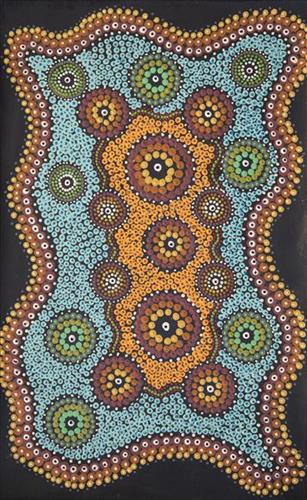
3 Pools
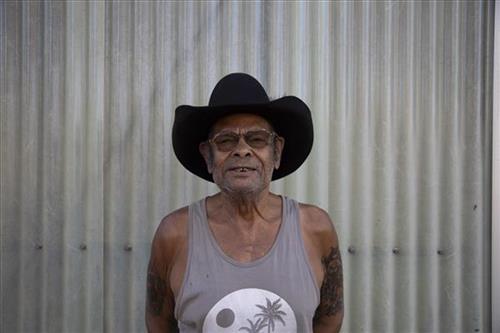
“It’s north of here. It might be Nyiyaparli country but we’re caretakers.
I haven’t been out for a long time. It’s painted from memory. It’s a beautiful swimming spot, good for a BBQ and picnic. It’s beautiful when it’s summertime, you get the big gumtrees from the shade. The pools are like a step, one down to the other. When it’s really flowing you can’t see the different pools.
I paint it as I see it. Even when I go out to Jigalong I’m always looking at the bush. Mainly looking for something to eat, but I can still see the Country. It’s close to my heart that I try to use the colours of Country to portray what I’m seeing.
The rainbow serpent, Jila (snake) came [here] from Yindjibarndi Country. This one is part of a series [along with] Kalgan’s Pool. The story is he came all the way through and out to Lake Dora. On that lake there, pretty much in the middle is a freshwater spring. And that’s where he lives, out there. Even out at Kalgan’s Pool, there’s a resident jila out there. I’ve seen him a couple of times, a huge olive python.”
– Sonny (Albert) Pilkington
Three Pools is a small cascading waterfall nestled in the Pilbara found a few hours north of Newman, where Sonny resides. This place is connected to the Rainbow Serpent Jukurrpa from Yindjibarndi Country of the North Western part of the Pilbara region.
The term Jukurrpa is often translated in English as the ‘dreaming’, or ‘dreamtime’. It refers generally to the period in which the world was created by ancestral beings, who assumed both human and nonhuman forms. These beings shaped what had been a formless landscape; creating waters, plants, animals, and people.
The Western Desert term jila is used interchangeably to describe springs considered to be ‘living’ waters and snakes, both of which play a central role in Martu culture and Jukurrpa (Dreaming). Of the many permanent springs in Martu Country, very few are ‘living waters’; waters inhabited by jila (powerful ancestral beings). Before they became snakes, these beings were men who made rain, formed the land and introduced cultural practices like ceremonies and ritual songs. Some of the men travelled the desert together, visiting one another, but they all ended their journeys at their chosen spring alone, transformed into a snake.