111582397511

Published by on


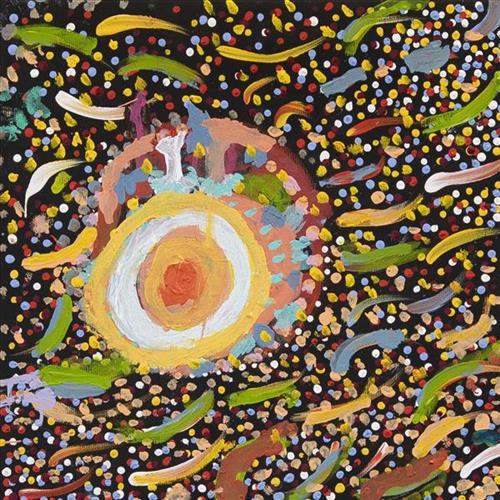
Pimurlu – Jatarr Lily Long

“Pimurlu is a special women’s place not far from Parnngurr community. There is a rockhole here; it is a little kapi (water) up in the rocks that you have to reach down for. Dreamtime [designs] in the stone everywhere here, Dreamtime properly here. We never put them there, old people never put them there, Dreamtime put them there. This is special Warnman culture, left there in Warnman lands. All the Minyipuru (Jakulyukulyu, Seven Sisters) grannies were dancing there, beautiful!”

–  Jatarr Lily Long

Pimurlu is a rockhole and important women’s site located between Parnngurr Aboriginal community and Karlamilyi River (Rudall River). This site lies within Jatarr’s ngurra (home Country, camp), the area which she knew intimately and travelled extensively with her family in her youth. During the pujiman (traditional, desert dwelling) Pimurlu was an important Warnman campsite. Surrounding Pimurlu rockhole is a hilly, rocky area featuring circular walka (sacred designs) left by the Minyipuru in the Jukurrpa (Dreaming). These same designs are painted on women’s bodies and faces for important ceremonial dancing today. 

Minyipuru is a central Jukurrpa narrative for Martu, Ngaanyatjarra, Pitjantjatjara and Yankunytjatjara people that is associated with the seasonal Pleiades star constellation. Relayed in song, dance, stories and paintings, Minyipuru serves as a creation narrative, a source of information relating to the physical properties of the land, and an embodiment of Aboriginal cultural laws. Beginning in Roebourne on the west coast of Western Australia, the story morphs in its movement eastward across the land, following the women as they walk, dance, and even fly from waterhole to waterhole. As they travel the women camp, sing, wash, dance and gather food, leaving markers in the landscape and creating landforms that remain to this day, such as groupings of rocks and trees, grinding stones and seeds. During the entirety of their journey the women are pursued by a lustful old man, Yurla, although interactions with other animals, groups of men, and spirit beings are also chronicled in the narrative.
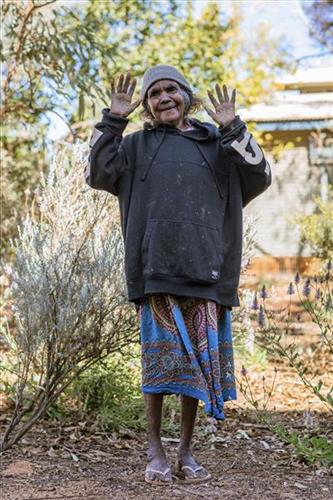
Name: Lily Jatarr Long


Language: Ngarnijarra, Warnman


Community: Irrungadji (Nullagine)


Biography:

“This Karlamilyi area, big land. That’s a ngurra (home Country, camp) belonging to our old people, Warnman people. We talk for our land, our jila (snake). I grew up in this Country, my Country. This land belongs to our father. In pujiman (traditional, desert dwelling) days I walked around here, used to walk up and down tuwa (sandhill) and back to the main camp belonging to Martu. We are Warnman ladies, painting Kintyre and Karlamilyi. We can share this Country.”

 - Sisters Wurta Amy French and Jatarr Lily Long


Jatarr Lily Long is a Warnman woman and senior custodian for Karlamilyi (Rudall River) Country. She was born in the late 1930s at Jatarrngara, a water source on the Karlamilyi River from which her name is derived. Jatarr is the sister of fellow artists Helen Dale Samson and the late Wurta Amy French. Her father was a drover who attempted, unsuccessfully, to ‘steal’ Jatarr’s mother and take her back to the Kimberley region. 

Jatarr grew up with her family in the area surrounding Tiwa (Canning Stock Route Well 26), a water source located east of Parnngurr Aboriginal Community and just west of a culturally significant group of hills called Partujarrapirri. Her family returned to the Karlamily region for a time, moving between camps located all along the Karlamily River and up to the large salt lake, Nyayartakujarra (Lake Dora). In the late 1940’s her family left Karlamily and travelled on foot for more than 200 kilometres to Jigalong Mission, where a supply of rationed food and water was assured. There they were reunited with family members that had already moved in from the desert. 

At Jigalong, Jatarr lived in a dormitory with her two sisters and went to school. Later, she worked as a cook on various pastoral stations in the Pilbara and mined for tin and other minerals with a yandy (dish used for winnowing seed). Eventually, Jatarr relocated Irrungadji Aboriginal community, just outside of Nullagine, where she continues to live with her sister Wurta, children and grandchildren.

Today Jatarr lives at Irrungadji Community near Nullagine with her children and grandchildren. As an artist, she has always worked with her sisters at her side, and they have frequently collaborated on larger works. In her paintings, Jatarr depicts her ngurra (home Country, camp) and its animals, waterholes, and Jukurrpa (Dreaming) stories. She uses her art as a means of transferring cultural knowledge to her children and grandchildren and as a political platform, protecting her Country from mining and other disruptions. Jatarr is known for her soft pastel palettes and dreamy landscapes, which blend aerial and frontal perspectives. Her work has been widely exhibited in Australia and internationally, and is held in major collections including the National Gallery of Victoria, Art Gallery of Western Australia, and National Museum of Australia.


© the artist / art centre