111582428179

Published by on


Waru

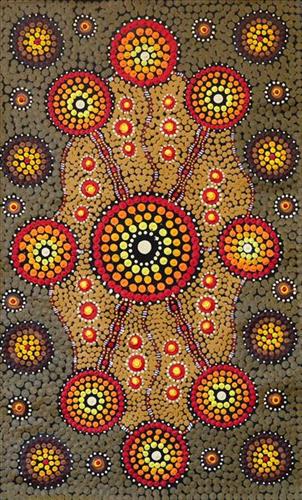
This work depicts the practice of fire burning as it continues to be used today through the Martu homelands. Over thousands of years, as Martu travelled and hunted on foot they would burn tracts of land, using waru (fire) as a means to assist with hunting and to encourage regenerative growth. Whilst fire burning practices have modernised in recent times, with Martu burning areas close to Aboriginal communities and along roads, or else further afield using helicopters and 4WDs with Indigenous ranger group Karnyirninpa Jukurrpa (KJ), the same objectives are met as those during pujiman (traditional, desert dwelling) times.

Targeted waru is an important tool in animal tracking. Small burns are lit to clear vegetation, expose burrows, and to allow for access to walk and track readily in exposed sands. Fires are typically burnt during cooler weather in small, controlled areas, reducing the risk of unmanageable, spontaneous bush fires whilst simultaneously providing diverse regenerating habitats. Remaining is a defined mosaic fire scar pattern in the land, across tali (sand dunes), linyji (clay pans), parulyukurru (spinifex country) and pila (sandy plains). This patterning is clearly visible from an aerial perspective, and becomes even more defined as new growth emerges. 

The patchwork nature of regrowth is aligned with the Martu cycle of burning and regrowth and its five distinct phases. First is nyurnma (freshly burnt Country), followed after the rains by waru-waru, when young, bright green plants start to grow. Nyukura occurs between one and three years after burning, when plants have matured and are fruiting and seeding. Manguu is four to six years post burning, when spinifex has matured to the point that it can be burned once again. Finally, kunarka signifies the time when spinifex and other plant species have become old growth, and pose a risk of destructive bushfires.
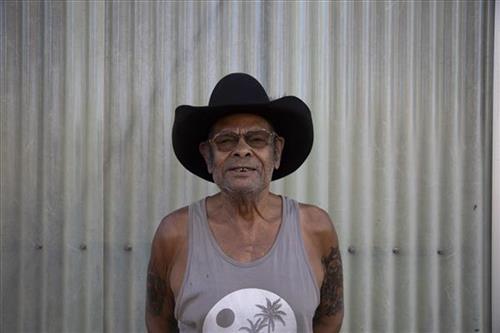
Name: Albert Pilkington


Language: Putijarra


Community: Jigalong


Biography:

“I was born in Kununoppin, in the wheatbelt. Left school when I was 15 and worked on cattle stations for 16 years, in the Pilbara, up through the Kimberleys, and back. My Grandfather is from east of Jigalong he didn’t see a whitefella until he was 18.
I started painting out of curiosity at first, and when I finished my first one I realised that I really liked doing it. I get a lot of inspiration from my love for country. I can’t get enough of it sometimes. I’ll be sitting at home and just get up in the car for a cruise, just to see the country. Now I’m up here I like to use earthy colours, colours of country. A lot of my painting is from memory. Been out here many times. Spent a lot of time out on this country. When I come back I want to pull up on the boundary and roll in the dirt. Walk outside, look around, get the colours, I love the colours.”
- Albert Pilkington

Albert is a Milankga man who speaks Martu Wangka. He was born in Kununoppin, but grew up in Geraldton where he lived with his mother and father. His mother Doris Pilkington was born in Belfour Downs Station and wrote the novel Follow the Rabbit-Proof Fence which the 2002 film Rabbit-Proof Fence was based on.
After leaving school at the age of 15 Albert worked on cattle stations in the north of Western Australia for the next 16 years. He then returned to school as a mature age student, completing a Bachelor of Science at Murdoch University, and his Masters of Applied Epidemiology at the Australian National University in Canberra.

Today Albert lives in Newman with his daughter - one of his six children.
While Albert has only recently begun painting he has found an immediate love for it and is deeply inspired by the colours of his country. When he is not painting, he loves to horse riding or hunting for bush tucker. Bush turkey and goanna are his favourite.


© the artist / art centre