111582436786

Published by on


Punmu, Wirlarra Side Jarntu Story

“This area here is our Country. It’s our Country right here. We returned to our Country with a Toyota and a grader that made the road. A grader right up to here. Punmu is a good place. It’s a happy place to live. My spirit feels good living here. In pujiman (traditional, desert dwelling) time we lived in this area now. I’m happy with this life now, happy because I feel grounded by my Country. It’s important to hold onto the legacy of the ancestors. It’s up to the young people to carry it on now. For the ancestors past and present.”

– Minyawe Miller as translated by Kanyirninpa Jukurrpa


Punmu refers to a region and an Aboriginal community within its vicinity, located 670km North-East of Newman. Created during the return to Country movement of the 1980s, with the recognition of Martu land rights and native title, the community was named after a nearby Jukurrpa (Dreaming) story.

Punmu Aboriginal community sits on the edge of a large salt lake known as Nyayartakujarra, or Lake Dora. The lake runs south into Karlamilyi River (Rudall River). Surrounding Punmu are numerous fresh water soaks and the red tali (sandhills) typical of the area. The most frequently visited yinta (permanent springs) around Punmu include Wirlarra, Rawa, Yilyara, Jila-jila and Tuu-tuu.

The Country around Punmu features in several Jukurrpa stories. Of particular importance is the story of the Jila Kujarra (Two Snakes), one of the key Jukurrpa narratives for the Martu. Though the story belongs to Warnman people, it is shared across the Western Desert with several other language groups. The narrative centres on the travels of two snakes as they are pursued by the Niminjarra, spiritual ancestors of the Warnman people. 

Before transforming themselves into snakes, the Jila Kujarra were young brothers. As snakes, they began travelling home to their mother, but were intercepted by the Niminjarra, who tracked the Jila Kujarra to Paji, east of Nyayartakujarra (Lake Dora). Though the Jila Kujarra eluded their pursuers here by escaping under the lake at Paji, they were soon after speared and injured by two Pukurti (initiates with bundled hair) at Nyayartakujarra, who returned with the Niminjarra to cook the snakes at the site of Kumpupirntily (Kumpupintily, Lake Disappointment). As the Niminjarra cut down the length of the Jila Kujarra, the snake’s bladders were pierced, causing an explosion of scalding hot urine in which the Niminjarra all perished and became black rocks at the site. The spirits of the Jila Kujarra returned to their mother at Nyayartakujarra, where the mother and her sons entered the ground below Nyayartakujarra and remain to this day.
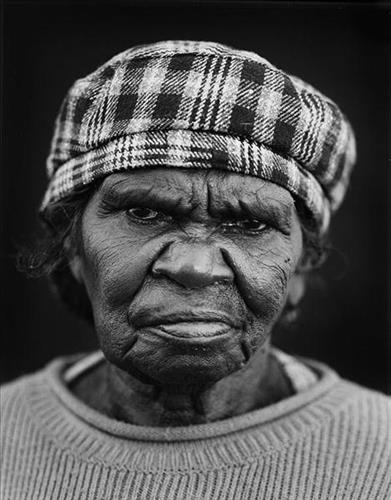
Name: Jakayu Biljabu (dec.)


Language: Manyjilyjarra


Community: Punmu


Biography:

"I was born in Pitu (Separation Well). Alongside that water place, Pitu, is where I grew up. I became an adult in the desert before I went to Jigalong

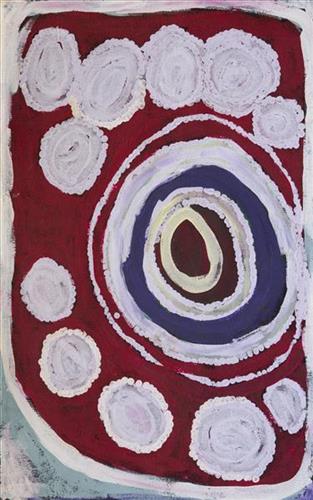
I'm really happy when I'm painting my Country. I'm proud as I follow my Country, I'm holding onto my Country. That's my water in the East. I'm painting my Country. It's not someone else's, it's my Country. 

I'm looking after my Country. I'm showing my family the Country. I feel privileged that I can see it. As I watch my children I'm really happy for them. I'm watching them all while they're working, on the Country. I'm so proud of them. I'm looking after them and now I feel fulfilled."

- Jakayu Biljabu as translated by Kanyirninpa Jukurrpa


Jakayu Biljabu (c.1935–2015) was a Manyjilyjarra woman born north of Pitu (Separation Well), an important cultural site and large soak located yulparirra (south) of Wuranu (Canning Stock Route Well 29). She lived a pujiman (traditional, desert-dwelling) lifestyle in her youth, moving through Country surrounding Kunawarritji (Canning Stock Route Well 33), Wikiri, Rarrki (Canning Stock Route Well 27), Wantili (Warntili, Canning Stock Route Well 25), Pitu, Nyilangkurr and Nyinyari. During this time, Jakayu’s family would regularly meet and travel with the families of fellow Martumili artists Bugai Whyoulter and Ngamaru Bidu.

Jakayu’s early contact with whitefellas occurred at wells along the Canning Stock Route, when drovers sometimes slaughtered a bullock and shared the meat with her family. Her father remained wary of Europeans, having heard of the violent methods used by Alfred Canning’s group when the Stock Route was chartered. As a result, Jakayu’s family were among the last pujimanpa (traditional, desert dwellers) to leave the desert. In 1963, while travelling with her husband, children and extended family, Jakayu encountered surveyor Len Beadell, who was grading roads for the Woomera Missile Testing Range. Soon after, her family was tracked by Jigalong Mission staff and brought to the mission, reuniting with relatives after many years.

She later worked as a baker at Jigalong Mission and at stations across the region before moving to the Aboriginal-owned Strelley Station. In 1982, during the ‘Return to Country’ movement, she relocated with her family to Punmu Aboriginal community, where she lived for the remainder of her life.

Jakayu became a senior Martumili Artist, celebrated for her bold painterly style and striking compositions deeply grounded in the Jukurrpa (Dreaming) narratives of her Country. Her paintings often depict the sandhills, claypans and salt lakes of the Manyjilyjarra desert regions she travelled through in her youth. She viewed painting as a vital means of passing knowledge to younger Martu generations, working both independently and in collaboration with younger artists such as Corban Williams. Acclaimed nationally and internationally, her work was exhibited widely and acquired by major institutions, including the National Museum of Australia, the National Gallery of Victoria, and Queensland Art Gallery | Gallery of Modern Art. Jakayu’s legacy endures through her art and the cultural knowledge she shared.


© the artist / art centre