111582442382

Published by on


Summer on Ngurra

“It’s their home for them, real ngurra (home Country, camp). Real ngurra is where they been born and grow up.”

– Corban Clause Williams

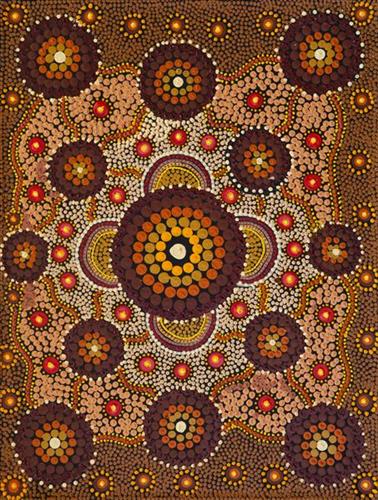
The Western Desert term ‘ngurra’ is hugely versatile in application. Broadly denoting birthplace and belonging, ngurra can refer to a body of water, a camp site, a large area of Country, or even a modern house. People identify with their ngurra in terms of specific rights and responsibilities, and the possession of intimate knowledge of the physical and cultural properties of one’s Country. This knowledge is traditionally passed intergenerationally through family connections. Country for Martu is full of memory; not just the memory of their own movement through it, but also of their family. As summarised by Ngalangka Nola Taylor, “painting the ngurra, they do it to remember their connections.” 

Painting ngurra, and in so doing sharing the Jukurrpa (Dreaming) stories and physical characteristics of that place, has today become an important means of cultural maintenance. Physical maintenance of one’s ngurra, like cultural maintenance, ensures a site’s wellbeing, and is a responsibility of the people belonging to that area.  
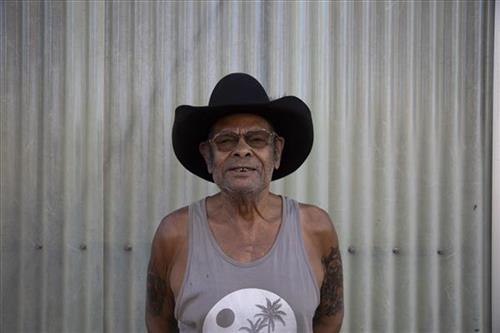
Name: Sonny Pilkington


Language: Putijarra


Community: Jigalong


Biography:

“I was born in Kununoppin, in the wheatbelt. Left school when I was 15 and worked on cattle stations for 16 years, in the Pilbara, up through the Kimberleys, and back. My Grandfather is from east of Jigalong he didn’t see a whitefella until he was 18.
I started painting out of curiosity at first, and when I finished my first one I realised that I really liked doing it. I get a lot of inspiration from my love for country. I can’t get enough of it sometimes. I’ll be sitting at home and just get up in the car for a cruise, just to see the country. Now I’m up here I like to use earthy colours, colours of country. A lot of my painting is from memory. Been out here many times. Spent a lot of time out on this country. When I come back I want to pull up on the boundary and roll in the dirt. Walk outside, look around, get the colours, I love the colours.”
- Albert Pilkington

Sonny is a Milankga man who speaks Martu Wangka. He was born in Kununoppin, but grew up in Geraldton where he lived with his mother and father. His mother Doris Pilkington was born in Belfour Downs Station and wrote the novel Follow the Rabbit-Proof Fence which the 2002 film Rabbit-Proof Fence was based on.
After leaving school at the age of 15 Albert worked on cattle stations in the north of Western Australia for the next 16 years. He then returned to school as a mature age student, completing a Bachelor of Science at Murdoch University, and his Masters of Applied Epidemiology at the Australian National University in Canberra.

Today, Sonny lives in Newman with his daughter - one of his six children.
While Sonny has only recently begun painting he has found an immediate love for it and is deeply inspired by the colours of his country. When he is not painting, he loves to horse riding or hunting for bush tucker. Bush turkey and goanna are his favourite.


© the artist / art centre