Biography:
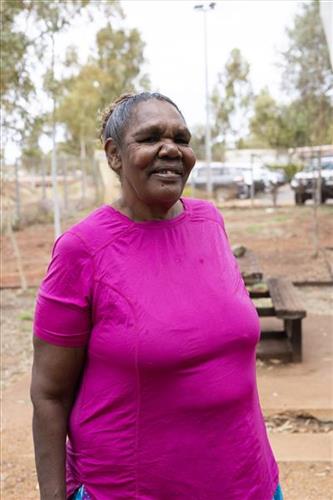
“My name is Roxanne Anderson. I was born in Barwidgee Station in the bush at a windmill called Top Mill. It’s 190 kilometres from Wiluna, southeast. My parents worked there at Barwidgee Station. My father was shearing and mustering sheep. My mother, she used to be the house lady, doing all the cleaning.
We stayed at the station with a lot of other families. My auntie used to look after us when my mum was at work. She learned [taught] us about hunting and gathering for bush tucker. We grew up there, we stayed there until we went into town on the Wiluna Mission in the 70’s, ‘till it closed in ’75 or maybe ’76. We got our education in Wiluna Mission, and on the holidays the boss lady from the station and my mum used to pick us up, but we wouldn’t hang around. We’d go back to the bush- learn about hunting and bush foods.
After Wiluna I was living with my auntie in East Perth, and I went to Carlisle Primary school. Then I went to Kalgoorlie Eastern Goldfield’s Senior High, stayed in a boarding place. I knew other people from Wiluna that was going there.
I got four childrens, my oldest is a son and the other three are my daughters. My son and my two youngest daughters all paint. They looked at me and learned. I got four grandchildren, three grandson and one granddaughter, little ones.
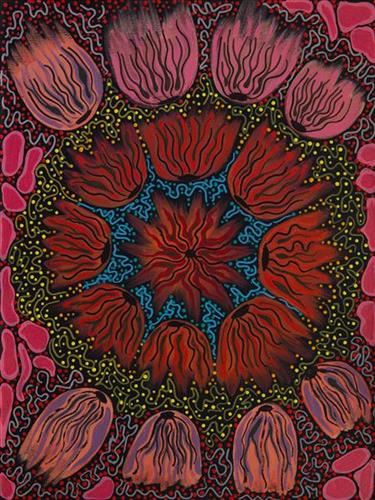
I had a lot of paintings in exhibitions. I also done a logo of the Birriliburu [Native Title] Determination on the t-shirts and cups. I even got a Canning Stock Route painting on one of those Headsox. They’re all over Australia, but most of them are sold. I paint about my Country, and the flowers on the Canning [Stock Route] and the colours are what you see when you’re travelling in the springtime when the flowers are out. I also paint about the Seven Sisters [dreaming].
My father was a painter, but he done oil painting, landscape. My sister Vera, she do dot painting, and I do dot painting too, and my sister Desrae [Anderson] and our brothers. I taught myself. I learned how to mix my colours and match. I like painting about Canning [Stock Route], Seven Sisters Jukurrpa (dreaming), and wildflowers. We tell our stories in the paint.”
- Roxanne Anderson
Born on Barwidgee Station at the first well on the Canning Stock Route near Top Mill, Western Australia, Roxanne Anderson is of the Martu people. Coming from a long line of talented artists, she is experimental in her approach, developing her own style. Working in various colour combinations, Roxanne brings to life the traditional stories of the Martu people which is embedded into the depth and detail of her paintings.
Roxanne's work was exhibited in the 2015 Revealed: New and Emerging WA Aboriginal Artists (Fremantle Arts Centre, WA), and selected by Headsox Australia to feature on their distinctive tube head and neckwear.