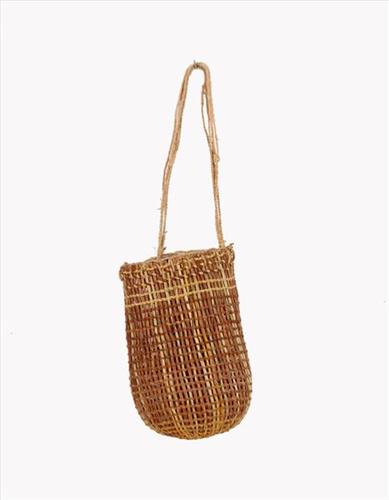
Burlupurr – dillybag
Burlupurr, or dilly bag, is usually a large woven collecting basket. These large bags are often made from the vine ‘Malasia scandens’, a strong pliable plant which grows along the floor and into the canopy of monsoon vine thickets. The bags are used to collect any kind of large numbers of heavy foods such as fish caught in conical fish traps or large collections of yams.
They can also be made from Pandanus spiralis, a plant which grows in many areas of Arnhem Land. These dilly bags are a tightly woven collecting basket, very finely made. These dilly bags are often used to collect sugarbag, the native honey.
Common colours used to dye pandanus used for weaving burlupurr include:
– barra gu-jirra: the soft, white and fleshy end of the pandanus leaf imparts green to the fibre.
– mun-gumurduk/ gala (Pogonolobus reticulatus): a bright yellow root that is crushed and put in a billycan with the fibre and boiled. It creates yellow when boiled once and deep orange hues when boiled multiple times.
– ngalpur (Haemodorum brevicaule): a bright red root which yields a range of purply red to brown colours.
– Baluk: ashes of certain plants are added to the boiling billycan with the fibre and dye plants to alter the colour that is imparted to the fibre. The fruiting body of gulpiny (Banksia denanta) is burnt and the ashes added to other day plants to make the colour pink.
As well as being of practical use, dilly bags are also of religious significance to Arnhem Land people. Dilly bags are said to be totemic objects and associated with particular sites in the landscape.
Dimensions: 21 x 11 x 11cm