Karrh Kunred (Spider Web)
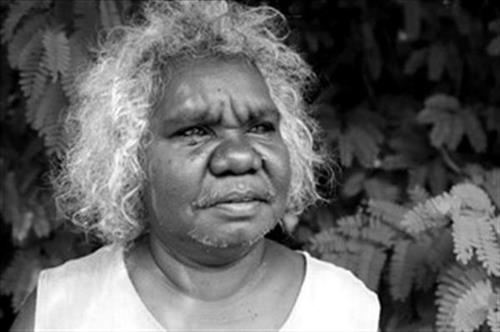
Lena Yarinkura reaches into deep time to make contemporary art.
Yarinkura has crafted a spider on a web of string made from the roots of manworrbal (Cocky Apple tree), with karlba (yellow ochre) and ngarradj (white cockatoo feathers). A harbinger who heralds death or sickness, karrh (spider) belongs to the yirridjdja moiety, as do the materials the work is made from, sourced from Yarinkura’s clan estate. Karrh kunred weaves together the essence of Djarngo (religion)—it is from Country, of Country.
Fear is a common emotional reaction to a spider, and emotions are a key aspect of Yarinkura’s work. Several years ago, she was viewing the body of a recently deceased family member when thousands of spiders appeared. They gave birth as they crawled over the corpse, a signal to Yarinkura. Then in mid‑October 2019, when she was visiting Maningrida from her home at Ankadbadberri in the Northern Territory, she saw a karrh making a kunred (web), which she read as a sign she was becoming ill. She became lightheaded and laid down. The karrh tied her up and wove his web around her. She tried to remove the web but it was like fishing line, too strong to break. Cocooned by the web she woke in a fever and was medically evacuated to Darwin for treatment. She later made a full recovery.
Karrh is manifested as multiple physical, emotional, metaphysical and cultural expressions: as a rock near Buluhkadaru outstation (a sacred site) where karrh travelled, stopped and turned to stone; as a song sung by renowned singer Jacky Marrpuma; as a dance, with arm actions mimicking the quick legs of a spider weaving a web; as a living insect. It is a metaphor, a message and, in Yarinkura’s hand, an artwork.
The late Bob Burruwal, Yarinkura’s husband and artistic collaborator, said of these works: ‘He (karrh) is the real bush Spiderman.’ You don’t need to see a Marvel movie to witness transmutations. Kune cosmological beliefs are made up of animals acting like humans and humans acting like animals, an encoded system of deities that guide moral codes, daily ritual and ceremonial activities from birth to death.
Taught traditional weaving techniques by her mother, Lena Djamarrayku, Yarinkura is committed to passing on this cultural knowledge to the younger generations: As a daluk (woman) artist I encourage other daluk. I learnt the weaving technique from my mother which I changed to make forms of Djarngo, I have worked with cast metal, I have always made new styles of work and encourage daluk to make works in their own unique style, make their own path. I teach my daughter Yolanda Rostron and granddaughter Philomena Rostron. And other family members like Leah‑Ann Campion and other young daluk artists.
Adapted excerpt. Yarinkura, Lena and Culpitt, Michelle. “Lena Yarinkura” in N Bullock, K Cole, D Hart & E Pitt (eds), Know My Name, National Gallery of Australia, Canberra, 2020, pp 376–377.