11153999663


Status: Stock


Emu Tracks to Puntawarri

What Now?  T- Shirt is a graphic taken from Judith Anya Samson’s painting Emu Tracks to Puntawarri

“Emu go to the springs to have a drink of water and then move on to the next one.”

– Judith Anya Samson

Puntawarri is an important cultural area, as well as the site of a now abandoned community, a waterhole, creek and lake. Puntawarri is located on the middle stretches of the Canning Stock Route and east of the Jigalong Aboriginal Community, where Judith grew up with her grandmother and senior Martumili Artist Dadda Samson. Both artists continue to live there today.

Puntawarri lies within Judith’s ngurra (home Country, camp) through her mother’s family, and as a young girl she frequently travelled and hunted with her family in this area, learning the stories for this Country. Depicted in this work are the tracks of a group of emus on their way to Puntawarri waterhole, searching for kapi (water). 

Karlaya (emu) were traditionally hunted during the pujiman (traditional, desert dwelling) era, and they continue to be a favoured bush tucker for Martu today. During the pujiman (traditional, desert dwelling) period, Martu would traverse very large distances annually in small family groups, moving seasonally from water source to water source, and hunting and gathering bush tucker as they went. Jina (tracks, footprints) are used by Martu people when tracking bush tucker. In the absence of an actual animal sighting, tracks act as an identifier that an animal was present, which can then be followed to the animal’s present location. Besides providing information on location, Martu are able to interpret from tracks the passage of time since the tracks were imprinted, as well as the corresponding animal species and its size.

The softer and more extensive the ground surface, the easier it is to locate and follow tracks, thus certain conditions are favoured for tracking. Tuulparra (spring) and yalijarra (hot time) are preferred over wantajarra (winter), when south easterly tradewinds blow strongly to obscure tracks. Tracks and burrows are also more readily visible in early growth lands, such as nyurnma (freshly burnt Country) and waru-waru (growth of new shoots and young plants). For this reason, fire burning is an important tool in animal tracking. Small burns are lit to clear vegetation, expose burrows, and to allow for access to walk and track readily in exposed sands, while simultaneously providing diverse regenerating habitats.

37780943999658


Status: Stock


Women’s T-Shirt

When I went  to Annabel’s country at the Amagula river mouth,  I was collecting oysters and I saw a starfish inside the rock. The colour was red, green, orange black. One day I’ll take a picture, but I remember it in my mind.  Nice Colour!!. In my language Starfish are called ‘ Miyalkwa’

37780943999657


Status: Stock


Screen printed cushion cover

When I went  to Annabel’s country at the Amagula river mouth,  I was collecting oysters and I saw a starfish inside the rock. The colour was red, green, orange black. One day I’ll take a picture, but I remember it in my mind.  Nice Colour!!. In my language Starfish are called ‘ Miyalkwa’

22173999626


Status: Stock


Warlarring White Gum Leaf -linen -Dora Griffiths

Dora has designed textile based on the leaf of a white gum tree, Warlarring.

Hand block printed and screen printed linen

11153999606


Status: Stock


Emu Tracks to Puntawarri

“Emu go to the springs to have a drink of water and then move on to the next one.”

– Judith Anya Samson

Puntawarri is an important cultural area, as well as the site of a now abandoned community, a waterhole, creek and lake. Puntawarri is located on the middle stretches of the Canning Stock Route and east of the Jigalong Aboriginal Community, where Judith grew up with her grandmother and senior Martumili Artist Dadda Samson. Both artists continue to live there today.

Puntawarri lies within Judith’s ngurra (home Country, camp) through her mother’s family, and as a young girl she frequently travelled and hunted with her family in this area, learning the stories for this Country. Depicted in this work are the tracks of a group of emus on their way to Puntawarri waterhole, searching for kapi (water). 

Karlaya (emu) were traditionally hunted during the pujiman (traditional, desert dwelling) era, and they continue to be a favoured bush tucker for Martu today. During the pujiman (traditional, desert dwelling) period, Martu would traverse very large distances annually in small family groups, moving seasonally from water source to water source, and hunting and gathering bush tucker as they went. Jina (tracks, footprints) are used by Martu people when tracking bush tucker. In the absence of an actual animal sighting, tracks act as an identifier that an animal was present, which can then be followed to the animal’s present location. Besides providing information on location, Martu are able to interpret from tracks the passage of time since the tracks were imprinted, as well as the corresponding animal species and its size.

The softer and more extensive the ground surface, the easier it is to locate and follow tracks, thus certain conditions are favoured for tracking. Tuulparra (spring) and yalijarra (hot time) are preferred over wantajarra (winter), when south easterly tradewinds blow strongly to obscure tracks. Tracks and burrows are also more readily visible in early growth lands, such as nyurnma (freshly burnt Country) and waru-waru (growth of new shoots and young plants). For this reason, fire burning is an important tool in animal tracking. Small burns are lit to clear vegetation, expose burrows, and to allow for access to walk and track readily in exposed sands, while simultaneously providing diverse regenerating habitats.

11613999431


Status: Stock


Swimming at Illari Spring

Town Camp Designs is a collection of products created by Ewyenper Atwatye, Tangentyere Artists and Yarrenyty Arltere Artists.


We are a 100% Aboriginal owned and run art centre. All sales directly support the artists, with all profit going towards artists fees and future projects. 

This beautiful silk scarf features a reproduction of an original artwork by Betty Conway of Tangentyere Artists.

Betty says of the work:

Every time we go out for the day, the women go for walk to look for goanna while the rest of the families wait back at the camp making fire ready to cook it. The crows hang around waiting for the scraps from the goanna.

There is a creek that flows from Areyonga to Illari Spring. When it has water horses come to drink – there are bullocks and camels – too many – all drinking from the creek. This is my country – Tempe Downs. 

100% silk, made in Australia.

11613999423


Status: Stock


Camping at Illari Spring

Town Camp Designs is a collection of products created by Ewyenper Atwatye, Tangentyere Artists and Yarrenyty Arltere Artists.


We are a 100% Aboriginal owned and run art centre. All sales directly support the artists, with all profit going towards artists fees and future projects. 

This beautiful silk scarf features a reproduction of an original artwork by Betty Conway of Tangentyere Artists.

Betty says of the work:

Every time we go out for the day, the women go for walk to look for goanna while the rest of the families wait back at the camp making fire ready to cook it. The crows hang around waiting for the scraps from the goanna.

There is a creek that flows from Areyonga to Illari Spring. When it has water horses come to drink – there are bullocks and camels – too many – all drinking from the creek. This is my country – Tempe Downs. 

100% silk, made in Australia

11483999382


Status: Stock


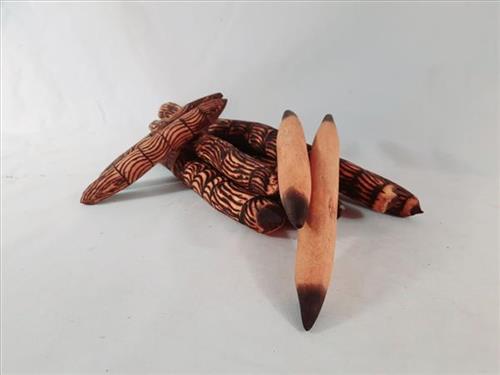
Timpilypa ~ Music Sticks

Known collectively as punu, the carvings of Anangu (Central and Western Desert Aboriginal people) have their beginnings in the Tjukurpa when the Creation Ancestors fashioned the first weapons and tools, setting down the laws and conventions of their design. Highly experienced craftsmen having grown up making traditional tools and weapons under the instruction of their fathers and grandfathers. The knowledge involved in this is inherited and passed on through the Tjukurpa or traditional Law. Inma or ceremony is one way in which this is done.


‘Munu timpilypa ngarinyi, laka purunypa. Laka purunypa….lakara lakara kulira panya palyaningi. Timpilypa alatjitu.’                                                                                  Anangu tjilpi

There are small sticks you make a  sound like a clap with…clap clap, listening closely then crafting them. That’s how you get music sticks.                               Senior Western Desert Aboriginal man


Rhythmic accompaniment to singing and dancing is part of celebrating the Tjukurpa. Timpilypa are used by both men and women and played by holding one stick loosely in the hand while striking  it with the other in a slow rhythmic beat. Differences in pitch and tone are achieved by varying the point and intensity of contact.

A larger single stick can also used to pound the earth while singing. Sometimes though, it is a pair of uncarved sticks plucked from the handiest tree

11613999307


Status: Stock


Tangentyre Artists designs

Established in 2005, Tangentyere Artists operates as a not-for-profit enterprise. Tangentyere Artists is a hub for art activities across the Town Camps (the name describing 18 Alice Springs Aboriginal housing associations), including the internationally renowned Yarrenyty Arltere Artists, located at Larapinta Town Camp.

Through their art, Town Camp Artists communicate stories about their families, identity and  lives. Their art practice aims to highlight the everyday experience of Aboriginal people in Central Australia. Through sharing  stories Artists place themselves in the national conversation, working towards understanding and reconciliation. Tangentyere is an Arrernte word that means coming together, working together.

Tangentyere Artists operates a studio, gallery space, and outreach program. As well as supporting Town Camp residents, we offer Indigenous artists visiting town from remote communities an open environment to create artworks and share artistic skills. Tangentyere Artists is committed to innovative, sustainable, fine art outcomes for Town Camp Artists.

11613999306


Status: Stock


Yarrenyty Arltere Artists designs

Yarrenyty Arltere Artists
Larapinta Valley Town Camp

‘We have been working for many years doing our art. Working hard. When we sew, the stress can calm down. The art room is a place for us to talk, tell stories and to just keep going.’
—Marlene Rubuntja

Yarrenyty Arltere Artists is the vibrant beating heart of the Yarrenyty Arltere Town Camp in Mparntwe (Alice Springs). Established in 2000 as a response to the chronic social issues the community were facing at that time, it has now, after many years of hard work and love, become an internationally recognized Art Centre. 

Working in soft sculptures, textiles, etchings and film this small but dynamic Art Centre has given opportunity, voice and income to people that too often find themselves marginalized.

Rich in personality and defiance, Yarrenyty Arltere Artists continues to be shaped by the artists and community that hold it so strongly and proudly as their own.