221776381252


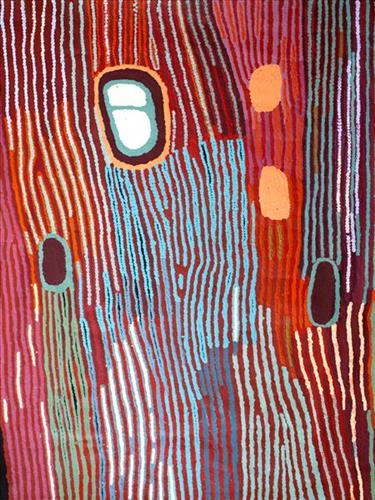
Milkwater

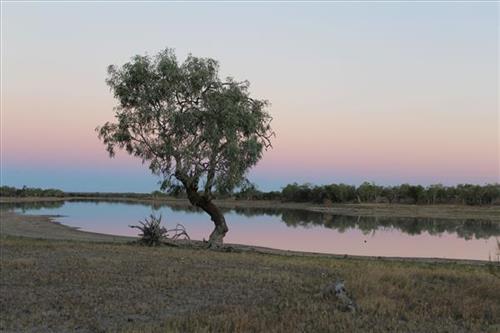
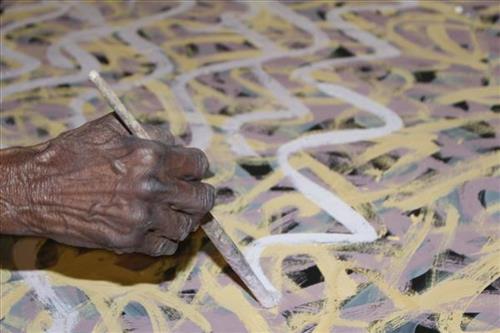
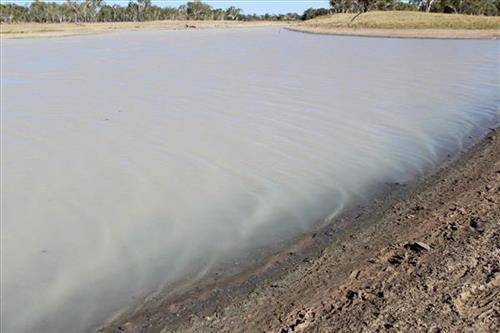
Senior artist, Kittey Malarvie’s traditional Country is the desert landscape around Sturt Creek, south west of Kununurra and north of the Great Sandy Desert.  Layers of intersecting lines map the country along the river banks and interpret the transition of the seasons across a remarkable place of black soil and water the colour of milk.  In this artwork Malarvie depicts a meditation on the multifaceted play of wind and light on water.  The stormy crescendo of wind and waves stirs the dark river bed and the rainbow serpent who resides beneath. “…the rainbow snake stays there, he keeps the water there until the rain comes.”

377814181808242


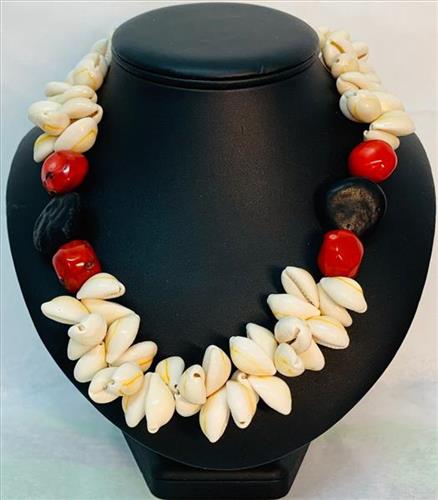
Necklace – Shell, Sandlewood Seed

My jewellery  is made from a variety of materials, which include semi precious stones, seeds, shell, wood and bone. All of the jewellery has sterling silver findings and on good quality jewellery wire. The seeds I used are sourced locally. 

377814181808237


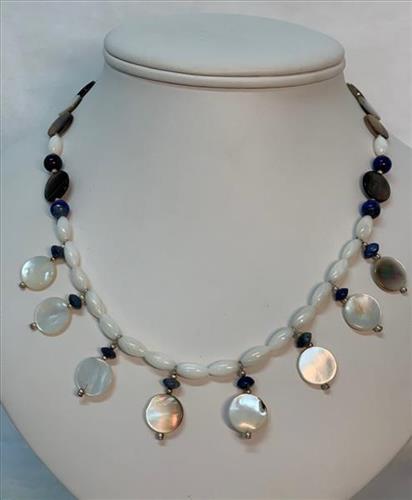
Necklace – Shell and Lapis

My jewellery  is made from a variety of materials, which include semi precious stones, seeds, shell, wood and bone. All of the jewellery have sterling silver findings and on good quality jewellery wire. The seeds that are used are sourced locally.

377814181808236


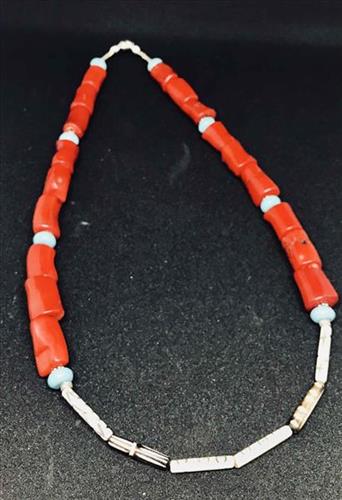
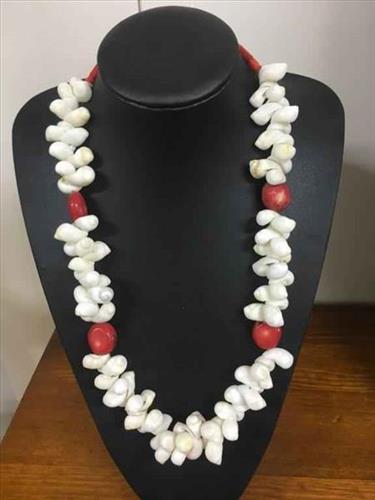
Necklace – Shell/Coral/Sterling Silver

My jewellry  is made from a variety of materials, which include semi precious stones, seeds, shell, wood and bone. All of the jewellery has sterling silver findings and on good quality jewellery wire. 

377814181808232


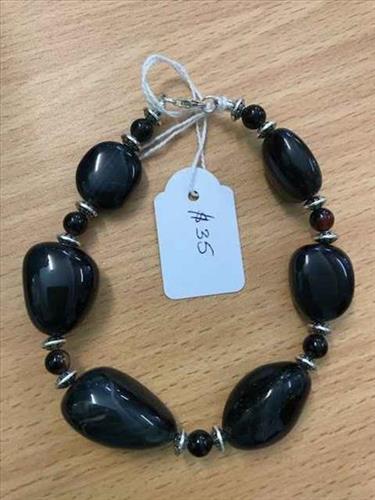
Bracelet – Sterling Silver

My jewellry  is made from a variety of materials, which include semi precious stones, seeds, shell, wood and bone. All of the jewellery has sterling silver findings and on good quality jewellery wire. 

111981809160


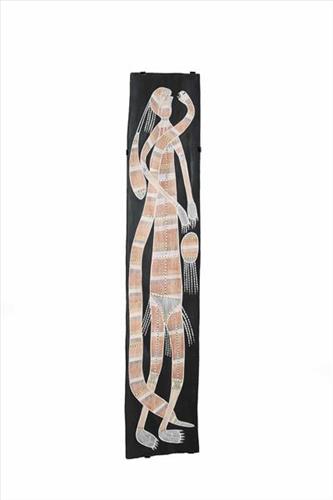
Wurum (Fish Increasing Spirit)

Aboriginal people throughout Australia undertook rituals, which were designed to result in the increase of various natural species. The Rembarrnga people of Central Arnhem Land tell of the spirit being Wurum who had a human form and carried fish in dilly bags. He is sometimes depicted with fins called konno on his legs and arms suggesting a transformational human-fish nature.

In order to create an abundance of certain fish species, Rembarrnga people would draw an image of Wurum on the side of a tree. They would then call out the following invocation; Deny ngarra-jalman ngarr-mangara, ‘We want to get fish’. Following this they would sleep for a night and then it is said that there would be an increase in fish.
Wurum is associated with a site called Kukaddjerre in Balngarra clan estate south of Maningrida. The Wurum also has a further function.

Burruwal described the paperbark Wurum he constructed as the ‘true’ or original form. This suggests that the more solid wooden carving may have been a later innovation. The artist told that ‘in the early days’ these paperbark figures would be placed, standing upright, around a mortuary site for two distinct purposes; to watch and ward off evil spirits, and to signal to people the presence of a mortuary location, so they could find or stay clear of it.

The ability of a contemporary artist like Burruwal to make these highly traditional paperbark figures – a relic of a bygone era – underscores the intimate spiritual links Burruwal has to his personal ancestry.

111981809156


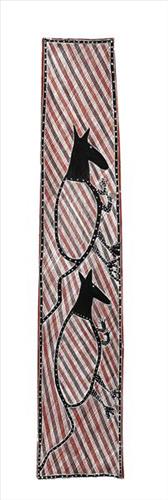
Yok (Bandicoot)

Brian is junggay (manager) for yok (bandi – coot). The ancestral site for yok is a hill called kordeme near Buluhkaduru outsta – tion. It is a restricted place. People used to hunt yok regularly, however they are rarely seen anymore. Lena Yarinkura explains that in the past junggay would perform rituals at the site, calling out all different kured (coun – try): Korlobidahdah, Mankorlod, Bulukada – ru, Ankadbarrbirri, Malyarngak, Raminggin – ing, Ji-balbal, Ji-bena. Baby yok would then spread throughout these areas. However, today there are no yok because djungkay have not been doing this work. Yok also has a powerful inside essence, mardayin, but this work is an ‘outside’, public story.

111981809131


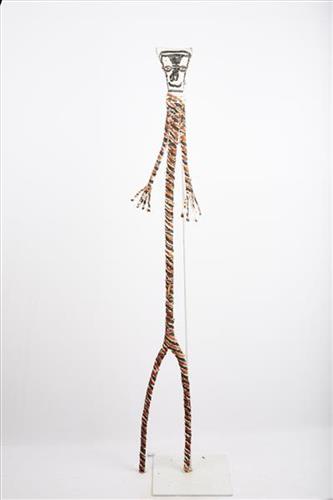
Mimih and Narawan (Snake)

The mimih spirit exists in a realm that runs parallel to and mirrors many facets of human life, also demonstrating the deep sense of time and place understood by Aboriginal and Torres Strait Islander people. Such spirits feature importantly in relation to Aboriginal spirituality, cosmology, social and moral tales as well as ritual. As is true with the multiple mediums employed by artists of West Arnhem Land, the development of artistic style and form is in line with an awareness by the artist that the work produced is predominantly made for a broader audience. Whether show in a national or international context these works communicate and exist in a particular space that is cross-cultural and simultaneously so particular to the Arnhem region.


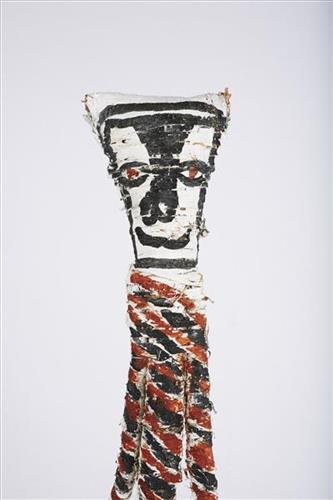
The mimih sits within a complex and important pedagogical and religious body of knowledge which links Kuninjku people to their distinctive escarpment homelands. Young Kuninjku artists, or apprentices, employ the mimih as an important exercise for the practice of the rarrk technique, as it could be achieved on a smaller surface area before, being attempted in larger scale, on pieces of bark. The mimih serves a purpose for those young artists first learning to carve in a social space of sharing and innovating. The initial mimih manifestation was a large form that almost mirrored the anatomy of a human and at this stage the sculptures have been likened to morkuy carvings visible in eastern Arnhem Land. Contemporaneously, mimih are depicted in a refined, slender, even emaciated form with a broad range of facial expressions giving both individual character to, and denoting the potential volatility and humour that mimih spirits are notable for in their interaction with bininj (humans). The sculptures are frequently carved from the thin trunks of softwoods such as kapok (bombax ceiba or cottonwood) kurrajong, beach hibiscus or leichardt and are painted with earth pigments for their colouring and design.

A leading figure engaging the spirit in visual storytelling was Crusoe Kuningbal, a Kuninjku man, who while traveling was familiarised with carving styles from the east of Arnhem at the mission in Milingimbi pre-dating World War II. This showing a notable connection and interaction of different language groups across such space. As well as travel and the development of art forms being informed by cross cultural dialogues within northern Aboriginal language groups. The mimih became a valued inclusion in performance and public ceremony by Kuninjku people like Kuningbal. At times these ceremonies were performed for extended language groups in the local region.


Now a familiar and broadly depicted figure of iconography, it is important to acknowledge the development of this quite recent sculptural tradition. The depiction of this particular spirit being, once used as an addition to the sharing of song cycles and ceremony, has since been elevated to a prominent form and subject of contemporary sculpture. Variation in the creation of
mimih acts as an indication of the individualism of each artist and their stylistic markers. Additionally significant to note is that in the space of the past thirty years the mimih has begun being produced by multiple language groups residing in the Maningrida area including the traditional owners of Maningrida, the Ndjébbana, speaking Kunibidji as well as Gurrgoni people who have strong ties to Kuninjku.

________
*Maningrida Arts & Culture acknowledge the work of many academic and non-academic voices when writing on this topic, it is important to note Luke Taylor, who’s broad research has informed this text.
111581809233


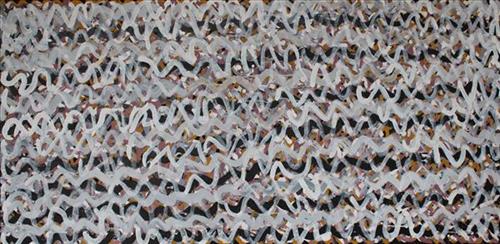
Wilarra

“Two Rockholes other side Punmu- Kayili (North) all the way keep going Kakarra (East), long way. Dingomili ngurra (Dingo’s home). Big one is Willarra. Dingos all stay in that place together, wild one [dingo] became a quiet one. All the dingos come from that place. Make a kuna (faeces), go home. Kirl Kirl (Well 36), Pinlankujarra and Karrarrngarri claypan are here too”

Wilarra, the site depicted in this painting, lies on the edge of a large salt lake, Nyayartakujarra (Lake Dora), near Punmu community.  A distinctive group of small salt water pools are clustered together here. The water from these pools is known for its’ powerful healing properties, and the pools are still visited today by Martu to bathe cuts and sores. 

Wilarra is also a term for ‘moon’ in Manyjillyjarra, and through the site’s jukurrpa (Dreamtime story), the site is united with the moon in significance. It is said that at Wilarra, the moon called to a family of dingoes; a mother, father and their large litter of dingo pups. The dingoes gathered at Wilarra, where the moon cared for them and created a windbreak for the family to shelter. “They scratched there in the salt lake and made those pools. They lay down there and had a sleep.” After a time, the dingoes continued travelling eastward toward the rising moon until they reached Kinyu (Well 35 on the Canning Stock Route), where they remained until all of the dingo pups had grown up. The moon asked the sun where it was going, and the sun replied it was also travelling east. From Kinyu the family travelled further east with the moon.