377814181906140


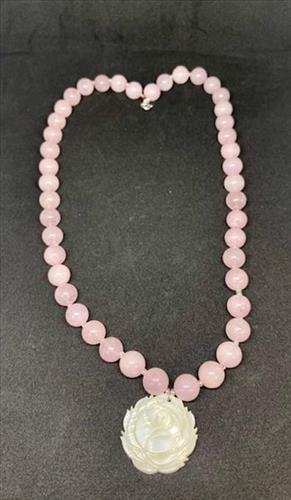
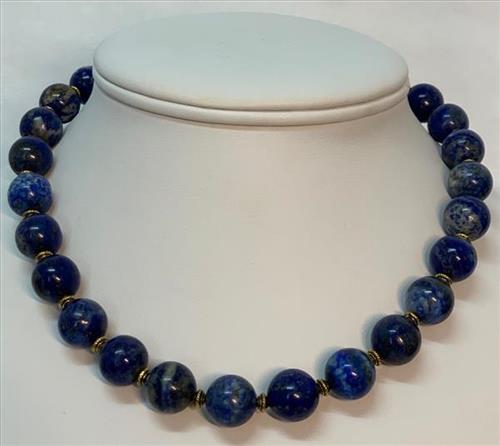
Lapis Lazuli Necklace

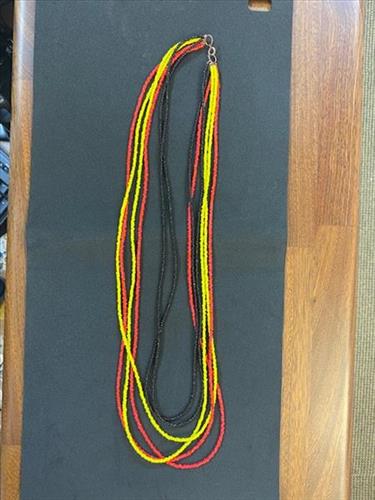
My jewellery  is made from a variety of materials, which include semi precious stones, seeds, shell, wood and bone. All of the jewellery have sterling silver findings and on good quality jewellery wire. The seeds that are used are sourced locally.

377814181906137


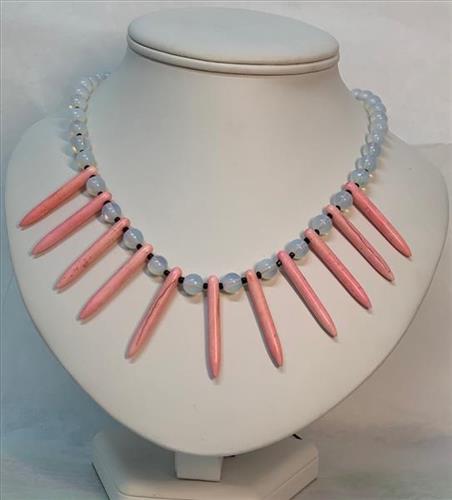
Opalite Necklace

My jewellery  is made from a variety of materials, which include semi precious stones, seeds, shell, wood and bone. All of the jewellery have sterling silver findings and on good quality jewellery wire. The seeds that are used are sourced locally.

111581906824


Untitled

“When Martu paint, it’s like a map. Martu draw story on the ground and on the canvas, and all the circle and line there are the hunting areas and different waters and tracks where people used to walk, and [some you] can’t cross, like boundaries. So nowadays you see a colourful painting and wonder what it is, but that’s how Martu tell story long ago. It’s not just a lovely painting, it’s a story and a songline and a history and everything that goes with it.” 

– Ngalangka Nola Taylor and Joshua Booth

This work portrays an area of Country that can be interpreted in multiple ways. Firstly, the image may be read as an aerial representation of a particular location known to the artist- either land that they or their family travelled, from the pujiman (traditional, desert dwelling) era to now. During the pujiman period, Martu would traverse very large distances annually in small family groups, moving seasonally from water source to water source, and hunting and gathering bush tucker as they went. At this time, one’s survival depended on their intimate knowledge of the location of resources; thus physical elements of Country, such as sources of kapi (water), tali (sandhills), different varieties of warta (trees, vegetation), ngarrini (camps), and jina (tracks) are typically recorded with the use of a use of a system of iconographic forms universally shared across the desert. 

An additional layer of meaning in the work relates to more intangible concepts; life cycles based around kalyu (rain, water) and waru (fire) are also often evident. A thousands of year old practice, fire burning continues to be carried out as both an aid for hunting and a means of land management today. As the Martu travelled and hunted they would burn tracts of land, ensuring plant and animal biodiversity and reducing the risk of unmanageable, spontaneous bush fires. The patchwork nature of regrowth is evident in many landscape works, with each of the five distinctive phases of fire burning visually described with respect to the cycle of burning and regrowth.  

Finally, metaphysical information relating to a location may also be recorded; jukurrpa (dreaming) narratives chronicle the creation of physical landmarks, and can be referenced through depictions of ceremonial sites, songlines, and markers left in the land. Very often, however, information relating to jukurrpa is censored by omission, or alternatively painted over with dotted patterns.

111581906797


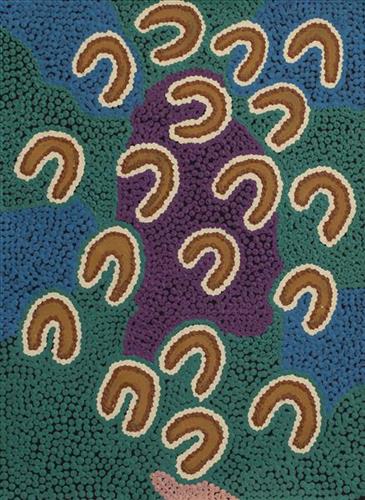
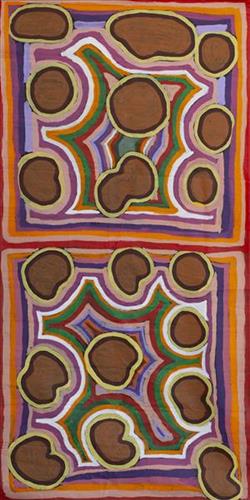
Wantis coming together

“When Martu paint, it’s like a map. Martu draw story on the ground and on the canvas, and all the circle and line there are the hunting areas and different waters and tracks where people used to walk, and [some you] can’t cross, like boundaries. So nowadays you see a colourful painting and wonder what it is, but that’s how Martu tell story long ago. It’s not just a lovely painting, it’s a story and a songline and a history and everything that goes with it.” 

– Ngalangka Nola Taylor and Joshua Booth

This work portrays an area of Country that can be interpreted in multiple ways. Firstly, the image may be read as an aerial representation of a particular location known to the artist- either land that they or their family travelled, from the pujiman (traditional, desert dwelling) era to now. During the pujiman period, Martu would traverse very large distances annually in small family groups, moving seasonally from water source to water source, and hunting and gathering bush tucker as they went. At this time, one’s survival depended on their intimate knowledge of the location of resources; thus physical elements of Country, such as sources of kapi (water), tali (sandhills), different varieties of warta (trees, vegetation), ngarrini (camps), and jina (tracks) are typically recorded with the use of a use of a system of iconographic forms universally shared across the desert. 

An additional layer of meaning in the work relates to more intangible concepts; life cycles based around kalyu (rain, water) and waru (fire) are also often evident. A thousands of year old practice, fire burning continues to be carried out as both an aid for hunting and a means of land management today. As the Martu travelled and hunted they would burn tracts of land, ensuring plant and animal biodiversity and reducing the risk of unmanageable, spontaneous bush fires. The patchwork nature of regrowth is evident in many landscape works, with each of the five distinctive phases of fire burning visually described with respect to the cycle of burning and regrowth.  

Finally, metaphysical information relating to a location may also be recorded; jukurrpa (dreaming) narratives chronicle the creation of physical landmarks, and can be referenced through depictions of ceremonial sites, songlines, and markers left in the land. Very often, however, information relating to jukurrpa is censored by omission, or alternatively painted over with dotted patterns.

111581906794


Clay pans at Puntawarri

This painting depicts Puntawarri, the artists’ mother’s family’s country. Puntawarri is on the middle stretches of the Canning Stock Route, near Well 17 also known as Durba Springs. Puntawarri is an important cultural area, east of the Jigalong Aboriginal Community, where the artist now lives with her grandmother. The artist’s grandmother frequently travelled and hunted with her family in this area when she was a young girl, and is now teaching Judith the stories for this country.

111581906791


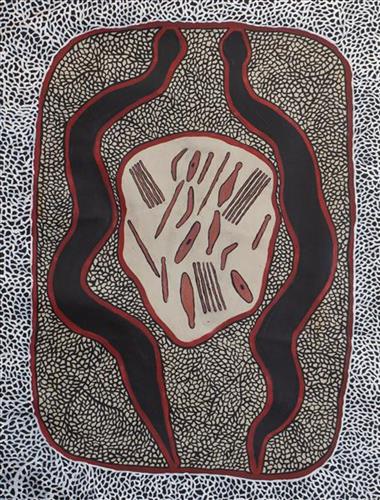
Niminjarra (weapons)

“Niminjarra is the two brothers transforming into a snake so they can go back home to Ngayartakujarra (Lake Dora). They were in training for ceremony, those two brothers, but they were kept too long and nobody was there to release them. They waited then they decided to transform into snakes to travel back to where they came from, because their mother was waiting for them. This is Jukurrpa (Dreaming story)

Here the Jila Kujarra are travelling West of Karilwara, back to their home Ngayartakujarra (Lake Dora). They come upon a place of weapons that belong to the Niminjarra. The Jila Kujarra continue to travel West and their tracks were sighted and followed by the Niminjarra.”

– Desmond Taylor

The term jukurrpa is often translated in English as the ‘dreaming’, or ‘dreamtime’. It refers generally to the period in which the world was created by ancestral beings, who assumed both human and nonhuman forms. These beings shaped what had been a formless landscape; creating waters, plants, animals, and people. At the same time they provided cultural protocols for the people they created, as well as rules for interacting with the natural environment. At their journey’s end, the ancestral beings transformed themselves into important waters, hills, rocks, and even constellations. 

Jila Kujarra (Two Snakes) is one of the key jukurrpa narratives for the Martu. Though the story belongs to Warnman people, it is shared across the Western Desert with several other language groups. The narrative centres on the travels of two snakes as they are pursued by the Niminjarra, spiritual ancestors of the Warnman people. Before transforming themselves into snakes, the Jila Kujarra were young brothers waiting to be released from ceremony at the boundary of Mukurtu, west of Mamunara (Canning Stock Route Well 28). They began travelling home to their mother in the west, but were intercepted by the Niminjarra as they hunted and hurled their spears in front of them. Suddenly the spears of the Niminjarra stuck in the ground and swayed in the air, alerting the Niminjarra to the tracks of the Jila Kujarra.

The Niminjarra started to track the Jila Kujarra, but stopped with their many weapons at Jantuwurujul (or Janturuly) to hunt for wild game. The Jila Kujarra continued to flee, reaching Paji, east of Nyayartakujarra (Lake Dora) before they were again intercepted by the Niminjarra. The Niminjarra believed the snakes had hidden in a cave north of Paji, and tried to smoke them out. Again, the Jila Kujarra eluded their pursuers, this time escaping under the lake at Paji and at the same time creating many small decoy snakes to lead the Niminjarra astray. 

Meanwhile, from a nearby hill, two Pukurti (initiates with bundled hair) prophesied that the Niminjarra would kill the Jila Kujarra. The Pukurti tracked the Jila Kujarra through to Nyayartakujarra, where they speared the snakes in the head to hold them down while they returned to Paji to summon the Niminjarra. The Niminjarra made a fire and cooked the snakes at Ngayartakujarra (Lake Dora). The snakes were too long to lay down on leafy branches to be cut up, so the Niminjarra lay down to make a human table. When the Niminjarra cut down the length of the Jila Kujarra, the snake’s bladders were pierced, causing an explosion of scalding hot urine in which the Niminjarra all perished and became black rocks at the site. At the same time, the urine of the Jila Kujarra formed the vast salt lake, Kumpupirntily, which translates to ‘bladder burst’.  

The spirits of the Jila Kujarra rose and continued to travel to their mother at Nyayartakujarra. She saw them coming towards her as flaming figures, and called out to them, piercing the surface of the salt lake with her digging stick. There, the mother and her sons entered the ground below Nyayartakujarra, where they remain to this day.



377814181906910


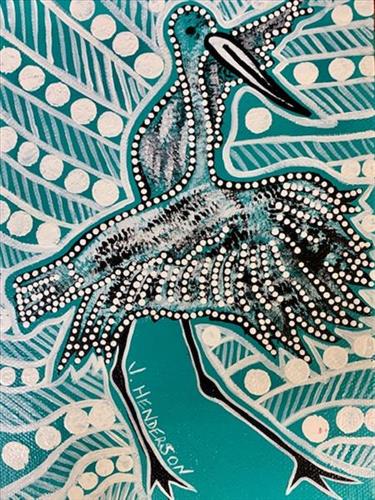
Brolga on White Dots

My art comes from the Land and the Sea, My mother came from Laura and that was known as freshwater Country, My Fathers County was Sea water, this is where my inspiration comes from for my designs and art.


377814181906908


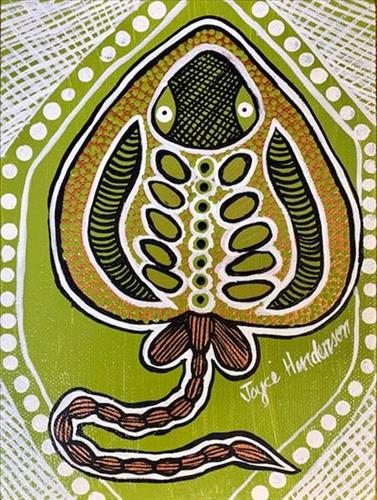
Stingray on Green and White Crosshatch

My art comes from the Land and the Sea, My mother came from Laura and that was known as freshwater Country, My Fathers County was Sea water, this is where my inspiration comes from for my designs and art.