111581938156


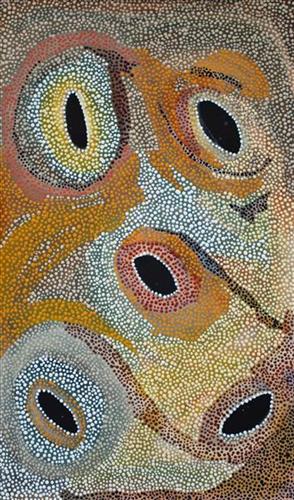
Punmu waterholes – Marianne Burton

“Punmu, I went there when I was a young girl, a teenager with my mother and father before my mother passed. Big mob of people was there. No building, just little cubby houses [bough shelters]. Long time I been there. 

These here are the waterholes around Punmu; Rawa spring- Rawa means ‘long time’, Tuu-tuu, Jila-jila, Wirlarra and Yilyara. That is my ngurra (home Country, camp). We grew up in Punmu around all these water holes. I still live here with my grandkids, [we share the] same stories for all these places.” 

 – Marianne Burton


 Punmu refers to a region and an Aboriginal community within its vicinity, located 670km North-East of Newman. Created during the return to Country movement of the 1980s, with the recognition of Martu land rights and native title, the community was named after a nearby Jukurrpa (Dreaming) story. As described by Marianne, Punmu is her ngurra; she grew up in this region with her parents. 

Punmu community sits on the edge of a large salt lake known as Nyayartakujarra, or Lake Dora. The lake runs south into Karlamilyi River (Rudall River). Surrounding Punmu are numerous fresh water soaks and the red tali (sandhills) typical of the area. The most frequently visited yinta (permanent springs) around Punmu include Wirlarra, Rawa, Yilyara, Jila-jila and Tuu-tuu.

The Country around Punmu features in several Jukurrpa stories. Of particular importance is the story of the Jila Kujarra (Two Snakes), one of the key Jukurrpa narratives for the Martu. Though the story belongs to Warnman people, it is shared across the Western Desert with several other language groups. The narrative centres on the travels of two snakes as they are pursued by the Niminjarra, spiritual ancestors of the Warnman people. 

 Before transforming themselves into snakes, the Jila Kujarra were young brothers. As snakes, they began travelling home to their mother, but were intercepted by the Niminjarra, who tracked the Jila Kujarra to Paji, east of Nyayartakujarra (Lake Dora). Though the Jila Kujarra eluded their pursuers here by escaping under the lake at Paji, they were soon after speared and injured by two Pukurti (initiates with bundled hair) at Nyayartakujarra, who returned with the Niminjarra to cook the snakes at the site of Kumpupirntily (Kumpupintily, Lake Disappointment). As the Niminjarra cut down the length of the Jila Kujarra, the snake’s bladders were pierced, causing an explosion of scalding hot urine in which the Niminjarra all perished and became black rocks at the site. The spirits of the Jila Kujarra returned to their mother at Nyayartakujarra, where the mother and her sons entered the ground below Nyayartakujarra and remain to this day.

111581938155


Wirlarra

Wirlarra, the site depicted in this painting, lies on the eastern edge of a large salt lake, Nyayartakujarra (Lake Dora), near Punmu Aboriginal community. A distinctive group of small salt water pools are clustered together here. The water from these pools is known for its’ powerful healing properties, and the pools are still visited today by Martu to bathe cuts and sores. 

Wirlarra is also a term for ‘moon’ in Manyjilyjarra, and through the site’s Jukurrpa (Dreaming) narrative, the site is united with the moon in significance. It is said that at Wirlarra, the moon called to a family of dingoes; a mother, father and their large litter of dingo pups. The dingoes gathered at Wirlarra, where the moon cared for them and created a windbreak for the family to shelter. Here the dingoes scratched at the surface of the salt lake and created the cluster of salt water pools located there today. They lay down there. After a time, the dingoes continued travelling eastward toward the rising moon until they reached Kinyu (Well 35 on the Canning Stock Route), where they remained until all of the dingo pups had grown up. From Kinyu the family travelled further east with the moon.

111581938154


Punmu kapi

“These here are the waterholes around Punmu. Rawa spring, Rawa means long time. On the right is Tuu Tuu, then Jila Jila, Wilarra and Yilyara.”

– Bianca Simpson

Punmu is an Aboriginal community located 670km North-East of Newman, in the Pilbara region of Western Australia. Created during the return to Country movement of the 1980s, with the recognition of Martu land rights and native title, the community was named after a nearby jukurrpa (dreamtime) story.

Punmu community sits on the edge of a large salt lake known as Nyayartakujarra, or Lake Dora. The lake runs south into Karlamilyi River. There are many yinta (permanent water sources) in Punmu’s nearby vicinity including Wilarra, Rawa, Yilyara, Jilajila and Tuutuu.

Punmu features in several jukurrpa narratives. Of particular importance for the Warnman people is the story of the ‘Jila Kujarra’ (Two Snakes). These snakes travelled through Parnngurr, Punkulyi, Yulpu, and Winukurrujunu, forming lakes, claypans, rocks, rockholes, waterholes and soaks as they went. The powerful elder of the two snakes, Wirnpa, finally stopped at the site of Wirnpa, named for him. The young snake kept on travelling until coming to Punmu waterholes Rawa and Yilyarra, making that Country his ngurra (home camp). Another jukurrpa story describes the formation of Nyayartakujarra as occurring when two travelling snakes were first sung to sleep and then killed by magic men. The snakes’ fat was said to have burned away and melted into Nyayartakujarra.

111581938153


Kurturarra

“Kurturarra is my Grandmother’s Country. Warla (lake) with a spring. Tali (sandhills) all around.”

 – Beverley Rogers

This site lies within Beverley’s ngurra (home Country, camp) through her grandmother. Kurturarra is a yinta (permanent spring) located within the largest of the salt lakes in the Percival Lakes region, and surrounded by acacia trees. The Percival Lakes form a string of ephemeral salt lakes in the north of Western Australia, extending across a distance of 350km. They lie at the southern region of the Great Sandy Desert and east of the Karlamilyi (Rudall River) region.

The region surrounding Kurturarra was formed by Wirnpa, one of the most powerful of the ancestral jila (snake) men and the last to travel the desert during the Jukurrpa (Dreaming). Wirnpa is a rainmaking jila who lived and hunted in the Percival Lakes area. His travels are described in the songs and stories of many language groups across the Western Desert, even those far removed from his home site. In his epic travels, Wirnpa met and feasted with many other ancestral beings, exchanged ceremonial objects, and created a series of different laws and ceremonies. When he finally returned home, he searched for his many children only to discover that they had already died. They had laid down and become the salt springs of the Percival Lakes. Wirnpa wept for his children before himself transforming into a snake and entering the soak where he still resides.

111581938152


Kunawarritji (Canning Stock Route Well 33)

This painting is part of the Nyina-ya ngurrangka ngampurrpa (stay in your home safely) collection – a body of works by Martu artists in lockdown. From Monday 16th March Martumili Artists closed on-site art-production and retail, as a protective measure in the face of the COVID-19 pandemic. The remote Martu communities of Parnngurr, Punmu, Kunawarritji, Warralong and Jigalong went into lockdown, with access to visitors strictly prohibited to protect community members, and in particular the important elders that call Martu Country home. Martu Artists who found themselves on Country during lockdown had the opportunity for reconnection with their daily art practice, undisturbed by busy contemporary life as Australia, and indeed the world, slowed down in the face of the global pandemic.


This collection of artworks showcases the unstoppable determination of Martu Artists in their work, and demonstrates a deep and enduring commitment to art-making as an act of cultural preservation and social connection. Martu elders use paintings as a means to pass on stories of Country, jukurrpa (dreaming), family histories and traditional environmental knowledge to younger family members. To Martu Artists, painting is connection. And in times of isolation and lockdown, they have remained connected to eachother, and to their Country.

“When I was a young girl, I walked everywhere, travelling along the Canning Stock Route. I walked north and west, around Wana warla (lake). I grew up around there, going right around that Country and all the way back to Kunawarritji. But once I became a woman I stopped travelling and just stayed around Kunawarritji.

[At] Kunawarritji, all the Minyipuru (Jakulyukulyu, Seven Sisters) mima (women) there. He been chase them, Yurla.”

 – Kumpaya Girgirba (Girgaba)

Kunawarritji is an important site in the Great Sandy Desert where multiple stories and histories intersect. Originally a spring water and major Martu pujiman (traditional, desert dwelling) camping site, at the turn of the 20th century Kunawarritji was converted into a well along the Canning Stock Route. Each year throughout the 1930-50s, the well became a site of contact between the drovers, their cattle, and desert families like Kumpaya’s. Kumpaya was born at Kiwirrkurra, 350 kilometres east of Kunawarritji. She grew up in the Country between these sites, and from an early age she and her family had encounters with drovers along the Canning Stock Route. In her paintings for this area, Kumpaya frequently depicts the waterholes between Kunawarritji and Punmu that she travelled between as a young woman. These water sources include Wuranu (Canning Stock Route Well 29), Juntu-juntu (Canning Stock Route Well 30), Mujingarra, Yurrunguny, Papuly, Nyipily (Nyipil, Canning Stock Route Well 34), Pikarnu, and Yalta. 

As Kumpaya describes in her account, Kunawarritji features in the Minyipuru (Jakulyukulyu, Seven Sisters) Jukurrpa (Dreaming). Minyipuru is a central Jukurrpa narrative for Martu, Ngaanyatjarra, Pitjantjatjara and Yankunytjatjara people that is associated with the seasonal Pleiades star constellation. Beginning in Roebourne on the west coast of Western Australia, the story morphs in its movement eastward across the land, following a group of women as they walk, dance, and even fly from waterhole to waterhole. As they travelled the women left markers in the landscape and create landforms that remain to this day. During the entirety of their journey the women are pursued by a lustful old man, Yurla, although interactions with other animals, groups of men, and spirit beings are also chronicled in the narrative. The Minyipuru travelled to Kunawarritji from Nyipily (Nyipil, Nibil, Canning Stock Route Well 34), and transformed themselves into a distinctive group of trees that remain in the area between these two sites. From Kunawarritji Yurla followed the sisters to Pangkapirni, where he finally caught one of the women. 

Today, Kunawarritji is a site of return, a place where people came back to continue their life in the desert with the formation of Kunawarritji Aboriginal community in the early 1980s. The community’s cultural significance endures, with the population swelling up to 1000 during cultural business.

111581938151


Kunawarritji (Canning Stock Route Well 33)

“When I was a young girl, I walked everywhere, travelling along the Canning Stock Route. I walked north and west, around Wana warla (lake). I grew up around there, going right around that Country and all the way back to Kunawarritji. But once I became a woman I stopped travelling and just stayed around Kunawarritji.

[At] Kunawarritji, all the Minyipuru (Jakulyukulyu, Seven Sisters) mima (women) there. He been chase them, Yurla.”

 – Kumpaya Girgirba (Girgaba)

Kunawarritji is an important site in the Great Sandy Desert where multiple stories and histories intersect. Originally a spring water and major Martu pujiman (traditional, desert dwelling) camping site, at the turn of the 20th century Kunawarritji was converted into a well along the Canning Stock Route. Each year throughout the 1930-50s, the well became a site of contact between the drovers, their cattle, and desert families like Kumpaya’s. Kumpaya was born at Kiwirrkurra, 350 kilometres east of Kunawarritji. She grew up in the Country between these sites, and from an early age she and her family had encounters with drovers along the Canning Stock Route. In her paintings for this area, Kumpaya frequently depicts the waterholes between Kunawarritji and Punmu that she travelled between as a young woman. These water sources include Wuranu (Canning Stock Route Well 29), Juntu-juntu (Canning Stock Route Well 30), Mujingarra, Yurrunguny, Papuly, Nyipily (Nyipil, Canning Stock Route Well 34), Pikarnu, and Yalta. 

As Kumpaya describes in her account, Kunawarritji features in the Minyipuru (Jakulyukulyu, Seven Sisters) Jukurrpa (Dreaming). Minyipuru is a central Jukurrpa narrative for Martu, Ngaanyatjarra, Pitjantjatjara and Yankunytjatjara people that is associated with the seasonal Pleiades star constellation. Beginning in Roebourne on the west coast of Western Australia, the story morphs in its movement eastward across the land, following a group of women as they walk, dance, and even fly from waterhole to waterhole. As they travelled the women left markers in the landscape and create landforms that remain to this day. During the entirety of their journey the women are pursued by a lustful old man, Yurla, although interactions with other animals, groups of men, and spirit beings are also chronicled in the narrative. The Minyipuru travelled to Kunawarritji from Nyipily (Nyipil, Nibil, Canning Stock Route Well 34), and transformed themselves into a distinctive group of trees that remain in the area between these two sites. From Kunawarritji Yurla followed the sisters to Pangkapirni, where he finally caught one of the women. 

Today, Kunawarritji is a site of return, a place where people came back to continue their life in the desert with the formation of Kunawarritji Aboriginal community in the early 1980s. The community’s cultural significance endures, with the population swelling up to 1000 during cultural business.

111581938150


Kulyakartu

This painting depicts Kulyakartu, Wokka’s ngurra (home Country, camp). Kulyakartu is located in the far north of the Martu homelands, near the Percival Lakes region of Western Australia’s Great Sandy Desert. Wokka has extensive knowledge of the Country in this region, where he grew up living traditionally during the pujiman (traditional, desert dwelling) days with his family. Kulyakartu is mostly grass Country where there is very good hunting. In particular parnajarrpa (goanna), wild cats, and lunki (witchetty grub) are found in abundance here. There is no permanent water source in Kulyakartu, so Wokka’s family would walk here annually following the wantajarra (wet season). During the yalijarra (hot, dry months) they would head south again to more permanent water.

111581938149


Yimiri

“Yimiri is [at] a salt lake. There’s two water in the middle, drinking water. That’s a drinking water for us. You can walk right up to lake in the middle of the salt. It’s fresh and beautiful. You gotta sing out for Yimiri, that’s a snake Country. That’s a special water place. We sing out for water; “Yimiri, I’m coming to visit you, I’m coming for fresh water.”

I grew up around these salt lakes [Percival Lakes] with all the families; Yuwali mob, all together. Too salty to drink, so get fresh water from Yimiri, a yinta (permanent spring) in the lake. When they got sick or sores, mothers would wash them in the salt on hot days to make the kids better.”

 -Ngarga Thelma Judson

Yimiri comprises two soaks situated in the middle of a salt lake in the Percival Lakes area, within Western Australia’s Great Sandy Desert. Around the waterhole the Country is dominated by tuwa (sand hills), depicted here with lines and sections of colour. This painting depicts Yimiri, a very important site for yinta. Yimiri is the larger of two soaks in the middle of a big salt warla (lake). When visiting this site to drink water, the plants and warta (trees, vegetation) growing in the kapi (water) are cleaned out as a way of maintaining the site.

During the pujiman (traditional, desert dwelling) days, Ngarga and her family travelled extensively through this county, their ngurra (home Country, camp). Her family moved up and down through this Country between water sources. When it was raining, they would build a wuungku (shelter) where they could sleep and stay warm beside a waru (fire). When they camped in a particular location for a period the elders would go hunting, leaving the children behind. Ngarga fondly recalls playing around in the tuwa (sandhills) in this region, catching parla-parla (type of lizard).

Yimiri is home to an ancestral jila (snake). The Western Desert term jila is used interchangeably to describe springs considered to be ‘living’ waters and snakes, both of which play a central role in Martu culture and Jukurrpa (Dreaming). During the pujiman (traditional, desert dwelling) period, knowledge of water sources was critical for survival, and today Martu Country is still defined in terms of the location of water sources. Of the many permanent springs in Martu Country, very few are ‘living waters’; waters inhabited by jila. Before they became snakes, these beings were men who made rain, formed the land and introduced cultural practices like ceremonies and ritual songs. Some of the men travelled the desert together, visiting one another, but they all ended their journeys at their chosen spring alone, transformed into a snake. These important springs are named after their jila inhabitant, guarding their waters.

The region surrounding Yimiri was formed by Wirnpa, one of the most powerful of the ancestral jila (snake) men and the last to travel the desert during the Jukurrpa. Wirnpa is a rainmaking jila who lived and hunted in the Percival Lakes area. His travels are described in the songs and stories of many language groups across the Western Desert, even those far removed from his home site. In his epic travels, Wirnpa met and feasted with many other ancestral beings, exchanged ceremonial objects, and created a series of different laws and ceremonies. When he finally returned home, he searched for his many children only to discover that they had already died. They had laid down and become the salt springs of the Percival Lakes. Wirnpa wept for his children before himself transforming into a snake and entering the soak where he still resides.

111581938148


Bush Tucker

Depicted in this work are traditional types of bush tucker, their habitats, and their related hunting and gathering methods. During the pujiman (traditional, desert dwelling) period, Martu would traverse very large distances annually in small family groups, moving seasonally from water source to water source, and hunting and gathering bush tucker as they went. Whilst desert life has moved away from mobile hunter-gatherer subsistence throughout the course of the twentieth century, bush tucker continues to be a significant component of the modern Martu diet. Hunting and gathering bush tucker remains equally valuable as an important cultural practice that is passed on intergenerationally. Though hunting and gathering implements have been modernised, methods of harvesting, tracking and the use of fire burning to drive animals from their retreats are still commonly practiced today. 

Typically, animals hunted for their kuwiyi (meat) include kirti-kirti (euro kangaroo) and marlu (plains kangaroo), parnajarrpa (sand goanna), kipara (Australian bustard, bush turkey) and karlaya (emu). Lunki (witchetty grub) and wuukurta (honey ants) are dug from tree and bush trunks, or from underground nests. Popular mayi (plant food) includes minyarra (bush onion), collected from small, grass like plants; root vegetables dug from underground such as kulyu and mata (types of bush potato); and seeds such as kalaru (samphire, salt bush), yuwinyji, and marnkalpa (spinifex species). Jawirli (quondong), wamurla (bush tomatoes), jinyjiwirrily (wild gooseberry), ngaputa (melon), and karlkula (bush banana) are some of the most popular bush fruits. These are often collected in the wantajarra (cool season) and tuulpara (spring) months, along with juri (sweet) botanical gums and wama (nectar), obtained from various plant species. 

Traditional tools used for hunting and gathering bush tucker were carved from wanari (mulga), mulunturu (desert oak), yurungkura (river red gum) and mijarrpa (bloodwoods), and included kurlata (spears), jurna (hitting stick), karli (boomerangs), wana (digging-sticks), piti (timber bowls used for carrying food and water), and jiwa (grinding stones for grinding seeds into flour). While carved objects retain enormous social and ceremonial importance in Martu life, they are no longer used for hunting and gathering.

111581938147


Kurturarra

“Kurturarra is my Grandmother’s Country. Warla (lake) with a spring. Tali (sandhills) all around.”

 – Beverley Rogers

This site lies within Beverley’s ngurra (home Country, camp) through her grandmother. Kurturarra is a yinta (permanent spring) located within the largest of the salt lakes in the Percival Lakes region, and surrounded by acacia trees. The Percival Lakes form a string of ephemeral salt lakes in the north of Western Australia, extending across a distance of 350km. They lie at the southern region of the Great Sandy Desert and east of the Karlamilyi (Rudall River) region.

The region surrounding Kurturarra was formed by Wirnpa, one of the most powerful of the ancestral jila (snake) men and the last to travel the desert during the Jukurrpa (Dreaming). Wirnpa is a rainmaking jila who lived and hunted in the Percival Lakes area. His travels are described in the songs and stories of many language groups across the Western Desert, even those far removed from his home site. In his epic travels, Wirnpa met and feasted with many other ancestral beings, exchanged ceremonial objects, and created a series of different laws and ceremonies. When he finally returned home, he searched for his many children only to discover that they had already died. They had laid down and become the salt springs of the Percival Lakes. Wirnpa wept for his children before himself transforming into a snake and entering the soak where he still resides.