111582006668

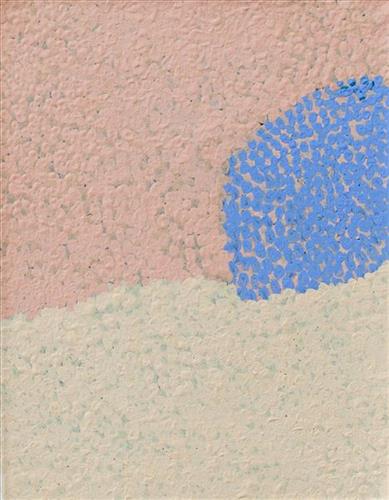
All the claypans this side of Punmu
“Punmu, Kirly-kirly, Pirninkujarra, [Between these places are areas of] nyurnma (freshly burnt Country), some spinifex, more nyurnma. Waru-waru (green shoots and young plants), green ones after rain time, yukuri (green grass, vegetation). Plenty bush tucker; kirti-kirti (hill kangaroo), jinyjiwirrilyi (wild gooseberry), sometimes jipuku (rabbit). Tuwa (sandhill) here, plenty tuwa. Another side tuwa and nyurnma, another side panka (level ground).”
– Wokka Taylor
Punmu refers to a region and an Aboriginal community within its vicinity, located 670km North-East of Newman. Created during the return to Country movement of the 1980s, with the recognition of Martu land rights and native title, the community was named after a nearby Jukurrpa (Dreaming) story. Punmu community sits on the edge of a large salt lake known as Nyayartakujarra, or Lake Dora. The lake runs south into Karlamilyi River (Rudall River).
Surrounding Punmu are numerous fresh water soaks and the red tali (sandhills) typical of the area. The Country around Punmu features in several Jukurrpa stories. Of particular importance is the story of the Jila Kujarra (Two Snakes), one of the key Jukurrpa narratives for the Martu. Though the story belongs to Warnman people, it is shared across the Western Desert with several other language groups. The narrative centres on the travels of two snakes as they are pursued by the Niminjarra, spiritual ancestors of the Warnman people.
Wokka travelled through this Country as a young man with his family. In his account, Wokka describes growth cycles associated with fire burning practices, types of bush tucker, and the geographical nature of the area between Punmu, Kirly-kirly and Pirninkujarra, south east of Punmu community.
111582006667
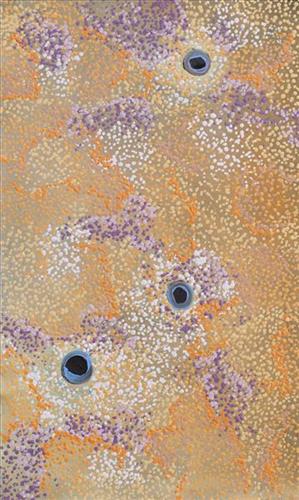
Kulyakartu
This painting depicts Kulyakartu, Derrick’s ancestral ngurra (home Country, camp). Kulyakartu is located in the far north of the Martu homelands, near the Percival Lakes region of Western Australia’s Great Sandy Desert.
Kulyakartu is mostly grass Country where there is very good hunting. In particular parnajarrpa (goanna), wild cats, and lunki (witchetty grub) are found in abundance here. There is no permanent water source in Kulyakartu, so the site was visited annually following the wantajarra (wet season).
111582006665

Kulyakartu
“Long time ago I been there. It is my grandmothers, grandfathers, fathers, mothers country, Kulyakartu. I am painting this particular place it keeps me connected, sense of belonging. Tell my grandmothers story through my art. Where she was born, I’m apart of that.
It makes me feel proud painting. Most important is telling the story behind the painting so people can understand where I am coming from. Kulyakartu is our ngurra (home, country, camp). I will continue telling the story through my art.”
– Derrick Butt
This painting depicts Kulyakartu, Derrick’s ancestral ngurra (home Country, camp). Kulyakartu is located in the far north of the Martu homelands, near the Percival Lakes region of Western Australia’s Great Sandy Desert.
Kulyakartu is mostly grass Country where there is very good hunting. In particular parnajarrpa (goanna), wild cats, and lunki (witchetty grub) are found in abundance here. There is no permanent water source in Kulyakartu, so the site was visited annually following the wantajarra (wet season).
111582006664
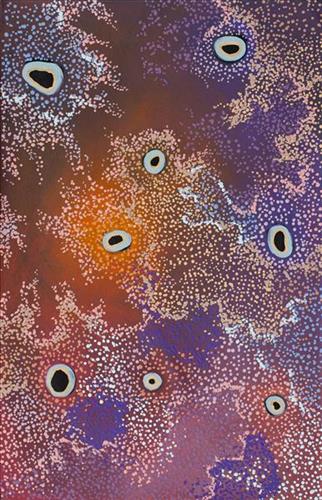
Kulyakartu
This painting depicts Kulyakartu, Derrick’s ancestral ngurra (home Country, camp). Kulyakartu is located in the far north of the Martu homelands, near the Percival Lakes region of Western Australia’s Great Sandy Desert.
Kulyakartu is mostly grass Country where there is very good hunting. In particular parnajarrpa (goanna), wild cats, and lunki (witchetty grub) are found in abundance here. There is no permanent water source in Kulyakartu, so the site was visited annually following the wantajarra (wet season).
111582006663
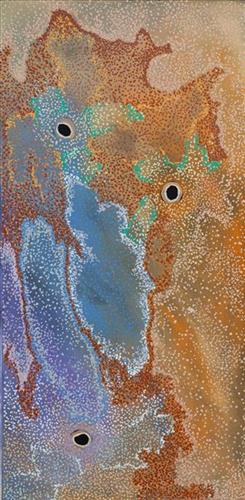
Kulyakartu
“Long time ago I been there. It is my grandmothers, grandfathers, fathers, mothers country, Kulyakartu. I am painting this particular place it keeps me connected, sense of belonging. Tell my grandmothers story through my art. Where she was born, I’m apart of that.
It makes me feel proud painting. Most important is telling the story behind the painting so people can understand where I am coming from. Kulyakartu is our ngurra (home, country, camp). I will continue telling the story through my art.”
– Derrick Butt
This painting depicts Kulyakartu, Derrick’s ancestral ngurra (home Country, camp). Kulyakartu is located in the far north of the Martu homelands, near the Percival Lakes region of Western Australia’s Great Sandy Desert.
Kulyakartu is mostly grass Country where there is very good hunting. In particular parnajarrpa (goanna), wild cats, and lunki (witchetty grub) are found in abundance here. There is no permanent water source in Kulyakartu, so the site was visited annually following the wantajarra (wet season).
111582006662
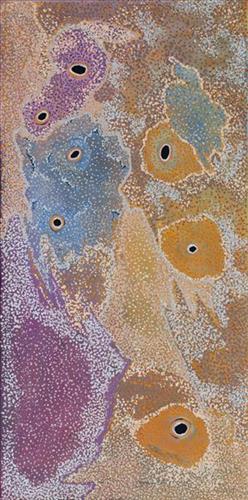
Kulyakartu
This painting depicts Kulyakartu, Derrick’s ancestral ngurra (home Country, camp). Kulyakartu is located in the far north of the Martu homelands, near the Percival Lakes region of Western Australia’s Great Sandy Desert.
Kulyakartu is mostly grass Country where there is very good hunting. In particular parnajarrpa (goanna), wild cats, and lunki (witchetty grub) are found in abundance here. There is no permanent water source in Kulyakartu, so the site was visited annually following the wantajarra (wet season).
111582006661
Kulyakartu
“Long time ago I been there. It is my grandmothers, grandfathers, fathers, mothers country, Kulyakartu. I am painting this particular place it keeps me connected, sense of belonging. Tell my grandmothers story through my art. Where she was born, I’m apart of that.
It makes me feel proud painting. Most important is telling the story behind the painting so people can understand where I am coming from. Kulyakartu is our ngurra (home, country, camp). I will continue telling the story through my art.”
– Derrick Butt
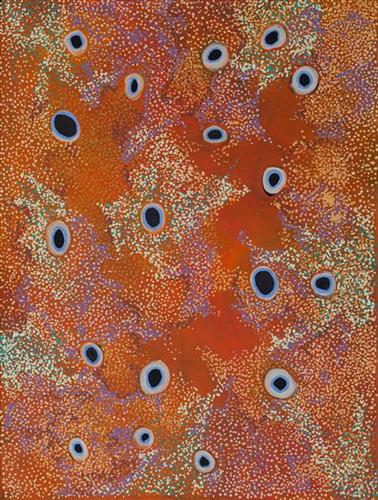
This painting depicts Kulyakartu, Derrick’s ancestral ngurra (home Country, camp). Kulyakartu is located in the far north of the Martu homelands, near the Percival Lakes region of Western Australia’s Great Sandy Desert.
Kulyakartu is mostly grass Country where there is very good hunting. In particular parnajarrpa (goanna), wild cats, and lunki (witchetty grub) are found in abundance here. There is no permanent water source in Kulyakartu, so the site was visited annually following the wantajarra (wet season).
111582006660
Kunawarritji, Kinyu, Kirtipirli, my country
“When I was a young girl, I walked everywhere, travelling along the Canning Stock Route. I walked north and west, around Wana warla (lake). I grew up around there, going right around that Country and all the way back to Kunawarritji. But once I became a woman I stopped travelling and just stayed around Kunawarritji.
[At] Kunawarritji, all the Minyipuru (Jakulyukulyu, Seven Sisters) mima (women) there. He been chase them, Yurla.”
– Kumpaya Girgirba (Girgaba)
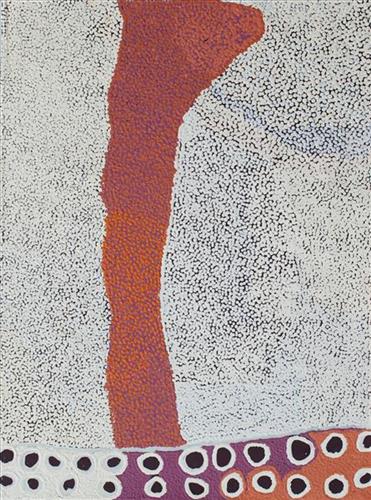
This is Kumpaya’s Country- her ‘ngurra’ (home Country, camp). People identify with their ngurra in terms of specific rights and responsibilities, and the possession of intimate knowledge of the physical and cultural properties of one’s Country. Painting ngurra, and in so doing sharing the Jukurrpa (Dreaming) stories and physical characteristics of that place, has today become an important means of cultural maintenance.
Kunawarritji is an important site in the Great Sandy Desert where multiple stories and histories intersect. Originally a spring water and major Martu pujiman (traditional, desert dwelling) camping site, at the turn of the 20th century Kunawarritji was converted into a well along the Canning Stock Route. Each year throughout the 1930-50s, the well became a site of contact between the drovers, their cattle, and desert families like Kumpaya’s. Kumpaya was born at Kiwirrkurra, 350 kilometres east of Kunawarritji. She grew up in the Country between these sites, and from an early age she and her family had encounters with drovers along the Canning Stock Route. In her paintings for this area, Kumpaya frequently depicts the waterholes between Kunawarritji and Punmu that she travelled between as a young woman.
Kirtipirli is a rockhole located south east of Kunawarritji Aboriginal community. Nearby water sources include Julyjarru and Nyakarilpa. This area forms part of Kumpaya’s ngurra (home Country, camp), the region which she knew intimately and travelled extensively with her family in her youth.
Kinyu (Canning Stock Route Well 35) is a small yinta (permanent spring) that was a popular camping site during the pujiman (traditional, desert dwelling) era. Kinyu forms part of Kumpaya’s ngurra (home Country, camp), the area which she knew intimately and travelled extensively with her family in her youth.
During the pujiman (traditional, desert dwelling) period, knowledge of water sources was critical for survival, and today Martu Country is still defined in terms of the location and type of water. Today, Kunawarritji is a site of return, a place where people came back to continue their life in the desert with the formation of Kunawarritji Aboriginal community in the early 1980s. The community’s cultural significance endures, with the population swelling up to 1000 during cultural business.
111582006659
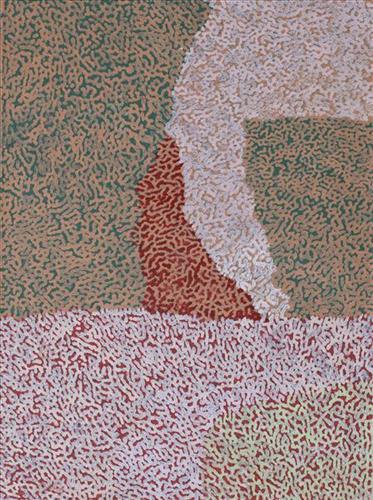
Kulyakartu
“My Country, Kulyakartu. I grew up there, from little boy to big boy grew up there.”
– Muuki Taylor
This painting depicts Kulyakartu, Muuki’s ngurra (home Country, camp). Kulyakartu is located in the far north of the Martu homelands, near the Percival Lakes region of Western Australia’s Great Sandy Desert. Muuki has extensive knowledge of the Country in this region, where he grew up living traditionally during the pujiman (traditional, desert dwelling) days with his family. Kulyakartu is mostly grass Country where there is very good hunting. In particular parnajarrpa (goanna), wild cats, and lunki (witchetty grub) are found in abundance here. There is no permanent water source in Kulyakartu, so Muuki’s family would walk here annually following the wantajarra (wet season). During the yalijarra (hot, dry season) they would head south again to more permanent water.
Muuki paints Kulyakartu in all its different seasonal stages. Often visible in his work is the patchwork nature of regrowth subsequent to the practice of waru (fire) burning that assists with hunting, regenerates growth, and encourages greater diversity in plant and animal life. This mosaic patterning is aligned with the five distinct Martu cyclical phases of burning and regrowth. First is nyurnma (freshly burnt Country) when Muuki is “making waru”. Following nyurnma are the rains and subsequent waru-waru, when young, bright green plants start to grow. Nyukura occurs between one and three years after burning, when plants have matured and are fruiting and seeding. Manguu is “when him finished”, four to six years post burning, and when spinifex has matured to the point that it can be burned once again. Finally, kunarka signifies the time when spinifex and other plant species have become old growth, and pose a risk of destructive bushfires.