111581952802


Untitled

“When Martu paint, it’s like a map. Martu draw story on the ground and on the canvas, and all the circle and line there are the hunting areas and different waters and tracks where people used to walk, and [some you] can’t cross, like boundaries. So nowadays you see a colourful painting and wonder what it is, but that’s how Martu tell story long ago. It’s not just a lovely painting, it’s a story and a songline and a history and everything that goes with it.” 

– Ngalangka Nola Taylor and Joshua Booth

This work portrays an area of Country that can be interpreted in multiple ways. Firstly, the image may be read as an aerial representation of a particular location known to the artist- either land that they or their family travelled, from the pujiman (traditional, desert dwelling) era to now. During the pujiman period, Martu would traverse very large distances annually in small family groups, moving seasonally from water source to water source, and hunting and gathering bush tucker as they went. At this time, one’s survival depended on their intimate knowledge of the location of resources; thus physical elements of Country, such as sources of kapi (water), tali (sandhills), different varieties of warta (trees, vegetation), ngarrini (camps), and jina (tracks) are typically recorded with the use of a use of a system of iconographic forms universally shared across the desert. 

An additional layer of meaning in the work relates to more intangible concepts; life cycles based around kalyu (rain, water) and waru (fire) are also often evident. A thousands of year old practice, fire burning continues to be carried out as both an aid for hunting and a means of land management today. As the Martu travelled and hunted they would burn tracts of land, ensuring plant and animal biodiversity and reducing the risk of unmanageable, spontaneous bush fires. The patchwork nature of regrowth is evident in many landscape works, with each of the five distinctive phases of fire burning visually described with respect to the cycle of burning and regrowth.  

Finally, metaphysical information relating to a location may also be recorded; Jukurrpa (Dreaming) narratives chronicle the creation of physical landmarks, and can be referenced through depictions of ceremonial sites, songlines, and markers left in the land. Very often, however, information relating to Jukurrpa is censored by omission, or alternatively painted over with dotted patterns.

111581952801


Puntawarri

“We drink water at Puntawarri. We clean and dig that waterhole. This Country is Puntawarri. My nanna, Dadda, taught me to paint this Country. Puntawarri is important because it is my pop’s, my nannas’ husband’s, place. They camped there and went hunting for goanna or anything, kangaroo or turkey. At Puntawarri there are all the waterholes. Good hunting this Country. There is still some Rabbit Proof Fence there.”

 – Judith Anya Samson

Puntawarri is an important cultural area located on the middle stretches of the Canning Stock Route and east of the Jigalong Mission (now Jigalong Aboriginal community), where Judith grew up and continues to live with her grandmother and renowned Martumili Artist, Dadda Samson. Puntawarri is also the site of an abandoned community, a waterhole, creek and lake. Puntawarri’s close proximity to Jigalong Mission made it a popular site for Martu to visit during the ‘mission days’.

While growing up at Jigalong Mission in the 1960’s, Dadda would return to Puntawarri every weekend to hunt and camp. Dadda has been teaching Judith to paint for a number of years, sharing the knowledge and Jukurrpa (Dreaming) stories associated with her ngurra (home Country, camp). 

For many Martu, like Dadda and her family, Jigalong Mission was the site where their pujiman (traditional, desert dwelling) lifestyle came to an end from the late 1940s as they transitioned to a life as stockmen and women working in cattle stations in the Pilbara region and beyond. In the wake of the extreme and prolonged drought of the 1960s, the last of the remaining pujimanpa (desert dwellers) were forced to move to missions like Jigalong, where a supply of food and water was assured. There, many Martu were reunited with family members that had already moved in from the desert.

The waterhole at Puntawarri is said to be populated by several kinds of ancestral jila (snake), however the site is best known for its association with the Ngayurnangalku, fearsome ancestral cannibal beings. During the Jukurrpa the Ngayurnangalku came together from all over the desert, first stopping near Puntawarri on their travels to Kumpupirntily (Kumpupintily, Lake Disappointment). At Kumpupirntily, they had a big meeting to debate whether or not they would continue to live as cannibals, and eventually came to the decision to stop eating people. That night, a female baby cannibal was born to the eastern Ngayurnangalku on the red sandhills at Puntawarri, where she continues to live today as the ‘big mummy’ Ngayurnangalku. Following protocol, the baby also had to be consulted by the group. She determined that the Ngayurnangalku should continue to eat people. Her decision divided the group, and from this point the group from the east continued to live as ‘bad’ cannibals at Kumpupirntily, while the group from the west became ‘good’, thereafter consuming only animals.

111581952800


Untitled

“When Martu paint, it’s like a map. Martu draw story on the ground and on the canvas, and all the circle and line there are the hunting areas and different waters and tracks where people used to walk, and [some you] can’t cross, like boundaries. So nowadays you see a colourful painting and wonder what it is, but that’s how Martu tell story long ago. It’s not just a lovely painting, it’s a story and a songline and a history and everything that goes with it.” 

– Ngalangka Nola Taylor and Joshua Booth

This work portrays an area of Country that can be interpreted in multiple ways. Firstly, the image may be read as an aerial representation of a particular location known to the artist- either land that they or their family travelled, from the pujiman (traditional, desert dwelling) era to now. During the pujiman period, Martu would traverse very large distances annually in small family groups, moving seasonally from water source to water source, and hunting and gathering bush tucker as they went. At this time, one’s survival depended on their intimate knowledge of the location of resources; thus physical elements of Country, such as sources of kapi (water), tali (sandhills), different varieties of warta (trees, vegetation), ngarrini (camps), and jina (tracks) are typically recorded with the use of a use of a system of iconographic forms universally shared across the desert. 

An additional layer of meaning in the work relates to more intangible concepts; life cycles based around kalyu (rain, water) and waru (fire) are also often evident. A thousands of year old practice, fire burning continues to be carried out as both an aid for hunting and a means of land management today. As the Martu travelled and hunted they would burn tracts of land, ensuring plant and animal biodiversity and reducing the risk of unmanageable, spontaneous bush fires. The patchwork nature of regrowth is evident in many landscape works, with each of the five distinctive phases of fire burning visually described with respect to the cycle of burning and regrowth.  

Finally, metaphysical information relating to a location may also be recorded; Jukurrpa (Dreaming) narratives chronicle the creation of physical landmarks, and can be referenced through depictions of ceremonial sites, songlines, and markers left in the land. Very often, however, information relating to Jukurrpa is censored by omission, or alternatively painted over with dotted patterns.

111581952798


Kumpupirntily (Kumpupintily, Lake Disappointment)

“Ngayurnangalku [were] fighting, coming in from everywhere. They all come in here [at Kumpupirntily], all meet up here. Ngayurnangalku travelled through this Country going to Kumpupirntily. They made that Country. That Country got everything- parngarra (goanna), karlaya (emu), dog, kangaroo, all there. And Ngayurnangalku… they’re there too. 

[Now the] Ngayurnangalku cannibal [live] in a lake, Kumpupirntily. They live in the lake, in the salt lake, that mob. They belong to there. They been born there, they living there, sleeping there. Big mob! That’s his [their] Country, Kumpupirntily. This one the Ngayurnangalku camp, they all there. They got their own city underground. Nobody ever know. Just like a store, you can lock him up. They got a big room, have a rest. Underground, not far. All the man, women, little kids, they all stopping there, and the mummy Ngayurnangalku, big mummy. All those little babies are his [hers]. There’s a hill there. They been walk all along here, they been get inside, that’s their hole over there. They all come and get in there. They got plenty jara (shield), yirrkili (boomerang), they property for the Ngayurnangalku, they maparn (holding power for sorcery). They hit you and kill you. He got to feed. Ngayurnangalku chuck away their jara and yirrkili when they go home. Pujurrpa (red ochre) there – that for Ngayurnangalku, make himself red, when he dance. 

They chuck them [boomerangs] in the afternoon. Before the wind. If it’s a wind blowing, no good, they all go in, in that rock (hill). Parla-parla (type of lizard) is Ngayurnangalku mate. He’s for Kumpupirntily that one. That’s for Ngayurnangalku. When you see that lizard come out, like this (making a smacking sound with its mouth) you gotta get away, you gotta go long way. Don’t come desert. Don’t stop, Ngayurnangalku be get up. Parla-parla make him get up this mob, you gotta go away, run away.”

Ngayurnangalku still there [in Kumpupirntily]. They’re still alive. They walking in the night, they got to feed. They all staying there- don’t go there! You’ll lose your life. We’ll be dead, he’ll be alive. No people gotta go come to this place. If they go there it’s one way! There’s a cannibal there. Don’t come to this place- you might get killed! They gonna eat you for lunch! Don’t go, keep away! I been block him, tell all the miners to keep away. Cannibal gonna come out of the lake, kill you, knock you on the head and have a feed. If they dig him up, anybody, blackfella, whitefella, they’ll get killed! They’ll have a good feed!”

My grandfather went to Lake Disappointment chasing the dingo and he heard an old woman making a noise like howling, but she was crying for that dingo that my grandfather was spearing and chasing. So that woman grabbed his arm and put her long sharp fingernail through his wrist and paralysed him. She put her fingernail right through his wrist. Then that cannibal took him to a group of other cannibals, ready to cook him up to eat. They took him and had him there and they were singing him first. My grandfather is a strong maparn (magic) man. Lucky for him. He got out of there, because of his strength as a maparn.” 

 – Yunkurra Billy Atkins

Yunkurra’s Country encompasses one of the most important and dangerous sites in the Western Desert; Kumpupirntily (Kumpupintily, Lake Disappointment), home to the Ngayurnangalku (cannibal beings). Kumpupirntily, the Ngayurnangalku, and their associated Jukurrpa (Dreaming) form the subject for the majority of Yunkurra’s copious body of work.

Kumpupirntily is a stark, flat and unforgiving expanse of blinding salt lake surrounded by sand hills, located in the Little Sandy and Gibson Desert of Western Australia; “that Country hasn’t got any trees, it’s just open and flat” (Yunkurra Billy Atkins). Kumpupirntily translates to ‘bladder burst’; the lake was formed when the bladder of the Jila Kujarra (Two Snakes) burst here. Jila Kujarra is one of the key Jukurrpa narratives for the Martu. Though the story belongs to Warnman people, it is shared across the Western Desert with several other language groups. The narrative centres on the travels of two snakes as they are pursued by the Niminjarra, spiritual ancestors of the Warnman people. 

Later in the Jukurrpa period the Ngayurnangalku (ancestral cannibal beings) made Kumpupirntily their home, where they continue to remain today. For this reason Kumpupirntily is considered one of the most sacred and dangerous sites of the Western Desert. The Ngayurnangalku are fearsome ancestral cannibal beings said to resemble people in their appearance, except for their fangs and long curved knife like fingernails they use to catch and hold their human victims. Coming from Natawalu (Canning Stock Route Well 40) in the north, Mundiwinti (Mundawindi) in the west, and from the Country around Kiwirrkurra in the east, the Ngayurnangalku travelled across the desert, stopping near Puntawarri, at Jilukurru (Killagurra Springs, Canning Stock Route Well 17) and at Kupayura (Savory Creek) before finally reaching Kumpupirntily.

At Kumpupirntily, the Ngayurnangalku had a meeting to debate whether or not they would continue to live as cannibals, and eventually came to the decision to stop eating people. That night, a female baby cannibal was born. Following protocol, the baby also had to be consulted by the group. She determined that the Ngayurnangalku should continue to eat people. Her decision divided the group, and from this point the group from the east continued to live as ‘bad’ cannibals at Kumpupirntily, while the group from the west became ‘good’, thereafter consuming only animals. The ‘good’ Ngayurnangalku are kept safe by Nganyangu men, ‘bodyguards’ who formed a sandhill in the middle of the lake. The Nganyangu also help to protect people from the cannibal Ngayurnangalku, providing a safe path of passage through Kumpupirntily. 

The cannibal Ngayurnangalku continue to live beneath the crust of Kumpupirntily lake in an underground world lit by their own sun. They surface only to feed on human flesh, coming in and out of the world we see through a small hill that acts as a gateway between worlds; Yapu Maparnpa (magical hill). Stored with the Ngayurnangalku in their underground world is an arsenal of maparnpa (holding power for sorcery) weapons. Along with these weapons are deposits of pujurrpa that the Ngayurnangalku use to paint themselves with when they dance.

Several phenomena at Kumpupirntily act as a warning of the imminent appearance of the Ngayurnangalku; still skies, wilany (boomerang-shaped clouds), and the emergence of the parla-parla (type of lizard), smacking their mouths. The vigilance of the Martu as they travel in the Country around Kumpupirntily is so great that several other precautions are followed; fires are not lit, planes and helicopters are not flown directly over the area, and digging in the lake is strongly discouraged. All of these activities are believed to disturb the Ngayurnangalku, causing them to rise from their underground world. 

111581952793


Kumpupirntily (Kumpupintily, Lake Disappointment)

“Ngayurnangalku [were] fighting, coming in from everywhere. They all come in here [at Kumpupirntily], all meet up here. Ngayurnangalku travelled through this Country going to Kumpupirntily. They made that Country. That Country got everything- parngarra (goanna), karlaya (emu), dog, kangaroo, all there. And Ngayurnangalku… they’re there too. 

[Now the] Ngayurnangalku cannibal [live] in a lake, Kumpupirntily. They live in the lake, in the salt lake, that mob. They belong to there. They been born there, they living there, sleeping there. Big mob! That’s his [their] Country, Kumpupirntily. This one the Ngayurnangalku camp, they all there. They got their own city underground. Nobody ever know. Just like a store, you can lock him up. They got a big room, have a rest. Underground, not far. All the man, women, little kids, they all stopping there, and the mummy Ngayurnangalku, big mummy. All those little babies are his [hers]. There’s a hill there. They been walk all along here, they been get inside, that’s their hole over there. They all come and get in there. They got plenty jara (shield), yirrkili (boomerang), they property for the Ngayurnangalku, they maparn (holding power for sorcery). They hit you and kill you. He got to feed. Ngayurnangalku chuck away their jara and yirrkili when they go home. Pujurrpa (red ochre) there – that for Ngayurnangalku, make himself red, when he dance. 

They chuck them [boomerangs] in the afternoon. Before the wind. If it’s a wind blowing, no good, they all go in, in that rock (hill). Parla-parla (type of lizard) is Ngayurnangalku mate. He’s for Kumpupirntily that one. That’s for Ngayurnangalku. When you see that lizard come out, like this (making a smacking sound with its mouth) you gotta get away, you gotta go long way. Don’t come desert. Don’t stop, Ngayurnangalku be get up. Parla-parla make him get up this mob, you gotta go away, run away.”

Ngayurnangalku still there [in Kumpupirntily]. They’re still alive. They walking in the night, they got to feed. They all staying there- don’t go there! You’ll lose your life. We’ll be dead, he’ll be alive. No people gotta go come to this place. If they go there it’s one way! There’s a cannibal there. Don’t come to this place- you might get killed! They gonna eat you for lunch! Don’t go, keep away! I been block him, tell all the miners to keep away. Cannibal gonna come out of the lake, kill you, knock you on the head and have a feed. If they dig him up, anybody, blackfella, whitefella, they’ll get killed! They’ll have a good feed!”

My grandfather went to Lake Disappointment chasing the dingo and he heard an old woman making a noise like howling, but she was crying for that dingo that my grandfather was spearing and chasing. So that woman grabbed his arm and put her long sharp fingernail through his wrist and paralysed him. She put her fingernail right through his wrist. Then that cannibal took him to a group of other cannibals, ready to cook him up to eat. They took him and had him there and they were singing him first. My grandfather is a strong maparn (magic) man. Lucky for him. He got out of there, because of his strength as a maparn.” 

 – Yunkurra Billy Atkins

Yunkurra’s Country encompasses one of the most important and dangerous sites in the Western Desert; Kumpupirntily (Kumpupintily, Lake Disappointment), home to the Ngayurnangalku (cannibal beings). Kumpupirntily, the Ngayurnangalku, and their associated Jukurrpa (Dreaming) form the subject for the majority of Yunkurra’s copious body of work.

Kumpupirntily is a stark, flat and unforgiving expanse of blinding salt lake surrounded by sand hills, located in the Little Sandy and Gibson Desert of Western Australia; “that Country hasn’t got any trees, it’s just open and flat” (Yunkurra Billy Atkins). Kumpupirntily translates to ‘bladder burst’; the lake was formed when the bladder of the Jila Kujarra (Two Snakes) burst here. Jila Kujarra is one of the key Jukurrpa narratives for the Martu. Though the story belongs to Warnman people, it is shared across the Western Desert with several other language groups. The narrative centres on the travels of two snakes as they are pursued by the Niminjarra, spiritual ancestors of the Warnman people. 

Later in the Jukurrpa period the Ngayurnangalku (ancestral cannibal beings) made Kumpupirntily their home, where they continue to remain today. For this reason Kumpupirntily is considered one of the most sacred and dangerous sites of the Western Desert. The Ngayurnangalku are fearsome ancestral cannibal beings said to resemble people in their appearance, except for their fangs and long curved knife like fingernails they use to catch and hold their human victims. Coming from Natawalu (Canning Stock Route Well 40) in the north, Mundiwinti (Mundawindi) in the west, and from the Country around Kiwirrkurra in the east, the Ngayurnangalku travelled across the desert, stopping near Puntawarri, at Jilukurru (Killagurra Springs, Canning Stock Route Well 17) and at Kupayura (Savory Creek) before finally reaching Kumpupirntily.

At Kumpupirntily, the Ngayurnangalku had a meeting to debate whether or not they would continue to live as cannibals, and eventually came to the decision to stop eating people. That night, a female baby cannibal was born. Following protocol, the baby also had to be consulted by the group. She determined that the Ngayurnangalku should continue to eat people. Her decision divided the group, and from this point the group from the east continued to live as ‘bad’ cannibals at Kumpupirntily, while the group from the west became ‘good’, thereafter consuming only animals. The ‘good’ Ngayurnangalku are kept safe by Nganyangu men, ‘bodyguards’ who formed a sandhill in the middle of the lake. The Nganyangu also help to protect people from the cannibal Ngayurnangalku, providing a safe path of passage through Kumpupirntily. 

The cannibal Ngayurnangalku continue to live beneath the crust of Kumpupirntily lake in an underground world lit by their own sun. They surface only to feed on human flesh, coming in and out of the world we see through a small hill that acts as a gateway between worlds; Yapu Maparnpa (magical hill). Stored with the Ngayurnangalku in their underground world is an arsenal of maparnpa (holding power for sorcery) weapons. Along with these weapons are deposits of pujurrpa that the Ngayurnangalku use to paint themselves with when they dance.

Several phenomena at Kumpupirntily act as a warning of the imminent appearance of the Ngayurnangalku; still skies, wilany (boomerang-shaped clouds), and the emergence of the parla-parla (type of lizard), smacking their mouths. The vigilance of the Martu as they travel in the Country around Kumpupirntily is so great that several other precautions are followed; fires are not lit, planes and helicopters are not flown directly over the area, and digging in the lake is strongly discouraged. All of these activities are believed to disturb the Ngayurnangalku, causing them to rise from their underground world. 

111581952791


Untitled

“When Martu paint, it’s like a map. Martu draw story on the ground and on the canvas, and all the circle and line there are the hunting areas and different waters and tracks where people used to walk, and [some you] can’t cross, like boundaries. So nowadays you see a colourful painting and wonder what it is, but that’s how Martu tell story long ago. It’s not just a lovely painting, it’s a story and a songline and a history and everything that goes with it.” 

– Ngalangka Nola Taylor and Joshua Booth

This work portrays an area of Country that can be interpreted in multiple ways. Firstly, the image may be read as an aerial representation of a particular location known to the artist- either land that they or their family travelled, from the pujiman (traditional, desert dwelling) era to now. During the pujiman period, Martu would traverse very large distances annually in small family groups, moving seasonally from water source to water source, and hunting and gathering bush tucker as they went. At this time, one’s survival depended on their intimate knowledge of the location of resources; thus physical elements of Country, such as sources of kapi (water), tali (sandhills), different varieties of warta (trees, vegetation), ngarrini (camps), and jina (tracks) are typically recorded with the use of a use of a system of iconographic forms universally shared across the desert. 

An additional layer of meaning in the work relates to more intangible concepts; life cycles based around kalyu (rain, water) and waru (fire) are also often evident. A thousands of year old practice, fire burning continues to be carried out as both an aid for hunting and a means of land management today. As the Martu travelled and hunted they would burn tracts of land, ensuring plant and animal biodiversity and reducing the risk of unmanageable, spontaneous bush fires. The patchwork nature of regrowth is evident in many landscape works, with each of the five distinctive phases of fire burning visually described with respect to the cycle of burning and regrowth.  

Finally, metaphysical information relating to a location may also be recorded; Jukurrpa (Dreaming) narratives chronicle the creation of physical landmarks, and can be referenced through depictions of ceremonial sites, songlines, and markers left in the land. Very often, however, information relating to Jukurrpa is censored by omission, or alternatively painted over with dotted patterns.

111581952788


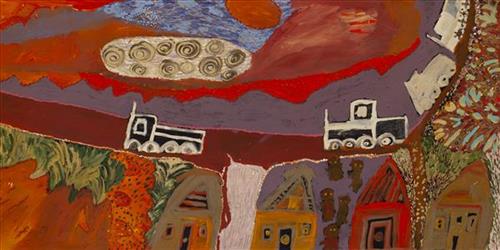
Puntawarri

“This one Puntawarri. Near Jigalong. Puntawarri. We paint because we go out working there long time. Just working. We’re going out working with the boys, you know? With the boys. KJ [Karninyanpa Jukurrpa Rangers]. We go out. The ladies go out, we camp there. Look for, ah…look for cats’ tracks everywhere, that’s what we do. Looking for cats. We just write it down. Everywhere. Kangaroos, and camels, you know, when we go out? That’s all.  


I was working at Puntawarri there, in the house. I got a house there, a big one. We stayed in there a long time. The husbands, my brothers, my sisters. But it’s finished now. The whitefellas. They took everything out, yeah? In Puntawarri. They been stealing, you know? Long time. But it’s finished now. We didn’t stay there. We just go out with the boys and the ladies, yeah. Just work around and camp there sometimes we go there, camping. That’s all. 


This is the houses here, yeah? They’re all gone now, the toilets and everything. This long time ago. Yeah long time. It finished now. And that’s the lake, and the flowers. The lake’s full. You walk around everywhere. Take the dogs. Go hunting, but that was long time [ago]. Long time. And the trucks are all coming to work. And all the people, they’re waiting for the truck to jump in! [laughs]. Yuwa.”  

– Helen Dale Samson

Puntawarri is an important cultural area located on the middle stretches of the Canning Stock Route and east of the Jigalong Aboriginal Community. It is also the site of a now abandoned community, and a rockhole, waterhole, creek and lake. Puntawarri’s close proximity to Jigalong Mission (now Jigalong Aboriginal community) made it a popular site for Martu to visit and camp at over weekends during the ‘mission days’. 

For many Martu, Jigalong Mission was the site where their pujiman (traditional, desert dwelling) lifestyle came to an end from the late 1940s as they transitioned to a life as stockmen and women working in cattle stations in the Pilbara region and beyond. In the wake of the extreme and prolonged drought of the 1960s, the last of the remaining pujimanpa (desert dwellers) were forced to move to missions like Jigalong, where a supply of food and water was assured. There, many Martu were reunited with family members that had already moved in from the desert.

The waterhole at Puntawarri is said to be populated by several kinds of ancestral jila (snake), however the site is best known for its association with the Ngayurnangalku, fearsome ancestral cannibal beings. During the Jukurrpa (Dreaming) the Ngayurnangalku came together from all over the desert, first stopping near Puntawarri on their travels to Kumpupirntily (Kumpupintily, Lake Disappointment). At Kumpupirntily, they had a big meeting to debate whether or not they would continue to live as cannibals, and eventually came to the decision to stop eating people. That night, a female baby cannibal was born to the eastern Ngayurnangalku on the red sandhills at Puntawarri, where she continues to live today as the ‘big mummy’ Ngayurnangalku. Following protocol, the baby also had to be consulted by the group. She determined that the Ngayurnangalku should continue to eat people. Her decision divided the group, and from this point the group from the east continued to live as ‘bad’ cannibals at Kumpupirntily, while the group from the west became ‘good’, thereafter consuming only animals.

111581952602


Parnngurr Rockhole

“We were climbing Parnngurr hill; we were frightened. Kartiya (Europeans) would walk around, trying to catch Martu people. We would run up the hill and hide. We watched them catch people. We were eating flour that white people gave us. It was horrible. From [Parnngurr rockhole], we got in the truck and went with the white people to Jigalong. Kumpaya [Girgirba], Jakayu [Biljabu] and Ngamaru [Bidu], we were all on top of the hill looking at the white people.”

 – Bugai Whyoulter

Parnngurr rockhole is located just south of Parnngurr Aboriginal community. This site lies within Bugai’s ngurra (home Country, camp), the area which she knew intimately and travelled extensively with her family in her youth. For many Martu, including Bugai, Parnngurr also signifies the location at which their nomadic bush life came to an end. Poignantly described here by Bugai, it was here that a group of 29 Martu were picked up by the Native Welfare Department to be taken to Jigalong Mission in 1963. Collectively the group had come to the decision to move to the mission as a result of an extended drought, which had caused a scarcity in food and water resources. The group also wanted to join their families, who had already moved to Jigalong.

At the junction of three linguistic groups; Manyjilyjarra, Kartujarra, and Warnman, Parnngurr rockhole was a critical and permanent source of water during the pujiman (traditional, desert born) era that supported many ritual large gatherings. During this nomadic period families stopped and camped here depending on the seasonal availability of water and the corresponding cycles of plant and animal life on which hunting and gathering bush tucker was reliant. At Parnngurr and other similarly important camp sites families would meet for a time before moving to their next destination. Parnngurr and its surrounds are physically dominated by distinctively red tali (sandhills), covered sparingly with spinifex and low lying shrub.

Parnngurr is also an important site chronicled in the epic Jukurrpa (Dreaming) story of the Jakulyukulyu, or Minyipuru (Seven Sisters). The sisters stopped to rest on Parnngurr Hill before continuing on their long journey east. Minyipuru is a central Jukurrpa narrative for Martu, Ngaanyatjarra, Pitjantjatjara and Yankunytjatjara people that is associated with the seasonal Pleiades star constellation. Relayed in song, dance, stories and paintings, Minyipuru serves as a creation narrative, a source of information relating to the physical properties of the land, and an embodiment of Aboriginal cultural laws. Beginning in Roebourne on the west coast of Western Australia, the story morphs in its movement eastward across the land, following the women as they walk, dance, and even fly from waterhole to waterhole. As they travel the women camp, sing, wash, dance and gather food, leaving markers in the landscape and creating landforms that remain to this day, such as groupings of rocks and trees, grinding stones and seeds. During the entirety of their journey the women are pursued by a lustful old man, Yurla, although interactions with other animals, groups of men, and spirit beings are also chronicled in the narrative.

111581952601


Parnngurr Rockhole

“We were climbing Parnngurr hill; we were frightened. Kartiya (Europeans) would walk around, trying to catch Martu people. We would run up the hill and hide. We watched them catch people. We were eating flour that white people gave us. It was horrible. From [Parnngurr rockhole], we got in the truck and went with the white people to Jigalong. Kumpaya [Girgirba], Jakayu [Biljabu] and Ngamaru [Bidu], we were all on top of the hill looking at the white people.”

 – Bugai Whyoulter

Parnngurr rockhole is located just south of Parnngurr Aboriginal community. This site lies within Bugai’s ngurra (home Country, camp), the area which she knew intimately and travelled extensively with her family in her youth. For many Martu, including Bugai, Parnngurr also signifies the location at which their nomadic bush life came to an end. Poignantly described here by Bugai, it was here that a group of 29 Martu were picked up by the Native Welfare Department to be taken to Jigalong Mission in 1963. Collectively the group had come to the decision to move to the mission as a result of an extended drought, which had caused a scarcity in food and water resources. The group also wanted to join their families, who had already moved to Jigalong.

At the junction of three linguistic groups; Manyjilyjarra, Kartujarra, and Warnman, Parnngurr rockhole was a critical and permanent source of water during the pujiman (traditional, desert born) era that supported many ritual large gatherings. During this nomadic period families stopped and camped here depending on the seasonal availability of water and the corresponding cycles of plant and animal life on which hunting and gathering bush tucker was reliant. At Parnngurr and other similarly important camp sites families would meet for a time before moving to their next destination. Parnngurr and its surrounds are physically dominated by distinctively red tali (sandhills), covered sparingly with spinifex and low lying shrub.

Parnngurr is also an important site chronicled in the epic Jukurrpa (Dreaming) story of the Jakulyukulyu, or Minyipuru (Seven Sisters). The sisters stopped to rest on Parnngurr Hill before continuing on their long journey east. Minyipuru is a central Jukurrpa narrative for Martu, Ngaanyatjarra, Pitjantjatjara and Yankunytjatjara people that is associated with the seasonal Pleiades star constellation. Relayed in song, dance, stories and paintings, Minyipuru serves as a creation narrative, a source of information relating to the physical properties of the land, and an embodiment of Aboriginal cultural laws. Beginning in Roebourne on the west coast of Western Australia, the story morphs in its movement eastward across the land, following the women as they walk, dance, and even fly from waterhole to waterhole. As they travel the women camp, sing, wash, dance and gather food, leaving markers in the landscape and creating landforms that remain to this day, such as groupings of rocks and trees, grinding stones and seeds. During the entirety of their journey the women are pursued by a lustful old man, Yurla, although interactions with other animals, groups of men, and spirit beings are also chronicled in the narrative.

111581952828


Untitled

This work portrays an area known intimately to the artist, painted here in exquisite detail from memory. During the pujiman (traditional, desert dwelling) era one’s survival depended on their intimate knowledge of the location of resources; thus physical elements of Country, such as sources of kapi (water), tali (sandhills), and different varieties of warta (trees, vegetation) were carefully observed and remembered. Today, this relationship with Country remains equally strong, despite the movement of Martu out of the desert and into remote Aboriginal Communities, towns and cities.

Also visible may be traces of life cycles based around kalyu (rain, water) and waru (fire). A thousands of year old practice, fire burning continues to be carried out as both an aid for hunting and a means of land management today. As the Martu travelled and hunted they would burn tracts of land, ensuring plant and animal biodiversity and reducing the risk of unmanageable, spontaneous bush fires. The patchwork nature of regrowth is visible in many landscape works, with each of the five distinctive phases of fire burning visually described with respect to the cycle of burning and regrowth.  

Finally, metaphysical information relating to a location may also be recorded; Jukurrpa (Dreaming) narratives chronicle the creation of physical landmarks, and can be referenced through depictions of ceremonial sites, songlines, and markers left in the land.