111581994779


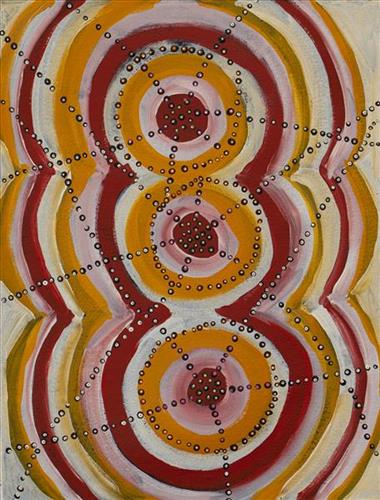
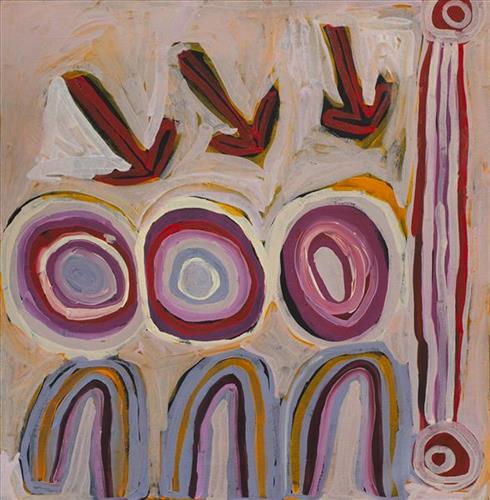
Puntawarri

“We drink water at Puntawarri. We clean and dig that waterhole. This Country is Puntawarri. My nanna, Dadda, taught me to paint this Country. Puntawarri is important because it is my pop’s, my nannas’ husband’s, place. They camped there and went hunting for goanna or anything, kangaroo or turkey. At Puntawarri there are all the waterholes. Good hunting this Country. There is still some Rabbit Proof Fence there.”

 – Judith Anya Samson

Puntawarri is an important cultural area located on the middle stretches of the Canning Stock Route and east of the Jigalong Mission (now Jigalong Aboriginal community), where Judith grew up and continues to live with her grandmother and renowned Martumili Artist, Dadda Samson. Puntawarri is also the site of an abandoned community, a waterhole, creek and lake. Puntawarri’s close proximity to Jigalong Mission made it a popular site for Martu to visit during the ‘mission days’.

While growing up at Jigalong Mission in the 1960’s, Dadda would return to Puntawarri every weekend to hunt and camp. Dadda has been teaching Judith to paint for a number of years, sharing the knowledge and Jukurrpa (Dreaming) stories associated with her ngurra (home Country, camp). 

For many Martu, like Dadda and her family, Jigalong Mission was the site where their pujiman (traditional, desert dwelling) lifestyle came to an end from the late 1940s as they transitioned to a life as stockmen and women working in cattle stations in the Pilbara region and beyond. In the wake of the extreme and prolonged drought of the 1960s, the last of the remaining pujimanpa (desert dwellers) were forced to move to missions like Jigalong, where a supply of food and water was assured. There, many Martu were reunited with family members that had already moved in from the desert.

The waterhole at Puntawarri is said to be populated by several kinds of ancestral jila (snake), however the site is best known for its association with the Ngayurnangalku, fearsome ancestral cannibal beings. During the Jukurrpa the Ngayurnangalku came together from all over the desert, first stopping near Puntawarri on their travels to Kumpupirntily (Kumpupintily, Lake Disappointment). At Kumpupirntily, they had a big meeting to debate whether or not they would continue to live as cannibals, and eventually came to the decision to stop eating people. That night, a female baby cannibal was born to the eastern Ngayurnangalku on the red sandhills at Puntawarri, where she continues to live today as the ‘big mummy’ Ngayurnangalku. Following protocol, the baby also had to be consulted by the group. She determined that the Ngayurnangalku should continue to eat people. Her decision divided the group, and from this point the group from the east continued to live as ‘bad’ cannibals at Kumpupirntily, while the group from the west became ‘good’, thereafter consuming only animals.
111581994778


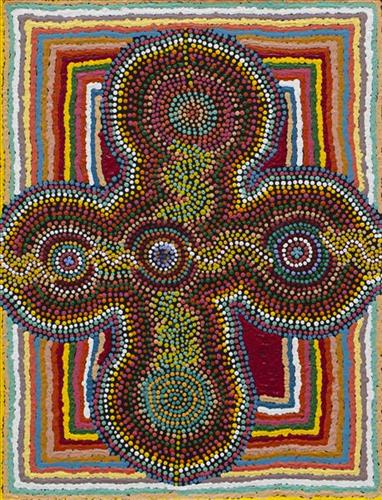
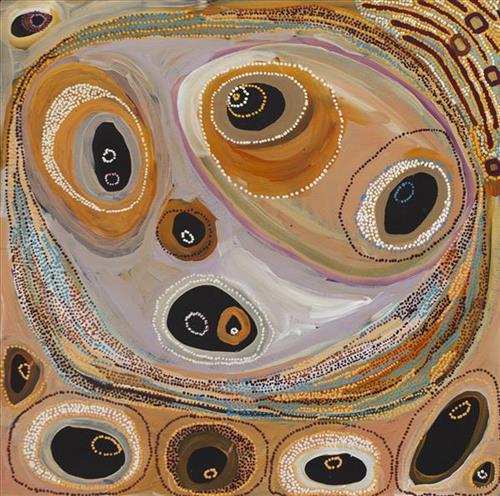
Kaalpa (Kalypa, Canning Stock route 23)

“Kaalpa (Kalypa, Canning Stock Route Well 23) is my grandfather’s Country. There’s a waterhole there, Kaalpa waterhole. It’s my two pops’ Country. They been walking around, hunting around Kaalpa. You can see a yapu (rock), warla (lake), claypans, karru (creek) and tuwa (sandhills) there. It’s on the [Canning] Stock Route, it’s Well 23.  

In pujiman (traditional, desert dwelling) days, pujimanpa (desert born people) walking around all this Country. My pops told me about that place, a big flat area, parlkarra (flat country) good for hunting parnajarrpa (goanna), lunki (witchetty grub), lungkurta (blue tongue lizard), wamurla (bush tomato), jinyjiwirrilyi (wild gooseberry). Kaalpa is a busy place for emus getting a drink. 

I went [to Kaalpa] for the first time [in 2018] on a Martumili KJ (Kanyirninpa Jukurrpa) trip. I went hunting there, got a parnajarrpa. When I went there, I was pukurlpa (happy). It made you open up your spirit, it feels like home.”

 – Corban Clause Williams

Kaalpa is a permanent water source located northeast of Kumpupirntily (Kumpupintily, Lake Disappointment). This site is a place of great cultural significance, and is also known for good hunting. Adjacent to the waterhole is a hill of the same name. The landscape around Kaalpa is parlkarra, bordered by tali (sandhills) stretching as far as Windy Corner, northeast and towards the border of Western Australia and the Northern Territory. The large and dangerous Jukurrpa (Dreamtime) mosquito and fly beings partially created the landforms in this area and continue to live underground here.

Kaalpa also features in the Minyipuru (Jakulyukulyu, Seven Sisters) Jukurrpa, a central creation narrative for Martu, Ngaanyatjarra, Pitjantjatjara and Yankunytjatjara people that is associated with the seasonal Pleiades star constellation. At Kaalpa the Minyipuru met a group of men; it was the first time either group had seen members of the opposite sex. The men tried to grab the women, but the Minyipuru chased them, hitting them with their digging sticks leaving them lying there as they continued travelling east.

Minyipuru is Relayed in song, dance, stories and paintings, Minyipuru serves as a creation narrative, a source of information relating to the physical properties of the land, and an embodiment of Aboriginal cultural laws. Beginning in Roebourne on the west coast of Western Australia, the story morphs in its movement eastward across the land, following the women as they walk, dance, and even fly from waterhole to waterhole. As they travel the women camp, sing, wash, dance and gather food, leaving markers in the landscape and creating landforms that remain to this day, such as groupings of rocks and trees, grinding stones and seeds. During the entirety of their journey the women are pursued by a lustful old man, Yurla, although interactions with other animals, groups of men, and spirit beings are also chronicled in the narrative.

The intersection of the Canning Stock Route with Kaalpa also made this a site of early contact with Europeans for many Martu then living a pujiman life in the desert. Following the route’s construction, Martu encountered Europeans and other Martu working as cattle drovers as they would travel up and down the Stock Route from water source to water source. Increasingly, pujimanpa followed the route to newly established ration depots, mission and pastoral stations. They were drawn to the route in search of food, by a sense of curiosity, or by loneliness. By the late 1950s and early 1960s, most of the desert family groups had left the desert. Eventually, these factors combined with an extreme and prolonged drought in the 1960s to prompt the few remaining pujimanpa to move in from the desert.

111581994777


Wantili (Warntili, Canning Stock Route Well 25)

 “Wantili is my place, where I was born. It’s a place where everyone was living- its all of their ngurra (home).It’s the Jukurrpa (Dreaming) of that place. All those claypans, a place where everyone comes together for ceremony and gatherings, all meeting with different families. I went there with my aunt [Jakayu Biljabu]  and my sister [Kumpaya Girgirba]- they told me the story of where I was born, in pujiman (traditional, desert dwelling) times. We walked all over the place, I was just a little one.”

-Glady Bidu Kuru

Wantili (Warntili, Canning Stock Route Well 25) is a large round jurnu (soak) and linyji (claypan) near Well 25 on the Canning Stock Route. The area is dominated by claypans surrounded by tuwa (sandhills), and Nyilangkurr, a prominent yapu (hill) is located on the edge of the claypan. Following rain the typically dry claypans are filled with water, with the overflow from nearby waterholes flowing to Wantili. At that time, Wantili becomes an important place for obtaining fresh water for drinking and bathing. Wantili is significant for the fact that at this site Kartujarra, Manyjilyjarra, Putijarra and Warnman people would all come together for ceremonies during the pujiman (traditional, desert dwelling) era. Many jiwa (stones used by women for grinding seeds) from these times can still be found there today. 

Wantili is an incredibly important cultural site, ‘where the creation started.’ (Cyril Whyoulter). In this creation story, the world was initially dark, and people were like rocks, with no arms or legs. Following the sun’s first rising, life-forms become increasingly complex while particular features in the land were created. Beyond these details much of the Jukurrpa (Dreaming) narrative relating to Wantili is ngurlu (sacred, taboo), and only for Martu, but the site is open, and anyone can go there. 

Wantili is also one of the many sites featured in the epic Minyipuru (Jakulyukulyu, Seven Sisters) Jukurrpa story. Minyipuru is a central Jukurrpa narrative for Martu, Ngaanyatjarra, Pitjantjatjara and Yankunytjatjara people that is associated with the seasonal Pleiades star constellation. Relayed in song, dance, stories and paintings, Minyipuru serves as a creation narrative, a source of information relating to the physical properties of the land, and an embodiment of Aboriginal cultural laws. The story follows the movement of a group of women travelling all the way across the desert, beginning at Roebourne on the coast of Western Australia, as they are pursued by Yurla, a lustful old man. As the women travelled, they stopped to rest at many sites to eat, dance, rest and sing, on the way leaving behind an assortment of articles that became formations in the land, such as groupings of rocks and trees, grinding stones and seeds. The sisters rested at Wantili before throwing seeds, then continued their journey far to the east and beyond Martu Country, stopping at various sites through central and South Australia.

The intersection of the Canning Stock Route with Wantili also made this a site of early contact with Europeans for many Martu then living a pujiman life in the desert. Following the route’s construction, Martu encountered Europeans and other Martu working as cattle drovers as they would travel up and down the Stock Route from water source to water source. Increasingly, pujimanpa (desert dwellers) followed the route to newly established ration depots, mission and pastoral stations. They were drawn to the route in search of food, by a sense of curiosity, or by loneliness. By the late 1950s and early 1960s, most of the desert family groups had left the desert. Eventually, these factors combined with an extreme and prolonged drought in the 1960s to prompt the few remaining pujimanpa to move in from the desert.

111581994776


Untitled

“I was learning about painting from school and from watching Bamba’s [Corban Clause Williams] mob painting. Bamba is my little brother. I like a painting about Country, painting my grandfather’s Country- Kaalpa (Kalypa, Canning Stock Route Well 23). 

I also like to go hunting with my family.”

– Robina Clause

Robina is part of the youngest generation of Martumili Artists. She, like her contemporaries, began to paint with her parents, grandparents and extended family, thus fostering an organic process of learning, not only about painting techniques, but also specific locations, family histories, traditional ways of life, and Jukurrpa (Dreaming). In this way, cultural knowledge continues to be transferred through visual arts, keeping Martu culture strong.

Robina’s subject matter is strongly informed by her traditional ngurra (home Country, camp) through her grandfather- Kaalpa (Kalypa, Canning Stock Route Well 23). A permanent water source located northeast of Kumpupirntily (Kumpupintily, Lake Disappointment), the site is of great cultural significance, and is also known for good hunting. Adjacent to the waterhole is a hill of the same name. The landscape around Kaalpa is parlkarra (flat country) bordered by tali (sandhills), stretching as far as Windy Corner, northeast and towards the border of Western Australia and the Northern Territory. The large and dangerous Jukurrpa (Dreamtime) mosquito and fly beings partially created the landforms in this area and continue to live underground here. Kaalpa also features in the Minyipuru (Jakulyukulyu, Seven Sisters) Jukurrpa, a central creation narrative for Martu, Ngaanyatjarra, Pitjantjatjara and Yankunytjatjara people that is associated with the seasonal Pleiades star constellation.   

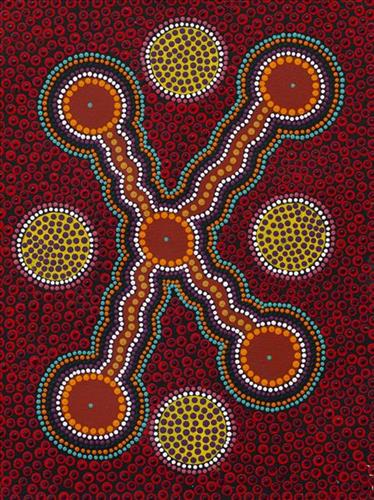
Stylistically Robina’s work melds traditional and contemporary elements, demonstrating the development of her own aesthetic while continuing to reflect the powerful influence of her elders. Dotted paint applied in modern palettes depict walka (designs), iconographic forms universally shared across the Western Desert. For many thousands of years these designs have represented men and women, kapi (water sources), tali (sandhills), different varieties of warta (trees, vegetation), ngarrini (camps), jina (tracks), jila (snakes), and Jukurrpa (Dreaming) ancestral beings.

111581994774


Kunawarritji walking around at sunset

Montana is part of the youngest generation of Martumili Artists. She, like her contemporaries, began to paint with her parents, grandparents and extended family, thus fostering an organic process of learning, not only about painting techniques, but also specific locations, family histories, traditional ways of life, and Jukurrpa (Dreaming). In this way, cultural knowledge continues to be transferred through visual arts, keeping Martu culture strong.

Montana’s subject matter is strongly informed by her traditional ngurra (home Country, camp) through her grandfather- Kaalpa (Kalypa, Canning Stock Route Well 23). A permanent water source located northeast of Kumpupirntily (Kumpupintily, Lake Disappointment), the site is of great cultural significance, and is also known for good hunting. Adjacent to the waterhole is a hill of the same name. The landscape around Kaalpa is parlkarra (flat country) bordered by tali (sandhills), stretching as far as Windy Corner, northeast and towards the border of Western Australia and the Northern Territory. The large and dangerous Jukurrpa (Dreamtime) mosquito and fly beings partially created the landforms in this area and continue to live underground here. Kaalpa also features in the Minyipuru (Jakulyukulyu, Seven Sisters) Jukurrpa, a central creation narrative for Martu, Ngaanyatjarra, Pitjantjatjara and Yankunytjatjara people that is associated with the seasonal Pleiades star constellation.   

Stylistically Montana’s paintings meld traditional and contemporary elements, demonstrating the development of her own aesthetic while continuing to reflect the powerful influence of her elders. Dotted paint applied in modern palettes depict walka (designs), iconographic forms universally shared across the Western Desert. For many thousands of years these designs have represented men and women, kapi (water sources), tali (sandhills), different varieties of warta (trees, vegetation), ngarrini (camps), jina (tracks), jila (snakes), and Jukurrpa (Dreaming) ancestral beings.

Montana has adopted an experimental approach to art making, and is always enthusiastic to explore other mediums, including jewellery making, screen printing and digital photography.

111581994773


Untitled

“Christine paints the Country of her family, kakarra (east) way from Punmu [Aboriginal community]. There’s a big warla (lake) over three tuwa (sandhills).”

We’ve been in Punmu a long time. We moved from Camp 61, [an outstation on Bilanooka Station] where we were schooling the kids there. We moved to Punmu, and we stayed there. Big mob of us came back in a truck, in an old tractor with the trailer. That old truck still there at the turnoff. We came in that one now.”

– Debra Thomas, Christine Thomas’ mother


As a mute artist, painting is an important means of communication for Christine. She is part of the youngest generation of Martumili Artists, and like her contemporaries, Christine began to paint with her parents, grandparents and extended family. Today she most often paints alongside her partner and fellow Martumili Artist, Jason Tinker. This organic process of learning, not only about painting techniques, but also specific locations, family histories, traditional ways of life, and Jukurrpa (Dreaming) is an important way in which Martu culture is transferred intergenerationally and thus kept strong.

Christine’s subject matter is strongly informed by her traditional ngurra (home Country, camp), encompassing the area between Punmu and Kunawarritji through her father and around the Karlamilyi (Rudall River) region through her mother.   

Stylistically Christine’s paintings meld traditional and contemporary elements, demonstrating the development of her own aesthetic while continuing to reflect the powerful influence of her elders. Dotted paint applied in modern palettes depict walka (designs), iconographic forms universally shared across the Western Desert. For many thousands of years these designs have represented men and women, kapi (water sources), tali (sandhills), different varieties of warta (trees, vegetation), ngarrini (camps), jina (tracks), jila (snakes), and Jukurrpa (Dreaming) ancestral beings.

111581994772


Untitled

Montana is part of the youngest generation of Martumili Artists. She, like her contemporaries, began to paint with her parents, grandparents and extended family, thus fostering an organic process of learning, not only about painting techniques, but also specific locations, family histories, traditional ways of life, and Jukurrpa (Dreaming). In this way, cultural knowledge continues to be transferred through visual arts, keeping Martu culture strong.

Montana’s subject matter is strongly informed by her traditional ngurra (home Country, camp) through her grandfather- Kaalpa (Kalypa, Canning Stock Route Well 23). A permanent water source located northeast of Kumpupirntily (Kumpupintily, Lake Disappointment), the site is of great cultural significance, and is also known for good hunting. Adjacent to the waterhole is a hill of the same name. The landscape around Kaalpa is parlkarra (flat country) bordered by tali (sandhills), stretching as far as Windy Corner, northeast and towards the border of Western Australia and the Northern Territory. The large and dangerous Jukurrpa (Dreamtime) mosquito and fly beings partially created the landforms in this area and continue to live underground here. Kaalpa also features in the Minyipuru (Jakulyukulyu, Seven Sisters) Jukurrpa, a central creation narrative for Martu, Ngaanyatjarra, Pitjantjatjara and Yankunytjatjara people that is associated with the seasonal Pleiades star constellation.   

Stylistically Montana’s paintings meld traditional and contemporary elements, demonstrating the development of her own aesthetic while continuing to reflect the powerful influence of her elders. Dotted paint applied in modern palettes depict walka (designs), iconographic forms universally shared across the Western Desert. For many thousands of years these designs have represented men and women, kapi (water sources), tali (sandhills), different varieties of warta (trees, vegetation), ngarrini (camps), jina (tracks), jila (snakes), and Jukurrpa (Dreaming) ancestral beings.

Montana has adopted an experimental approach to art making, and is always enthusiastic to explore other mediums, including jewellery making, screen printing and digital photography.

111581994771


Untitled

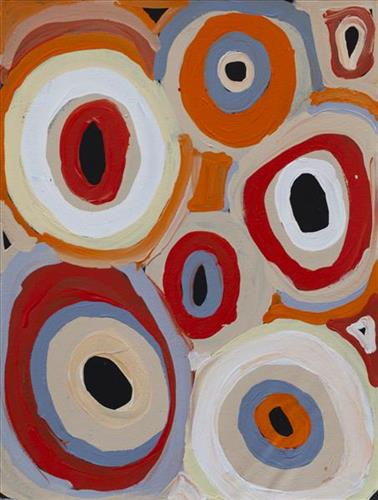
This is Dale’s Country- her ‘ngurra’ (home Country, camp). People identify with their ngurra in terms of specific rights and responsibilities, and the possession of intimate knowledge of the physical and cultural properties of one’s Country. Painting ngurra, and in so doing sharing the Jukurrpa (Dreaming) stories and physical characteristics of that place, has today become an important means of cultural maintenance. Dale’s ngurra encompasses her birthplace, Jigalong, and the Country that her family walked in the pujiman (traditional, desert-dwelling) era, including Puntawarri, Raarki (Canning Stock Route Well 27), Kularti, Kumpupirntily , Mirtikanya, (Kumpupintily, Lake Disappointment), and Mukurtu.

Portrayed in this work are features of Dale’s family’s ngurra, such as the striking salt lakes, dominant permanent red tali (sandhills), warta (trees, vegetation), and the individually named water sources they camped at. Rock holes, waterholes, soaks and springs were all extremely important sites for Martu people during the pujiman period, and are generally depicted with circular forms. 

The encyclopaedic knowledge of the location, quality and seasonal availability of the hundreds of water bodies found in one’s Country sustained Martu as they travelled across their Country, hunting and gathering, visiting family, and fulfilling ceremonial obligations. They would traverse very large distances annually, visiting specific areas in the dry and wet season depending on the availability of water and the corresponding cycles of plant and animal life on which hunting and gathering bush tucker was reliant. As they travelled and hunted they would also burn areas of Country, generating a greater diversity of plant and animal life.

111581995475


Untitled

This is Wurta Amy French’s Country- her ‘ngurra’ (home Country, camp). People identify with their ngurra in terms of specific rights and responsibilities, and the possession of intimate knowledge of the physical and cultural properties of one’s Country. Painting ngurra, and in so doing sharing the Jukurrpa (Dreaming) stories and physical characteristics of that place, has today become an important means of cultural maintenance. 

Wurta’s ngurra encompasses the Country that she and her family walked in the pujiman (traditional, desert-dwelling) era. At this time Wurta travelled nomadically with her own and other family groups. The Country they traversed encompassed an enormous tract of land, all around the Karlamily (Rudall River) region and through to Tiwa (Canning Stock Route Well 26) .

Wurta was born at Wantili (Warntili, Canning Stock Route Well 25). She grew up, walked and hunted primarily around water sources Pangkartal, Yalpalpa, Walirrlirri, Yanytikuji, Wartararra, Tintinmarran, Pimurlu, Raarki (Canning Stock Route Well 27), and Tiwa. Her family continued to live nomadically before eventually deciding to move to Jigalong Mission along with many other relatives following an extreme and prolonged drought in the 1960s. 

Portrayed in this work are features of Wurta’s ngurra, such as the hills, gorges and valleys, warta (trees, vegetation), and the individually named water sources she and her family camped at. Rock holes, waterholes, soaks and springs were all extremely important sites for Martu people during the pujiman period, and are generally depicted with circular forms. 

The encyclopaedic knowledge of the location, quality and seasonal availability of the hundreds of water bodies found in one’s Country sustained Martu as they travelled across their Country, hunting and gathering, visiting family, and fulfilling ceremonial obligations. They would traverse very large distances annually, visiting specific areas in the dry and wet season depending on the availability of water and the corresponding cycles of plant and animal life on which hunting and gathering bush tucker was reliant. As they travelled and hunted they would also burn areas of Country, generating a greater diversity of plant and animal life.

221781995458


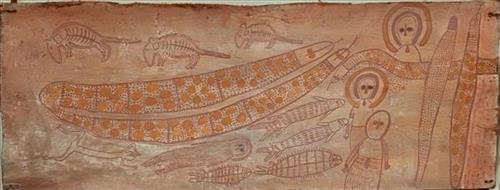
The Beginning of Reproduction

This painting depicts all the couples and pairs mating. Wandjina was the God who gave the blessing the animals and people to mate. There is a rock wallaby couple with a baby. There is a bush woman (Chilllinger) looking around for a man. It’s about regeneration and growth and making babies.