111976646860


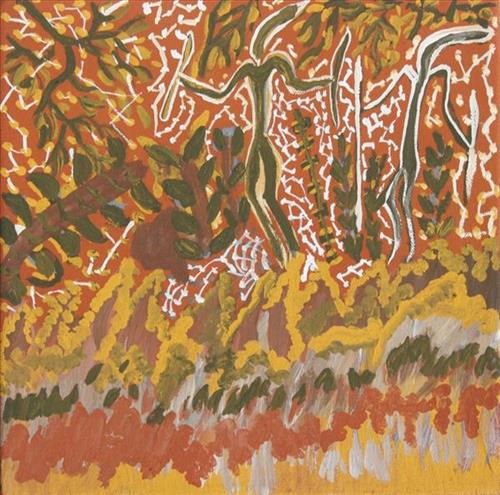
Mimih Spirit

Aboriginal people in the rocky environments of western and south-western Arnhem Land tell of the existence of tall slender spirits which they call Mimih. The name Mimih is well known throughout the top end of the Northern Territory. Aboriginal groups living in the rocky environments of western and southern Arnhem Land share mythology which relates to the beings known as Mimih. These groups include the Kunwok chain of languages, and also Rembarrnga, Dalabon and Djawoyn language groups. Other groups of people with familial and ceremonial links to rock country inhabitants are also familiar with the idea of the Mimih.

In recent years the Mimih has become a topic in the repertoires of some artists among the Kunibídji people, speakers of the Ndjébbana language and the traditional landowners of the Maningrida area. The people of western Arnhem Land believe that Mimih spirits live in a social organisation similar to Aboriginal people and that Mimih society existed before humans. Mimih are credited with instructing the first people with knowledge relating to survival in the rocky environment of the Arnhem Land plateau. Mimih are said to have taught the first humans how to hunt and butcher game and also how to dance, sing and paint. The song and dance style of western Arnhem Land Aboriginal people is still known today as Mimih style. This term is also used by Aboriginal people further to the east in Central Arnhem Land when describing the dance and song of their western neighbours.

Despite the usual descriptions of Mimih as being benign towards humans, sometimes however they are attributed with mischievous and dangerous qualities, capable of kidnapping and even killing humans. ‘Clever’ men, or Aboriginal men with supernatural powers, sometimes befriend the Mimih and are taught their songs and dances and shown their secret places. The Mimih are like people using the same kinship terms and speaking the same language as the local Aboriginal group. They live in families like humans and it is said that some of these Aboriginal men with mystical knowledge have spent time living with them in their camps.

Mimih are however, terribly thin, having necks so slender that a stiff breeze would be fatal. For this reason they emerge only on windless days and nights to hunt. As soon as a breeze develops, the Mimih are said to run back to their rocky caverns and disappear inside.

111976647616


Mimih Spirit

Aboriginal people in the rocky environments of western and south-western Arnhem Land tell of the existence of tall slender spirits which they call Mimih. The name Mimih is well known throughout the top end of the Northern Territory. Aboriginal groups living in the rocky environments of western and southern Arnhem Land share mythology which relates to the beings known as Mimih. These groups include the Kunwok chain of languages, and also Rembarrnga, Dalabon and Djawoyn language groups. Other groups of people with familial and ceremonial links to rock country inhabitants are also familiar with the idea of the Mimih.

In recent years the Mimih has become a topic in the repertoires of some artists among the Kunibídji people, speakers of the Ndjébbana language and the traditional landowners of the Maningrida area. The people of western Arnhem Land believe that Mimih spirits live in a social organisation similar to Aboriginal people and that Mimih society existed before humans. Mimih are credited with instructing the first people with knowledge relating to survival in the rocky environment of the Arnhem Land plateau. Mimih are said to have taught the first humans how to hunt and butcher game and also how to dance, sing and paint. The song and dance style of western Arnhem Land Aboriginal people is still known today as Mimih style. This term is also used by Aboriginal people further to the east in Central Arnhem Land when describing the dance and song of their western neighbours.

Despite the usual descriptions of Mimih as being benign towards humans, sometimes however they are attributed with mischievous and dangerous qualities, capable of kidnapping and even killing humans. ‘Clever’ men, or Aboriginal men with supernatural powers, sometimes befriend the Mimih and are taught their songs and dances and shown their secret places. The Mimih are like people using the same kinship terms and speaking the same language as the local Aboriginal group. They live in families like humans and it is said that some of these Aboriginal men with mystical knowledge have spent time living with them in their camps.

Mimih are however, terribly thin, having necks so slender that a stiff breeze would be fatal. For this reason they emerge only on windless days and nights to hunt. As soon as a breeze develops, the Mimih are said to run back to their rocky caverns and disappear inside.
111976648313


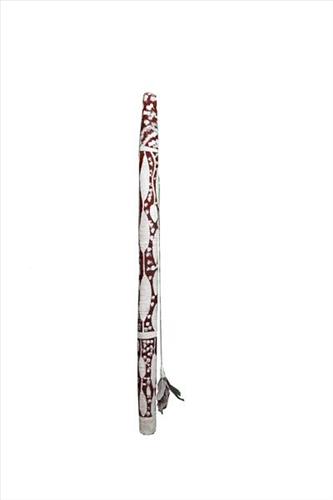
Coil Basket

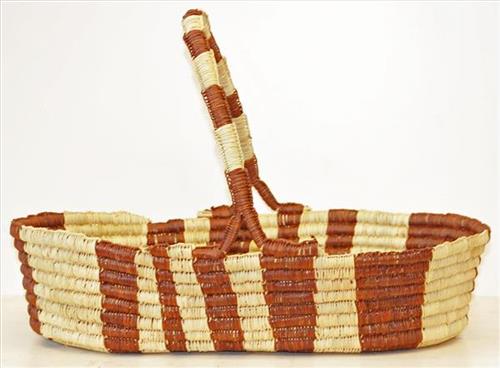
Coiling technique was introduced in the 1920s at Goulburn Island to the Maung people by missionaries and quickly spread to the mainland. Many artists produce coiled baskets of varied shapes, ranging from small round baskets to large oval baby baskets made from dyed pandanus. Artists combine colours and patterns to obtain intricate new graphic patterns.

111976649302


Wak Wak

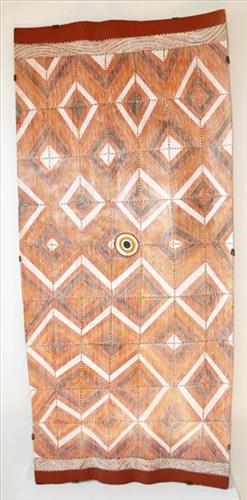
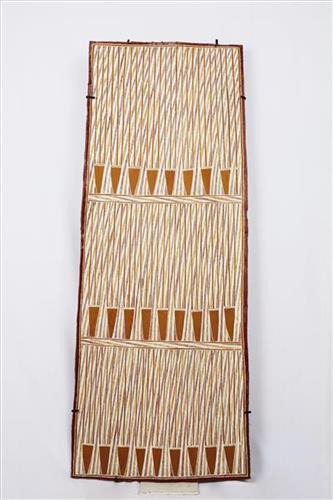
This painting depicts a sacred site at ‘Kurrurldul’, an outstation south of Maningrida.

The ‘rarrk’, or abstract crosshatching, on this work represents the design for the crow totem ancestor called ‘Djimarr’. Today this being exists in the form of a rock, which is permanently submerged at the bottom of Kurrurldul Creek. The ‘Djimarr’ rock in the stream at Kurrurldul is said to move around and call out in a soft hooting tone at night. Both the stone itself and the area around it are considered sacred.

The imagery represents the rock mentioned above at the bottom of Kurrurldul creek, which is the final transmutation of the dreaming ancestor ‘Djimarr’. Finally, the pattern used here is also the crow design used in the sacred ‘Mardayin’ ceremony, which is a large regional patri-moiety ceremony now rarely conducted in central and eastern Arnhem Land.

221776655615


Burning the Bush Hunting

Kira Kiro (Bradshaw) figures are depicted burning the bush to hunt for animals.

111976662935


Namorrorddo a profane spirit

Namorrorddo is a profane spirit sometimes called a ‘bad angel’ in Aboriginal English.

The Namorrorddo is a yirridjdja moiety being associated with the Yabbadurruwa regional cult ceremony.

Namorrorddo sits upon a rock and is usually painted with long claw like hands and feet. Sometimes spurs protrude from the elbows somewhat like those of a flying fox. Namorrorddo carries light, which emanates from his head. The shooting stars seen at night are Namorrorddo travelling across the night sky.

He whistles an eerie cry, which Aboriginal people say they can hear at night from time to time. Namorrorddo is feared as an evil being who attacks humans by clubbing them with his fighting stick or miyarrul. Namorrorddo is also sometimes depicted carrying bamboo spears and a spear thrower. Namorrorddo is a major dreaming totem for the Kardbam clan. There are a few examples of images of Namorrorddo painted in rock shelters in the Mann and Liverpool Rivers district.

111976671651


Jima Jima (Waterlily)

Jimi jima is one of Tommy Gondorra Steele’s personal dreamings. It is similar to what is commonly known as a waterlily (monochoria australasica). Jimi jima is mainly associated with a waterhole named Yalija, but also other sacred waterholes in the Wurdeja area. Tommy’s painting of jima jima depicts the lily as it exists naturally in wet water areas at Wurdeja. They have an edible root, which is brownish and bitter when raw, but once roasted on coals it is deliciously sweet. They are only found in sacred waterholes in the Wurdeja area, including Yalija, and humans and spirits live off them. They are a bright blue flowering plant.

Tommy Gondorra Steele is the last male member of the Garnawula Niya clan. He lives at Wurdeja outstation, about four kilometres east of the Blyth River. He is the traditional owner of that area. Wurdeja is surrounded by a series of sacred waterholes and it is these waterholes, which provide the subject matter for Steele’s art.

111576675086


Kunawarritji and the Seven Sisters

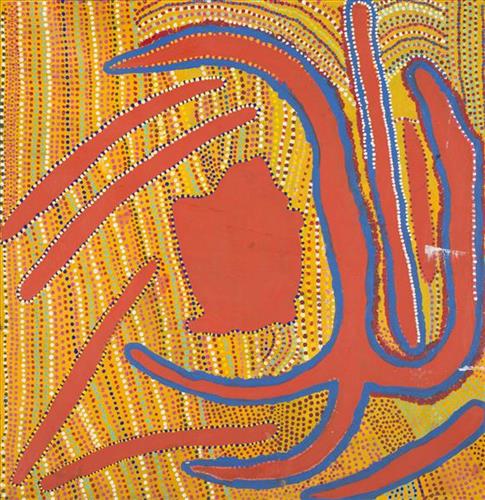
The term Jukurrpa is often translated in English as the ‘dreaming’, or ‘dreamtime’. It refers generally to the period in which the world was created by ancestral beings, who assumed both human and nonhuman forms. These beings shaped what had been a formless landscape; creating waters, plants, animals, and people. At the same time they provided cultural protocols for the people they created, as well as rules for interacting with the natural environment. At their journey’s end, the ancestral beings transformed themselves into important waters, hills, rocks, and even constellations. 

Minyipuru, or Jakulyukulyu (Seven Sisters) is a central Jukurrpa narrative for Martu, Ngaanyatjarra, Pitjantjatjara and Yankunytjatjara people that is associated with the seasonal Pleiades star constellation. Relayed in song, dance, stories and paintings, Minyipuru serves as a creation narrative, a source of information relating to the physical properties of the land, and an embodiment of Aboriginal cultural laws. When Martumili Artists was established in 2005, this was the first Jukurrpa story the artists agreed to paint for a broader public. 

Beginning in Roebourne on the west coast of Western Australia, the story morphs in its movement eastward across the land, following a group of women as they walk, dance, and even fly from waterhole to waterhole. As they travel the women camp, sing, wash, dance and gather food, leaving markers in the landscape and creating landforms that remain to this day, such as groupings of rocks and trees, grinding stones and seeds. During the entirety of their journey the women are pursued by a lustful old man, Yurla, although interactions with other animals, groups of men, and spirit beings are also chronicled.

111576675227


Punmu

“This is daddy’s ngurra (home Country, camp), mummy’s ngurra. I used to go to Punmu to visit people there.”

 – Bugai Whyoulter

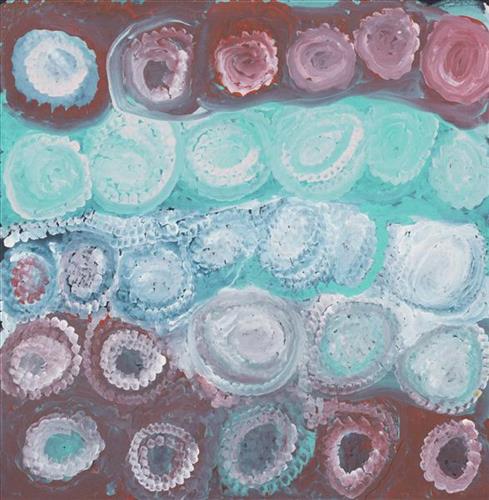
Punmu refers to a region and an Aboriginal community within its vicinity, located 670km North-East of Newman. Created during the return to Country movement of the 1980s, with the recognition of Martu land rights and native title, the community was named after a nearby Jukurrpa (Dreaming) story. Punmu community sits on the edge of a large salt lake known as Nyayartakujarra, or Lake Dora. The lake runs south into Karlamilyi River (Rudall River). Surrounding Punmu are numerous fresh water soaks and the red tali (sandhills) typical of the area. The most frequently visited yinta (permanent springs) around Punmu include Wirlarra, Rawa, Yilyara, Jila-jila and Tuu-tuu.

Bugai grew up in and travelled through this Country during the pujiman (traditional, desert-dwelling) era. At Punmu, Bugai and her family would collect minyarra (bush onions) and hunt jipuku (rabbit). Bugai recalls a specific time when she travelled here with her mama (father) as a juri (beautiful, good) time. She paints the Country around Punmu, paying special attention to the many yinta and tuwa (sandhills), and to the pastel palette characteristic to the expansive white plains of Nyayartakujarra. 

The Country around Punmu features in several Jukurrpa (Dreaming) stories. Of particular importance is the story of the Jila Kujarra (Two Snakes), one of the key Jukurrpa narratives for the Martu. Though the story belongs to Warnman people, it is shared across the Western Desert with several other language groups. The narrative centres on the travels of two snakes as they are pursued by the Niminjarra, spiritual ancestors of the Warnman people. 

Before transforming themselves into snakes, the Jila Kujarra were young brothers. As snakes, they began travelling home to their mother, but were intercepted by the Niminjarra, who tracked the Jila Kujarra to Paji, east of Nyayartakujarra (Lake Dora). Though the Jila Kujarra eluded their pursuers here by escaping under the lake at Paji, they were soon after speared and injured by two Pukurti (initiates with bundled hair) at Nyayartakujarra, who returned with the Niminjarra to cook the snakes at the site of Kumpupirntily (Kumpupintily, Lake Disappointment). As the Niminjarra cut down the length of the Jila Kujarra, the snake’s bladders were pierced, causing an explosion of scalding hot urine in which the Niminjarra all perished and became black rocks at the site. The spirits of the Jila Kujarra returned to their mother at Nyayartakujarra, where the mother and her sons entered the ground below Nyayartakujarra and remain to this day.

111576675211


Kurta Kurta

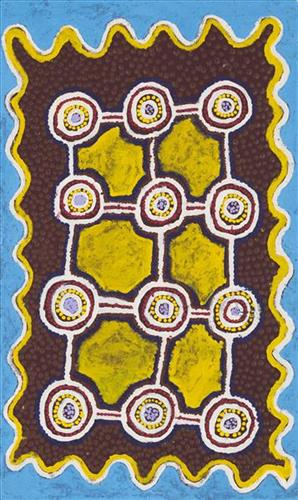
“When Martu paint, it’s like a map. Martu draw story on the ground and on the canvas, and all the circle and line there are the hunting areas and different waters and tracks where people used to walk, and [some you] can’t cross, like boundaries. So nowadays you see a colourful painting and wonder what it is, but that’s how Martu tell story long ago. It’s not just a lovely painting, it’s a story and a songline and a history and everything that goes with it.” 

– Ngalangka Nola Taylor and Joshua Booth

This work portrays an area of Country that can be interpreted in multiple ways. Firstly, the image may be read as an aerial representation of a particular location known to the artist- either land that they or their family travelled, from the pujiman (traditional, desert dwelling) era to now. During the pujiman period, Martu would traverse very large distances annually in small family groups, moving seasonally from water source to water source, and hunting and gathering bush tucker as they went. At this time, one’s survival depended on their intimate knowledge of the location of resources; thus physical elements of Country, such as sources of kapi (water), tali (sandhills), different varieties of warta (trees, vegetation), ngarrini (camps), and jina (tracks) are typically recorded with the use of a use of a system of iconographic forms universally shared across the desert. 

An additional layer of meaning in the work relates to more intangible concepts; life cycles based around kalyu (rain, water) and waru (fire) are also often evident. A thousands of year old practice, fire burning continues to be carried out as both an aid for hunting and a means of land management today. As the Martu travelled and hunted they would burn tracts of land, ensuring plant and animal biodiversity and reducing the risk of unmanageable, spontaneous bush fires. The patchwork nature of regrowth is evident in many landscape works, with each of the five distinctive phases of fire burning visually described with respect to the cycle of burning and regrowth.  

Finally, metaphysical information relating to a location may also be recorded; jukurrpa (dreaming) narratives chronicle the creation of physical landmarks, and can be referenced through depictions of ceremonial sites, songlines, and markers left in the land. Very often, however, information relating to jukurrpa is censored by omission, or alternatively painted over with dotted patterns.