111981256901


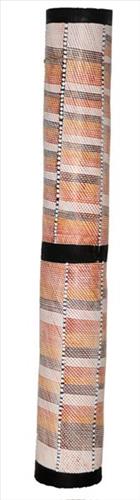
Lorrkon (Hollow Log)

The Lorrkon or bone pole coffin ceremony was the final ceremony in a sequence of mortuary rituals celebrated by the people of Arnhem Land. This ceremony involves the placing of the deceased’s bones into a hollow log which was decorated with painted clan designs and ceremonially placed into the ground where it remained until it slowly decayed over many years.

The log is made from a termite hollowed Stringybark tree (Eucalyptus tetradonta) and is decorated with totemic emblems. The western Arnhem Land version of the Lorrkon ceremony involves the singing of sacred songs to the accompaniment of karlikarli, a pair of sacred boomerangs used as rhythm instruments. During the final evening of the ceremony, dancers decorate themselves with kapok down, or today, cotton wool and conduct much of the final segments of the ceremony in the secrecy of a restricted mens’ camp. The complete ceremony may stretch over a period of two weeks, but on the last night the bones of the deceased, which have been kept in a bark container or today wrapped in cloth and kept in a suitcase are taken out, are painted with red ochre and placed inside the hollow log. This ceremony may take place many years after the person has died.

At first light on the final morning of the Lorrkon ceremony, the men appear, coming out of their secret bush camp carrying the pole towards the women’s camp. The two groups call to each other using distinct ceremonial calls. The women have prepared a hole for the pole to be placed into and when it is stood upright, women in particular kinship relationships to the deceased dance around the pole in a jumping/shuffling motion. The Lorrkon is then often covered with a tarpaulin and left to slowly decay.
111581256922


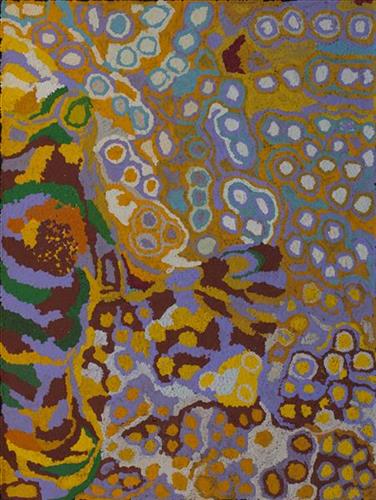
Untitled

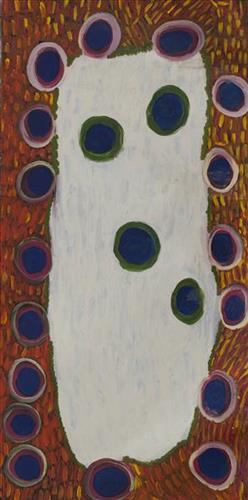
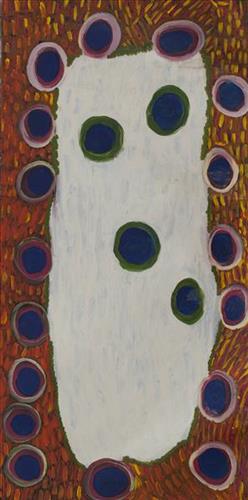
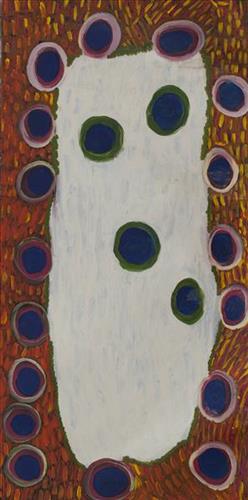
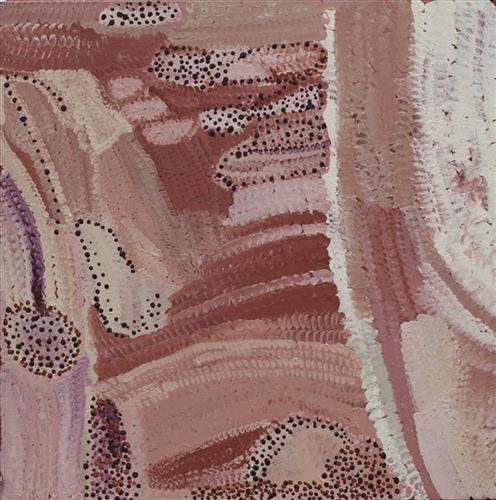
This is Bugai’s Country- her ‘ngurra’ (home Country, camp). People identify with their ngurra in terms of specific rights and responsibilities, and the possession of intimate knowledge of the physical and cultural properties of one’s Country. Painting ngurra, and in so doing sharing the Jukurrpa (Dreaming) stories and physical characteristics of that place, has today become an important means of cultural maintenance. 

Bugai’s ngurra encompasses the Country that she and her family walked in the pujiman (traditional, desert-dwelling) era. At this time Bugai travelled nomadically with her own and other family groups, most notably the Bidu family. The Country they traversed encompassed an enormous tract of land, with an aerial distance of more than 600 kilometres, from present day Balfour Downs Station to Kunawarritji (Canning Stock Route Well 33). Bugai was born at Pulkinya. She grew up, walked and hunted primarily around Parnngurr, Punmu, Kun Kun (Kuny-kuny) and Kunawarritji. As a young woman Bugai travelled with her husband through the Karlamily (Rudall River) region and up and down the Canning Stock Route, where she first met cattle drovers. She continued to live nomadically before eventually deciding to move to Jigalong Mission along with many other relatives following an extreme and prolonged drought in the 1960s. 

Portrayed in this work are features of Bugai’s ngurra, such as the striking salt lakes, dominant permanent red tali (sandhills), warta (trees, vegetation), and the individually named water sources Bugai and her family camped at. These include Parnngurr, Martilirri, Wangkakalu, Kurta-kurta (Camel Rock), Pimurlu, Jilkupuka (Canning Stock Route Well 21), Kaalpa (Canning Stock Route Well 23), Kartarru (Canning Stock Route Well 24), Wantili (Warntili, Canning Stock Route Well 25), Tiwa (Canning Stock Route Well 26), Partujarrapirri, Raarki (Canning Stock Route Well 27), Wuranu (Canning Stock Route Well 29), Juntu- juntu (Canning Stock Route Well 30), and Kunawarritji. Rock holes, waterholes, soaks and springs were all extremely important sites for Martu people during the pujiman period, and are generally depicted with circular forms. 

The encyclopaedic knowledge of the location, quality and seasonal availability of the hundreds of water bodies found in one’s Country sustained Martu as they travelled across their Country, hunting and gathering, visiting family, and fulfilling ceremonial obligations. They would traverse very large distances annually, visiting specific areas in the dry and wet season depending on the availability of water and the corresponding cycles of plant and animal life on which hunting and gathering bush tucker was reliant. As they travelled and hunted they would also burn areas of Country, generating a greater diversity of plant and animal life.

111581256764


Pitu

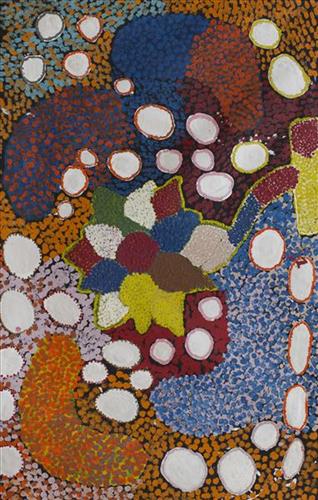
This painting depicts Pitu, an area east of Parnngurr in the Western Desert. Pitu is the artist’s home country. The artist’s surname “Bidu” is non-standard spelling of this placename.

111581256721


Kumpupirntily

““If they dig him up, anybody, blackfella, whitefellas they’ll get killed! Ngayurnangalku still there [in Kumpupirntily]. No people gotta go come to this place. If they go there it’s one way! There’s a cannibal there. Don’t come to this place- you might get killed! They gonna eat you for lunch! Don’t go, keep away!!

Some people paint a rockhole, only rockhole. Nothing. I got story. Jukurrpa. Full up….”

– Billy Yunkurra Atkins

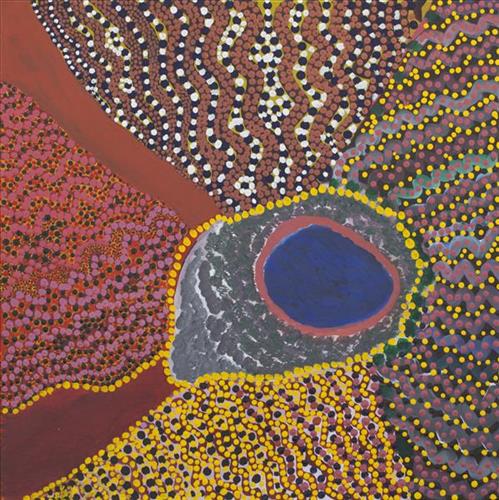
This painting depicts Yunkurra’s Country; Kumpupirntily (Lake Disappointment) in the Canning Stock Route area. This large warla (salt lake) is one of the most sacred and dangerous sites in the far Western Desert. This is where the Ngayurnangalku (cannibal beings) live beneath the lake, surfacing only to feed on human flesh.


111581257738


Untitled

“The old people, they sit down and paint and tell stories of the old days, and we listen and learn.”

– Corban Clause Williams

Transfer of cultural knowledge through visual arts is an important way for Martu artists to keep their culture strong. Younger Martu artists typically begin painting with their parents, grandparents and extended family, thus fostering an organic process of learning, not only about painting techniques, but also specific locations, family histories, traditional ways of life, bush tucker and  jukurrpa (dreaming). Senior Martu artists also often paint together where a story of mutual significance is conveyed, and in this way have produced many of the stunning, large scale collaborative works for which Martumili Artists are most well known.

111581257737


Untitled

“The old people, they sit down and paint and tell stories of the old days, and we listen and learn.”

– Corban Clause Williams

Transfer of cultural knowledge through visual arts is an important way for Martu artists to keep their culture strong. Younger Martu artists typically begin painting with their parents, grandparents and extended family, thus fostering an organic process of learning, not only about painting techniques, but also specific locations, family histories, traditional ways of life, bush tucker and  jukurrpa (dreaming). Senior Martu artists also often paint together where a story of mutual significance is conveyed, and in this way have produced many of the stunning, large scale collaborative works for which Martumili Artists are most well known.

111581257728


Untitled

“The old people, they sit down and paint and tell stories of the old days, and we listen and learn.”

– Corban Clause Williams

Transfer of cultural knowledge through visual arts is an important way for Martu artists to keep their culture strong. Younger Martu artists typically begin painting with their parents, grandparents and extended family, thus fostering an organic process of learning, not only about painting techniques, but also specific locations, family histories, traditional ways of life, bush tucker and  jukurrpa (dreaming). Senior Martu artists also often paint together where a story of mutual significance is conveyed, and in this way have produced many of the stunning, large scale collaborative works for which Martumili Artists are most well known.

111581257712


Untitled

Doreen first learned to paint alongside her mother, beginning her artistic career with Martumili Artists in March 2009 when she and the other women of Punmu painted a large collaborative artwork to raise funds for the community. Doreen is now an established artist in her own right, known for her loose, uninhibited painting style. As a deaf woman, painting is an important means of communication and expression for Doreen. As a deaf woman, painting is an important means of communication and expression for Doreen.

Doreen likes to paint the comings and goings of community life- the motorcars, aeroplanes and critters that populate her homes of Warralong, Punmu and Port Hedland.

111581257704


Untitled

Doreen first learned to paint alongside her mother, beginning her artistic career with Martumili Artists in March 2009 when she and the other women of Punmu painted a large collaborative artwork to raise funds for the community. Doreen is now an established artist in her own right, known for her loose, uninhibited painting style. As a deaf woman, painting is an important means of communication and expression for Doreen. As a deaf woman, painting is an important means of communication and expression for Doreen.

Doreen likes to paint the comings and goings of community life- the motorcars, aeroplanes and critters that populate her homes of Warralong, Punmu and Port Hedland.

111581258296


untitled

“This one here. Yeah. That’s Jigalong. I’ve been there. I was working there. That’s good, this one here. Stories, yeah? This one here. I was painting in Jigalong. This one’s the cars. The cars. And the houses in Jigalong. And then the sandhills, lakes. That’s the lake [points to top right-hand corner]. The lake here and the green trees, and the sandhills. We going out working, you know? We going out working to Jigalong. All the ladies, we go out. All the ladies. Yeah that’s the one, all the ladies. We work choppers. Yeah I’ve been there in Jigalong with my mum and dad long time. And the cars. We go out in that. We go out working. We just work around Jigalong, the ladies.”

– Helen Dale Samson

Jigalong Aboriginal Community, the largest of the Martu communities, is located on the western edge of the Little Sandy Desert, not far from the town of Newman. Jigalong was established in 1907 as the site for a maintenance and rations store for workmen constructing the Rabbit Proof Fence, and converted to a camel breeding site in the 1930’s before finally becoming a Christian mission under the Apostolic Church in 1947. The land was returned to the Martu in 1974. 

For many Martu, Jigalong Mission was the site where their pujiman (traditional, desert dwelling) lifestyle came to an end from the late 1940s as they transitioned to a life as stockmen and women working in cattle stations in the Pilbara region and beyond. In the wake of the extreme and prolonged drought of the 1960s, the last of the remaining pujimanpa (desert dwellers) were forced to move to missions like Jigalong, where a supply of food and water was assured. There, many Martu were reunited with family members that had already moved in from the desert. 

Old Jigalong is where the camp on Jigalong Station was situated before the present Community was built. Dale grew up here, but would frequently camp with her family on Country during weekends. Helen Dale continues to live in Jigalong today.