111582055193


Untitled

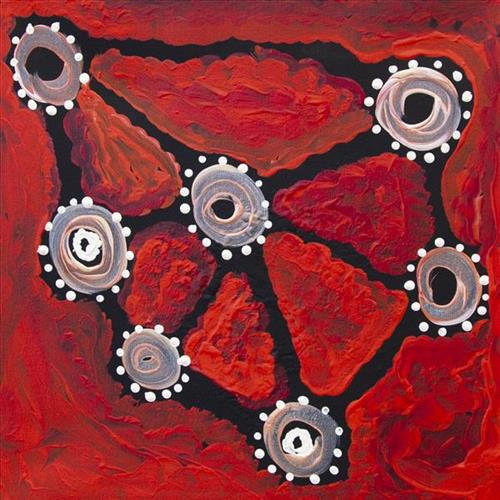
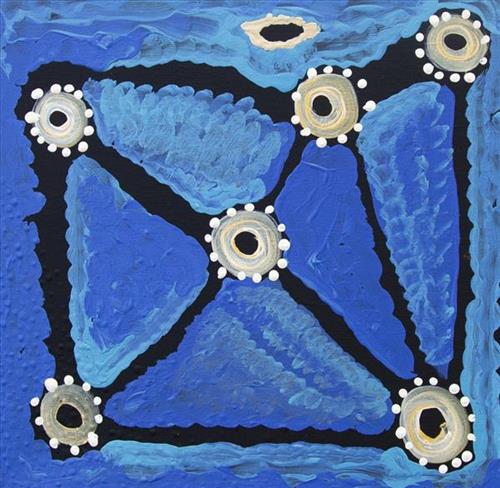
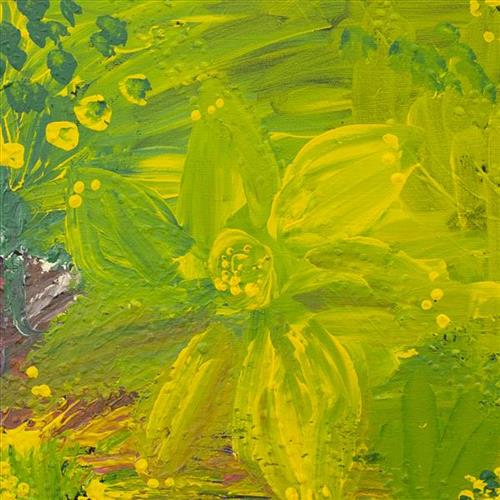
“When Martu paint, it’s like a map. Martu draw story on the ground and on the canvas, and all the circle and line there are the hunting areas and different waters and tracks where people used to walk, and [some you] can’t cross, like boundaries. So nowadays you see a colourful painting and wonder what it is, but that’s how Martu tell story long ago. It’s not just a lovely painting, it’s a story and a songline and a history and everything that goes with it.” 

– Ngalangka Nola Taylor and Joshua Booth

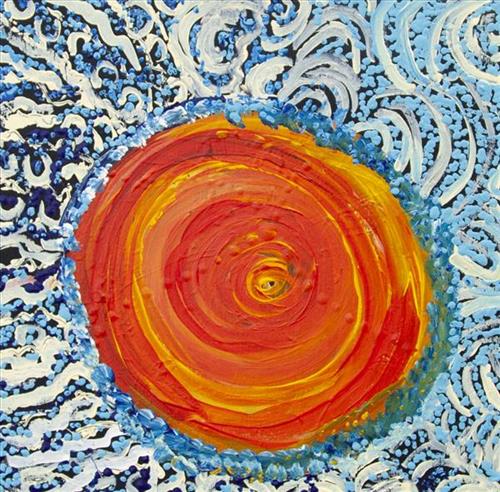
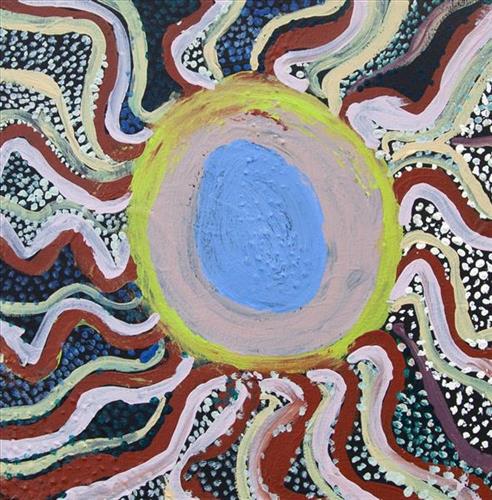
This work portrays an area of Country that can be interpreted in multiple ways. Firstly, the image may be read as an aerial representation of a particular location known to the artist- either land that they or their family travelled, from the pujiman (traditional, desert dwelling) era to now. During the pujiman period, Martu would traverse very large distances annually in small family groups, moving seasonally from water source to water source, and hunting and gathering bush tucker as they went. At this time, one’s survival depended on their intimate knowledge of the location of resources; thus physical elements of Country, such as sources of kapi (water), tali (sandhills), different varieties of warta (trees, vegetation), ngarrini (camps), and jina (tracks) are typically recorded with the use of a use of a system of iconographic forms universally shared across the desert. 

An additional layer of meaning in the work relates to more intangible concepts; life cycles based around kalyu (rain, water) and waru (fire) are also often evident. A thousands of year old practice, fire burning continues to be carried out as both an aid for hunting and a means of land management today. As the Martu travelled and hunted they would burn tracts of land, ensuring plant and animal biodiversity and reducing the risk of unmanageable, spontaneous bush fires. The patchwork nature of regrowth is evident in many landscape works, with each of the five distinctive phases of fire burning visually described with respect to the cycle of burning and regrowth.  

Finally, metaphysical information relating to a location may also be recorded; Jukurrpa (Dreaming) narratives chronicle the creation of physical landmarks, and can be referenced through depictions of ceremonial sites, songlines, and markers left in the land. Very often, however, information relating to Jukurrpa is censored by omission, or alternatively painted over with dotted patterns.
111582055187


Untitled

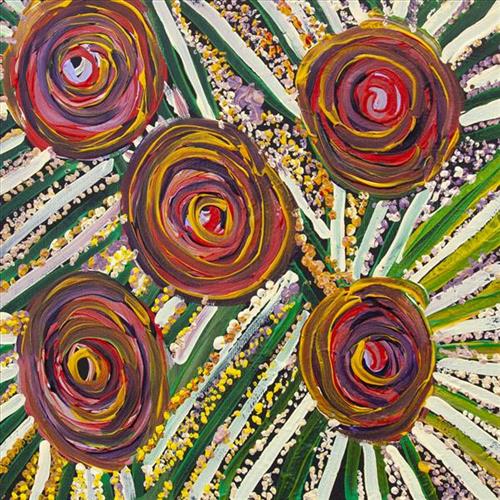
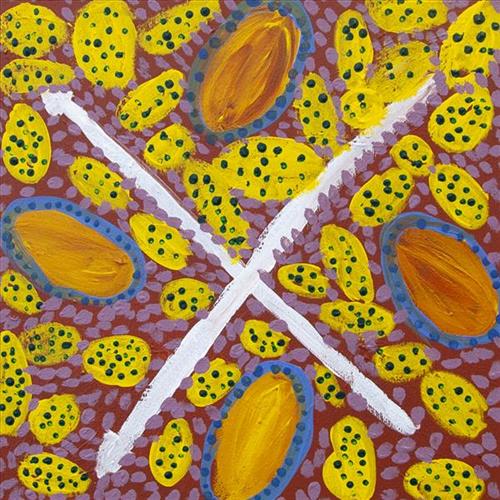
“When Martu paint, it’s like a map. Martu draw story on the ground and on the canvas, and all the circle and line there are the hunting areas and different waters and tracks where people used to walk, and [some you] can’t cross, like boundaries. So nowadays you see a colourful painting and wonder what it is, but that’s how Martu tell story long ago. It’s not just a lovely painting, it’s a story and a songline and a history and everything that goes with it.” 

– Ngalangka Nola Taylor and Joshua Booth

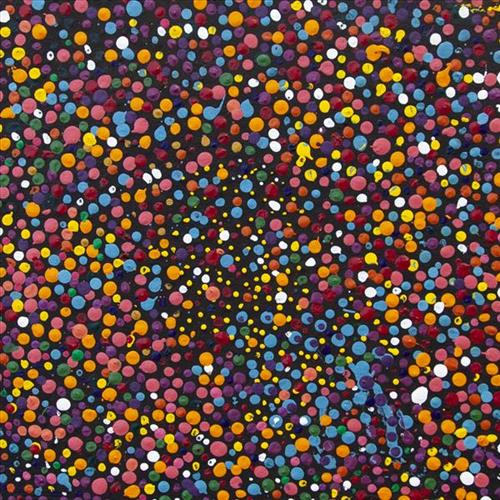
This work portrays an area of Country that can be interpreted in multiple ways. Firstly, the image may be read as an aerial representation of a particular location known to the artist- either land that they or their family travelled, from the pujiman (traditional, desert dwelling) era to now. During the pujiman period, Martu would traverse very large distances annually in small family groups, moving seasonally from water source to water source, and hunting and gathering bush tucker as they went. At this time, one’s survival depended on their intimate knowledge of the location of resources; thus physical elements of Country, such as sources of kapi (water), tali (sandhills), different varieties of warta (trees, vegetation), ngarrini (camps), and jina (tracks) are typically recorded with the use of a use of a system of iconographic forms universally shared across the desert. 

An additional layer of meaning in the work relates to more intangible concepts; life cycles based around kalyu (rain, water) and waru (fire) are also often evident. A thousands of year old practice, fire burning continues to be carried out as both an aid for hunting and a means of land management today. As the Martu travelled and hunted they would burn tracts of land, ensuring plant and animal biodiversity and reducing the risk of unmanageable, spontaneous bush fires. The patchwork nature of regrowth is evident in many landscape works, with each of the five distinctive phases of fire burning visually described with respect to the cycle of burning and regrowth.  

Finally, metaphysical information relating to a location may also be recorded; Jukurrpa (Dreaming) narratives chronicle the creation of physical landmarks, and can be referenced through depictions of ceremonial sites, songlines, and markers left in the land. Very often, however, information relating to Jukurrpa is censored by omission, or alternatively painted over with dotted patterns.
111582055178


Untitled

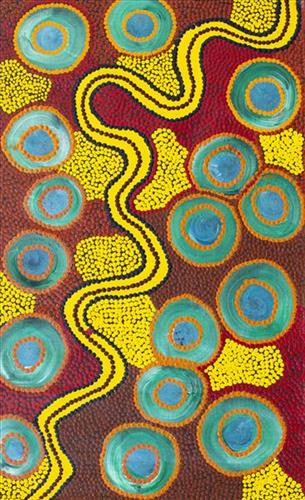
This is Dale’s Country- her ‘ngurra’ (home Country, camp). People identify with their ngurra in terms of specific rights and responsibilities, and the possession of intimate knowledge of the physical and cultural properties of one’s Country. Painting ngurra, and in so doing sharing the Jukurrpa (Dreaming) stories and physical characteristics of that place, has today become an important means of cultural maintenance. Dale’s ngurra encompasses her birthplace, Jigalong, and the Country that her family walked in the pujiman (traditional, desert-dwelling) era, including Puntawarri, Raarki (Canning Stock Route Well 27), Kularti, Kumpupirntily , Mirtikanya, (Kumpupintily, Lake Disappointment), and Mukurtu.

Portrayed in this work are features of Dale’s family’s ngurra, such as the striking salt lakes, dominant permanent red tali (sandhills), warta (trees, vegetation), and the individually named water sources they camped at. Rock holes, waterholes, soaks and springs were all extremely important sites for Martu people during the pujiman period, and are generally depicted with circular forms. 

The encyclopaedic knowledge of the location, quality and seasonal availability of the hundreds of water bodies found in one’s Country sustained Martu as they travelled across their Country, hunting and gathering, visiting family, and fulfilling ceremonial obligations. They would traverse very large distances annually, visiting specific areas in the dry and wet season depending on the availability of water and the corresponding cycles of plant and animal life on which hunting and gathering bush tucker was reliant. As they travelled and hunted they would also burn areas of Country, generating a greater diversity of plant and animal life.

111582055176


Wantili (Warntili, Canning Stock Route Well 25)

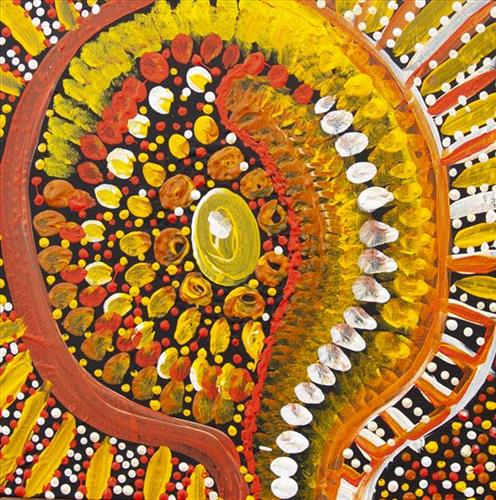
“This is my Grandmother’s [Bugai Whyoulter’s] Country, my Country. Wantili (Warntili, Canning Stock Route Well 25) is old Law Grounds from Dreaming days and very important to Martu people. My grandmother always tells me about Wantili because she grew up around Wantili. It is close to her birthplace and is her ngurra (home Country, camp). She was a young girl walking around at Wantili. Her family would travel between Wantili, Kaalpa, Juntu-juntu, Raarki, and Wuranu Wells along the Canning Stock Route. Big mob of people they been walking around there. She saw whitefellas there for the first time, Canning mob when they were traveling up and down the stock route with the bullock. They were running away from those whitefellas, watching them from a distance. She was a teenager when she was travelling around there with her four mothers and one daddy. They used to travel around in family groups, Bugai and Jakayu [Biljabu], and Jakayu’s nyupa (partner) Phillip Biljabu. They met Kumpaya [Girgirba] coming from Kun Kun (Kuny-Kuny), Kunawarritji area. Bugai returned to the Wantili area as a young woman, when she worked driving cattle along the Stock Route. 

Wantili is good for painting and telling stories. Our stories are still strong. I wanted to take Bugai back to Wantili. It is an important place; she hadn’t been there for a long time. My nana [Pinyirr] Nancy took me there as a young boy. Bugai is the older sister of Nancy. I been… three times going there. It’s important that place, out a long way from Newman… Those old people like going to Wantili, where the creation started. Jakayu and Kumpaya… them two aunties told me a story about Dreamtime, and how important Wantili was. People from different tribes…from all over the place could come there for the initiation ceremony. The Jukurrpa (Dreaming) stories from Wantili are just for Martu but the site is open, and anyone can go there. 

It’s a lovely part of the Country to take the kids for a swim. The place has changed. The water used to be muddy like chocolate, now the water is clear. Maybe from climate change, maybe from mining, maybe from something else. The changes don’t have to be bad; the landscape is always changing, same way as Martu people. It’s good to make work sitting out in Country, but I can make these paintings anywhere, just like those old people. Wherever I am, painting Country takes me back there in my head, back to Jukurrpa times, back to pujiman (traditional, desert dwelling) days when my grandmother walked around there, and back to days going there for a swim as a kid. I hope this painting carries people there too. I’m proud to be able to share my culture and stories with younger Martu people and whitefellas.”

111582055173


Wantili (Warntili, Canning Stock Route Well 25)

“This is my Grandmother’s [Bugai Whyoulter’s] Country, my Country. Wantili (Warntili, Canning Stock Route Well 25) is old Law Grounds from Dreaming days and very important to Martu people. My grandmother always tells me about Wantili because she grew up around Wantili. It is close to her birthplace and is her ngurra (home Country, camp). She was a young girl walking around at Wantili. Her family would travel between Wantili, Kaalpa, Juntu-juntu, Raarki, and Wuranu Wells along the Canning Stock Route. Big mob of people they been walking around there. She saw whitefellas there for the first time, Canning mob when they were traveling up and down the stock route with the bullock. They were running away from those whitefellas, watching them from a distance. She was a teenager when she was travelling around there with her four mothers and one daddy. They used to travel around in family groups, Bugai and Jakayu [Biljabu], and Jakayu’s nyupa (partner) Phillip Biljabu. They met Kumpaya [Girgirba] coming from Kun Kun (Kuny-Kuny), Kunawarritji area. Bugai returned to the Wantili area as a young woman, when she worked driving cattle along the Stock Route. 

Wantili is good for painting and telling stories. Our stories are still strong. I wanted to take Bugai back to Wantili. It is an important place; she hadn’t been there for a long time. My nana [Pinyirr] Nancy took me there as a young boy. Bugai is the older sister of Nancy. I been… three times going there. It’s important that place, out a long way from Newman… Those old people like going to Wantili, where the creation started. Jakayu and Kumpaya… them two aunties told me a story about Dreamtime, and how important Wantili was. People from different tribes…from all over the place could come there for the initiation ceremony. The Jukurrpa (Dreaming) stories from Wantili are just for Martu but the site is open, and anyone can go there. 

It’s a lovely part of the Country to take the kids for a swim. The place has changed. The water used to be muddy like chocolate, now the water is clear. Maybe from climate change, maybe from mining, maybe from something else. The changes don’t have to be bad; the landscape is always changing, same way as Martu people. It’s good to make work sitting out in Country, but I can make these paintings anywhere, just like those old people. Wherever I am, painting Country takes me back there in my head, back to Jukurrpa times, back to pujiman (traditional, desert dwelling) days when my grandmother walked around there, and back to days going there for a swim as a kid. I hope this painting carries people there too. I’m proud to be able to share my culture and stories with younger Martu people and whitefellas.”

111582055172


Wantili (Warntili, Canning Stock Route Well 25)

“This is my Grandmother’s [Bugai Whyoulter’s] Country, my Country. Wantili (Warntili, Canning Stock Route Well 25) is old Law Grounds from Dreaming days and very important to Martu people. My grandmother always tells me about Wantili because she grew up around Wantili. It is close to her birthplace and is her ngurra (home Country, camp). She was a young girl walking around at Wantili. Her family would travel between Wantili, Kaalpa, Juntu-juntu, Raarki, and Wuranu Wells along the Canning Stock Route. Big mob of people they been walking around there. She saw whitefellas there for the first time, Canning mob when they were traveling up and down the stock route with the bullock. They were running away from those whitefellas, watching them from a distance. She was a teenager when she was travelling around there with her four mothers and one daddy. They used to travel around in family groups, Bugai and Jakayu [Biljabu], and Jakayu’s nyupa (partner) Phillip Biljabu. They met Kumpaya [Girgirba] coming from Kun Kun (Kuny-Kuny), Kunawarritji area. Bugai returned to the Wantili area as a young woman, when she worked driving cattle along the Stock Route. 

Wantili is good for painting and telling stories. Our stories are still strong. I wanted to take Bugai back to Wantili. It is an important place; she hadn’t been there for a long time. My nana [Pinyirr] Nancy took me there as a young boy. Bugai is the older sister of Nancy. I been… three times going there. It’s important that place, out a long way from Newman… Those old people like going to Wantili, where the creation started. Jakayu and Kumpaya… them two aunties told me a story about Dreamtime, and how important Wantili was. People from different tribes…from all over the place could come there for the initiation ceremony. The Jukurrpa (Dreaming) stories from Wantili are just for Martu but the site is open, and anyone can go there. 

It’s a lovely part of the Country to take the kids for a swim. The place has changed. The water used to be muddy like chocolate, now the water is clear. Maybe from climate change, maybe from mining, maybe from something else. The changes don’t have to be bad; the landscape is always changing, same way as Martu people. It’s good to make work sitting out in Country, but I can make these paintings anywhere, just like those old people. Wherever I am, painting Country takes me back there in my head, back to Jukurrpa times, back to pujiman (traditional, desert dwelling) days when my grandmother walked around there, and back to days going there for a swim as a kid. I hope this painting carries people there too. I’m proud to be able to share my culture and stories with younger Martu people and whitefellas.”

111582055171


Wantili (Warntili, Canning Stock Route Well 25)

“This is my Grandmother’s [Bugai Whyoulter’s] Country, my Country. Wantili (Warntili, Canning Stock Route Well 25) is old Law Grounds from Dreaming days and very important to Martu people. My grandmother always tells me about Wantili because she grew up around Wantili. It is close to her birthplace and is her ngurra (home Country, camp). She was a young girl walking around at Wantili. Her family would travel between Wantili, Kaalpa, Juntu-juntu, Raarki, and Wuranu Wells along the Canning Stock Route. Big mob of people they been walking around there. She saw whitefellas there for the first time, Canning mob when they were traveling up and down the stock route with the bullock. They were running away from those whitefellas, watching them from a distance. She was a teenager when she was travelling around there with her four mothers and one daddy. They used to travel around in family groups, Bugai and Jakayu [Biljabu], and Jakayu’s nyupa (partner) Phillip Biljabu. They met Kumpaya [Girgirba] coming from Kun Kun (Kuny-Kuny), Kunawarritji area. Bugai returned to the Wantili area as a young woman, when she worked driving cattle along the Stock Route. 

Wantili is good for painting and telling stories. Our stories are still strong. I wanted to take Bugai back to Wantili. It is an important place; she hadn’t been there for a long time. My nana [Pinyirr] Nancy took me there as a young boy. Bugai is the older sister of Nancy. I been… three times going there. It’s important that place, out a long way from Newman… Those old people like going to Wantili, where the creation started. Jakayu and Kumpaya… them two aunties told me a story about Dreamtime, and how important Wantili was. People from different tribes…from all over the place could come there for the initiation ceremony. The Jukurrpa (Dreaming) stories from Wantili are just for Martu but the site is open, and anyone can go there. 

It’s a lovely part of the Country to take the kids for a swim. The place has changed. The water used to be muddy like chocolate, now the water is clear. Maybe from climate change, maybe from mining, maybe from something else. The changes don’t have to be bad; the landscape is always changing, same way as Martu people. It’s good to make work sitting out in Country, but I can make these paintings anywhere, just like those old people. Wherever I am, painting Country takes me back there in my head, back to Jukurrpa times, back to pujiman (traditional, desert dwelling) days when my grandmother walked around there, and back to days going there for a swim as a kid. I hope this painting carries people there too. I’m proud to be able to share my culture and stories with younger Martu people and whitefellas.”

111582055170


Untitled

This is Dale’s Country- her ‘ngurra’ (home Country, camp). People identify with their ngurra in terms of specific rights and responsibilities, and the possession of intimate knowledge of the physical and cultural properties of one’s Country. Painting ngurra, and in so doing sharing the Jukurrpa (Dreaming) stories and physical characteristics of that place, has today become an important means of cultural maintenance. Dale’s ngurra encompasses her birthplace, Jigalong, and the Country that her family walked in the pujiman (traditional, desert-dwelling) era, including Puntawarri, Raarki (Canning Stock Route Well 27), Kularti, Kumpupirntily , Mirtikanya, (Kumpupintily, Lake Disappointment), and Mukurtu.

Portrayed in this work are features of Dale’s family’s ngurra, such as the striking salt lakes, dominant permanent red tali (sandhills), warta (trees, vegetation), and the individually named water sources they camped at. Rock holes, waterholes, soaks and springs were all extremely important sites for Martu people during the pujiman period, and are generally depicted with circular forms. 

The encyclopaedic knowledge of the location, quality and seasonal availability of the hundreds of water bodies found in one’s Country sustained Martu as they travelled across their Country, hunting and gathering, visiting family, and fulfilling ceremonial obligations. They would traverse very large distances annually, visiting specific areas in the dry and wet season depending on the availability of water and the corresponding cycles of plant and animal life on which hunting and gathering bush tucker was reliant. As they travelled and hunted they would also burn areas of Country, generating a greater diversity of plant and animal life.

111582055169


Untitled

This is Jatarr’s Country- her ‘ngurra’ (home Country, camp). People identify with their ngurra in terms of specific rights and responsibilities, and the possession of intimate knowledge of the physical and cultural properties of one’s Country. Painting ngurra, and in so doing sharing the Jukurrpa (Dreaming) stories and physical characteristics of that place, has today become an important means of cultural maintenance. 

Jatarr’s ngurra encompasses the Country that she and her family walked in the pujiman (traditional, desert-dwelling) era. At this time Jatarr travelled nomadically with her own and other family groups. The Country they traversed encompassed an enormous tract of land, all around the Karlamily (Rudall River) region and through to Tiwa (Canning Stock Route Well 26) .

Jatarr was born at Jartarrangara. She grew up, walked and hunted primarily around Pangkartal, Yalpalpa, Walirrlirri, Yanytikuji, Wartararra, Tintinmarran, Pulikati, Pimurlu, Raarki (Canning Stock Route Well 27), and Tiwa. Her family continued to live nomadically before eventually deciding to move to Jigalong Mission along with many other relatives following an extreme and prolonged drought in the 1960s. 

Portrayed in this work are features of Jatarr’s ngurra, such as the hills, gorges and valleys, warta (trees, vegetation), and the individually named water sources she and her family camped at. Rock holes, waterholes, soaks and springs were all extremely important sites for Martu people during the pujiman period, and are generally depicted with circular forms. 

The encyclopaedic knowledge of the location, quality and seasonal availability of the hundreds of water bodies found in one’s Country sustained Martu as they travelled across their Country, hunting and gathering, visiting family, and fulfilling ceremonial obligations. They would traverse very large distances annually, visiting specific areas in the dry and wet season depending on the availability of water and the corresponding cycles of plant and animal life on which hunting and gathering bush tucker was reliant. As they travelled and hunted they would also burn areas of Country, generating a greater diversity of plant and animal life.

111582054825


Canning Stock Route

“When they were laying out the Canning Stock Route, whitefellas used to get Martu people to show them where the permanent water was. The whitefellas was asking Martu people to show them permanent water, like soaks and rockholes, for a shortcut from Wiluna to Billiluna. When the whitefellas found out where the permanent water was, they made wells in every place and they called it the Canning Stock Route. That was how they went cut-across.”

– Yanjimi Peter Rowlands


Western Australia’s gold rush, beginning in 1885, created a huge demand for beef from mines located between Halls Creek and Wiluna. At that time, most of Western Australia’s cattle came from the Kimberley, though an infestation of tropical ticks among the East Kimberley herds gave the West Kimberley pastoralists a monopoly on the beef trade — causing prices to soar. A Royal Commission in 1904 proposed the construction of a stock route through Western Australia’s desert country to eliminate the ticks through exposure to its hot, dry conditions, resulting in the near 2000 kilometre Canning Stock Route. The proposal was successful insofar as the eradication of ticks was concerned; however, the establishment of the Canning Stock Route was to have far reaching repercussions for Western Australia’s Aboriginal population. 

The construction of the route by Alfred Canning and his team in 1910 resulted in first contact with Europeans for many Martu then living a pujiman (traditional, desert dwelling) life in the desert. This contact began with Canning’s use of Aboriginal guides to lead him to the sources of water that would be transformed into 48 stock route wells. Acts of cruelty toward these guides included, amongst other things, chaining them at night to prevent their escape and giving them salt water to drink, thereby ensuring their thirst and subsequent necessity to lead the party to water sources.

Following the construction of the Canning Stock Route, Martu encountered Europeans and other Martu working as cattle drovers as they would travel up and down the Stock Route from water source to water source. Increasingly, pujiman followed the route to newly established ration depots, mission and pastoral stations. They were drawn to the route in search of food, by a sense of curiosity, or by loneliness. By the late 1950s and early 1960s, most of the desert family groups had left the desert. Eventually, these factors combined with an extreme and prolonged drought in the 1960s to prompt the few remaining pujiman to move in from the desert. One of the last major migrations of Martu people occurred in 1963, when many of the pujiman born Martumili Artists moved to Jigalong.

Patterns of movement which had defined Aboriginal people’s relationships to Country were forever changed by the Canning Stock Route, but the Martu relationship with Country remains strong through the maintenance of physical and cultural ties to desert life and knowledge.