111982076241


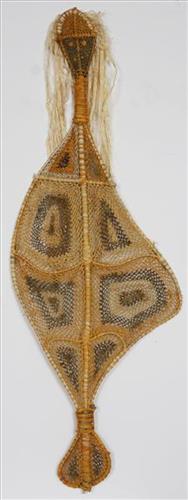
Nawarlah – Brown River Stingray

We hunt the Nawarlah (Brown River Stingray) during the wet season.  There is a plant with a yellow flower that tells us that it is the right time.  We know it will be fat. 

It is well known that Aboriginal art often depicts images of sacred totems or dreamings of Aboriginal culture. However, the world of the non-sacred also provides a rich source of subject matter for Aboriginal art. Much of the rock art of western Arnhem Land for example features secular topics such as common food animals and plants, depicted because of their economic importance but also merely because of their existence in the environment.

111982076240


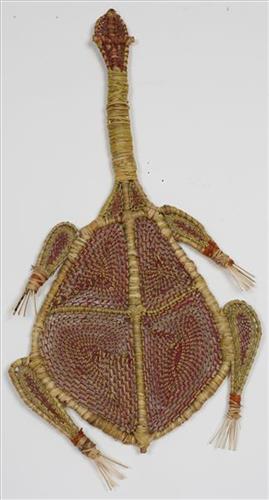
Barnda – long neck turtle

In the mythology or dreaming history of the Ganalbingu and Gurrgurrdjunggu peoples, two sisters who were the human forms of barnda ‘the Long-neck Turtle’ (Chelodina rugosa) came travelling a long distance from the east towards Ganalbingu country in Central Arnhem Land. They travelled through Martay country arriving at a place called Ji-malawa, the site today of a homeland/outstation community in the Blyth River district. At this place they turned their speech to the Burarra language and named sites as they travelled. The two Barnda sisters continued their journey to Gamardi, a site in Djinang country and they again changed their language to a dialect of Djinang called Wulagi.

Barnda is also Bulunbulun’s personal ‘Dreaming’ given to him by his father who was walking in the swamp at the time of the artist’s birth. 

While discussing the painting’s imagery, Bulunbulun explained that some components were the domain of ‘inside’ or secret ceremonial meaning and therefore he could only describe the ‘outside’ or public aspects of them.

In the painting Bulunbulun depicts the passage of the barnda through the country and the locations where the long neck turtle stopped to create features in the landscape in the Dreamtime. The two black circular forms are ngambul ‘a waterhole’ formed by barnda. The two horizontal bands of rarrk ‘crosshatching’ in the midlle and upper section of the painting are marwurru ‘a paperbark log’ over which barnda walked along the journey. The large areas of rarrk represent gurrwiling ‘the swamp’ created by barnda. The vertical swaying lines are gunbuluru and wuye different types of reeds that are so sharp that they can cut one legs when walking through the swamp. At the top of the painting above the head of the image of the turtle is a band of rarrk, which represents the view of the plain country and swamp from a hill.


111982076238


Barnda – long neck turtle

In the mythology or dreaming history of the Ganalbingu and Gurrgurrdjunggu peoples, two sisters who were the human forms of barnda ‘the Long-neck Turtle’ (Chelodina rugosa) came travelling a long distance from the east towards Ganalbingu country in Central Arnhem Land. They travelled through Martay country arriving at a place called Ji-malawa, the site today of a homeland/outstation community in the Blyth River district. At this place they turned their speech to the Burarra language and named sites as they travelled. The two Barnda sisters continued their journey to Gamardi, a site in Djinang country and they again changed their language to a dialect of Djinang called Wulagi.

Barnda is also Bulunbulun’s personal ‘Dreaming’ given to him by his father who was walking in the swamp at the time of the artist’s birth. 

While discussing the painting’s imagery, Bulunbulun explained that some components were the domain of ‘inside’ or secret ceremonial meaning and therefore he could only describe the ‘outside’ or public aspects of them.

In the painting Bulunbulun depicts the passage of the barnda through the country and the locations where the long neck turtle stopped to create features in the landscape in the Dreamtime. The two black circular forms are ngambul ‘a waterhole’ formed by barnda. The two horizontal bands of rarrk ‘crosshatching’ in the midlle and upper section of the painting are marwurru ‘a paperbark log’ over which barnda walked along the journey. The large areas of rarrk represent gurrwiling ‘the swamp’ created by barnda. The vertical swaying lines are gunbuluru and wuye different types of reeds that are so sharp that they can cut one legs when walking through the swamp. At the top of the painting above the head of the image of the turtle is a band of rarrk, which represents the view of the plain country and swamp from a hill.


111982076237


Yawkyawk

Yawkyawk is a word in the Kunwinjku/Kunwok language of Western Arnhem Land meaning ‘young woman’ and ‘young woman spirit being’. The different groups of Kunwinjku people (one of the Eastern dialect groups call themselves Kuninjku) each have Yawkyawk mythologies, which relate to specific locations in clan estates. These mythologies are represented in bark paintings and sculptures of Yawkyawk beings. There are also a few examples of rock art images of these beings.
The female water spirits Yawkyawk or Ngalkunburriyaymi are perhaps the most enigmatic of mythological themes. Sometimes compared to the European notion of mermaids, they exist as spiritual beings living in freshwater streams and rock pools, particularly those in the stone country. The spirit Yawkyawk is usually described and depicted with the tail of a fish. Thus the Kuninjku people sometimes call them ngalberddjenj which literally means ‘the young woman who has a tail like a fish’. They have long hair, which is associated with trailing blooms of green algae (called man-bak in Kuninjku). At times they leave their aquatic homes to walk about on dry land, particularly at night.
Aboriginal people believe that in the beginning most animals were humans. During the time of the creation of landscapes and plants and animals, these ancestral heroes in human form transmutated into their animal forms via a series of various significant events now recorded as oral mythologies. The creation ancestor Yawkyawk travelled the country in human form and changed into the form of Ngalkunburriyaymi as a result of various ancestral adventures. Today the Kuninjku believe that Ngalkunburriyaymi are alive and well and living in freshwater sites in a number of sacred locations.
Some features of a respective country are equated with body parts of Yawkyawk. For example a bend in a river or creek may be said to be ‘the tail of the Yawkyawk, a billabong may be ‘the head of the Yawkyawk and so on. Thus different groups can be linked together by means of a shared mythology featured in the landscape, which crosscuts clan and language group boundaries.

111982076235


Birlmu or Namarnkorl (Barramundi)

It is well known that Aboriginal art often depicts images of sacred totems or dreamings of Aboriginal culture. However, the world of the non-sacred also provides a rich source of subject matter for Aboriginal art. Much of the rock art of western Arnhem Land for example features secular topics such as common food animals and plants, depicted because of their economic importance but also merely because of their existence in the environment. The artist has painted ‘birlmu’ or ‘namarnkorl’ (Barramundi [Lates calcarifer]). During the dry season the barramundi is an important food source for inland Aboriginal people. These fish are caught throughout the artist’s clan estate, either in fishtraps woven from pandanus or sedge grass, or else hunted with spears and fishing lines in billabongs and streams where they shelter from the sun under fallen logs or amongst the leaves of water plants.

111982076234


Birlmu or Namarnkorl (Barramundi)

It is well known that Aboriginal art often depicts images of sacred totems or dreamings of Aboriginal culture. However, the world of the non-sacred also provides a rich source of subject matter for Aboriginal art. Much of the rock art of western Arnhem Land for example features secular topics such as common food animals and plants, depicted because of their economic importance but also merely because of their existence in the environment. The artist has painted ‘birlmu’ or ‘namarnkorl’ (Barramundi [Lates calcarifer]). During the dry season the barramundi is an important food source for inland Aboriginal people. These fish are caught throughout the artist’s clan estate, either in fishtraps woven from pandanus or sedge grass, or else hunted with spears and fishing lines in billabongs and streams where they shelter from the sun under fallen logs or amongst the leaves of water plants.

111982076233


Nawarlah – Brown River Stingray

We hunt the Nawarlah (Brown River Stingray) during the wet season.  There is a plant with a yellow flower that tells us that it is the right time.  We know it will be fat. 

It is well known that Aboriginal art often depicts images of sacred totems or dreamings of Aboriginal culture. However, the world of the non-sacred also provides a rich source of subject matter for Aboriginal art. Much of the rock art of western Arnhem Land for example features secular topics such as common food animals and plants, depicted because of their economic importance but also merely because of their existence in the environment.

111982076230


Nawarlah – Brown River Stingray

We hunt the Nawarlah (Brown River Stingray) during the wet season.  There is a plant with a yellow flower that tells us that it is the right time.  We know it will be fat. 

It is well known that Aboriginal art often depicts images of sacred totems or dreamings of Aboriginal culture. However, the world of the non-sacred also provides a rich source of subject matter for Aboriginal art. Much of the rock art of western Arnhem Land for example features secular topics such as common food animals and plants, depicted because of their economic importance but also merely because of their existence in the environment.

111582076283


Wantili (Warntili, Canning Stock Route Well 25)

 “Wantili is my place, where I was born. It’s a place where everyone was living- its all of their ngurra (home).It’s the Jukurrpa (Dreaming) of that place. All those claypans, a place where everyone comes together for ceremony and gatherings, all meeting with different families. I went there with my aunt [Jakayu Biljabu]  and my sister [Kumpaya Girgirba]- they told me the story of where I was born, in pujiman (traditional, desert dwelling) times. We walked all over the place, I was just a little one.”

-Glady Bidu Kuru

Wantili (Warntili, Canning Stock Route Well 25) is a large round jurnu (soak) and linyji (claypan) near Well 25 on the Canning Stock Route. The area is dominated by claypans surrounded by tuwa (sandhills), and Nyilangkurr, a prominent yapu (hill) is located on the edge of the claypan. Following rain the typically dry claypans are filled with water, with the overflow from nearby waterholes flowing to Wantili. At that time, Wantili becomes an important place for obtaining fresh water for drinking and bathing. Wantili is significant for the fact that at this site Kartujarra, Manyjilyjarra, Putijarra and Warnman people would all come together for ceremonies during the pujiman (traditional, desert dwelling) era. Many jiwa (stones used by women for grinding seeds) from these times can still be found there today. 

Wantili is an incredibly important cultural site, ‘where the creation started.’ (Cyril Whyoulter). In this creation story, the world was initially dark, and people were like rocks, with no arms or legs. Following the sun’s first rising, life-forms become increasingly complex while particular features in the land were created. Beyond these details much of the Jukurrpa (Dreaming) narrative relating to Wantili is ngurlu (sacred, taboo), and only for Martu, but the site is open, and anyone can go there. 

Wantili is also one of the many sites featured in the epic Minyipuru (Jakulyukulyu, Seven Sisters) Jukurrpa story. Minyipuru is a central Jukurrpa narrative for Martu, Ngaanyatjarra, Pitjantjatjara and Yankunytjatjara people that is associated with the seasonal Pleiades star constellation. Relayed in song, dance, stories and paintings, Minyipuru serves as a creation narrative, a source of information relating to the physical properties of the land, and an embodiment of Aboriginal cultural laws. The story follows the movement of a group of women travelling all the way across the desert, beginning at Roebourne on the coast of Western Australia, as they are pursued by Yurla, a lustful old man. As the women travelled, they stopped to rest at many sites to eat, dance, rest and sing, on the way leaving behind an assortment of articles that became formations in the land, such as groupings of rocks and trees, grinding stones and seeds. The sisters rested at Wantili before throwing seeds, then continued their journey far to the east and beyond Martu Country, stopping at various sites through central and South Australia.

The intersection of the Canning Stock Route with Wantili also made this a site of early contact with Europeans for many Martu then living a pujiman life in the desert. Following the route’s construction, Martu encountered Europeans and other Martu working as cattle drovers as they would travel up and down the Stock Route from water source to water source. Increasingly, pujimanpa (desert dwellers) followed the route to newly established ration depots, mission and pastoral stations. They were drawn to the route in search of food, by a sense of curiosity, or by loneliness. By the late 1950s and early 1960s, most of the desert family groups had left the desert. Eventually, these factors combined with an extreme and prolonged drought in the 1960s to prompt the few remaining pujimanpa to move in from the desert.

111582076282


Karlamilyi

Karlamilyi (Rudall River region) and its surrounds are Warnman Country, located in the very heart of the Martu homelands. The region is situated southwest of the Great Sandy Desert and northeast of the Little Sandy Desert. Spanning through the region is the epic Karlamilyi River, which runs north into Nyayartakujarra (Ngayarta Kujarra, Lake Dora), a large salt lake. The Broadhurst and Fingoon Ranges extend diagonally across the river’s path. The landscape is striking for its abundance of gorges and valleys carved by ice age glaciers, rugged cliffs, red tali (sand dunes), grasslands, sandstone and quartz rocky outcrops, and salt lakes. 

Across the whole region are hundreds of water sources; including waterholes, creeks, soaks, lakes, pools and rockholes. Lining the rivers are coolabah, walyji (river gum), yulbah (bats wing coral tree), and several species of acacia and hakea. Jalkuran (paperbark), kurrulyu/ mijarrpa (bloodwood) and jawirli (quandong) are found in the region’s valleys, and wikirrpa (desert oaks) and grasses in the sandplains. The area is abundant with bird species, jila (snakes), maruntu (goannas), red kangaroos and warlpaju (rock wallabies). The region is also home to remote aboriginal communities Punmu and Parnngurr.

According to two of the central Martu Jukurrpa (Dreaming) narratives, the Karlamilyi River and its surrounds were created by the ancestral beings Jila Kujarra (Two Snakes) and the Wati Kujarra (Two Goanna Men) as they travelled across the lands.