111982095228


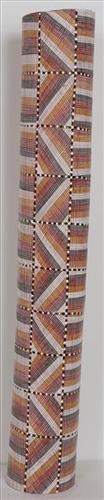
Wak Wak

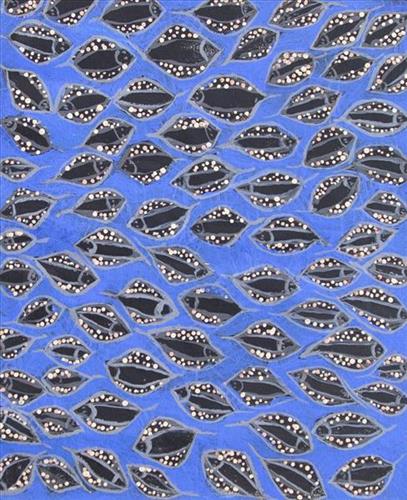
This painting depicts a sacred site at ‘Kurrurldul’, an outstation south of Maningrida.

The ‘rarrk’, or abstract crosshatching, on this work represents the design for the crow totem ancestor called ‘Djimarr’. Today this being exists in the form of a rock, which is permanently submerged at the bottom of Kurrurldul Creek. The ‘Djimarr’ rock in the stream at Kurrurldul is said to move around and call out in a soft hooting tone at night. Both the stone itself and the area around it are considered sacred.

The imagery represents the rock mentioned above at the bottom of Kurrurldul creek, which is the final transmutation of the dreaming ancestor ‘Djimarr’. Finally, the pattern used here is also the crow design used in the sacred ‘Mardayin’ ceremony, which is a large regional patri-moiety ceremony now rarely conducted in central and eastern Arnhem Land.

111982095227


Wak Wak

This painting depicts a sacred site at ‘Kurrurldul’, an outstation south of Maningrida.

The ‘rarrk’, or abstract crosshatching, on this work represents the design for the crow totem ancestor called ‘Djimarr’. Today this being exists in the form of a rock, which is permanently submerged at the bottom of Kurrurldul Creek. The ‘Djimarr’ rock in the stream at Kurrurldul is said to move around and call out in a soft hooting tone at night. Both the stone itself and the area around it are considered sacred.

The imagery represents the rock mentioned above at the bottom of Kurrurldul creek, which is the final transmutation of the dreaming ancestor ‘Djimarr’. Finally, the pattern used here is also the crow design used in the sacred ‘Mardayin’ ceremony, which is a large regional patri-moiety ceremony now rarely conducted in central and eastern Arnhem Land.

111582095188


Kun Kun (Kuny-Kuny)

Kun Kun (Kuny-kuny) is a soak accessing a large body of underground water, located southeast of Kunawarritji (Canning Stock Route Well 33). The site is sacred for its association with the marlu (kangaroo) Jukurrpa (Dreaming), and was an important ceremonial site during the pujiman (traditional, desert dwelling) period.

At this time, Martu would traverse very large distances annually in small family groups, moving seasonally from water source to water source, and hunting and gathering bush tucker as they went. Knowledge of water sources was critical for survival, and today Martu Country is still defined in terms of the location and type of water. Each of the hundreds of claypans, rockholes, waterholes, soaks and springs found in the Martu desert homelands is known by name, location, quality and seasonal availability through real life experience and the recounting of Jukurrpa narratives.

Soaks, or soakwaters, derive their name from the manner in which their waters generally seep into the sand from below stores, sometimes as part of an ephemeral river or creek. Soaks were an especially important source of water during the pujiman era, being the most dependable water source in times of drought. Water was obtained from soaks by scooping away the sand with a piti (timber bowls used for carrying food and water) until clear water gathered at the base of the hole, sometimes at a depth of several metres.

111582095174


Untitled

“When Martu paint, it’s like a map. Martu draw story on the ground and on the canvas, and all the circle and line there are the hunting areas and different waters and tracks where people used to walk, and [some you] can’t cross, like boundaries. So nowadays you see a colourful painting and wonder what it is, but that’s how Martu tell story long ago. It’s not just a lovely painting, it’s a story and a songline and a history and everything that goes with it.” 

– Ngalangka Nola Taylor and Joshua Booth

This work portrays an area of Country that can be interpreted in multiple ways. Firstly, the image may be read as an aerial representation of a particular location known to the artist- either land that they or their family travelled, from the pujiman (traditional, desert dwelling) era to now. During the pujiman period, Martu would traverse very large distances annually in small family groups, moving seasonally from water source to water source, and hunting and gathering bush tucker as they went. At this time, one’s survival depended on their intimate knowledge of the location of resources; thus physical elements of Country, such as sources of kapi (water), tali (sandhills), different varieties of warta (trees, vegetation), ngarrini (camps), and jina (tracks) are typically recorded with the use of a use of a system of iconographic forms universally shared across the desert. 

An additional layer of meaning in the work relates to more intangible concepts; life cycles based around kalyu (rain, water) and waru (fire) are also often evident. A thousands of year old practice, fire burning continues to be carried out as both an aid for hunting and a means of land management today. As the Martu travelled and hunted they would burn tracts of land, ensuring plant and animal biodiversity and reducing the risk of unmanageable, spontaneous bush fires. The patchwork nature of regrowth is evident in many landscape works, with each of the five distinctive phases of fire burning visually described with respect to the cycle of burning and regrowth.  

Finally, metaphysical information relating to a location may also be recorded; Jukurrpa (Dreaming) narratives chronicle the creation of physical landmarks, and can be referenced through depictions of ceremonial sites, songlines, and markers left in the land. Very often, however, information relating to Jukurrpa is censored by omission, or alternatively painted over with dotted patterns.

111582095171


Sylvana Station

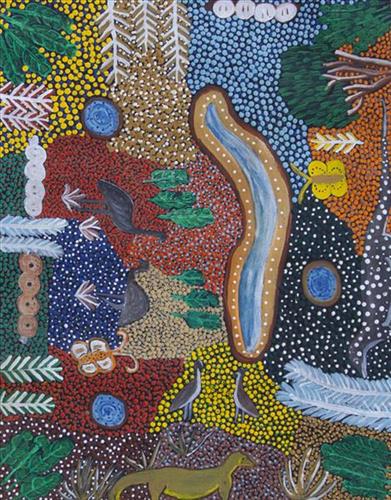
This work portrays an area known intimately to the artist, painted here in exquisite detail from memory. During the pujiman (traditional, desert dwelling) era one’s survival depended on their intimate knowledge of the location of resources; thus physical elements of Country, such as sources of kapi (water), tali (sandhills), and different varieties of warta (trees, vegetation) were carefully observed and remembered. Today, this relationship with Country remains equally strong, despite the movement of Martu out of the desert and into remote Aboriginal Communities, towns and cities.

Also visible may be traces of life cycles based around kalyu (rain, water) and waru (fire). A thousands of year old practice, fire burning continues to be carried out as both an aid for hunting and a means of land management today. As the Martu travelled and hunted they would burn tracts of land, ensuring plant and animal biodiversity and reducing the risk of unmanageable, spontaneous bush fires. The patchwork nature of regrowth is visible in many landscape works, with each of the five distinctive phases of fire burning visually described with respect to the cycle of burning and regrowth.  

Finally, metaphysical information relating to a location may also be recorded; Jukurrpa (Dreaming) narratives chronicle the creation of physical landmarks, and can be referenced through depictions of ceremonial sites, songlines, and markers left in the land. 

111582095170


Pujiman

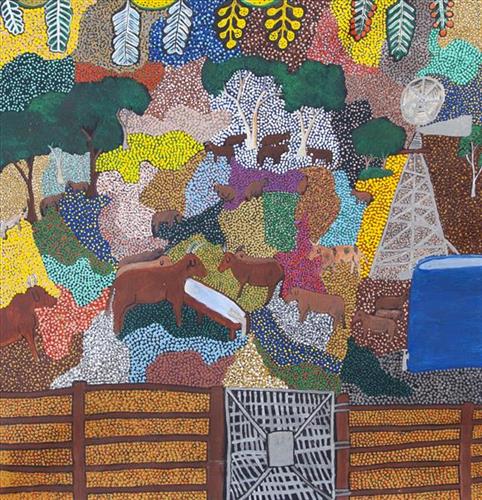
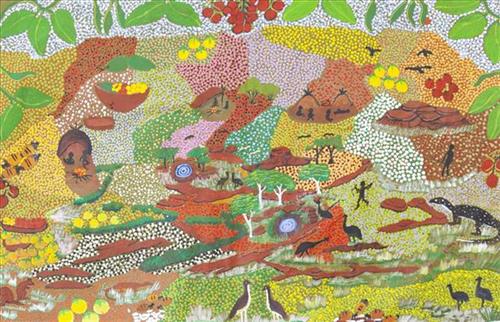
“This painting is of pujiman (traditional, desert dwelling) [people]. It’s around Parnngurr area. The men are getting ready to go hunting. There’s dingoes; Pujiman would get ’em as a little baby and raise ’em up to keep as hunting dogs. [There’s] Kids staying home, and women too. Shade is made from spinifex. Not much of a shelter but to keep the heat away.”

– Noreena Kadibil


Depicted in this work is a scene of everyday pujiman life at Parnngurr rockhole as communicated to Noreena by her parents and grandparents. Parnngurr rockhole is located just south of Parnngurr Aboriginal community. At the junction of three linguistic groups; Manyjilyjarra, Kartujarra, and Warnman, it was a critical and permanent source of water during the pujiman (traditional, desert born) era that supported many ritual large gatherings. During this nomadic period families stopped and camped here depending on the seasonal availability of water and the corresponding cycles of plant and animal life on which hunting and gathering bush tucker was reliant. At Parnngurr and other similarly important camp sites families would meet for a time before moving to their next destination. Parnngurr and its surrounds are physically dominated by distinctively red tali (sandhills), covered sparingly with spinifex and low lying shrub.

Parnngurr is also important site chronicled in the epic Jukurrpa (Dreaming) story of the Minyipuru (Jakulyukulyu, Seven Sisters). The sisters stopped to rest on Parnngurr Hill before continuing on their long journey east. Minyipuru is a central Jukurrpa narrative for Martu, Ngaanyatjarra, Pitjantjatjara and Yankunytjatjara people that is associated with the seasonal Pleiades star constellation.

It is of great significance to the creative output of Martumili Artists that some of the last of the remaining pujimanpa (traditional, desert dwellers) comprise a high portion of the core elders that paint with the group. Through these elders critical traditional cultural and social knowledge has been, and continues to be, passed on to younger Martu artists; knowledge from the pujiman (traditional, desert dwelling) era. At this time Martu traversed very large distances annually in small family groups, moving seasonally from water source to water source, and hunting and gathering bush tucker as they went. 

Whilst desert life has moved away from mobile hunter-gatherer subsistence throughout the course of the twentieth century, all Martumili Artists, young and old, have regular experience of the practices that most closely approximate the pujiman lifestyle. Living between Newman and the remote Martu communities of Punmu, Parnngurr, Kunawarritji, Jigalong, Irrungadji (Nullagine) and Warralong, knowledge of Jukurrpa (Dreaming) narratives, kapi location and quality, and the medicinal properties of native plants, as well as the continued practices of hunting, gathering, and waru (fire) burning are all transferred to younger generations as integral components of everyday life. 

In addition to strong cultural and social maintenance through life in Aboriginal communities, cultural knowledge is transferred through visual arts as practiced by Martumili Artists. Younger Martu artists typically begin painting with their parents, grandparents and extended family, thus fostering an organic process of learning, not only about painting techniques, but also specific locations, family histories, traditional ways of life, bush tucker and Jukurrpa.
111582095169


Katjarra

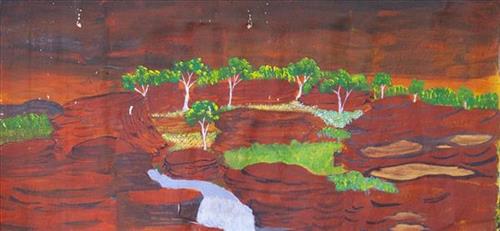
“This is my father’s Country; this is where my grandfather and grandmother come from. Katjarra is homeland for Putijarra, it’s their ngurra (home Country, camp). This is where pujiman (traditional, desert dwelling) Martu used to live a long time ago. Most of them pass[ed] away and are buried there. Some of them left and went looking for their families in Wiluna and Jigalong. Long, long time ago, the old Martu people used to roam this Country. They used to sleep in the caves away from the wind and the rain of winter. 

Katjarra is well known as a sacred area, no mining companies can’t do any mining round Katjarra because the oldies say the sites are not to be destroyed.”

 – Noreena Kadibil

Katjarra (Carnarvon Range) mountain ranges are part of Noreena’s ngurra (home Country, camp). The mountain range, distinctive from a distance for its blue hue, is located in the south western corner of Birriliburu Indigenous Protected Area. This region lies at the southern end of Martu Country and at the intersection of the Little Sandy and Gibson Deserts of Western Australia. Katjarra was an important camping place for Martu walking between Jigalong and Wiluna for law business up until the late 1960s, as well as Martu who walked the Canning Stock Route into Wiluna. Katjarra was also the site of the 2008 Birriliburru Native Title Determination, one of the first land grants to Martu.

Within the Katjarra mountain range are many water sources, including a culturally significant creek close to Milyinirri (Canning Stock Route Well 6), also named Katjarra. This creek is home to an ancestral rainmaking jila (snake), and its waters cascade down the hill from here. The Western Desert term jila is used interchangeably to describe springs considered to be ‘living’ waters and snakes, both of which play a central role in Martu culture and Jukurrpa (Dreaming). During the pujiman period, knowledge of water sources was critical for survival, and today Martu Country is still defined in terms of the location of water sources. Of the many permanent springs in Martu Country, very few are ‘living waters’; waters inhabited by powerful ancestral snakes. Before they became snakes, these beings were men who made rain, formed the land and introduced cultural practices like ceremonies and ritual songs. Some of the men travelled the desert together, visiting one another, but they all ended their journeys at their chosen spring alone, transformed into a snake. These important springs, like Katjarra, are named after their jila inhabitant.

Katjarra also features as a site in the Minyipuru (Jakulyukulyu, Seven Sisters) Jukurrpa, and that of the yalapara (perentie goanna), an ancestral goanna being who was responsible for the creation of many significant land features in the area. 

111582095138


Stingray Season

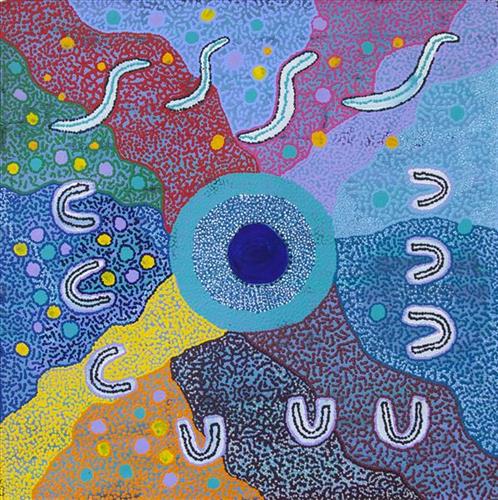
“When Martu paint, it’s like a map. Martu draw story on the ground and on the canvas, and all the circle and line there are the hunting areas and different waters and tracks where people used to walk, and [some you] can’t cross, like boundaries. So nowadays you see a colourful painting and wonder what it is, but that’s how Martu tell story long ago. It’s not just a lovely painting, it’s a story and a songline and a history and everything that goes with it.” 

– Ngalangka Nola Taylor and Joshua Booth

This work portrays an area of Country that can be interpreted in multiple ways. Firstly, the image may be read as an aerial representation of a particular location known to the artist- either land that they or their family travelled, from the pujiman (traditional, desert dwelling) era to now. During the pujiman period, Martu would traverse very large distances annually in small family groups, moving seasonally from water source to water source, and hunting and gathering bush tucker as they went. At this time, one’s survival depended on their intimate knowledge of the location of resources; thus physical elements of Country, such as sources of kapi (water), tali (sandhills), different varieties of warta (trees, vegetation), ngarrini (camps), and jina (tracks) are typically recorded with the use of a use of a system of iconographic forms universally shared across the desert. 

An additional layer of meaning in the work relates to more intangible concepts; life cycles based around kalyu (rain, water) and waru (fire) are also often evident. A thousands of year old practice, fire burning continues to be carried out as both an aid for hunting and a means of land management today. As the Martu travelled and hunted they would burn tracts of land, ensuring plant and animal biodiversity and reducing the risk of unmanageable, spontaneous bush fires. The patchwork nature of regrowth is evident in many landscape works, with each of the five distinctive phases of fire burning visually described with respect to the cycle of burning and regrowth.  

Finally, metaphysical information relating to a location may also be recorded; Jukurrpa (Dreaming) narratives chronicle the creation of physical landmarks, and can be referenced through depictions of ceremonial sites, songlines, and markers left in the land. Very often, however, information relating to Jukurrpa is censored by omission, or alternatively painted over with dotted patterns.

111582095133


Untitled

This is Dale’s Country- her ‘ngurra’ (home Country, camp). People identify with their ngurra in terms of specific rights and responsibilities, and the possession of intimate knowledge of the physical and cultural properties of one’s Country. Painting ngurra, and in so doing sharing the Jukurrpa (Dreaming) stories and physical characteristics of that place, has today become an important means of cultural maintenance. Dale’s ngurra encompasses her birthplace, Jigalong, and the Country that her family walked in the pujiman (traditional, desert-dwelling) era, including Puntawarri, Raarki (Canning Stock Route Well 27), Kularti, Kumpupirntily , Mirtikanya, (Kumpupintily, Lake Disappointment), and Mukurtu.

Portrayed in this work are features of Dale’s family’s ngurra, such as the striking salt lakes, dominant permanent red tali (sandhills), warta (trees, vegetation), and the individually named water sources they camped at. Rock holes, waterholes, soaks and springs were all extremely important sites for Martu people during the pujiman period, and are generally depicted with circular forms. 

The encyclopaedic knowledge of the location, quality and seasonal availability of the hundreds of water bodies found in one’s Country sustained Martu as they travelled across their Country, hunting and gathering, visiting family, and fulfilling ceremonial obligations. They would traverse very large distances annually, visiting specific areas in the dry and wet season depending on the availability of water and the corresponding cycles of plant and animal life on which hunting and gathering bush tucker was reliant. As they travelled and hunted they would also burn areas of Country, generating a greater diversity of plant and animal life.

111582095131


Bush Medicine

“I used to walk around Patjarr with my grandmother collecting bush medicine.  We would grab the leaves, the roots, make a fire and boil it up in a big pot.  Then we would put it in a little container, you rub it on when you are sick.  Helps with boils, scabies, wounds.  This one is called Warlparriny.”

 – Mary Larry 

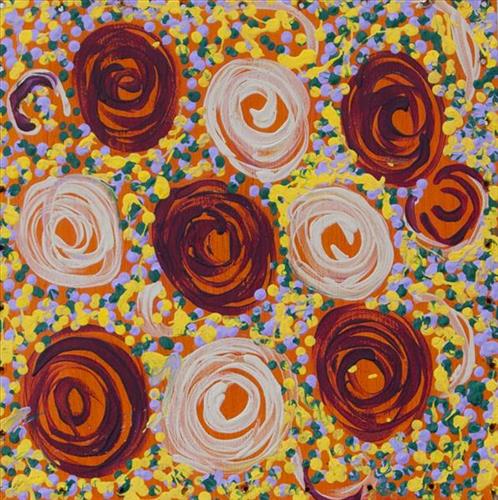
Traditional Martu knowledge of plant properties was encyclopedic, and saw plants used for purposes as diverse as food resources, carving implements, tobacco, firewood, shelter construction, and bush medicines. Depicted in this work are types of bush medicines, their habitats, and the processes used in their preparation. 

Physical ailments treated with plant based poltices, body washes, drinks, rubs and pastes included fever, congestion, headache, skin sores, aching limbs, and digestive problems. More serious health issues were often treated with a combination of bush medicine and maparn (magic healing/ healer).

Plants still prepared to make bush medicines today include warlji (desert bloodwood), kalpari (Dysphania Kalpari) and nayju (green crumbweed), which can be soaked in a water solution to make a skin wash. One of the most popular types of bush medicine still used today is wanta (red sap), collected from the mijarrpa (bloodwood) tree and brewed as a tea to ease heart pains and other body aches.