Lipuru and Warlawarla
The artist has depicted several wells on the Canning Stock Route and a number of permanent water sources in the same region.

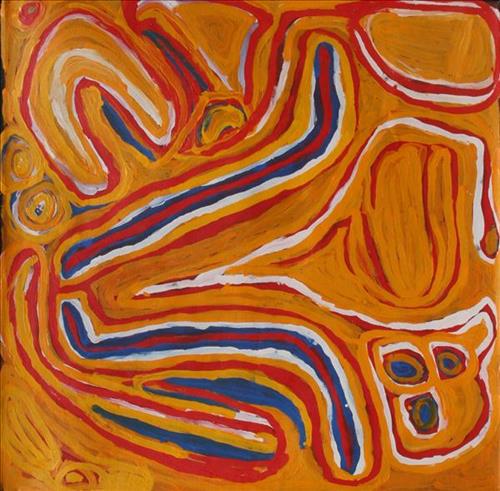
The artist has depicted several wells on the Canning Stock Route and a number of permanent water sources in the same region.


This artist primarily paints her country around Kunawarritji (Well 33) and across to Kiwirrkura which is her birth place. As a young woman, the artist travelled this country extensively so she has a very in depth knowledge of the land. Kumpaya now lives on the community of Parnngurr with her family.


This painting depicts Yartuturma Warla, a salt lake in the artist’s country between Punmu and Kunawarritji Aboriginal Communities. May says, “In the Jukurrpa (Dreamtiume), two wantis (women) went there looking for men. They were singing out there. Then the men found them and put them on their heads and then flew far away.”


This painting represents the “Rock hole’ Jurnu, Yinta, everything!!”When the artist was younger during the Pujiman (bush) days she walked around a very extensive area of the desert all around the Canning Stock Route area. They would walk from water source to water source; this is what she is illustrating through this painting. Represented are a lot of the different Jurnu (rock holes) and Yinta (spring) where she and her family would go. Mili means belongs to everybody and Ngurra is home or country, all of the artists family walked here. She was here with all her Jurtu (sisters) Wungu, Yarpa, Nyikaya and Wunja walking around everywhere. She was also in this country with fellow artists Nora Wompi and Nora Nungabar as well as her mummy Yurnurr. When the artist was a baby in the Pujiman time near Kilkil (well 36) on the Canning Stock Route there was no whitefellas. Then they saw the drovers with the bullocks and camels so they ran away a long way. She didn’t like them and she had no clothes on.


This painting is part of a quadriptych painted by the artist representing different times and cycles within his country Kulyakartu. Kulyakartu is an area in the far north of the Martu homelands, near the Percival Lakes in the northern Great Sandy Desert. The artist lived out this way traditionally with his family during the pujiman (bush) days.
This is the second panel that shows Kulyakartu later when it is a little bit dry and the spinifex starts to dry out, maybe around winter time. This is when the flowers come out, particularly the ngatarn-ngatarn which is a yellow mulla mulla known as a tassel top or a Pussytail, when the seeds dry up you can eat them.


This painting portrays Nyurnma with all of the plants in flower. There are all kinds of plants, the warmala (bush tomatoes) have purple flowers. The yellow dots are the grasses coming up. The bare ground is a rocky bit where the plants don’t grow as well.


This painting depoicts the tracks of a mob of emus on their way to Puntawarri for kapi (water). Puntawarri is the artists’ mother’s family’s country and is on the middle stretches of the Canning Stock Route, near Well 17 also known as Durba Springs. Puntawarri is an important cultural area, east of the Jigalong Aboriginal Community, where the artist now lives with her grandmother. The artist’s grandmother frequently travelled and hunted with her family in this area when she was a young girl, and is now teaching Judith the stories for this country.


“My Country, Kulyakartu. I grew up there, from little boy to big boy grew up there.”
This painting depicts Muuki’s Country, Kulyakartu; an area in the far north of the Martu homelands, near the Percival Lakes in the northern Great Sandy Desert. The artist has extensive knowledge of the Country in this region, where he grew up living traditionally during the pujiman (traditional, desert dwelling) days with his family. Kulyakartu is mostly grass Country where there is very good hunting. There is no permanent water source in Kulyakartu, so his family would walk here annually following the wet season.
Muuki paints his Country in all its different seasonal stages. Often visible in his work is the patchwork of nyurnma (burnt ground) depicting the regrowth subsequent to the practice of waru (fire) burning that assists with hunting, regenerates growth, and encourages greater diversity in plant and animal life.


This painting portrays part of the artist’s country where their family lived traditionally during the pujiman (bush) days. The Martu lived very nomadically moving from water source to water source hunting and gathering bush tucker as they went. They would traverse very large distances visiting some areas in the dry and some in the wet season depending on the availability of water. As they travelled and hunted they would also burn areas of country creating a larger diversity of plant and animal life.


This painting portrays part of the artist’s country where their family lived traditionally during the pujiman (bush) days. The Martu lived very nomadically moving from water source to water source hunting and gathering bush tucker as they went. They would traverse very large distances visiting some areas in the dry and some in the wet season depending on the availability of water. As they travelled and hunted they would also burn areas of country creating a larger diversity of plant and animal life.