Merlemerle dja Mandjabu
Merlemerle (butterfly) and Mandjabu (fishtrap). Roseanna s printing one of her late grandmothers designs, Merlemerle.
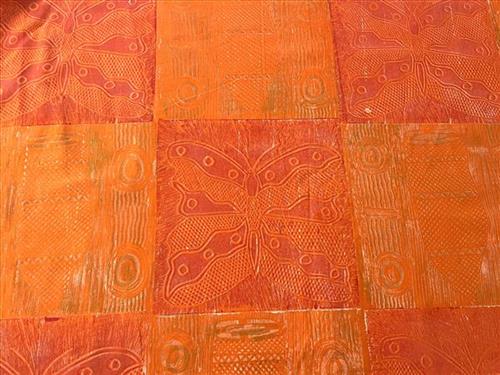
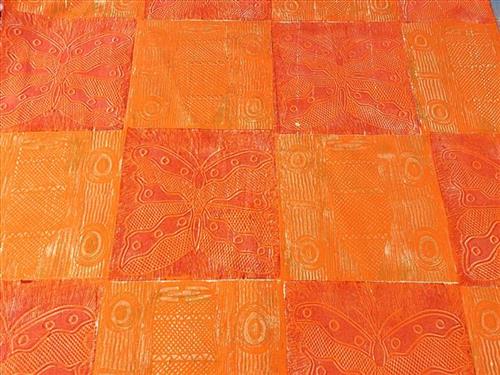
Merlemerle (butterfly) and Mandjabu (fishtrap). Roseanna s printing one of her late grandmothers designs, Merlemerle.
A ‘bamagora’ is a Burarra word for a traditional woven tent-like structure. A bamagora was woven to create a shelter for a child or adult when sleeping.
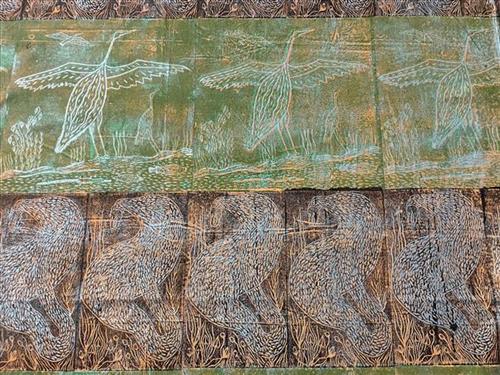
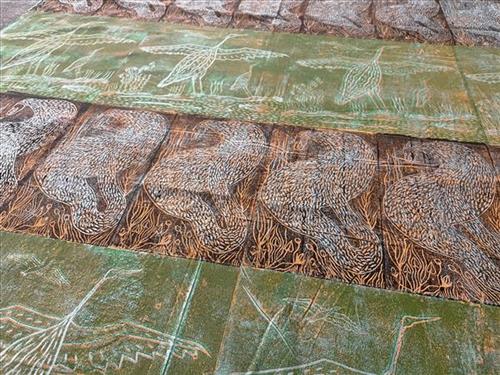
Bolung (Rainbow Serpent) is from the sacred country of Dukala- Djarranj. This is the country of Jay’s grandparent and a place of great significance, as Bolung, the Rainbow Serpent, travelled through the landscape. Rock art in the area depicts a rotund Bolung.
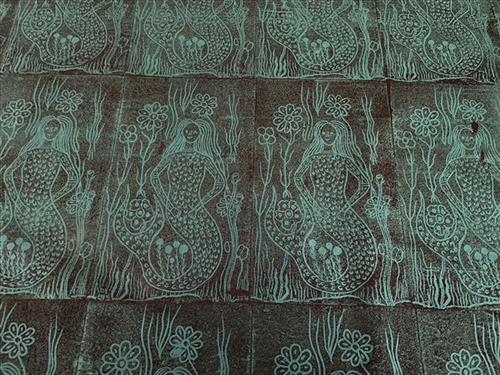
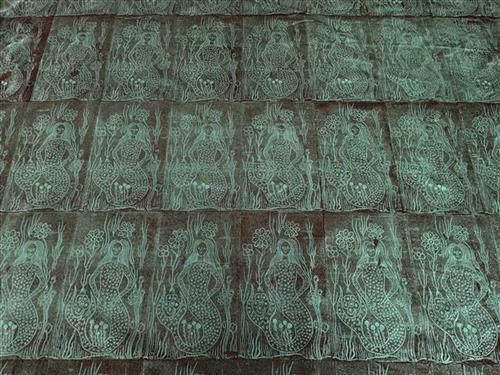
Ngalkunburriyaymi
Kuninjku people call mermaids yawkyawk, but in my language, Kune, we call them Ngalkunburriyaymi (pronounced Ngaal gun borro yay mee).
The Ngalkunburriyaymi depicted in my artworks is from a place called Marra-yii (sp?). There are too many Ngalkunburriyaymi living at this place. They are always there and have been there forever. We can go camping and fishing at this place. Marar-yii is a place in the river. They are freshwater. They are Duwa moiety. Same as the freshwater crocodile.
My mum told me her story. Ngalkunburriyaymi gave her a baby. Ngalkunburriyaymi came to her in a dream. They gave her my brother. In my mother’s dream, she went fishing Marra-yii and Ngalkunburriyaymi came to her to tell her she was having a baby. She said to her I will give you a baby. In a couple of months, you will be pregnant.
Ngalkunburriyaymi eats fish and waterlilies.
Owen Yalandja is my cousin from my father’s side and Lulu is my grandmother also from my father’s side. They are from different outstations, but we are family. My Ngalkunburriyaymi story is connected to them but different.
I love my mother’s story and it is why I made a lino plate. I print it on different colour fabrics – silk, linen and cotton. I like using lots of different colours. I come from a family who have made artwork on bark and hollow logs using ochre—black, yellow, red and white. But at Babbarra Designs, we can use bright colours in our fabric designs.
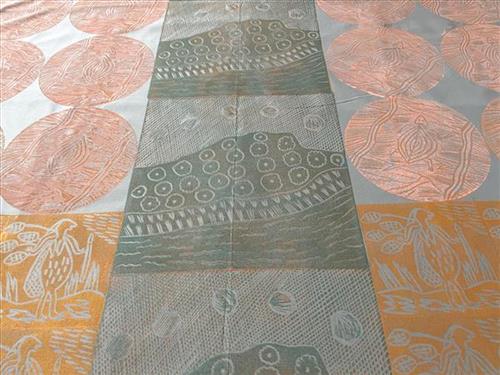
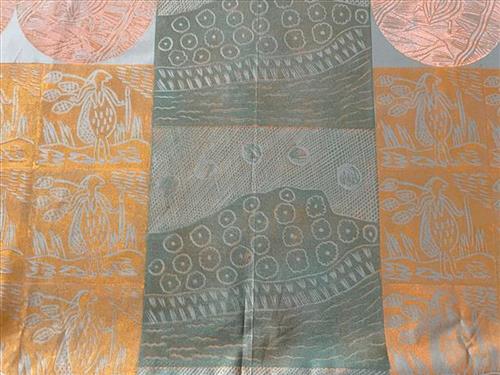
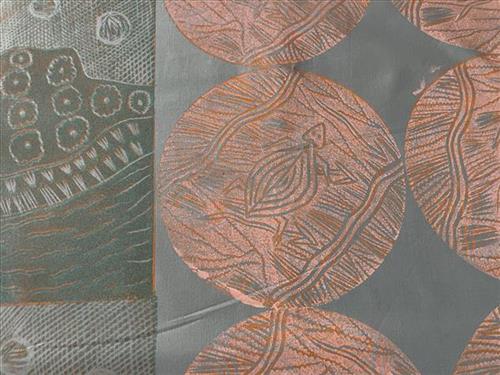
Ngaldjorlhbo is a powerful woman who created the spiritual and tangible world for the Aboriginal people in Western Arnhem Land. In creating the land and environment, she endowed Kuninjku people with the ability to create art, and with their culture, to share with future generations. Ngaldjorlhbo gives women the cultural knowledge and deep links to country, identity and ancestor spirits.
‘I like lino, print my design and doing different way to print my lino, different colours and different way. I print lino Yawkyawk (spirit woman) and Ngaldjorlhbo (mother of Everything). This was an old lady and she create that language and the world before. I also print also Rolk (maggot), my mother design cause I’m the Djunkay (land manager) for her.’ Janet Marawarr 2020
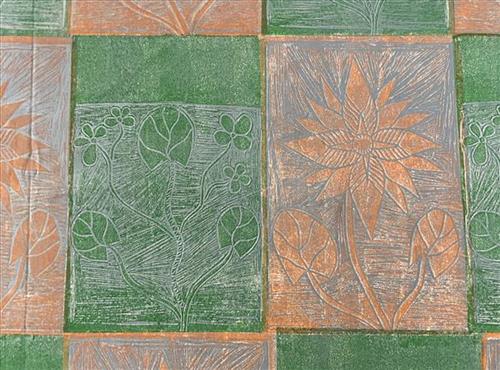
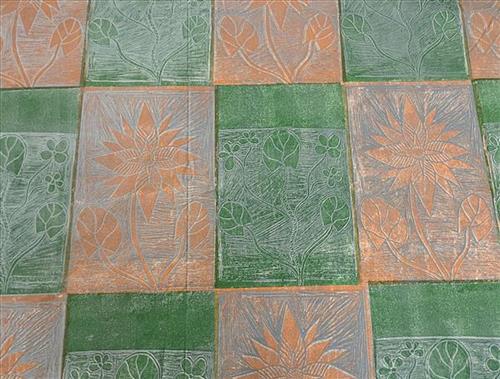
Wayuk (Waterlily) Nymphaea violacea.
The stem of wayuk is a popular bushfood and the beautiful flower is enjoyed across Arnhem Land.
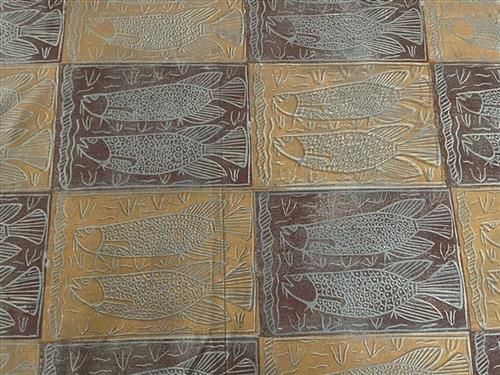
This design tells the story of Saratoga dreaming a freshwater fish that swims on the edge of creeks and rivers. This design is the Saratoga dreaming from the Mularra songline. Where the Saratoga we call Murdulngu, Danguny travelled from Malmyangarnak billabong to Mirrigatja.
This Billabong was owned by Murdulngu (Saratoga) before the water was taken over by shark Barlangu he came all the way from east to north then to west. He was travelling when that water level was high he went up the stream but he couldn’t make it. This Barlangu came from Murruggun clan but really this shark came from long way all the way south. This story is connected through Mularra songline it represents many clans.
With permission from clan elders, Carol is able to pass on this family knowledge through her passion in textile and art.
‘I am proud of my first design, I want to keep this design for future, for my children and grandchildren so they remember this story, this story is a big part of the mularra songline’
A soft aqua base cloth.
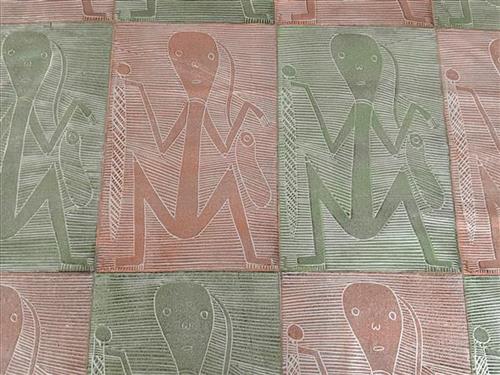
Buluwana (Spirit Woman)
The Kuninjku people of Arnhem Land tell of a time when their ancestors suffered a terrible drought. People living in the rocky outlier region near the middle Mann River dug wells to get water until these too dried up. Then they obtained water by cutting the trunks of Melaleuca trees called djidjdjerok which store brackish water inside. When these trees were exhausted, people were surviving only on wild honey. Eventually people died of thirst. The bones of these people are said to be those found in the caves of the escarpment country of Western Arnhem Land in the Mann River district.
In the ancestral time of creation there was a great drought. During this time Buluwana and her family camped at Ngandarrayo on Kurulk clan land. They were weak from thirst and close to death. The malevolent gigantic form of the Death Adder snake confronted the group. Buluwana attempted to run away with the rest of her family but was crushed and turned to stone. Today an arrangement of rocks standing in the ground remains as Buluwana’s present day form. Only her head protrudes as a prismoid standing stone, the rest of her body is under the ground. Other human remains lying on rock ledges are said to be the remains of other early ancestors.
SOURCE: Maningrida Arts & Culture
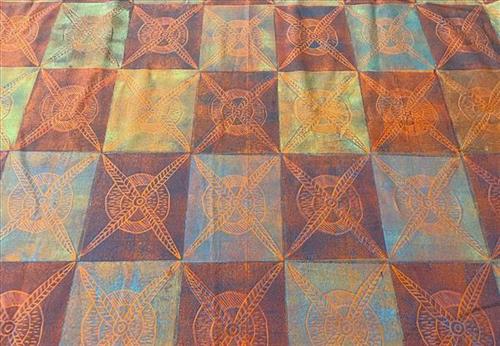
The ceremony known throughout Arnhem Land generically as Marradjiri is a ceremony of diplomacy given by one group to another to establish good relations and to strengthen kinship (for example by marriage) and economic ties (for example the sharing of clan estate resources).
The central object in the Marradjiri ceremony is a decorated polepainted with clan designs. The work on the pole is undertaken as part of the ceremony and is accompanied by the associated song series.
Often the ceremony commences when one group invites another and the people invited perform the Marradjiri. When a child finds their first bush food or object of value it is taken as a sign that the Marradjiri ceremony should be performed and an invitation is sent out sometimes in the form of a lock of hair from this child or in the form of some other token, sometimes encased in beeswax and wrapped in cloth. The token is delivered to the invited performers who then prepare to give the ceremony to their hosts at the residence of the host group.
Each evening before sunset the performance begins and continues for two or three hours. In the early stages of the ceremony the dancers perform with body clan designs which become progressively more elaborate as the time approaches the end of the ceremony. Usually this may take two or three weeks.
In the Marradjiri, the pole is said to represent a mast of a Makassan prau. There exists many loan words (over three hundred in total) in North Australian Aboriginal languages and one of these is the Makassan word for mast of a ship ‘palayarrang’ which has changed in some Maningrida languages to ‘bulayarrang’ and a few other variations.
It is possible that the name of this ceremony has its origins in the Makassan word for mast. The Marradjiri ceremony is influenced heavily by Makassan themes.
On the final night of the ceremony the pole appears out of the darkness on the edge of the camp decorated with feathered tassles and long ropes which represent the rigging of the prau. Dancers hold these ropes and move the pole back and forth in the fashion of a prau rolling in rough sea as depicted. The dancers bring the pole down and dance with it until it is finally presented to the host group with great ritual and the pole is set into the ground to the accompaniment of the head song man chanting through a long list of clan names associated with the travels of creation ancestors.
When the dancers part with the pole they break into mourning as they may have done at the end of each Makassan trepanging season when their Makassan visitors returned to Sulawesi on the new early dry season winds. The pole is then kept by the host group, often being hung from the roof of a dwelling. Text taken from Maningrida Arts and Culture
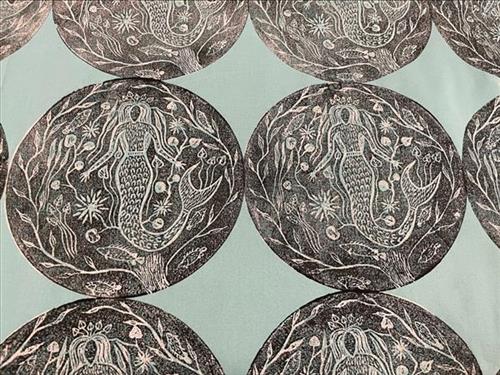
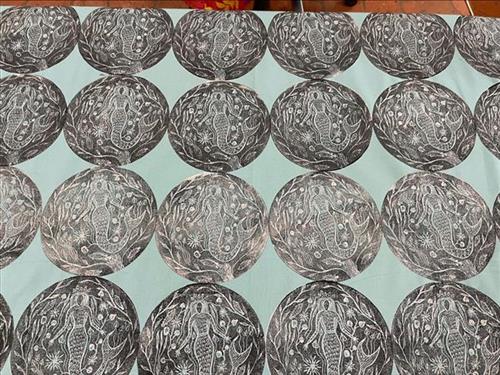
Ngalkunburriyaymi
Kuninjku people call mermaids yawkyawk, but in my language, Kune, we call them Ngalkunburriyaymi (pronounced Ngaal gun borro yay mee).
The Ngalkunburriyaymi depicted in my artworks is from a place called Marra-yii (sp?). There are too many Ngalkunburriyaymi living at this place. They are always there and have been there forever. We can go camping and fishing at this place. Marar-yii is a place in the river. They are freshwater. They are Duwa moiety. Same as the freshwater crocodile.
My mum told me her story. Ngalkunburriyaymi gave her a baby. Ngalkunburriyaymi came to her in a dream. They gave her my brother. In my mother’s dream, she went fishing Marra-yii and Ngalkunburriyaymi came to her to tell her she was having a baby. She said to her I will give you a baby. In a couple of months, you will be pregnant.
Ngalkunburriyaymi eats fish and waterlilies.
Owen Yalandja is my cousin from my father’s side and Lulu is my grandmother also from my father’s side. They are from different outstations, but we are family. My Ngalkunburriyaymi story is connected to them but different.
I love my mother’s story and it is why I made a lino plate. I print it on different colour fabrics – silk, linen and cotton. I like using lots of different colours. I come from a family who have made artwork on bark and hollow logs using ochre—black, yellow, red and white. But at Babbarra Designs, we can use bright colours in our fabric designs.