377810582122138


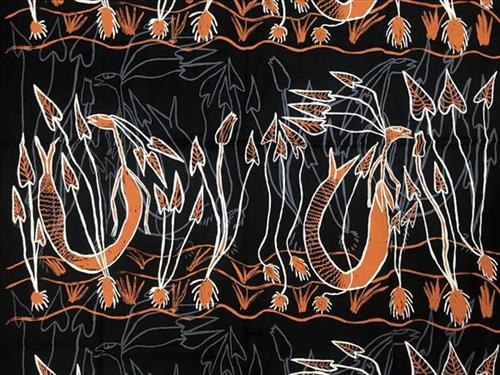
Yawkyawk dja Wayuk (Young Woman Spirit and Water Lily)

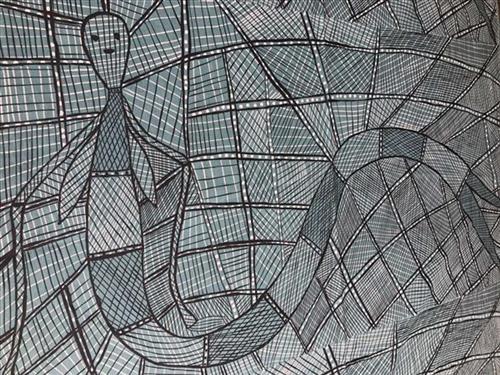
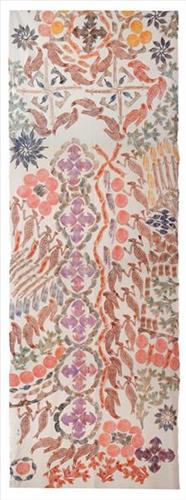
Deborah Wurrkidj is a Kuninjku artist from the Kurulk clan whose country lies around the outstation of Mumeka in central Arnhem Land. This image depicts a female water spirit, or yawkyawk, from a creek in the rock country near Yikkarakal. The Yawkyawk is a story of the Duwa moiety that Deborah learnt to paint from her father.

Yawkyawk are water spirits (mermaids) and also young women. This design is yawkyawk in the billabong near Yikkarakal. Yawkyawk move like women, the one on the left is the old woman and on the right is the young woman. They are mother and daughter.

“Sometimes you can hear yawkyawk talking at night. My grandmother told me a story that they heard those yawkyawk and when they looked out with their torch at night, all the women saw the yawkyawk tails flapping and disappearing in the water. The water is very cold in that billabong and the sand is soft, you might fall down there in the mud. There are also wayuk (water lilies) in this design, and other grasses. Sometimes when they are cold, the yawkyawk get out of the water to lie in the sun, but when they hear our footsteps they quickly jump back in.

when wer were on the outstation our elders would tell us this story of the Yawkyawk. They look after my place. They also give a babay to you.” – Deborah Wurrkidj

Beautiful black linen with slight stretch, grey white and ochre ink.

Hand Screen Printed by Publisher, Sydney Australia

377810582122135


Yawkyawk in Stone Country

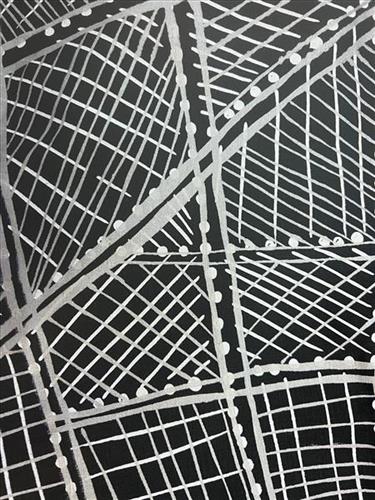
Yawkyawk in Stone Country Yawkyawk is a word from the Aboriginal Kunwinjku/Kunwok language, meaning ‘young woman’ and ‘young woman spirit being’. Sometimes compared to the European notion of mermaids, yawkyawks are usually depicted with the tails of fish. They have long hair, associated with trailing blooms of algae, typically found in Arnhem Land streams and rock pools. White and gun metal ink on a bright light blue linen.

377810582122061


Andjolpo, Yawkyawk, Kundalk, Duruk, Rolk & Kunmadj

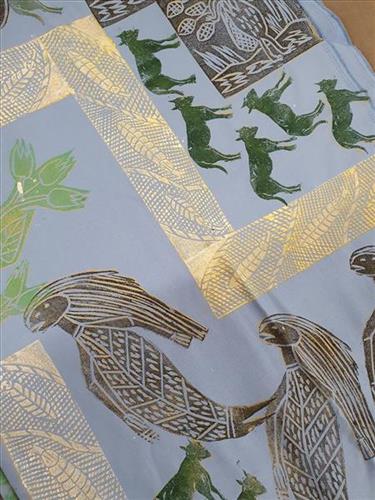
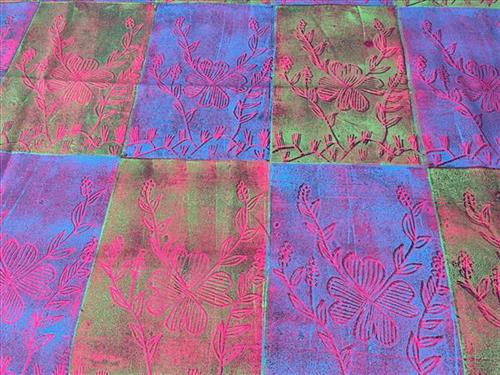
‘I like lino, print my design and doing different way to print my lino, different colours and different way. I print lino Yawkyawk (spirit woman) and Andjolpo. This was an (Andjolpo) old lady and she create that language and the world before. I also print also Rolk (maggot), my mother design cause I’m the Djunkay (land manager) for her.’ Janet Marawarr 2020 This is a beautiful piece of cloth printed by hand in Maningrida. Janet’s layout breaks away from a traditional block printed lino. Yawkyawk (young woman spirit) dance loosely together with  Kundalk (sharp grass), Duruk (dogs), Rolk (maggots) and Kunmadji (pandanus mat in a harmonious repeat pattern.

377810582122136


Yawkyawk in Stone Country

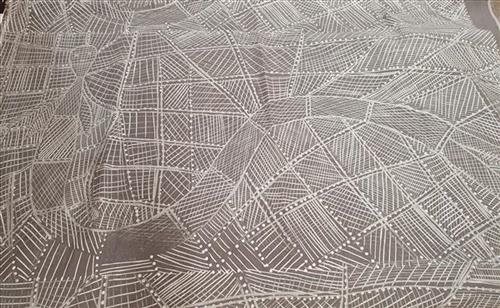
Yawkyawk is a word from the Aboriginal Kunwinjku/Kunwok language, meaning ‘young woman’ and ‘young woman spirit being’.

Sometimes compared to the European notion of mermaids, yawkyawks are usually depicted with the tails of fish. They have long hair, associated with trailing blooms of algae, typically found in Arnhem Land streams and rock pools.

White and gun metal ink on a bright light blue linen.

Hand Screen Printed by Publisher, Sydney Australia

111582122067


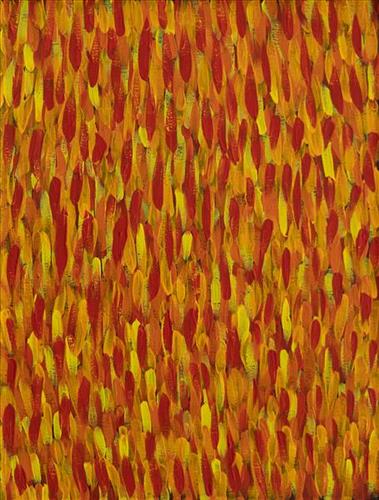
Waru (fire)

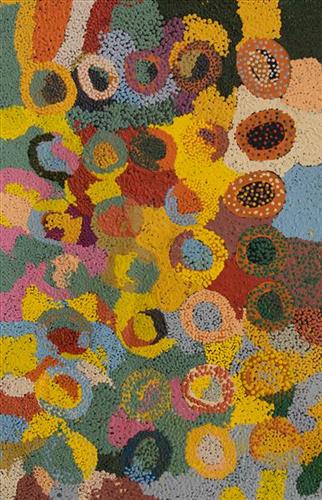
This work depicts the practice of fire burning as it continues to be used today through the Martu homelands. Over thousands of years, as Martu travelled and hunted on foot they would burn tracts of land, using waru (fire) as a means to assist with hunting and to encourage regenerative growth. Whilst fire burning practices have modernised in recent times, with Martu burning areas close to Aboriginal communities and along roads, or else further afield using helicopters and 4WDs with Indigenous ranger group Karnyirninpa Jukurrpa (KJ), the same objectives are met as those during pujiman (traditional, desert dwelling) times.

Targeted waru is an important tool in animal tracking. Small burns are lit to clear vegetation, expose burrows, and to allow for access to walk and track readily in exposed sands. Fires are typically burnt during cooler weather in small, controlled areas, reducing the risk of unmanageable, spontaneous bush fires whilst simultaneously providing diverse regenerating habitats. Remaining is a defined mosaic fire scar pattern in the land, across tali (sand dunes), linyji (clay pans), parulyukurru (spinifex country) and pila (sandy plains). This patterning is clearly visible from an aerial perspective, and becomes even more defined as new growth emerges. 

The patchwork nature of regrowth is aligned with the Martu cycle of burning and regrowth and its five distinct phases. First is nyurnma (freshly burnt Country), followed after the rains by waru-waru, when young, bright green plants start to grow. Nyukura occurs between one and three years after burning, when plants have matured and are fruiting and seeding. Manguu is four to six years post burning, when spinifex has matured to the point that it can be burned once again. Finally, kunarka signifies the time when spinifex and other plant species have become old growth, and pose a risk of destructive bushfires.

111582122064


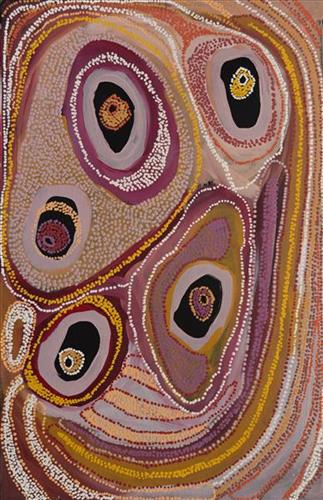
Kaalpa (Kalypa, Canning Stock Route Well 23)

“Kaalpa (Kalypa, Canning Stock Route Well 23) is my grandfather’s Country. There’s a waterhole there, Kaalpa waterhole. It’s my two pops’ Country. They been walking around, hunting around Kaalpa. You can see a yapu (rock), warla (lake), claypans, karru (creek) and tuwa (sandhills) there. It’s on the [Canning] Stock Route, it’s Well 23.  

In pujiman (traditional, desert dwelling) days, pujimanpa (desert born people) walking around all this Country. My pops told me about that place, a big flat area, parlkarra (flat country) good for hunting parnajarrpa (goanna), lunki (witchetty grub), lungkurta (blue tongue lizard), wamurla (bush tomato), jinyjiwirrilyi (wild gooseberry). Kaalpa is a busy place for emus getting a drink. 

I went [to Kaalpa] for the first time [in 2018] on a Martumili KJ [Kanyirninpa Jukurrpa] trip. I went hunting there, got a parnajarrpa. When I went there, I was pukurlpa (happy). It made you open up your spirit, it feels like home.”

 – Corban Clause Williams

Kaalpa is a permanent water source located northeast of Kumpupirntily (Kumpupintily, Lake Disappointment). This site is a place of great cultural significance, and is also known for good hunting. Adjacent to the waterhole is a hill of the same name. The landscape around Kaalpa is parlkarra, bordered by tali (sandhills) stretching as far as Windy Corner, northeast and towards the border of Western Australia and the Northern Territory. The large and dangerous Jukurrpa (Dreamtime) mosquito and fly beings partially created the landforms in this area and continue to live underground here.

Kaalpa also features in the Minyipuru (Jakulyukulyu, Seven Sisters) Jukurrpa, a central creation narrative for Martu, Ngaanyatjarra, Pitjantjatjara and Yankunytjatjara people that is associated with the seasonal Pleiades star constellation. At Kaalpa the Minyipuru met a group of men; it was the first time either group had seen members of the opposite sex. The men tried to grab the women, but the Minyipuru chased them, hitting them with their digging sticks and leaving them lying there as they continued travelling east.

Relayed in song, dance, stories and paintings, Minyipuru serves as a creation narrative, a source of information relating to the physical properties of the land, and an embodiment of Aboriginal cultural laws. Beginning in Roebourne on the west coast of Western Australia, the story morphs in its movement eastward across the land, following the women as they walk, dance, and even fly from waterhole to waterhole. As they travel the women camp, sing, wash, dance and gather food, leaving markers in the landscape and creating landforms that remain to this day, such as groupings of rocks and trees, grinding stones and seeds. During the entirety of their journey the women are pursued by a lustful old man, Yurla, although interactions with other animals, groups of men, and spirit beings are also chronicled in the narrative.

The intersection of the Canning Stock Route with Kaalpa also made this a site of early contact with Europeans for many Martu then living a pujiman life in the desert. Following the route’s construction, Martu encountered Europeans and other Martu working as cattle drovers as they would travel up and down the Stock Route from water source to water source. Increasingly, pujimanpa followed the route to newly established ration depots, mission and pastoral stations. They were drawn to the route in search of food, by a sense of curiosity, or by loneliness. By the late 1950s and early 1960s, most of the desert family groups had left the desert. Eventually, these factors combined with an extreme and prolonged drought in the 1960s to prompt the few remaining pujimanpa to move in from the desert.

111582122057


Parnngurr Rockhole

“Bugai [Whyoulter] told us to go back towards Parnngurr [with the intention of going into Jigalong mission], and we all went together along the track towards Parnngurr. In the afternoon we were going along, getting water for ourselves and walked over a sandhill. On the other side of the sandhill were a lot of vehicles: there was a bulldozer in front, then a grader and then several Land Rovers. We dropped everything and started to run. Old Man Biljabu [Jakayu’s husband] stopped and got ready to kill the whitefellas with his maparn [invisible power]. The whitefellas were waving in a friendly way and we all called out to Old Man Biljabu, “Stop! Stop! Don’t do it!” Jakayu and her husband started to walk towards the whitefellas. Everyone else followed behind them, starting to walk slowly.

We went and met the whitefellas and started talking to them, but they couldn’t understand us… The whitefella told us to go back to our camp and he would come and bring us food. After a time, he came and gave us a whole sheep, and some flour, sugar, bread and fruit. We threw the sheep away [for fear it might be poisoned] and left all the other food except for the sugar. We didn’t boil the sugar in the water with the tea, we just stirred it into warm water and drank it, like we did with bush tucker [edible botanical gum]. We used some of the flour to make a wet dough and drizzle it onto the ashes, the way we cooked seed damper. We didn’t finish eating the food – we just got up and went to Wiirnukurrujunu for pencil yams. We saw other Martu family groups pass by on the far side.

[Later, ] the whitefella followed us and found us where we were asleep… He went back to the mission to get Martu people who could translate. He went back to Jigalong and told Bob Ward, an old man, Sam Kelly’s father. He and Mr. Ward tracked us all the way to Yulpu and got there in the afternoon.

That day, everyone had gone hunting, and when we came back to our camp, there were four or five Land Rovers there. Mum had gone hunting early in the morning, carrying water with her. All us kids had gone west from Yulpu, and we had got one big goanna between all of us. When we came back in the afternoon, we saw that the whitefellas were in our camp, waiting for us. Us kids walked over slowly… When we came closer, Mr Ward opened a box and gave us blankets, clothes and food. He asked us where the others were, and we told him that they had gone over the hill. He told us to follow them and to call them back, and to come back all together and to wait at the road building camp. We agreed to do this. He told all us kids, “This is one blanket for all of you, you have to share it.” But we didn’t take the blanket. We kept walking with no clothes on, we left it there, no clothes, no blanket, didn’t even take the dresses.

We followed our parents over the hill… We spent the night with them and then went back to the place where we had been spotted [originally, at Parnngurr rockhole]. We waited there for the whitefellas to come back. When they arrived, they said that they had left their truck in between Parnngurr and Jigalong because it couldn’t go over the sandhills. The whitefellas were coming to get us in the Land Rover, taking three of us at a time, over to where the truck was waiting. From there they were carting all the people back to the truck. We all got in the truck and went right up to Old Jigalong, got there in the night time. That’s all.”

– Ngamaru Bidu, as translated by Ngalangka Nola Taylor

Parnngurr rockhole is located just south of Parnngurr Aboriginal community. This site lies within Ngamaru’s ngurra (home Country, camp), the area which she knew intimately and travelled extensively with her family in her youth. For many Martu, including Ngamaru, Parnngurr also signifies the location at which their nomadic bush life came to an end. Poignantly described here by Ngamaru, it was here that a group of 29 Martu were picked up by the Native Welfare Department to be taken to Jigalong Mission in 1963. Collectively the group had come to the decision to move to the mission as a result of an extended drought, which had caused a scarcity in food and water resources. The group also wanted to join their families, who had already moved to Jigalong.

At the junction of three linguistic groups; Manyjilyjarra, Kartujarra, and Warnman, Parnngurr rockhole was a critical and permanent source of water during the pujiman (traditional, desert born) era that supported many ritual large gatherings. During this nomadic period families stopped and camped here depending on the seasonal availability of water and the corresponding cycles of plant and animal life on which hunting and gathering bush tucker was reliant. At Parnngurr and other similarly important camp sites families would meet for a time before moving to their next destination. Parnngurr and its surrounds are physically dominated by distinctively red tali (sandhills), covered sparingly with spinifex and low lying shrub.

Parnngurr is also an important site chronicled in the epic Jukurrpa (Dreaming) story of the Jakulyukulyu, or Minyipuru (Seven Sisters). The sisters stopped to rest on Parnngurr Hill before continuing on their long journey east. Minyipuru is a central Jukurrpa narrative for Martu, Ngaanyatjarra, Pitjantjatjara and Yankunytjatjara people that is associated with the seasonal Pleiades star constellation. Relayed in song, dance, stories and paintings, Minyipuru serves as a creation narrative, a source of information relating to the physical properties of the land, and an embodiment of Aboriginal cultural laws. Beginning in Roebourne on the west coast of Western Australia, the story morphs in its movement eastward across the land, following the women as they walk, dance, and even fly from waterhole to waterhole. As they travel the women camp, sing, wash, dance and gather food, leaving markers in the landscape and creating landforms that remain to this day, such as groupings of rocks and trees, grinding stones and seeds. During the entirety of their journey the women are pursued by a lustful old man, Yurla, although interactions with other animals, groups of men, and spirit beings are also chronicled in the narrative.

377810582122223


Yawkyawk in Stone Country

Yawkyawk is a word from the Aboriginal Kunwinjku/Kunwok language, meaning ‘young woman’ and ‘young woman spirit being’.

Sometimes compared to the European notion of mermaids, yawkyawks are usually depicted with the tails of fish. They have long hair, associated with trailing blooms of algae, typically found in Arnhem Land streams and rock pools.

White and gun metal ink on a bright light blue linen.

Hand Screen Printed by Publisher, Sydney Australia