111582120577


The Watch Out

DESART PHOTOGRAPHY PRIZE

RETURNING UNSOLD WORKS (EDITION NUMBERS) TO ART CENTRES AND FUTURE SALES/PRINTING PROCEDURES

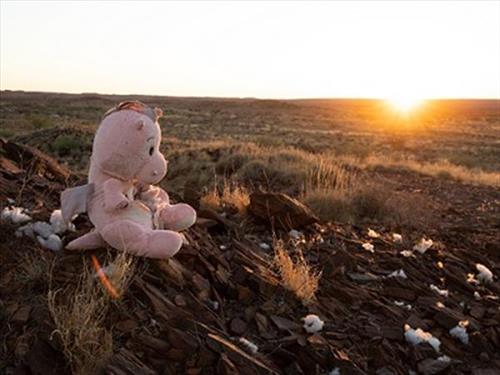
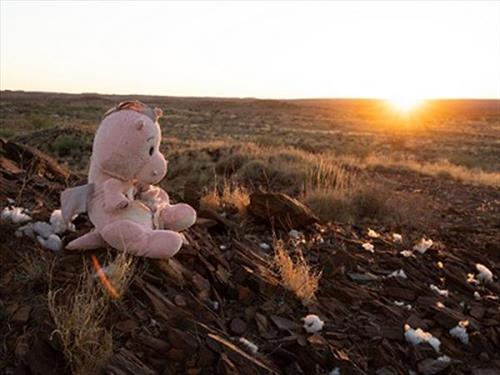
For each successful entry for the photography prize, Desart will print one photograph, to be catalogued as an AP (Artist’s Proof). This image will be framed and shown in the exhibition and then retained by Desart (catalogued on SAM for our ‘Collection’).

Desart manages sales for the first month of the exhibition. During this time, Desart will retain 30% of the public sale price to recoup framing, printing, freight and general exhibition costs. The artist will be paid 70% of the public price. Art Centres must invoice Desart for this.

Desart will create catalogue numbers on SAM for an edition of 10 works, but these 10 works will only be printed on demand if the image sells.

The works are priced so that they are part of a finite edition – that is, no more than 10 will ever be produced. It is essential that everyone honours even this after the exhibition to retain the integrity and value of the work as a limited edition. If the artist wishes to alter the image, they could potentially create a ‘second state’ to sell, but the original photograph is capped at an edition of 10 only.

After the first month, any unsold ‘works’ (which are actually catalogue numbers rather than physical works) are returned to the art centre for any future sales.

For this Desart will provide each art centre with a report of sales. The art centre will the need to catalogue these in their own system (SAM) using the remaining edition numbers.

Below is our contact (Richard at Darkstar) and all prints should be printed there, to the same specifications, in order to retain the integrity and identical nature of the edition of photographs.

darkstardigital.com.au

Richard Crampton: 0408 849 276

rcrampton@darkstardigital.com.au

Shop 3, 138 Botany Rd, Alexandria, NSW 2015

Images are sent by drop box including thumbnails and print size should be specified as A2, A3 or A4. For consistency the works need to be printed on white cotton rag paper. Printing costs can be found on the website:

http://darkstardigital.com.au/pricing/

Richard is prepared to send the works straight to the purchaser or back to the art centre but you will need to factor in packing and shipping costs (he will let you know how much). Sydney clients are often happy to go and pick the work up.

111582120576


The Watch Out

DESART PHOTOGRAPHY PRIZE

RETURNING UNSOLD WORKS (EDITION NUMBERS) TO ART CENTRES AND FUTURE SALES/PRINTING PROCEDURES

For each successful entry for the photography prize, Desart will print one photograph, to be catalogued as an AP (Artist’s Proof). This image will be framed and shown in the exhibition and then retained by Desart (catalogued on SAM for our ‘Collection’).

Desart manages sales for the first month of the exhibition. During this time, Desart will retain 30% of the public sale price to recoup framing, printing, freight and general exhibition costs. The artist will be paid 70% of the public price. Art Centres must invoice Desart for this.

Desart will create catalogue numbers on SAM for an edition of 10 works, but these 10 works will only be printed on demand if the image sells.

The works are priced so that they are part of a finite edition – that is, no more than 10 will ever be produced. It is essential that everyone honours even this after the exhibition to retain the integrity and value of the work as a limited edition. If the artist wishes to alter the image, they could potentially create a ‘second state’ to sell, but the original photograph is capped at an edition of 10 only.

After the first month, any unsold ‘works’ (which are actually catalogue numbers rather than physical works) are returned to the art centre for any future sales.

For this Desart will provide each art centre with a report of sales. The art centre will the need to catalogue these in their own system (SAM) using the remaining edition numbers.

Below is our contact (Richard at Darkstar) and all prints should be printed there, to the same specifications, in order to retain the integrity and identical nature of the edition of photographs.

darkstardigital.com.au

Richard Crampton: 0408 849 276

rcrampton@darkstardigital.com.au

Shop 3, 138 Botany Rd, Alexandria, NSW 2015

Images are sent by drop box including thumbnails and print size should be specified as A2, A3 or A4. For consistency the works need to be printed on white cotton rag paper. Printing costs can be found on the website:

http://darkstardigital.com.au/pricing/

Richard is prepared to send the works straight to the purchaser or back to the art centre but you will need to factor in packing and shipping costs (he will let you know how much). Sydney clients are often happy to go and pick the work up.

111582120575


The Watch Out

DESART PHOTOGRAPHY PRIZE

RETURNING UNSOLD WORKS (EDITION NUMBERS) TO ART CENTRES AND FUTURE SALES/PRINTING PROCEDURES

For each successful entry for the photography prize, Desart will print one photograph, to be catalogued as an AP (Artist’s Proof). This image will be framed and shown in the exhibition and then retained by Desart (catalogued on SAM for our ‘Collection’).

Desart manages sales for the first month of the exhibition. During this time, Desart will retain 30% of the public sale price to recoup framing, printing, freight and general exhibition costs. The artist will be paid 70% of the public price. Art Centres must invoice Desart for this.

Desart will create catalogue numbers on SAM for an edition of 10 works, but these 10 works will only be printed on demand if the image sells.

The works are priced so that they are part of a finite edition – that is, no more than 10 will ever be produced. It is essential that everyone honours even this after the exhibition to retain the integrity and value of the work as a limited edition. If the artist wishes to alter the image, they could potentially create a ‘second state’ to sell, but the original photograph is capped at an edition of 10 only.

After the first month, any unsold ‘works’ (which are actually catalogue numbers rather than physical works) are returned to the art centre for any future sales.

For this Desart will provide each art centre with a report of sales. The art centre will the need to catalogue these in their own system (SAM) using the remaining edition numbers.

Below is our contact (Richard at Darkstar) and all prints should be printed there, to the same specifications, in order to retain the integrity and identical nature of the edition of photographs.

darkstardigital.com.au

Richard Crampton: 0408 849 276

rcrampton@darkstardigital.com.au

Shop 3, 138 Botany Rd, Alexandria, NSW 2015

Images are sent by drop box including thumbnails and print size should be specified as A2, A3 or A4. For consistency the works need to be printed on white cotton rag paper. Printing costs can be found on the website:

http://darkstardigital.com.au/pricing/

Richard is prepared to send the works straight to the purchaser or back to the art centre but you will need to factor in packing and shipping costs (he will let you know how much). Sydney clients are often happy to go and pick the work up.
111582120572


The Watch Out

DESART PHOTOGRAPHY PRIZE

RETURNING UNSOLD WORKS (EDITION NUMBERS) TO ART CENTRES AND FUTURE SALES/PRINTING PROCEDURES

For each successful entry for the photography prize, Desart will print one photograph, to be catalogued as an AP (Artist’s Proof). This image will be framed and shown in the exhibition and then retained by Desart (catalogued on SAM for our ‘Collection’).

Desart manages sales for the first month of the exhibition. During this time, Desart will retain 30% of the public sale price to recoup framing, printing, freight and general exhibition costs. The artist will be paid 70% of the public price. Art Centres must invoice Desart for this.

Desart will create catalogue numbers on SAM for an edition of 10 works, but these 10 works will only be printed on demand if the image sells.

The works are priced so that they are part of a finite edition – that is, no more than 10 will ever be produced. It is essential that everyone honours even this after the exhibition to retain the integrity and value of the work as a limited edition. If the artist wishes to alter the image, they could potentially create a ‘second state’ to sell, but the original photograph is capped at an edition of 10 only.

After the first month, any unsold ‘works’ (which are actually catalogue numbers rather than physical works) are returned to the art centre for any future sales.

For this Desart will provide each art centre with a report of sales. The art centre will the need to catalogue these in their own system (SAM) using the remaining edition numbers.

Below is our contact (Richard at Darkstar) and all prints should be printed there, to the same specifications, in order to retain the integrity and identical nature of the edition of photographs.

darkstardigital.com.au

Richard Crampton: 0408 849 276

rcrampton@darkstardigital.com.au

Shop 3, 138 Botany Rd, Alexandria, NSW 2015

Images are sent by drop box including thumbnails and print size should be specified as A2, A3 or A4. For consistency the works need to be printed on white cotton rag paper. Printing costs can be found on the website:

http://darkstardigital.com.au/pricing/

Richard is prepared to send the works straight to the purchaser or back to the art centre but you will need to factor in packing and shipping costs (he will let you know how much). Sydney clients are often happy to go and pick the work up.

111982120766


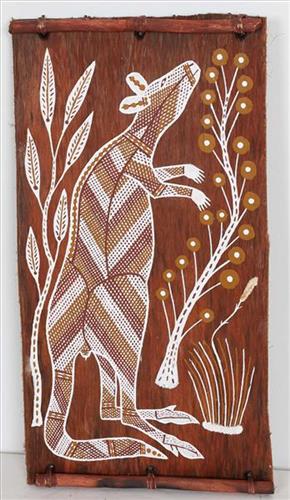
Nabarlek (Petrogale concinna)

Nabarlek are a tiny species of macropod found in northern Australia. They are a shy and nocturnal animal that resides in rocky hollows and forages in the surrounding area. Their diet is grasses, sedges, and ferns found in and around their scrub covered refuges. They are distinguished by a reddish tinge to the mostly grey fur and a distinct stripe at the cheek. They move with great speed and agility when observed, with a forward leaning posture and a bushy tail that arches over the back.

111982120764


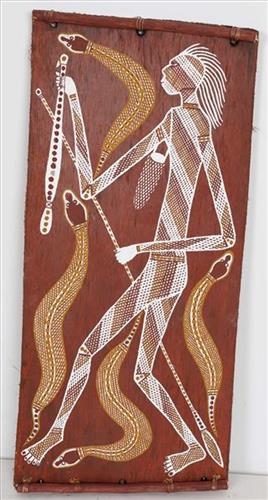
Namarrkon the Lightning Spirit

Namarden or Namarrkon are Eastern Kunwinjku names for the Lightning Spirit. This entity, which is responsible for lightning and thunder, is painted on both stone and bark in a form described as ‘like a grasshopper’. Namarrkon is said to have made Ngaldjurr – Leichardt’s or the spectacular grasshopper [Petasia ephippigera]. The species emerges, mates and is most active and visible in the season known as Kunemeleng, between October and December when there are intense electrical storms. Ngaldjurr is then said to be ‘looking for’ Namarrkon. Namarrkon makes lightning and thunder by striking out with kurlbburru – stone axes which protrude from its joints. Today, the Kuninjku will not leave axes lying out in the open during an electrical storm as the axes act as an attraction to the destructive force of Namarrkon. The lines emanating from Namarrkon’s head are said to be mardno or lightning bolts of power.

There is a dreaming site for the lightning spirit on the Liverpool River. The site, Kukkurrh, is a high undercut red gravel bank on a bend in the river. The rest of the country along the river is either flat grassy plains or thick mangrove forest. The red cliffs are in startling contrast to the rest of the landscape. The Kuninjku tell of a lightning man who grew angry and began making a terrifying and destructive storm. A lightning woman began to feel sorry for the human beings who were being killed by the storm. The man and woman stood as ‘cousin’ to each other in tribal relationship – this relationship between men and women is one of restraint and avoidance. When the lightning woman grabbed her cousin to calm him down he immediately became quiet and let people live. So it is today, say the Kuninjku, if a man is fighting and no one can calm him, he will become quiet if his cousin tries to restrain him

111982120763


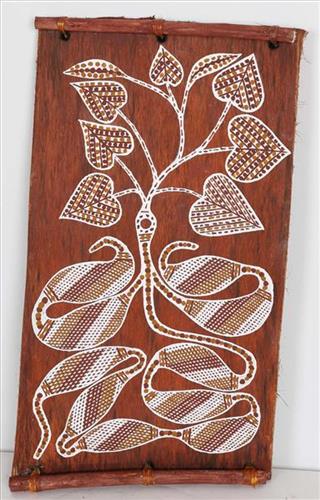
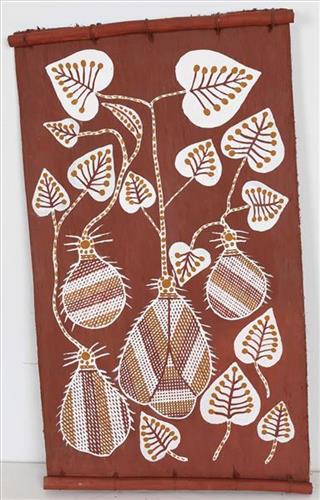
Man-ngalinj (bush potato)

Man-ngalinj is a root vegetable often described as ‘bush potato’. It’s duwa, the artist’s moiety. It has a bulbous root and a long thin vine with small flowers that grows across the ground or up the trunks of nearby trees. Large crops can be found near the artist’s outstation, Bolkdjam. Man-ngalinj are harvested after the Wet season in the early Dry

111982120761


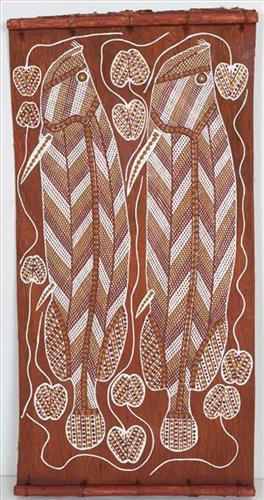
Ngaldadmurrng

This is a painting of ngaldadmurrng ‘Saratoga fish’ (Scleropages jardini) sometimes also called the Northern Spotted Barramundi.

Saratoga are commonly found in creeks, rivers and billabongs around the artist’s clan estate. The animal depicted is on one level easy to recognise and it’s meaning is easily accessible. On a deeper level the animal is depicted with intense rarrk ‘cross hatched’ infill, which creates a reference to Mardayin ceremonial mysticism. 

Saratoga makes their nests on the bottom of riverbeds in the sand by digging with their tails and fins and lay eggs into these depressions. During mortuary rituals the Kuninjku imitate these nests in sand sculpture. At the end of funerals all those who have attended the funeral are required to stand in the ‘saratoga’s nests’ and they are doused with water to be cleansed from the polluting effects of the deceased. A large meteorite crater near Mumeka in the Liverpool River district is said to be the nest of the saratoga which now stands in the landscape as djang ‘a sacred site’. 

In painting this image Marawarr is continuing a long tradition of figurative artistic practice carried out by Arnhem Land.