377810582121871


Ngalkunburriyaymi & Modjarrkki

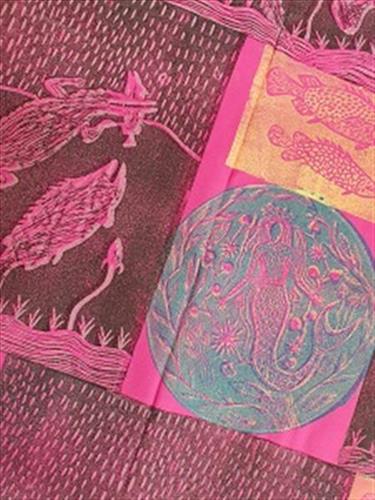
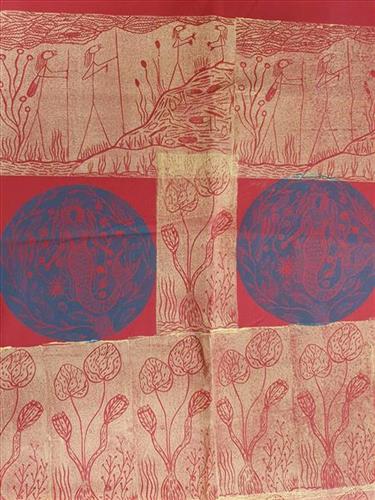
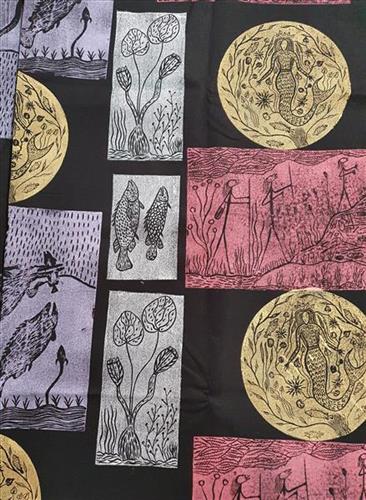
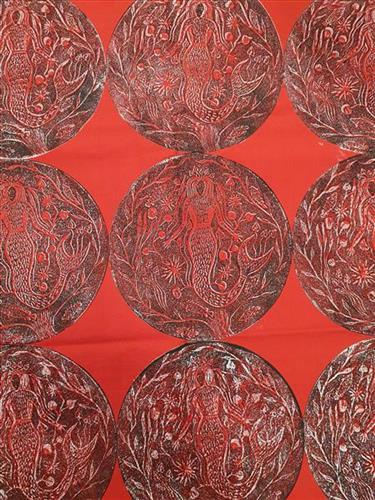
Kuninjku people call mermaids yawkyawk but in my language, Kune we call them Ngalkunburriyaymi (pronuced Ngaal gun borro yay mee). The Ngalkunburriyaymi depicted in my artworks is from a place called Marra-yii (sp?).  There are too many Ngalkunburriyaymi living at this place.  They are always there and have been there forever. We can go camping and fishing at this place.  Marar-yii is a place in the river. They are freshwater. They are Duwa moiety. Same as the freshwater crocodile. 

My mum told me her story.  Ngalkunburriyaymi gave her a baby.  Ngalkunburriyaymi came to her in a dream.  They gave her my brother. In my mother’s dream she went fishing Marra-yii and Ngalkunburriyaymi came to her to tell her she was having a baby.  She said to her I will give you a baby.  In a couple of months, you will be pregnant.

Ngalkunburriyaymi eat fish and waterlilies.

Owen Yalandja is my cousin from my father’s side and Lulu is my grandmother also from my father’s side. They are from different outstations, but we are family.  My Ngalkunburriyaymi story is connected to them but different.

I love my mother’s story and it is why I made a lino plate and I print it on different colour fabrics – silk, linen and cotton. I like using lots of different colours.  I come from a family who have made artwork on bark and hollow logs using ochre.  Black, yellow, red and white. But at Babbarra Designs we can use bright colours for our fabric.

Modjarrkki

Modjarrkki is the freshwater crocodile only eats little fish like barramundi and saratoga.  He doesn’t eat big things like kangaroo.

377810582121862


Ngalkunburriyaymi, Bini-murreko & Wayuk

Kuninjku people call mermaids yawkyawk but in my language, Kune we call them Ngalkunburriyaymi (pronuced Ngaal gun borro yay mee). The Ngalkunburriyaymi depicted in my artworks is from a place called Marra-yii (sp?).  There are too many Ngalkunburriyaymi living at this place.  They are always there and have been there forever. We can go camping and fishing at this place.  Marar-yii is a place in the river. They are freshwater. They are Duwa moiety. Same as the freshwater crocodile. 

My mum told me her story.  Ngalkunburriyaymi gave her a baby.  Ngalkunburriyaymi came to her in a dream.  They gave her my brother. In my mother’s dream she went fishing Marra-yii and Ngalkunburriyaymi came to her to tell her she was having a baby.  She said to her I will give you a baby.  In a couple of months, you will be pregnant.

Ngalkunburriyaymi eat fish and waterlilies.

Owen Yalandja is my cousin from my father’s side and Lulu is my grandmother also from my father’s side. They are from different outstations, but we are family.  My Ngalkunburriyaymi story is connected to them but different.

I love my mother’s story and it is why I made a lino plate and I print it on different colour fabrics – silk, linen and cotton. I like using lots of different colours.  I come from a family who have made artwork on bark and hollow logs using ochre.  Black, yellow, red and white. But at Babbarra Designs we can use bright colours for our fabric.

‘Bini-murreko means two brothers – big brother and little brother.

Two brothers were really strong leaders and good hunters, sharing animals with different tribes.
With those different tribe there were jealousy going on.
Little brother went walkabout and heard the different tribe was talking about his tribe.
They said ngarribin manre djed-djedme bokko
Meaning: will make spear for them
Ngarrbin danj-bun, ngarrbinbun
Meaning: will spear them kill them
little brother turn around went back tell his brother
Namurre bokko kadi marne djed-djedme Karre wonens, kardi-djal danjbun
Meaning: they making spear for us, they gonna spear us
Couple of months they saw different tribe
They changed their attitude
They been bringing lots of animals to them and start asking for women
And that tribe realise that’s how those brothers died.
They kill them
This Why? They got jealous because two brothers was a good hunter.

This story written on the rock art and it stays forever.’

Wayuk – waterlillies

377810582121859


Jin-merduwa (Mermaid) from Gupanga

My niece Stephanie is singing a song called Diyama and it is about Jin-merduwa. She is in the Ripple Effect Band. They are now famous in Maningrida and everywhere. Her great grandmother told her about the Jin-merduwa living at Gupanga.  I heard the story before Stephanie.  Now I hear her singing the story about that place.  I am very proud of her. We have the same country.  Our stories match.  She is singing the story and I am making artwork about the story. 

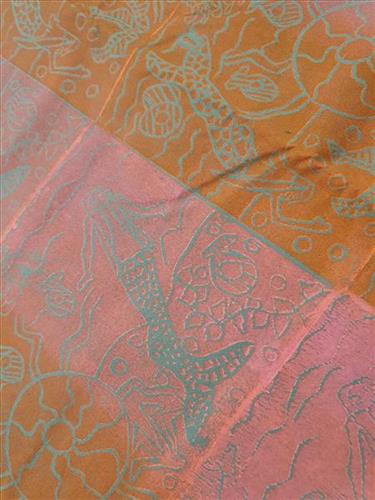
My lino print shows the Jin-merduwa who live at Gupanga.  Gupanga is located at the mouth of the Blyth River.  It is a saltwater place.  There must be more than one Jin-merduwa living there?  They eat fish, shellfish and seaweed.  Sometimes they travel to the end of the river to find food in the ocean, but they don’t go far and always swim back to their home.

Gupanga is a beautiful place.  The sand is golden, there are mangroves, and the water is cloudy.  It is good hunting in that area.  When we lived there, we got lots of barramundi, mudcrabs, shellfish, everything!

This is a bit of a dangerous story.  I can’t say too much about this sacred place. The Rangers help to look after this place, but they also know they must be careful.   

Kuninjku people call mermaids yawkyawk.  Yawkyawk are also freshwater.  In my language, Burarra we call them Jin-merduwa.  

I love to make lino print fabric showing Jin-merduwa. I like using bright colours but sometimes I print using black and white.

 A beautiful, one off, lino cut, hand printed deign by Elizabeth Wullunmingu depicting the story of Jin-merduwa.  Sometimes she also includes her turtle print. 

377810582121857


Ngalkunburriyaymi, Modjarrkki & Namurre Boko

Kuninjku people call mermaids yawkyawk but in my language, Kune we call them Ngalkunburriyaymi (pronuced Ngaal gun borro yay mee). The Ngalkunburriyaymi depicted in my artworks is from a place called Marra-yii (sp?).  There are too many Ngalkunburriyaymi living at this place.  They are always there and have been there forever. We can go camping and fishing at this place.  Marar-yii is a place in the river. They are freshwater. They are Duwa moiety. Same as the freshwater crocodile. 

My mum told me her story.  Ngalkunburriyaymi gave her a baby.  Ngalkunburriyaymi came to her in a dream.  They gave her my brother. In my mother’s dream she went fishing Marra-yii and Ngalkunburriyaymi came to her to tell her she was having a baby.  She said to her I will give you a baby.  In a couple of months, you will be pregnant.

Ngalkunburriyaymi eat fish and waterlilies.

Owen Yalandja is my cousin from my father’s side and Lulu is my grandmother also from my father’s side. They are from different outstations, but we are family.  My Ngalkunburriyaymi story is connected to them but different.

I love my mother’s story and it is why I made a lino plate and I print it on different colour fabrics – silk, linen and cotton. I like using lots of different colours.  I come from a family who have made artwork on bark and hollow logs using ochre.  Black, yellow, red and white. But at Babbarra Designs we can use bright colours for our fabric.

Modjarrkki

Modjarrkki is the freshwater crocodile only eats little fish like barramundi and saratoga.  He doesn’t eat big things like kangaroo.

Namurre Boko (Two Brother’s Story)

‘Bini-murreko means two brothers – big brother and little brother.

Two brothers were really strong leaders and good hunters, sharing animals with different tribes.
With those different tribe there were jealousy going on.
Little brother went walkabout and heard the different tribe was talking about his tribe.
They said ngarribin manre djed-djedme bokko
Meaning: will make spear for them
Ngarrbin danj-bun, ngarrbinbun
Meaning: will spear them kill them
little brother turn around went back tell his brother
Namurre bokko kadi marne djed-djedme Karre wonens, kardi-djal danjbun
Meaning: they making spear for us, they gonna spear us
Couple of months they saw different tribe
They changed their attitude
They been bringing lots of animals to them and start asking for women
And that tribe realise that’s how those brothers died.
They kill them
This Why? They got jealous because two brothers was a good hunter.

This story written on the rock art and it stays forever.’

This story was transcribed by Jay Jurrupula Rostron. Her lino designs illustrate the different scenes in this ancestral story.  Jay is a meticulous artist with a fine lino carving technique and beautiful colour combinations that reflect the Arnhem Land environment and her homeland near Korlobididah.


377810582121853


Ngalkunburriyaymi & Wayuk

Kuninjku people call mermaids yawkyawk but in my language, Kune we call them Ngalkunburriyaymi (pronuced Ngaal gun borro yay mee). The Ngalkunburriyaymi depicted in my artworks is from a place called Marra-yii (sp?).  There are too many Ngalkunburriyaymi living at this place.  They are always there and have been there forever. We can go camping and fishing at this place.  Marar-yii is a place in the river. They are freshwater. They are Duwa moiety. Same as the freshwater crocodile. 

My mum told me her story.  Ngalkunburriyaymi gave her a baby.  Ngalkunburriyaymi came to her in a dream.  They gave her my brother. In my mother’s dream she went fishing Marra-yii and Ngalkunburriyaymi came to her to tell her she was having a baby.  She said to her I will give you a baby.  In a couple of months, you will be pregnant.

Ngalkunburriyaymi eat fish and waterlilies.

Owen Yalandja is my cousin from my father’s side and Lulu is my grandmother also from my father’s side. They are from different outstations, but we are family.  My Ngalkunburriyaymi story is connected to them but different.

I love my mother’s story and it is why I made a lino plate and I print it on different colour fabrics – silk, linen and cotton. I like using lots of different colours.  I come from a family who have made artwork on bark and hollow logs using ochre.  Black, yellow, red and white. But at Babbarra Designs we can use bright colours for our fabric.

Wayuk (waterlily)

111582121886


Kulyakartu

Kulyakartu is a large area in the far north of the Martu homelands, near the Percival Lakes region of Western Australia’s Great Sandy Desert. Kulyakartu is mostly flat grass Country, and is known as a good hunting area. In particular, parnajarrpa (goanna), wild cats, and lunki (witchetty grub) are found in abundance here. In the wantajarra (wet season) the dry lakes in the region fill with water.

111582121884


Seasons

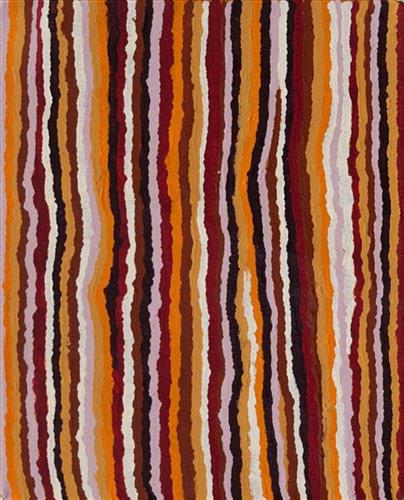
“My paintings are all about the seasons. The Country is always changing. One day you might see one kind of flower and the next day they are gone; they have given way to a new kind of flower. 

I see the Country in a different way. In my paintings I am looking at the Country with a birds eye view, the way you see the land when you’re in a plane.”

– Derrick Butt 


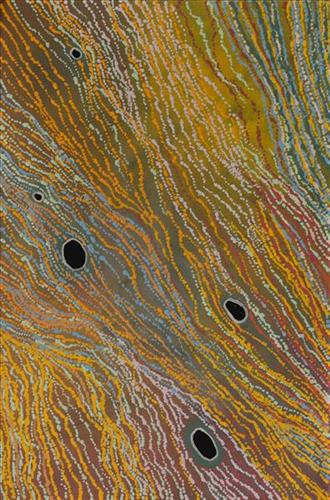
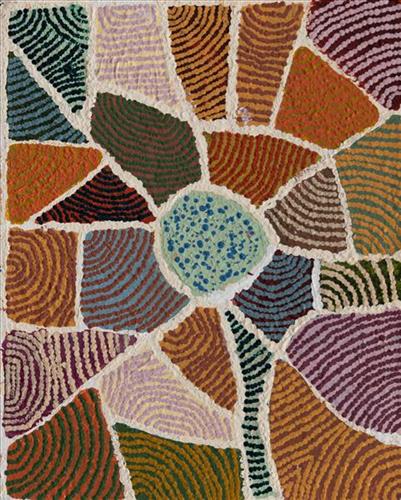
This work portrays an area of Derrick’s ngurra (home Country, camp) represented aerially. During the pujiman period, Martu would traverse very large distances annually in small family groups, moving seasonally from water source to water source, and hunting and gathering bush tucker as they went. At this time, one’s survival depended on their intimate knowledge of the location of resources; thus physical elements of Country, such as sources of kapi (water), tali (sandhills), different varieties of warta (trees, vegetation), ngarrini (camps), and jina (tracks) are typically recorded in paintings with the use of a system of iconographic forms universally shared across the desert.  

An additional layer of meaning in the work relates to more intangible concepts as described by Derrick; life cycles based around kalyu (rain, water) and waru (fire).

111582121874


Muuki

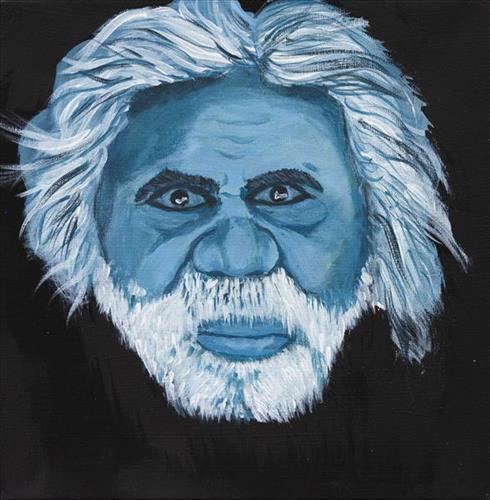
Muuki Taylor is a highly respected cultural leader, and is often called upon as an authority by other artists. In addition to painting with Martumili Artists, Muuki works as a senior cultural advisor for local Martu ranger group, Kanyirninpa Jukurrpa, where he provides invaluable advice and guidance.


111582121887


Untitled

“When Martu paint, it’s like a map. Martu draw story on the ground and on the canvas, and all the circle and line there are the hunting areas and different waters and tracks where people used to walk, and [some you] can’t cross, like boundaries. So nowadays you see a colourful painting and wonder what it is, but that’s how Martu tell story long ago. It’s not just a lovely painting, it’s a story and a songline and a history and everything that goes with it.” 

– Ngalangka Nola Taylor and Joshua Booth

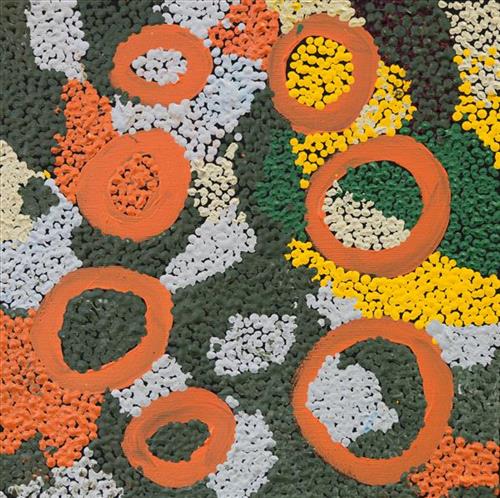
This work portrays an area of Country that can be interpreted in multiple ways. Firstly, the image may be read as an aerial representation of a particular location known to the artist- either land that they or their family travelled, from the pujiman (traditional, desert dwelling) era to now. During the pujiman period, Martu would traverse very large distances annually in small family groups, moving seasonally from water source to water source, and hunting and gathering bush tucker as they went. At this time, one’s survival depended on their intimate knowledge of the location of resources; thus physical elements of Country, such as sources of kapi (water), tali (sandhills), different varieties of warta (trees, vegetation), ngarrini (camps), and jina (tracks) are typically recorded with the use of a use of a system of iconographic forms universally shared across the desert. 

An additional layer of meaning in the work relates to more intangible concepts; life cycles based around kalyu (rain, water) and waru (fire) are also often evident. A thousands of year old practice, fire burning continues to be carried out as both an aid for hunting and a means of land management today. As the Martu travelled and hunted they would burn tracts of land, ensuring plant and animal biodiversity and reducing the risk of unmanageable, spontaneous bush fires. The patchwork nature of regrowth is evident in many landscape works, with each of the five distinctive phases of fire burning visually described with respect to the cycle of burning and regrowth.  

Finally, metaphysical information relating to a location may also be recorded; Jukurrpa (Dreaming) narratives chronicle the creation of physical landmarks, and can be referenced through depictions of ceremonial sites, songlines, and markers left in the land. Very often, however, information relating to Jukurrpa is censored by omission, or alternatively painted over with dotted patterns.

111582121880


Parnngurr Rockhole

“Bugai [Whyoulter] told us to go back towards Parnngurr [with the intention of going into Jigalong mission], and we all went together along the track towards Parnngurr. In the afternoon we were going along, getting water for ourselves and walked over a sandhill. On the other side of the sandhill were a lot of vehicles: there was a bulldozer in front, then a grader and then several Land Rovers. We dropped everything and started to run. Old Man Biljabu [Jakayu’s husband] stopped and got ready to kill the whitefellas with his maparn [invisible power]. The whitefellas were waving in a friendly way and we all called out to Old Man Biljabu, “Stop! Stop! Don’t do it!” Jakayu and her husband started to walk towards the whitefellas. Everyone else followed behind them, starting to walk slowly.

We went and met the whitefellas and started talking to them, but they couldn’t understand us… The whitefella told us to go back to our camp and he would come and bring us food. After a time, he came and gave us a whole sheep, and some flour, sugar, bread and fruit. We threw the sheep away [for fear it might be poisoned] and left all the other food except for the sugar. We didn’t boil the sugar in the water with the tea, we just stirred it into warm water and drank it, like we did with bush tucker [edible botanical gum]. We used some of the flour to make a wet dough and drizzle it onto the ashes, the way we cooked seed damper. We didn’t finish eating the food – we just got up and went to Wiirnukurrujunu for pencil yams. We saw other Martu family groups pass by on the far side.

[Later, ] the whitefella followed us and found us where we were asleep… He went back to the mission to get Martu people who could translate. He went back to Jigalong and told Bob Ward, an old man, Sam Kelly’s father. He and Mr. Ward tracked us all the way to Yulpu and got there in the afternoon.

That day, everyone had gone hunting, and when we came back to our camp, there were four or five Land Rovers there. Mum had gone hunting early in the morning, carrying water with her. All us kids had gone west from Yulpu, and we had got one big goanna between all of us. When we came back in the afternoon, we saw that the whitefellas were in our camp, waiting for us. Us kids walked over slowly… When we came closer, Mr Ward opened a box and gave us blankets, clothes and food. He asked us where the others were, and we told him that they had gone over the hill. He told us to follow them and to call them back, and to come back all together and to wait at the road building camp. We agreed to do this. He told all us kids, “This is one blanket for all of you, you have to share it.” But we didn’t take the blanket. We kept walking with no clothes on, we left it there, no clothes, no blanket, didn’t even take the dresses.

We followed our parents over the hill… We spent the night with them and then went back to the place where we had been spotted [originally, at Parnngurr rockhole]. We waited there for the whitefellas to come back. When they arrived, they said that they had left their truck in between Parnngurr and Jigalong because it couldn’t go over the sandhills. The whitefellas were coming to get us in the Land Rover, taking three of us at a time, over to where the truck was waiting. From there they were carting all the people back to the truck. We all got in the truck and went right up to Old Jigalong, got there in the night time. That’s all.”

– Ngamaru Bidu, as translated by Ngalangka Nola Taylor

Parnngurr rockhole is located just south of Parnngurr Aboriginal community. This site lies within Ngamaru’s ngurra (home Country, camp), the area which she knew intimately and travelled extensively with her family in her youth. For many Martu, including Ngamaru, Parnngurr also signifies the location at which their nomadic bush life came to an end. Poignantly described here by Ngamaru, it was here that a group of 29 Martu were picked up by the Native Welfare Department to be taken to Jigalong Mission in 1963. Collectively the group had come to the decision to move to the mission as a result of an extended drought, which had caused a scarcity in food and water resources. The group also wanted to join their families, who had already moved to Jigalong.

At the junction of three linguistic groups; Manyjilyjarra, Kartujarra, and Warnman, Parnngurr rockhole was a critical and permanent source of water during the pujiman (traditional, desert born) era that supported many ritual large gatherings. During this nomadic period families stopped and camped here depending on the seasonal availability of water and the corresponding cycles of plant and animal life on which hunting and gathering bush tucker was reliant. At Parnngurr and other similarly important camp sites families would meet for a time before moving to their next destination. Parnngurr and its surrounds are physically dominated by distinctively red tali (sandhills), covered sparingly with spinifex and low lying shrub.

Parnngurr is also an important site chronicled in the epic Jukurrpa (Dreaming) story of the Jakulyukulyu, or Minyipuru (Seven Sisters). The sisters stopped to rest on Parnngurr Hill before continuing on their long journey east. Minyipuru is a central Jukurrpa narrative for Martu, Ngaanyatjarra, Pitjantjatjara and Yankunytjatjara people that is associated with the seasonal Pleiades star constellation. Relayed in song, dance, stories and paintings, Minyipuru serves as a creation narrative, a source of information relating to the physical properties of the land, and an embodiment of Aboriginal cultural laws. Beginning in Roebourne on the west coast of Western Australia, the story morphs in its movement eastward across the land, following the women as they walk, dance, and even fly from waterhole to waterhole. As they travel the women camp, sing, wash, dance and gather food, leaving markers in the landscape and creating landforms that remain to this day, such as groupings of rocks and trees, grinding stones and seeds. During the entirety of their journey the women are pursued by a lustful old man, Yurla, although interactions with other animals, groups of men, and spirit beings are also chronicled in the narrative.