377810582132776


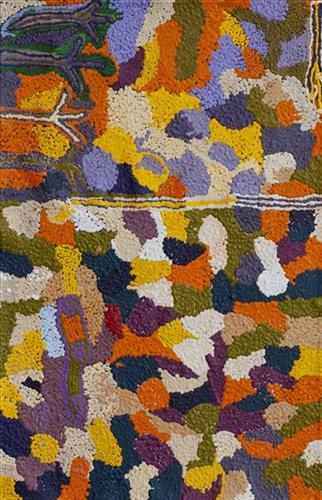
Kunwardde dja Karrbarda (Rocks and Yam Vine)

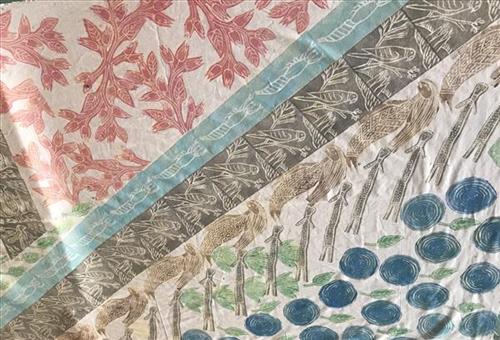
Susan Marawarr is a Kuninjku artist from the Kurulk clan whose country lies around the outstation of Mumeka in central Arnhem Land. In this design, she has depicted karrbarda (long yam) on her traditional country, the kunwardde (stone country).

The large stones represent the kunwardde rocky outcrops, which are elevated above the flat floodplains. The vines creeping around the large rocks are from the karrbarda. Women dig up karrbarda with kungarrndutj (digging sticks) and they are then cooked in the ashes of the fire to be eaten.

These yams are purple on the saltwater side of country and on inland freshwater country they are white. Karrbarda are an important manme (bush food) that are collected during the wet and dry seasons.

377810582132775


Wak Wak – Deborah Wurrkidj

Wak Wak (Black Crow Dreaming) by Deborah Wurrkidj depicts a sacred site at ‘Kurrurldul’, an outstation south of Maningrida.

The ‘rarrk’, or abstract crosshatching, on this work represents the design for the crow totem ancestor called ‘Djimarr’. Today this being exists in the form of a rock, which is permanently submerged at the bottom of Kurrurldul Creek. The ‘Djimarr’ rock in the stream at Kurrurldul is said to move around and call out in a soft hooting tone at night. Both the stone itself and the area around it are considered sacred.

The imagery represents the rock mentioned above at the bottom of Kurrurldul creek, which is the final transmutation of the dreaming ancestor ‘Djimarr’. Finally, the pattern used here is also the crow design used in the sacred ‘Mardayin’ ceremony, which is a large regional patri-moiety ceremony now rarely conducted in central and eastern Arnhem Land.

377810582132774


Sea Shells and Dilly Bags

‘Sometimes when we go down to the beach in Maningrida we pick all these shells up. Some family make necklaces and earrings. In the olden days they used to collect shells and put them in the dilly bags. The old people used to carry dilly bags when they went hunting. They used the dilly bag for bush food. My design shows mud muscle and long bum and cockles.’ Belinda Kernan 2022

Belinda’s mother is from Eastern Arrernte country near Alice Springs, the community of Ltyentye Apurte (Santa Teresa), and her father’s country is Maningrida. Belinda speaks languages from both sides of her family, as well as various languages belonging to Central Arnhem Land. She lives in Maningrida and prints lino at the women centre. Belinda is also a strong leader for young people in her community.

377810582132773


Kukurlk Kare

Karrinung kukurlk kare, karrijare manme (we are going underground looking for food).

“This is my country. In this painting, I’m looking at her little bit different way. This is what we see when we’re kukurlk kare (going underground)

Man-kurndalh (Black plum) I call mother. It is my mother’s Djang/Dreaming. The bush onion (kulumuduk) is white, the same as onions you buy at the store. We don’t eat this one though, it’s poison.

Wayuk is the water lily, with the big root growing in the earth. This is when that water is drying up a bit. There are worms and beetles- this is what we see underground, when we are digging for manme.”

-Jennifer Wurrkidj

Hand screen printed in Maningrida


377810582132772


Kukurlk Kare

Karrinung kukurlk kare, karrijare manme (we are going underground looking for food).

“This is my country. In this painting, I’m looking at her little bit different way. This is what we see when we’re kukurlk kare (going underground)

Man-kurndalh (Black plum) I call mother. It is my mother’s Djang/Dreaming. The bush onion (kulumuduk) is white, the same as onions you buy at the store. We don’t eat this one though, it’s poison.

Wayuk is the water lily, with the big root growing in the earth. This is when that water is drying up a bit. There are worms and beetles- this is what we see underground, when we are digging for manme.”

-Jennifer Wurrkidj

Hand screen printed in Maningrida


377810582132771


Mardarda and Njarlarla

In Esther’s first screen design, she depicts the story of Mardarda (bones) and Njarlarla (fire sticks) carried in a dilly bag, reminiscent of traditional ways of the Ndjebenna people.

‘Back in the old days, our people would use a ‘bush lighter’ for lighting fires, which was two pieces of special wood which would make fire easily. The old people carried a dilly bag containing the fire stick all times, when they moved camps.

Old people would always carry dilly bags, sometimes with water, honey, food or bones of our deceased people.

When someone passed away their body would be put on a high platform built from eucalyptus and paperbark. They would use a firestick to light a fire under the platform, and people would sing and dance around that platform to send the deceased’s spirit back to his or her country.

The body would then be left here for many months. When ready, the clan would return to collect the bones to take them back to the deceased’s homeland for burial.

To travel to the homeland, people would paint the bones with brown ochre and place them in a dillybag. When they reached the deceased’s homeland, people would sing together, place the bones in the lorrkkon and to leave them rest forever.”

111581705149


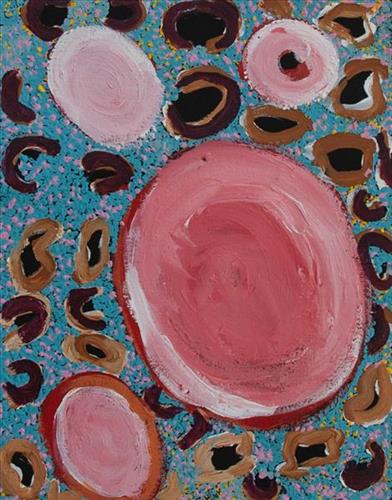
Wantili

“My ngurra (home Country), Wantili area. [Points to linear forms] Sandhill, sandhill, sandhill everywhere. Claypan there, in the middle. Good place for swimming and drinking, for hunting little kangaroo. When no water [we would] go to Well, when there rain we stay there at Wantili. Everywhere, we been walking everywhere.

Near to Wantili [there’s a] road going Kayili (North). Long time [ago] only horses and cattle [travelled along that road], going Meekatharra and back in the cold time, gone right up to Jijai Bore. Half way, when he see water at Wantili, that mob would camp one night, bullock eating all the grass and mens drinking water. One Martu been working with that mob, droving bullock. Every time he been give us meat, all the pujiman (nomadic bush dwellers).”

Wantili is dominated by claypans surrounded by tuwa (sandhills). Following rain the claypans are filled with water, with the overflow from nearby waterholes flowing to Wantili. At that time, Wantili becomes an important place for obtaining fresh water for drinking and bathing. Wantili is significant for the fact that at this site Kartujarra, Manyjilyjarra, Putujarra and Warnman people would all come together for ceremonies. Many jiwa (stones used by women for grinding seeds) from these times can still be found there today.

Wantili is an incredibly important cultural site, ‘‘where the creation started.’ The jukurrpa related to the creation at Wantili are just for Martu, but the site is open and anyone can go there. Wantili is one of the many sites featured in the epic Minyipuru (Seven Sisters) jukurrpa (dreamtime) narrative. The story follows the movement of seven sisters travelling all the way across the desert, beginning at Roebourne on the coast of Western Australia, as they are pursued by a lustful old man, Yurla. As the women travel they stop to rest at many sites to eat, dance, rest and sing, on the way leaving behind an assortment of articles that become formations in the land. The Seven Sisters rested at Wantili before throwing seeds, then continuing their journey on to Tiwa, Juntujuntu, and then onward to Pangkapini, where they finally escaped Yurla by flying into the sky to become the Pleaides constellation of stars.


111582106769


Untitled

This is Dale’s Country- her ‘ngurra’ (home Country, camp). People identify with their ngurra in terms of specific rights and responsibilities, and the possession of intimate knowledge of the physical and cultural properties of one’s Country. Painting ngurra, and in so doing sharing the Jukurrpa (Dreaming) stories and physical characteristics of that place, has today become an important means of cultural maintenance. Dale’s ngurra encompasses her birthplace, Jigalong, and the Country that her family walked in the pujiman (traditional, desert-dwelling) era, including Puntawarri, Raarki (Canning Stock Route Well 27), Kularti, Kumpupirntily , Mirtikanya, (Kumpupintily, Lake Disappointment), and Mukurtu.

Portrayed in this work are features of Dale’s family’s ngurra, such as the striking salt lakes, dominant permanent red tali (sandhills), warta (trees, vegetation), and the individually named water sources they camped at. Rock holes, waterholes, soaks and springs were all extremely important sites for Martu people during the pujiman period, and are generally depicted with circular forms. 

The encyclopaedic knowledge of the location, quality and seasonal availability of the hundreds of water bodies found in one’s Country sustained Martu as they travelled across their Country, hunting and gathering, visiting family, and fulfilling ceremonial obligations. They would traverse very large distances annually, visiting specific areas in the dry and wet season depending on the availability of water and the corresponding cycles of plant and animal life on which hunting and gathering bush tucker was reliant. As they travelled and hunted they would also burn areas of Country, generating a greater diversity of plant and animal life.

377810582132506


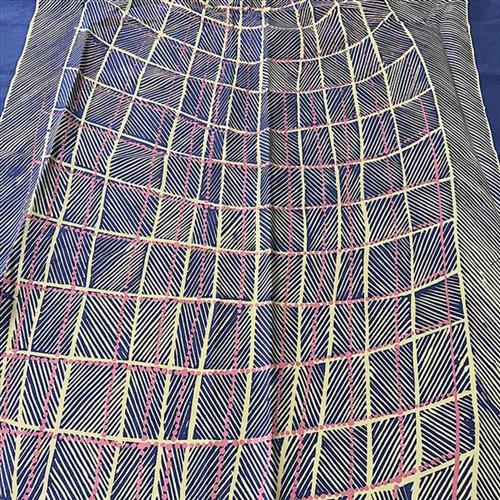
Mandjabu (Fish Trap) – Susan Marawarr

“In old times people would make these mandjabu (fish traps) to go fishing. They are made with vine we find in the jungle. That old man, Anchor Gulunba, he showed me how to make these fish traps. I would sit there and watch him making them. We catch barramundi, catfish, all kinds of fish.” – Helen Lanyinwanga

Kuninjku people traditionally make two sorts of conical fish traps. One called mandjabu made from a vine called milil, and another smaller one called manylik mandjabu, made from the grass manylik. The mandjabu conical fish trap is bigger and stronger and used in tidal reaches of creeks to catch large fish. The smaller, lighter manylik trap is used in freshwater flowing creeks to catch smaller fish and freshwater prawns. Traditionally, only men were involved in the construction of the large fish traps, but children would often crawl inside and assist.

To make fish traps and fish net fences artists firstly get vine (milil) from the jungle and they put it in water for one night to make it soft. Next they start weaving it; they make rings for the inside to keep the fish trap’s shape. Artists work for three or four weeks on the fish trap. They also make string from kurrajong (burdaga) to attach the hibiscus (bardainy) rings and to tie the conical end of the fish trap. This fish trap is used in saltwater and freshwater. People also use fish net fences called mun-dirra. A long time ago they would put the mun-dirra across rivers and creeks. In the middle they would place the an-gujechiya. They also used small things like sticks, rocks, mud and grass to block the fish from going through. People would then catch fish like saltwater barramundi rajarra, freshwater barramundi (janambal), small black freshwater catfish (buliya), bonefish (an-guwirrpiya), and sand bass (dalakan) in these fish traps.

377810582132468


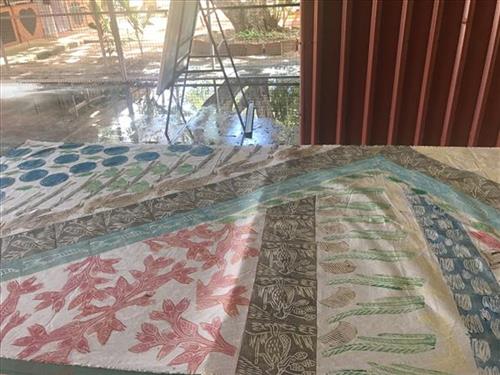
Yawkyawk and Ngalng – Major Work

‘Yawkyawk swim underneath the rock. They always stay there. When the sun comes out they come out from underneath the river, make themselves warm. They sit and they look around. When they sit, they cry to themselves. Ngaldjorlhbo (mother of everything) she created them – yawkyawk and the other one [Ngalng].

Ngalng (fresh water yabby)

‘This is a story from Mankorlod. This is a djang story. This is the creation story about the fresh water yabby. Starting with the stone, that’s the raw one and the cooked one. The stone rock suddenly turned to ngalng, in a flash. Ngalng started growing and turned into a body. It’s a magic one and it can change from rock to ngalng to human and back to ngalng. Now it’s a ngalng. 

The country is near Mankorlod and Korlobididah. The ngalng is stuck there forever on the rock at Korlobididah.’ 

In conversation with Janet Marawarr 2022


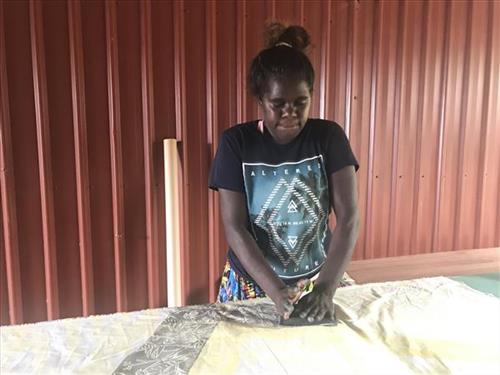
This textile was created in 2021 by Janet and her granddaughter Lamischa. This work was created over many days on a long table using the lino printing technique.