111582102084


Kintyre

“Young and old gotta do ‘im togther- old people gotta learn the young fellas about that place. Country. Martumili (belonging to Martu).”

 – Wokka Taylor

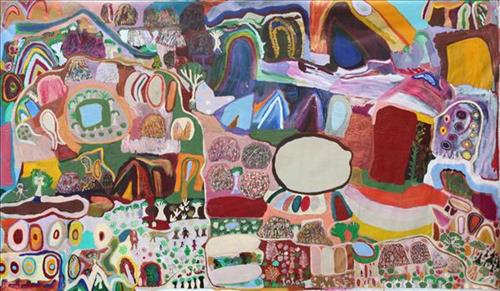
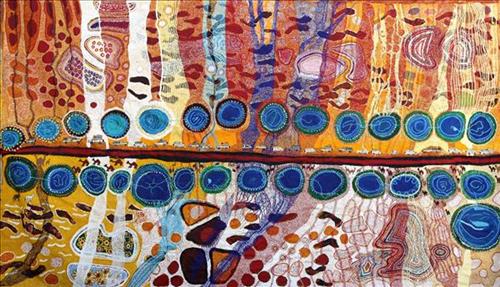
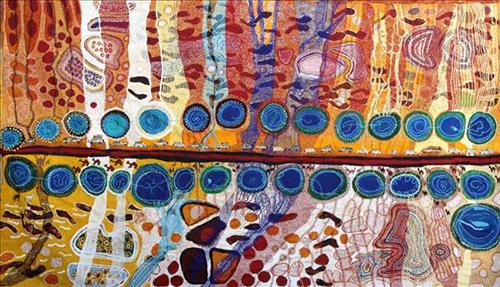
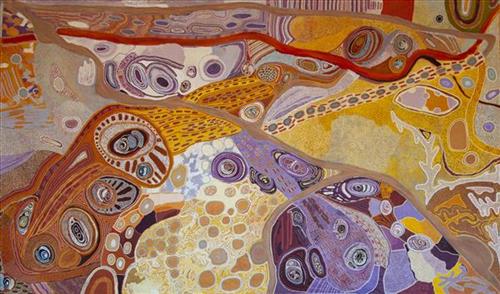
Produced to be a part of FORM’s Tracks We Share project, Martu artists embarked the creation of a large-scale collaborative painting depicting the Country and stories of Kintyre. Martu filmmaker and FORM project officer Curtis Taylor, FORM project officer Greg Taylor/Annie McLoughlin and Martumili staff and artists travelled to Parnngurr to attend an intense period of art making and conversation. Under the tutelage and direction from their elders, young artists laid the groundwork for the painting, with elders adding layers of details and knowledge to these foundations. Created by 23 artists over 18 months, the resulting artwork brings together stories of jukurrpa (dreaming), pre-colonial Martu life, personal histories, and contemporary mining interference with the important site of Kintyre, located within the heart of Martu Country- Karlamilyi national park.

Martu artists were part of the Western Desert Lands Aboriginal Corporation (WDLAC) 2021 AGM in Newman and unveiled the 5x3metre collaborative ‘Kintyre’ artwork to Martu Native Title holders and their families.  This was part of the Martu discussion about making a native title claim over Karlamilyi National park. Martu used the ‘Kintyre’ artwork to tell stories of great cultural importance and personal significance about this ngurra (Country, homeland), and to tell WDLAC to keep going with its work on getting this country back into Martu hands. The following day, Martu Elders and leaders showed and explained the ‘Kintyre’ work to WA Minister for Aboriginal Affairs, Hon Stephen Dawson.  Martu and WDLAC signed a shared statement of intent with the Minister, binding the Government and Martu to work together for Martu native title over Karlamilyi, as well as housing and community development reforms for Punmu, Kunawarritji and Parnngurr.

Kintyre is a claypan located just north of the Karlamilyi (Rudall River) region. During the pujiman (traditional, desert dwelling) era, the site was a popular camping ground in the wantajarra (wet season), when the claypan filled with kapi (water). Today Kintyre is best known for its substantial uranium deposits, and the area has been developed for mining. Protest from traditional land owners in combination with a declining uranium market have resulted in the project being put on hold for the time being.
 

111582102083


Kintyre

“Young and old gotta do ‘im togther- old people gotta learn the young fellas about that place. Country. Martumili (belonging to Martu).”

 – Wokka Taylor

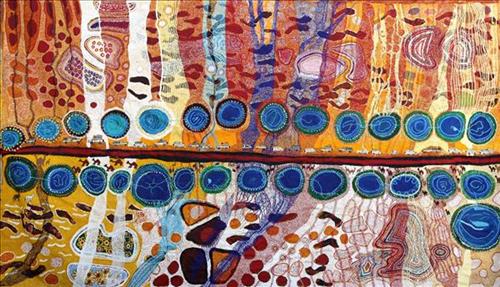
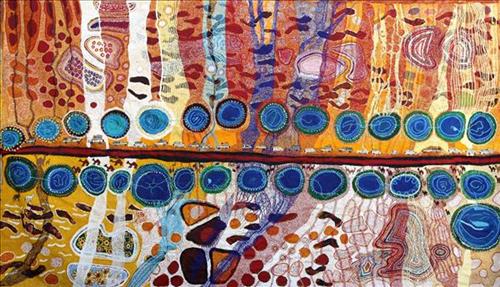
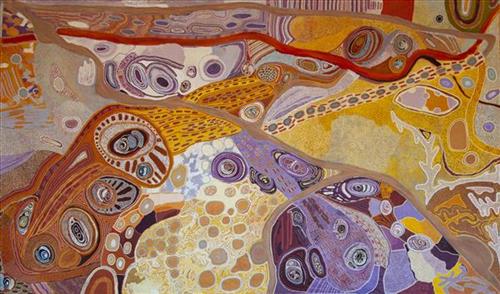
Produced to be a part of FORM’s Tracks We Share project, Martu artists embarked the creation of a large-scale collaborative painting depicting the Country and stories of Kintyre. Martu filmmaker and FORM project officer Curtis Taylor, FORM project officer Greg Taylor/Annie McLoughlin and Martumili staff and artists travelled to Parnngurr to attend an intense period of art making and conversation. Under the tutelage and direction from their elders, young artists laid the groundwork for the painting, with elders adding layers of details and knowledge to these foundations. Created by 23 artists over 18 months, the resulting artwork brings together stories of jukurrpa (dreaming), pre-colonial Martu life, personal histories, and contemporary mining interference with the important site of Kintyre, located within the heart of Martu Country- Karlamilyi national park.

Martu artists were part of the Western Desert Lands Aboriginal Corporation (WDLAC) 2021 AGM in Newman and unveiled the 5x3metre collaborative ‘Kintyre’ artwork to Martu Native Title holders and their families.  This was part of the Martu discussion about making a native title claim over Karlamilyi National park. Martu used the ‘Kintyre’ artwork to tell stories of great cultural importance and personal significance about this ngurra (Country, homeland), and to tell WDLAC to keep going with its work on getting this country back into Martu hands. The following day, Martu Elders and leaders showed and explained the ‘Kintyre’ work to WA Minister for Aboriginal Affairs, Hon Stephen Dawson.  Martu and WDLAC signed a shared statement of intent with the Minister, binding the Government and Martu to work together for Martu native title over Karlamilyi, as well as housing and community development reforms for Punmu, Kunawarritji and Parnngurr.

Kintyre is a claypan located just north of the Karlamilyi (Rudall River) region. During the pujiman (traditional, desert dwelling) era, the site was a popular camping ground in the wantajarra (wet season), when the claypan filled with kapi (water). Today Kintyre is best known for its substantial uranium deposits, and the area has been developed for mining. Protest from traditional land owners in combination with a declining uranium market have resulted in the project being put on hold for the time being.
 

111582102082


Kintyre

“Young and old gotta do ‘im togther- old people gotta learn the young fellas about that place. Country. Martumili (belonging to Martu).”

 – Wokka Taylor

Produced to be a part of FORM’s Tracks We Share project, Martu artists embarked the creation of a large-scale collaborative painting depicting the Country and stories of Kintyre. Martu filmmaker and FORM project officer Curtis Taylor, FORM project officer Greg Taylor/Annie McLoughlin and Martumili staff and artists travelled to Parnngurr to attend an intense period of art making and conversation. Under the tutelage and direction from their elders, young artists laid the groundwork for the painting, with elders adding layers of details and knowledge to these foundations. Created by 23 artists over 18 months, the resulting artwork brings together stories of jukurrpa (dreaming), pre-colonial Martu life, personal histories, and contemporary mining interference with the important site of Kintyre, located within the heart of Martu Country- Karlamilyi national park.

Martu artists were part of the Western Desert Lands Aboriginal Corporation (WDLAC) 2021 AGM in Newman and unveiled the 5x3metre collaborative ‘Kintyre’ artwork to Martu Native Title holders and their families.  This was part of the Martu discussion about making a native title claim over Karlamilyi National park. Martu used the ‘Kintyre’ artwork to tell stories of great cultural importance and personal significance about this ngurra (Country, homeland), and to tell WDLAC to keep going with its work on getting this country back into Martu hands. The following day, Martu Elders and leaders showed and explained the ‘Kintyre’ work to WA Minister for Aboriginal Affairs, Hon Stephen Dawson.  Martu and WDLAC signed a shared statement of intent with the Minister, binding the Government and Martu to work together for Martu native title over Karlamilyi, as well as housing and community development reforms for Punmu, Kunawarritji and Parnngurr.

Kintyre is a claypan located just north of the Karlamilyi (Rudall River) region. During the pujiman (traditional, desert dwelling) era, the site was a popular camping ground in the wantajarra (wet season), when the claypan filled with kapi (water). Today Kintyre is best known for its substantial uranium deposits, and the area has been developed for mining. Protest from traditional land owners in combination with a declining uranium market have resulted in the project being put on hold for the time being.
 

111982128159


Wak Wak

This painting depicts a sacred site at ‘Kurrurldul’, an outstation south of Maningrida.

The ‘rarrk’, or abstract crosshatching, on this work represents the design for the crow totem ancestor called ‘Djimarr’. Today this being exists in the form of a rock, which is permanently submerged at the bottom of Kurrurldul Creek. The ‘Djimarr’ rock in the stream at Kurrurldul is said to move around and call out in a soft hooting tone at night. Both the stone itself and the area around it are considered sacred.

The imagery represents the rock mentioned above at the bottom of Kurrurldul creek, which is the final transmutation of the dreaming ancestor ‘Djimarr’. Finally, the pattern used here is also the crow design used in the sacred ‘Mardayin’ ceremony, which is a large regional patri-moiety ceremony now rarely conducted in central and eastern Arnhem Land.

111982128158


Ngalkunburriyaymi fish-women spirit #1

the water spirits Yawkyawk or Ngalkunburriyaymi are perhaps the most enigmatic of themes. sometimes compared to the European notion of mermaids, they exist as spiritual beings living in freshwater streams, particularly those in the stone country. the spirit yawkyawk are usually described and depicted with the tails of fish, as in the painting. thus the kuninjku people sometimes call them Ngalberddjenj which literally means the women who has a tail like a fish.’ they have long hair which is associated with trailing blooms of green algae (called man-bak in kuninjku ) found in freshwater streams and rock pools. at times they leave their aquatic homes to walk about dry land, particularly at night.

Today the kuninjku believe that ngalkunburriyaymi are alive and well living in freshwater sites in a number of sacred locations. the kuninjku also believe that ‘ clever’ men ( magicians with mystical powers called in Kuninjku na-kordang ) may take these spirits as wives. the Ngalkunburriyaymi also have husbands and children of their own kind. their sites are usually shared with the rainbow serpent ngalyod. some have ritual importance; for example in some depictions the yawkyawk spirit holds ceremonial string, just like the lengths of string women hold between both hands today during certain public ceremonies.

There are at least three major Ngalkunburriyaymi sacred sites that are well known in the area south and  south-west of Maningrida. one site is on the Mann River at a place near Yikarrakal Outstation where the Mann River has rugged rocky banks and clefts beneath stone overhangs in the water. Another very similar site further west in the Kumadderr River district is surrounded by a number of small but very old rock art sites and has become known in English as Dreaming Lady . A third site is a major yawkyawk dreaming place which is so significant that the traditional clas custodians have set up an outstation community near the site, and the identity of this group is very much related  to their yawkyawk dreaming for which they have spiritual and practical responsibility. This group, known as dangkorlo clan, are well known for their bark paintings and sculptures of yawkyawk.

The techniques of bark painting are usually handed down from one generation to the next, as are the rights of each artist to a particular site or dreaming. The artists mother is a member of the Dangkorlo clan. This theme has often been painted by Flora’s father Mick Kubarkku.


11151030580


Karlamilyi

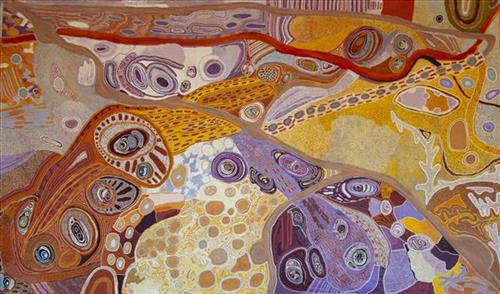
This is a collaborative work by Amy French and her sister, Lily Long, depicting Karlamilyi, also known as Rudall River National Park. The sisters say: “We are Warnman ladies, painting Kintyre and Karlamilyi. We can share this country.” Pinpi River flows through the central, long axis of this painting. Geographically, Pinpi flows into Yantikuji and then into the great Karlamilyi (Rudall River). For this piece, Amy French, the elder of the sisters, focussed on Kintyre. Her side of the work also features Wirriwirri claypan and the hand pump on the Camp Tracy road, with both these water sources shown in bright turquoise. The relatively muted shades on Lily Long’s side of the painting describe Kalkun Kalkun, Karlamilyi (Rudall River) and lines of rocky hills. The sisters say that this is good country for hunting marlu (kangaroo) and for gathering minyarra (bush onions) and other foods.

11151031973


Canning Stock Route- Our Country

Work on this painting commenced at Parnngurr Community in September 2011. The canvas was rolled out and Judith Anya  Samson, under Kumpaya’s instruction, painted the road and waterholes. Mid way through the waterholes being put down Kumpaya jumped in and started painting with Judith, soon a large number of artists were involved.

The painting was worked on at Parnngurr on and off for two weeks and finally completed by Kumpaya and Kathleen after ten days of nonstop painting to complete the detail.

The painting depicts the Canning Stock Route and the wells along it, more importantly it illustrates the artists intimate knowledge of their Country, the importance of fire to manage Country, the vast sand hills and underground water sources, the song lines , the Jukurrpa (Martu dreaming). The creation of this work provides an opportunity for young and old artists to work together, sharing knowledge and skills.

“There’s minyi puru (seven sisters) all through this painting, the seven sisters stopped all through this country, at all of the waterholes”

“The Jina (feet) show where Martu walked in pujiman, all through the desert, we still walk through our country, now there are lots of Toyotas on the CSR, tourists, Martu and the Martu rangers working on the country to look after it”

“You can see the pattern waru (Fire) makes on country and how much water there is in the desert, Martu know how to find this water, not just the water in CSR wells”

“Kunawarritji is the big waterhole; it’s my home, its lovely country”

– Kumpaya Girgirba 

Western Australia’s gold rush, beginning in 1885, created a huge demand for beef from mines located between Halls Creek and Wiluna. At that time, most of Western Australia’s cattle came from the Kimberley, though an infestation of tropical ticks among the East Kimberley herds gave the West Kimberley pastoralists a monopoly on the beef trade — causing prices to soar. A Royal Commission in 1904 proposed the construction of a stock route through Western Australia’s desert country to eliminate the ticks through exposure to its hot, dry conditions, resulting in the near 2000 kilometre Canning Stock Route. The proposal was successful insofar as the eradication of ticks was concerned; however, the establishment of the Canning Stock Route was to have far reaching repercussions for Western Australia’s Aboriginal population. 

The construction of the route by Alfred Canning and his team in 1910 resulted in first contact with Europeans for many Martu then living a pujiman (traditional, desert dwelling) life in the desert. This contact began with Canning’s use of Aboriginal guides to lead him to the sources of water that would be transformed into 48 stock route wells. Acts of cruelty toward these guides included, amongst other things, chaining them at night to prevent their escape and giving them salt water to drink, thereby ensuring their thirst and subsequent necessity to lead the party to water sources.

Following the construction of the Canning Stock Route, Martu encountered Europeans and other Martu working as cattle drovers as they would travel up and down the Stock Route from water source to water source. Increasingly, pujiman followed the route to newly established ration depots, mission and pastoral stations. They were drawn to the route in search of food, by a sense of curiosity, or by loneliness. By the late 1950s and early 1960s, most of the desert family groups had left the desert. Eventually, these factors combined with an extreme and prolonged drought in the 1960s to prompt the few remaining pujiman to move in from the desert. One of the last major migrations of Martu people occurred in 1963, when many of the pujiman born Martumili Artists moved to Jigalong.

Patterns of movement which had defined Aboriginal people’s relationships to Country were forever changed by the Canning Stock Route, but the Martu relationship with Country remains strong through the maintenance of physical and cultural ties to desert life and knowledge.

11151031972


Canning Stock Route- Our Country

Work on this painting commenced at Parnngurr Community in September 2011. The canvas was rolled out and Judith Anya  Samson, under Kumpaya’s instruction, painted the road and waterholes. Mid way through the waterholes being put down Kumpaya jumped in and started painting with Judith, soon a large number of artists were involved.

The painting was worked on at Parnngurr on and off for two weeks and finally completed by Kumpaya and Kathleen after ten days of nonstop painting to complete the detail.

The painting depicts the Canning Stock Route and the wells along it, more importantly it illustrates the artists intimate knowledge of their Country, the importance of fire to manage Country, the vast sand hills and underground water sources, the song lines , the Jukurrpa (Martu dreaming). The creation of this work provides an opportunity for young and old artists to work together, sharing knowledge and skills.

“There’s minyi puru (seven sisters) all through this painting, the seven sisters stopped all through this country, at all of the waterholes”

“The Jina (feet) show where Martu walked in pujiman, all through the desert, we still walk through our country, now there are lots of Toyotas on the CSR, tourists, Martu and the Martu rangers working on the country to look after it”

“You can see the pattern waru (Fire) makes on country and how much water there is in the desert, Martu know how to find this water, not just the water in CSR wells”

“Kunawarritji is the big waterhole; it’s my home, its lovely country”

– Kumpaya Girgirba 

Western Australia’s gold rush, beginning in 1885, created a huge demand for beef from mines located between Halls Creek and Wiluna. At that time, most of Western Australia’s cattle came from the Kimberley, though an infestation of tropical ticks among the East Kimberley herds gave the West Kimberley pastoralists a monopoly on the beef trade — causing prices to soar. A Royal Commission in 1904 proposed the construction of a stock route through Western Australia’s desert country to eliminate the ticks through exposure to its hot, dry conditions, resulting in the near 2000 kilometre Canning Stock Route. The proposal was successful insofar as the eradication of ticks was concerned; however, the establishment of the Canning Stock Route was to have far reaching repercussions for Western Australia’s Aboriginal population. 

The construction of the route by Alfred Canning and his team in 1910 resulted in first contact with Europeans for many Martu then living a pujiman (traditional, desert dwelling) life in the desert. This contact began with Canning’s use of Aboriginal guides to lead him to the sources of water that would be transformed into 48 stock route wells. Acts of cruelty toward these guides included, amongst other things, chaining them at night to prevent their escape and giving them salt water to drink, thereby ensuring their thirst and subsequent necessity to lead the party to water sources.

Following the construction of the Canning Stock Route, Martu encountered Europeans and other Martu working as cattle drovers as they would travel up and down the Stock Route from water source to water source. Increasingly, pujiman followed the route to newly established ration depots, mission and pastoral stations. They were drawn to the route in search of food, by a sense of curiosity, or by loneliness. By the late 1950s and early 1960s, most of the desert family groups had left the desert. Eventually, these factors combined with an extreme and prolonged drought in the 1960s to prompt the few remaining pujiman to move in from the desert. One of the last major migrations of Martu people occurred in 1963, when many of the pujiman born Martumili Artists moved to Jigalong.

Patterns of movement which had defined Aboriginal people’s relationships to Country were forever changed by the Canning Stock Route, but the Martu relationship with Country remains strong through the maintenance of physical and cultural ties to desert life and knowledge.

11151031971


Canning Stock Route- Our Country

Work on this painting commenced at Parnngurr Community in September 2011. The canvas was rolled out and Judith Anya  Samson, under Kumpaya’s instruction, painted the road and waterholes. Mid way through the waterholes being put down Kumpaya jumped in and started painting with Judith, soon a large number of artists were involved.

The painting was worked on at Parnngurr on and off for two weeks and finally completed by Kumpaya and Kathleen after ten days of nonstop painting to complete the detail.

The painting depicts the Canning Stock Route and the wells along it, more importantly it illustrates the artists intimate knowledge of their Country, the importance of fire to manage Country, the vast sand hills and underground water sources, the song lines , the Jukurrpa (Martu dreaming). The creation of this work provides an opportunity for young and old artists to work together, sharing knowledge and skills.

“There’s minyi puru (seven sisters) all through this painting, the seven sisters stopped all through this country, at all of the waterholes”

“The Jina (feet) show where Martu walked in pujiman, all through the desert, we still walk through our country, now there are lots of Toyotas on the CSR, tourists, Martu and the Martu rangers working on the country to look after it”

“You can see the pattern waru (Fire) makes on country and how much water there is in the desert, Martu know how to find this water, not just the water in CSR wells”

“Kunawarritji is the big waterhole; it’s my home, its lovely country”

– Kumpaya Girgirba 

Western Australia’s gold rush, beginning in 1885, created a huge demand for beef from mines located between Halls Creek and Wiluna. At that time, most of Western Australia’s cattle came from the Kimberley, though an infestation of tropical ticks among the East Kimberley herds gave the West Kimberley pastoralists a monopoly on the beef trade — causing prices to soar. A Royal Commission in 1904 proposed the construction of a stock route through Western Australia’s desert country to eliminate the ticks through exposure to its hot, dry conditions, resulting in the near 2000 kilometre Canning Stock Route. The proposal was successful insofar as the eradication of ticks was concerned; however, the establishment of the Canning Stock Route was to have far reaching repercussions for Western Australia’s Aboriginal population. 

The construction of the route by Alfred Canning and his team in 1910 resulted in first contact with Europeans for many Martu then living a pujiman (traditional, desert dwelling) life in the desert. This contact began with Canning’s use of Aboriginal guides to lead him to the sources of water that would be transformed into 48 stock route wells. Acts of cruelty toward these guides included, amongst other things, chaining them at night to prevent their escape and giving them salt water to drink, thereby ensuring their thirst and subsequent necessity to lead the party to water sources.

Following the construction of the Canning Stock Route, Martu encountered Europeans and other Martu working as cattle drovers as they would travel up and down the Stock Route from water source to water source. Increasingly, pujiman followed the route to newly established ration depots, mission and pastoral stations. They were drawn to the route in search of food, by a sense of curiosity, or by loneliness. By the late 1950s and early 1960s, most of the desert family groups had left the desert. Eventually, these factors combined with an extreme and prolonged drought in the 1960s to prompt the few remaining pujiman to move in from the desert. One of the last major migrations of Martu people occurred in 1963, when many of the pujiman born Martumili Artists moved to Jigalong.

Patterns of movement which had defined Aboriginal people’s relationships to Country were forever changed by the Canning Stock Route, but the Martu relationship with Country remains strong through the maintenance of physical and cultural ties to desert life and knowledge.

11151031970


Canning Stock Route- Our Country

Work on this painting commenced at Parnngurr Community in September 2011. The canvas was rolled out and Judith Anya  Samson, under Kumpaya’s instruction, painted the road and waterholes. Mid way through the waterholes being put down Kumpaya jumped in and started painting with Judith, soon a large number of artists were involved.

The painting was worked on at Parnngurr on and off for two weeks and finally completed by Kumpaya and Kathleen after ten days of nonstop painting to complete the detail.

The painting depicts the Canning Stock Route and the wells along it, more importantly it illustrates the artists intimate knowledge of their Country, the importance of fire to manage Country, the vast sand hills and underground water sources, the song lines , the Jukurrpa (Martu dreaming). The creation of this work provides an opportunity for young and old artists to work together, sharing knowledge and skills.

“There’s minyi puru (seven sisters) all through this painting, the seven sisters stopped all through this country, at all of the waterholes”

“The Jina (feet) show where Martu walked in pujiman, all through the desert, we still walk through our country, now there are lots of Toyotas on the CSR, tourists, Martu and the Martu rangers working on the country to look after it”

“You can see the pattern waru (Fire) makes on country and how much water there is in the desert, Martu know how to find this water, not just the water in CSR wells”

“Kunawarritji is the big waterhole; it’s my home, its lovely country”

– Kumpaya Girgirba 

Western Australia’s gold rush, beginning in 1885, created a huge demand for beef from mines located between Halls Creek and Wiluna. At that time, most of Western Australia’s cattle came from the Kimberley, though an infestation of tropical ticks among the East Kimberley herds gave the West Kimberley pastoralists a monopoly on the beef trade — causing prices to soar. A Royal Commission in 1904 proposed the construction of a stock route through Western Australia’s desert country to eliminate the ticks through exposure to its hot, dry conditions, resulting in the near 2000 kilometre Canning Stock Route. The proposal was successful insofar as the eradication of ticks was concerned; however, the establishment of the Canning Stock Route was to have far reaching repercussions for Western Australia’s Aboriginal population. 

The construction of the route by Alfred Canning and his team in 1910 resulted in first contact with Europeans for many Martu then living a pujiman (traditional, desert dwelling) life in the desert. This contact began with Canning’s use of Aboriginal guides to lead him to the sources of water that would be transformed into 48 stock route wells. Acts of cruelty toward these guides included, amongst other things, chaining them at night to prevent their escape and giving them salt water to drink, thereby ensuring their thirst and subsequent necessity to lead the party to water sources.

Following the construction of the Canning Stock Route, Martu encountered Europeans and other Martu working as cattle drovers as they would travel up and down the Stock Route from water source to water source. Increasingly, pujiman followed the route to newly established ration depots, mission and pastoral stations. They were drawn to the route in search of food, by a sense of curiosity, or by loneliness. By the late 1950s and early 1960s, most of the desert family groups had left the desert. Eventually, these factors combined with an extreme and prolonged drought in the 1960s to prompt the few remaining pujiman to move in from the desert. One of the last major migrations of Martu people occurred in 1963, when many of the pujiman born Martumili Artists moved to Jigalong.

Patterns of movement which had defined Aboriginal people’s relationships to Country were forever changed by the Canning Stock Route, but the Martu relationship with Country remains strong through the maintenance of physical and cultural ties to desert life and knowledge.