111582126988


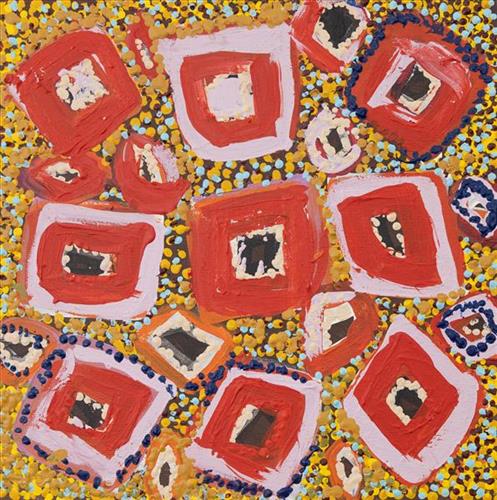
Puntawarri

“All around is sandhills and lakes on every side. You can see the grass, but the lakes are all dry. In the middle is Puntawarri waterhole. That’s the jila (snake) place, two jila. They nyupa (spouses), they darlings, man and woman. They sleeping near to Puntawarri. It’s a hole in the ground- that jila will come out of the ground and all the dust will go everywhere. All the dust going everywhere, the dust that flies up when the jila flies up out of its hole. The jila isn’t in that place anymore. It’s gone now but that jila used to stop there.” 

 – Helen Dale Samson

Puntawarri is an important cultural area located on the middle stretches of the Canning Stock Route and east of the Jigalong Mission (now Jigalong Aboriginal community). It is also the site of an abandoned community, a waterhole, creek and lake. Puntawarri’s close proximity to Jigalong Mission made it a popular site for Martu to visit during the ‘mission days’. Dale was born at Jigalong Mission, and continues to live in the community now located there today. Though she grew up in the dormitory at Jigalong, she spent her weekends and holidays in the bush, camping at sites such as Puntawarri with her extended family. Once married, she lived around Puntawarri, walking and hunting in the surrounding Country.

For many Martu, like Dale’s family, Jigalong Mission was the site where their pujiman (traditional, desert dwelling) lifestyle came to an end from the late 1940s as they transitioned to a life as stockmen and women working in cattle stations in the Pilbara region and beyond. In the wake of the extreme and prolonged drought of the 1960s, the last of the remaining pujimanpa (desert dwellers) were forced to move to missions like Jigalong, where a supply of food and water was assured. There, many Martu were reunited with family members that had already moved in from the desert.

The waterhole at Puntawarri is said to be populated by several kinds of ancestral jila, as referred to by Dale in her account. However the site is best known for its association with the Ngayurnangalku, fearsome ancestral cannibal beings. During the Jukurrpa (Dreaming) the Ngayurnangalku came together from all over the desert, first stopping near Puntawarri on their travels to Kumpupirntily (Kumpupintily, Lake Disappointment). At Kumpupirntily, they had a big meeting to debate whether or not they would continue to live as cannibals, and eventually came to the decision to stop eating people. That night, a female baby cannibal was born to the eastern Ngayurnangalku on the red sandhills at Puntawarri, where she continues to live today as the ‘big mummy’ Ngayurnangalku. Following protocol, the baby also had to be consulted by the group. She determined that the Ngayurnangalku should continue to eat people. Her decision divided the group, and from this point the group from the east continued to live as ‘bad’ cannibals at Kumpupirntily, while the group from the west became ‘good’, thereafter consuming only animals.
111582126985


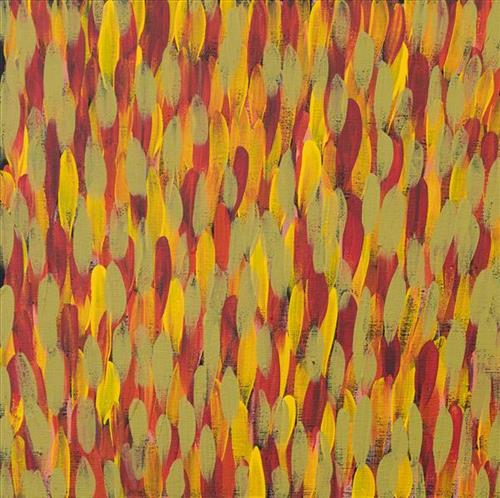
Waru (fire)

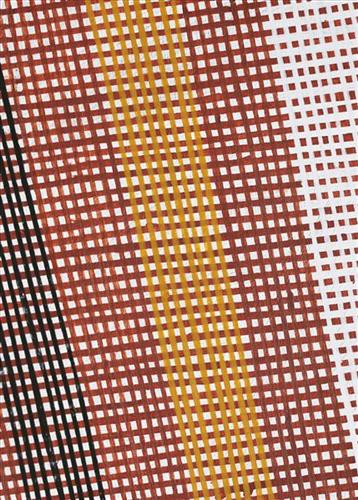
This work depicts the practice of fire burning as it continues to be used today through the Martu homelands. Over thousands of years, as Martu travelled and hunted on foot they would burn tracts of land, using waru (fire) as a means to assist with hunting and to encourage regenerative growth. Whilst fire burning practices have modernised in recent times, with Martu burning areas close to Aboriginal communities and along roads, or else further afield using helicopters and 4WDs with Indigenous ranger group Karnyirninpa Jukurrpa (KJ), the same objectives are met as those during pujiman (traditional, desert dwelling) times.

Targeted waru is an important tool in animal tracking. Small burns are lit to clear vegetation, expose burrows, and to allow for access to walk and track readily in exposed sands. Fires are typically burnt during cooler weather in small, controlled areas, reducing the risk of unmanageable, spontaneous bush fires whilst simultaneously providing diverse regenerating habitats. Remaining is a defined mosaic fire scar pattern in the land, across tali (sand dunes), linyji (clay pans), parulyukurru (spinifex country) and pila (sandy plains). This patterning is clearly visible from an aerial perspective, and becomes even more defined as new growth emerges. 

The patchwork nature of regrowth is aligned with the Martu cycle of burning and regrowth and its five distinct phases. First is nyurnma (freshly burnt Country), followed after the rains by waru-waru, when young, bright green plants start to grow. Nyukura occurs between one and three years after burning, when plants have matured and are fruiting and seeding. Manguu is four to six years post burning, when spinifex has matured to the point that it can be burned once again. Finally, kunarka signifies the time when spinifex and other plant species have become old growth, and pose a risk of destructive bushfires.

111982127246


Dirdbim (Moon Dreaming)

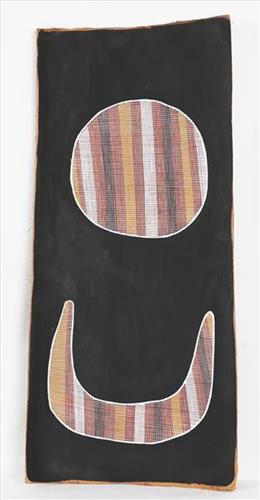
The images in this painting refer to a site in the clan estate of the artist, at a place called Dirdbim which literally means ‘image of the moon’. The site is a large, unusually round hole in sandstone, residual on the plain not far from the Mann River. Mick Kubarkku is an artist well known for his paintings of the full and new moons, the sun and the stars. He also taught several family members to paint this important dreaming. Here Lulu Laradjbi, Mick Kubarrkus’s wife, has painted the full and new moon called dird bukkulurl and lirrk kurrmeng in the Eastern Kunwinjku language.

The large hole is said to be the full moon created by the rainbow serpent Ngalyod, who pierced the rock in times of the ‘dreaming’ and left the shape of the full moon. Dirdbim is not far from the artists’ residence today at Yikarrakkal and the area is rich in rock art and old camping sites. As well there are numerous human remains, bones wrapped up in paper bark and older remains lying in clefts of sandstone shelters. The Eastern Kunwinjku people of the district have always used Dirdbim as a mortuary site because of the mythological history of the area which is connected to the moon story. This is because the mythology of the moon ancestor relates how his adversary, the spotted quoll, argued with the moon over the fate of humanity. The quoll decided he would die once and once only but the moon took his place in the sky to be reborn each lunar month. Because of this Kubarkku often painted this subject with bones or murrngno surrounding the image, just as human bones surround the actual site at Dirdbim.

The techniques of bark painting are usually handed down from one generation to the next, as are the rights of each artist to a particular site or ‘dreaming’. The similarity between this painting by Laradjbi, and some of her husband’s paintings is a reflection of this process of transmission.

111982127240


Namarrkon the Lightning Spirit

Namarden or Namarrkon are Eastern Kunwinjku names for the Lightning Spirit. This entity, which is responsible for lightning and thunder, is painted on both stone and bark in a form described as ‘like a grasshopper’. Namarrkon is said to have made Ngaldjurr – Leichardt’s or the spectacular grasshopper [Petasia ephippigera]. The species emerges, mates and is most active and visible in the season known as Kunemeleng, between October and December when there are intense electrical storms. Ngaldjurr is then said to be ‘looking for’ Namarrkon. Namarrkon makes lightning and thunder by striking out with kurlbburru – stone axes which protrude from its joints. Today, the Kuninjku will not leave axes lying out in the open during an electrical storm as the axes act as an attraction to the destructive force of Namarrkon. The lines emanating from Namarrkon’s head are said to be mardno or lightning bolts of power.

There is a dreaming site for the lightning spirit on the Liverpool River. The site, Kukkurrh, is a high undercut red gravel bank on a bend in the river. The rest of the country along the river is either flat grassy plains or thick mangrove forest. The red cliffs are in startling contrast to the rest of the landscape. The Kuninjku tell of a lightning man who grew angry and began making a terrifying and destructive storm. A lightning woman began to feel sorry for the human beings who were being killed by the storm. The man and woman stood as ‘cousin’ to each other in tribal relationship – this relationship between men and women is one of restraint and avoidance. When the lightning woman grabbed her cousin to calm him down he immediately became quiet and let people live. So it is today, say the Kuninjku, if a man is fighting and no one can calm him, he will become quiet if his cousin tries to restrain him

111982127238


Wak Wak

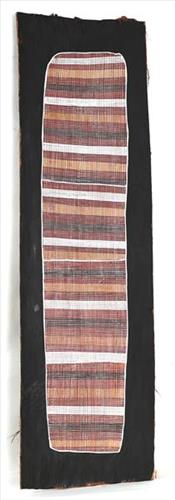
This painting depicts a sacred site at ‘Kurrurldul’, an outstation south of Maningrida.

The ‘rarrk’, or abstract crosshatching, on this work represents the design for the crow totem ancestor called ‘Djimarr’. Today this being exists in the form of a rock, which is permanently submerged at the bottom of Kurrurldul Creek. The ‘Djimarr’ rock in the stream at Kurrurldul is said to move around and call out in a soft hooting tone at night. Both the stone itself and the area around it are considered sacred.

The imagery represents the rock mentioned above at the bottom of Kurrurldul creek, which is the final transmutation of the dreaming ancestor ‘Djimarr’. Finally, the pattern used here is also the crow design used in the sacred ‘Mardayin’ ceremony, which is a large regional patri-moiety ceremony now rarely conducted in central and eastern Arnhem Land.

377810582127213


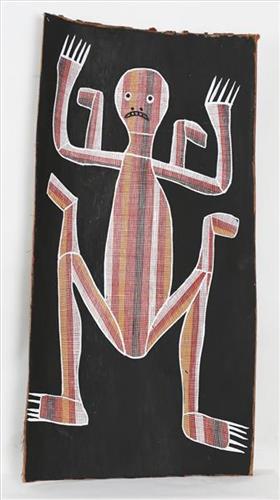
Yawkyawk and Bush Flower

Yawkyawk is a word from the Aboriginal Kunwinjku language, meaning ‘young woman’ and ‘young woman spirit being’.

Sometimes compared to the European notion of mermaids, yawkyawks are usually depicted with the tails of fish. They have long hair, associated with trailing blooms of algae, typically found in Arnhem Land streams and rock pools.

111582127201


Bush Flowers

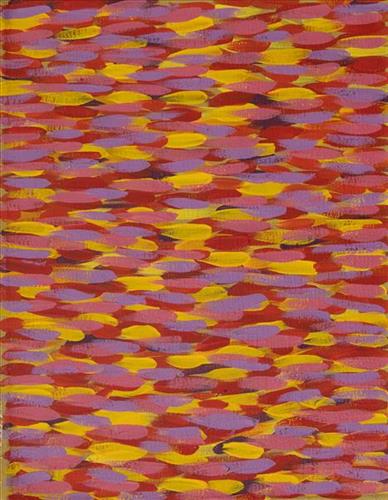
“When Martu paint, it’s like a map. Martu draw story on the ground and on the canvas, and all the circle and line there are the hunting areas and different waters and tracks where people used to walk, and [some you] can’t cross, like boundaries. So nowadays you see a colourful painting and wonder what it is, but that’s how Martu tell story long ago. It’s not just a lovely painting, it’s a story and a songline and a history and everything that goes with it.” 

– Ngalangka Nola Taylor and Joshua Booth

This work portrays an area of Country that can be interpreted in multiple ways. Firstly, the image may be read as an aerial representation of a particular location known to the artist- either land that they or their family travelled, from the pujiman (traditional, desert dwelling) era to now. During the pujiman period, Martu would traverse very large distances annually in small family groups, moving seasonally from water source to water source, and hunting and gathering bush tucker as they went. At this time, one’s survival depended on their intimate knowledge of the location of resources; thus physical elements of Country, such as sources of kapi (water), tali (sandhills), different varieties of warta (trees, vegetation), ngarrini (camps), and jina (tracks) are typically recorded with the use of a use of a system of iconographic forms universally shared across the desert. 

An additional layer of meaning in the work relates to more intangible concepts; life cycles based around kalyu (rain, water) and waru (fire) are also often evident. A thousands of year old practice, fire burning continues to be carried out as both an aid for hunting and a means of land management today. As the Martu travelled and hunted they would burn tracts of land, ensuring plant and animal biodiversity and reducing the risk of unmanageable, spontaneous bush fires. The patchwork nature of regrowth is evident in many landscape works, with each of the five distinctive phases of fire burning visually described with respect to the cycle of burning and regrowth.  

Finally, metaphysical information relating to a location may also be recorded; Jukurrpa (Dreaming) narratives chronicle the creation of physical landmarks, and can be referenced through depictions of ceremonial sites, songlines, and markers left in the land. Very often, however, information relating to Jukurrpa is censored by omission, or alternatively painted over with dotted patterns.