111582126999
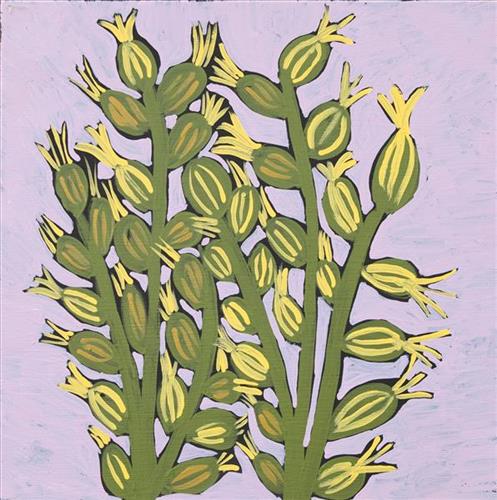
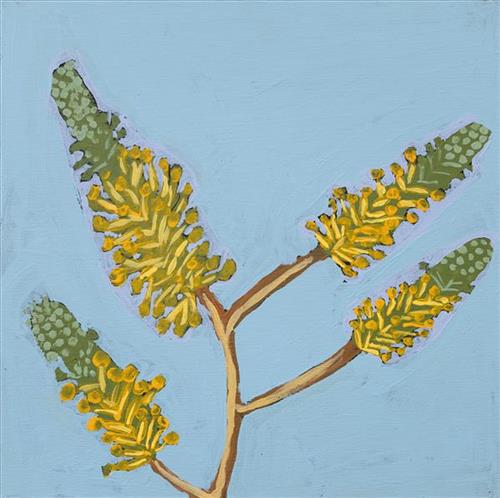
Ngujarna yuwinyji
Depicted in this work are traditional types of bush tucker, their habitats, and their related hunting and gathering methods. During the pujiman (traditional, desert dwelling) period, Martu would traverse very large distances annually in small family groups, moving seasonally from water source to water source, and hunting and gathering bush tucker as they went. Whilst desert life has moved away from mobile hunter-gatherer subsistence throughout the course of the twentieth century, bush tucker continues to be a significant component of the modern Martu diet. Hunting and gathering bush tucker remains equally valuable as an important cultural practice that is passed on intergenerationally. Though hunting and gathering implements have been modernised, methods of harvesting, tracking and the use of fire burning to drive animals from their retreats are still commonly practiced today.
Typically, animals hunted for their kuwiyi (meat) include kirti-kirti (euro kangaroo) and marlu (plains kangaroo), parnajarrpa (sand goanna), kipara (Australian bustard, bush turkey) and karlaya (emu). Lunki (witchetty grub) and wuukurta (honey ants) are dug from tree and bush trunks, or from underground nests. Popular mayi (plant food) includes minyarra (bush onion), collected from small, grass like plants; root vegetables dug from underground such as kulyu and mata (types of bush potato); and seeds such as kalaru (samphire, salt bush), yuwinyji, and marnkalpa (spinifex species). Jawirli (quondong), wamurla (bush tomatoes), jinyjiwirrily (wild gooseberry), ngaputa (melon), and karlkula (bush banana) are some of the most popular bush fruits. These are often collected in the wantajarra (cool season) and tuulpara (spring) months, along with juri (sweet) botanical gums and wama (nectar), obtained from various plant species.
Traditional tools used for hunting and gathering bush tucker were carved from wanari (mulga), mulunturu (desert oak), yurungkura (river red gum) and mijarrpa (bloodwoods), and included kurlata (spears), jurna (hitting stick), karli (boomerangs), wana (digging-sticks), piti (timber bowls used for carrying food and water), and jiwa (grinding stones for grinding seeds into flour). While carved objects retain enormous social and ceremonial importance in Martu life, they are no longer used for hunting and gathering.
111982126958
Wak Wak
This painting depicts a sacred site at ‘Kurrurldul’, an outstation south of Maningrida.
The ‘rarrk’, or abstract crosshatching, on this work represents the design for the crow totem ancestor called ‘Djimarr’. Today this being exists in the form of a rock, which is permanently submerged at the bottom of Kurrurldul Creek. The ‘Djimarr’ rock in the stream at Kurrurldul is said to move around and call out in a soft hooting tone at night. Both the stone itself and the area around it are considered sacred.
The imagery represents the rock mentioned above at the bottom of Kurrurldul creek, which is the final transmutation of the dreaming ancestor ‘Djimarr’. Finally, the pattern used here is also the crow design used in the sacred ‘Mardayin’ ceremony, which is a large regional patri-moiety ceremony now rarely conducted in central and eastern Arnhem Land.
111982126952
Wak Wak
This painting depicts a sacred site at ‘Kurrurldul’, an outstation south of Maningrida.
The ‘rarrk’, or abstract crosshatching, on this work represents the design for the crow totem ancestor called ‘Djimarr’. Today this being exists in the form of a rock, which is permanently submerged at the bottom of Kurrurldul Creek. The ‘Djimarr’ rock in the stream at Kurrurldul is said to move around and call out in a soft hooting tone at night. Both the stone itself and the area around it are considered sacred.
The imagery represents the rock mentioned above at the bottom of Kurrurldul creek, which is the final transmutation of the dreaming ancestor ‘Djimarr’. Finally, the pattern used here is also the crow design used in the sacred ‘Mardayin’ ceremony, which is a large regional patri-moiety ceremony now rarely conducted in central and eastern Arnhem Land.
111982126951
Kun-madj – large dillybag vine
Kun-madj, or dilly bag, is a large woven collecting basket. These large bags are often made from the vine ‘Malasia scandens’, a strong pliable plant which grows along the floor and into the canopy of monsoon vine thickets. The bags are used to collect any kind of large numbers of heavy foods such as fish caught in conical fish traps or large collections of yams.
They can also be made from Pandanus spiralis, a plant which grows in many areas of Arnhem Land. These dilly bags are a tightly woven collecting basket, very finely made. These dilly bags are often used to collect sugarbag, the native honey
As well as being of practical use, dilly bags are also of religious significance to Arnhem Land people. Dilly bags are said to be totemic objects and associated with particular sites in the landscape.
111982126949
Kun-madj – large dillybag vine
Kun-madj, or dilly bag, is a large woven collecting basket. These large bags are often made from the vine ‘Malasia scandens’, a strong pliable plant which grows along the floor and into the canopy of monsoon vine thickets. The bags are used to collect any kind of large numbers of heavy foods such as fish caught in conical fish traps or large collections of yams.
They can also be made from Pandanus spiralis, a plant which grows in many areas of Arnhem Land. These dilly bags are a tightly woven collecting basket, very finely made. These dilly bags are often used to collect sugarbag, the native honey
As well as being of practical use, dilly bags are also of religious significance to Arnhem Land people. Dilly bags are said to be totemic objects and associated with particular sites in the landscape.
111982126877
Barlangu (Shark)
SHARK STORY;
This shark jumped from Mirrngatja to Malyangarnak and the Saratoga jumped from Mahjangarnak to Mirrngatja. When the shark came to Malyangarnak and the Saratoga went to Mirrngatja those two places swapped names, Malyangarnak was given the name Malyangarnak, we were told these stories by the two Traditional Owners of Malyangarnak who have now deceased but we still remember their stories.
111982127309
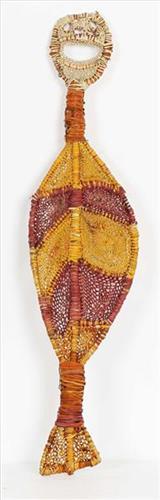
Yawkyawk (Ngalkunburriyaymi)
This is a weaving of Ngalkunburriyaymi, the fish-women spirit. The water spirits Yawkyawk or Ngalkunburriyaymi are perhaps the most enigmatic. Sometimes compared to the European notion of mermaids, they exist as spiritual beings living in freshwater streams, particularly those in the stone country. The spirit Yawkyawk are usually describe and depicted with the tails of fish, as in this painting. Thus the Kununjku people sometime call them ngalberddjenj which literally means ‘the woman who has a tail like a fish’. They have long hair which is associated with trailing blooms of green algae (called man-bak in Kuninjku) found in freshwater streams and rock pools. At times they leave their aquatic homes to walk about on dry land, particularly at night.
Aboriginal people believe that at one time all animals were humans. During the time of the creation of landscapes and plants and animals, these ancestors heroes in human form changed into their animal forms via a series of various significant events now recorded as oral mythologies.
Today the Kuninjku believe that ngalkunburriyaymi are alive and well and living in freshwater sites in a number of sacred locations. The Kuninjku also believe that ‘clever’ man (magicians with mystical powers called in Kuninjku na-kordang) may take these spirits as wives. The father of Mandarrk, a well known artist who resided in the Central Arnhem area, is said to have had such a spirit as a wife. Unfortunately, it is said, she failed one day to return from being sent to fetch water from the river, and returned to her kin. The ngalkunburriyaymi also have husbands and children of their own kind. Their sites are usually shared with the rainbow serpent ngalyod. Some have ritual importance, for example in some depictions, the yawkyawk spirit holds ceremonial string, just like the lengths of string women hold between both hands today during certain public ceremonies.
There are at least three major ngalkunburriyaymi sacred sites that are well known in the area south and south-west of Maningrida. One site Bolerrhlerr is on the Mann River at a place near Yikarrakkal Outstation where the Mann River has rugged rocky banks and clefts beneath stone overhangs in the water. The yawkyawk in this painting refers to this site. Another very similar site further west in the Kumadderr River district is surrounded by a number of small but very old rock art sites and has become known in English as ‘Dreaming Lady’. A third site is a major yawkyawk dreaming place which is so significant that the traditional clan custodians have set up an outstation community near the site the identify of this group is very much related to their yawkyawk dreaming for which they have spiritual and practical responsibility. This group, known as the Dangkorlo clan, are well known for their bark paintings and sculptures of yawkyawk. Both of Kubarkku’s wives are members of the Dangkorlo clan.
111982127306
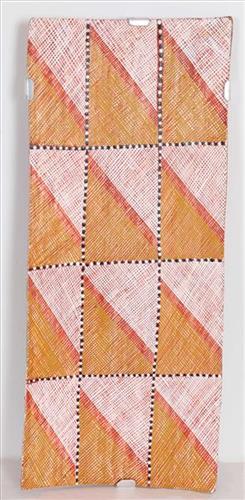
Galawon (Goanna)
This painting depicts two goannas embedded in an intricate depiction of gungara, the mini cyclones common during the wet season in Arnhem Land. Gungara also relates specifically to the Bilwoyinj site. At this site, two of the most important Kuninjku creation beings, a father and son, hunted and ate goanna. They left some goanna fat behind, which turned into the rock that still stands at the site today.
111982127303
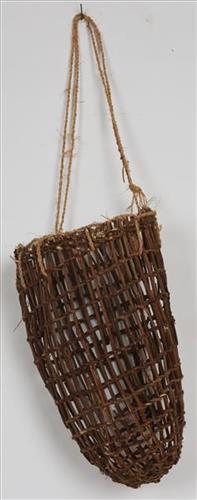
Kun-madj – large dillybag vine
Kun-madj, or dilly bag, is a large woven collecting basket. These large bags are often made from the vine ‘Malasia scandens’, a strong pliable plant which grows along the floor and into the canopy of monsoon vine thickets. The bags are used to collect any kind of large numbers of heavy foods such as fish caught in conical fish traps or large collections of yams.
They can also be made from Pandanus spiralis, a plant which grows in many areas of Arnhem Land. These dilly bags are a tightly woven collecting basket, very finely made. These dilly bags are often used to collect sugarbag, the native honey
As well as being of practical use, dilly bags are also of religious significance to Arnhem Land people. Dilly bags are said to be totemic objects and associated with particular sites in the landscape.