111982132502
Coil Basket
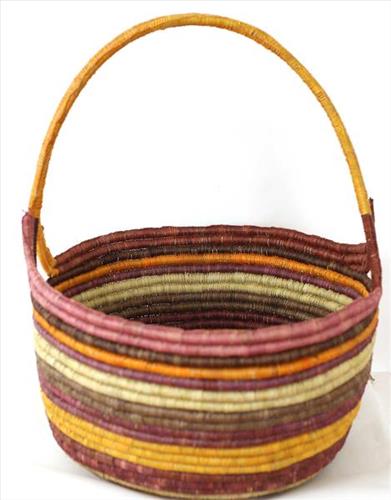
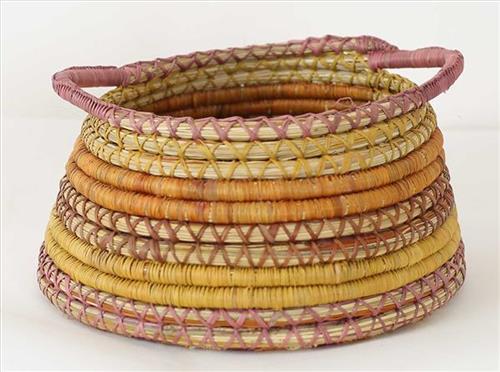
Coiling technique was introduced in the 1920s at Goulburn Island to the Maung people by missionaries and quickly spread to the mainland. Many artists produce coiled baskets of varied shapes, ranging from small round baskets to large oval baby baskets made from dyed pandanus. Artists combine colours and patterns to obtain intricate new graphic patterns.
111982132501
Coil Basket
Coiling technique was introduced in the 1920s at Goulburn Island to the Maung people by missionaries and quickly spread to the mainland. Many artists produce coiled baskets of varied shapes, ranging from small round baskets to large oval baby baskets made from dyed pandanus. Artists combine colours and patterns to obtain intricate new graphic patterns.
111982133193
An-gujechiya (Fish Trap)
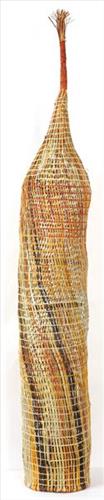
To make fish traps and fish net fences artists firstly get vine (mirlarl) from the jungle and they put it in water for one night to make it soft. Next they start weaving it; they make rings for the inside to keep the fish trap’s shape. Artists work for three or four weeks on the fish trap. They also make string from kurrajong (burdaga) to attach the hibiscus (bardainy) rings and to tie the conical end of the fish trap. This fish trap is used in saltwater and freshwater. People also use fish net fences called mun-dirra. A long time ago they would put the mun-dirra across rivers and creeks. In the middle they would place the an-gujechiya. They also used small things like sticks, rocks, mud and grass to block the fish from going through. People would then catch fish like saltwater barramundi rajarra, freshwater barramundi (janambal), small black freshwater catfish (buliya), bonefish (an-guwirrpiya), and sand bass (dalakan) in these fish traps.
111982133137
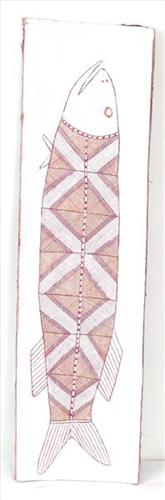
Walkkadda (Freshwater Mullet)

111982133136
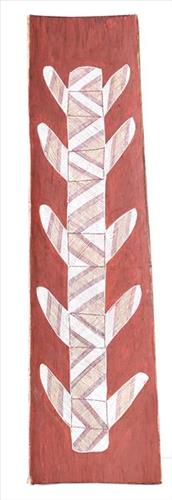
Kunkurra (The Spiralling Wind)
‘Kunkurra’, the spiralling wind is associated with several sites in the Kardbam clan estate. On one level, this painting can be interpreted as a depiction of the kinds of mini-cyclones common during the wet season in Arnhem Land, where the artist lives. In this painting, Kunkurra also relates specifically to a site called Bilwoyinj, near Mankorlod.
At this site, two of the most important Kuninjku creation beings, a father and son known as na-korrkko, are believed to have hunted and eaten a goanna. They left some of the goanna fat behind at the site, which turned into the rock that still stands there today. The word Bilwoyinj, which is the name of this site, also refers to the fat of the goanna. Bilwoyinj site is also a ceremonial ground for a ceremony called Yabbaduruwa, a major ceremony owned by the Yirridja patrimoiety. The Yabbaduruwa ceremony is primarily concerned with initiation, land ownership and promoting the cyclical regeneration of the human and natural worlds.
111982133135
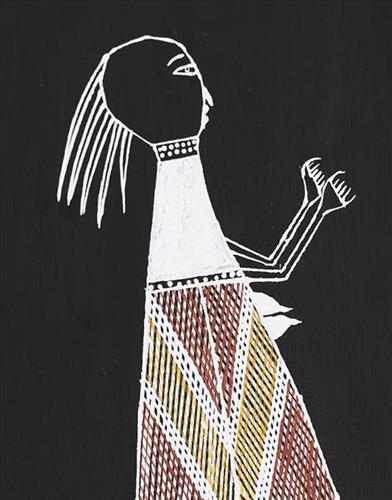
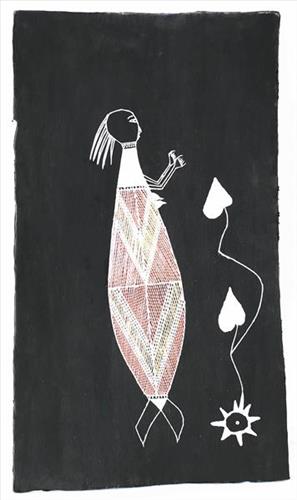
Djomi
There are two Dreaming ladies at Bábbarra billabong – Djómi and Bábbarra. These two are sisters: one freshwater ‘mermaid’ and one saltwater one. Big long head, big stomach and very skinny legs that Bábbarra.
Their mother is the crocodile who lives in the Bábbarra billabong.
Both sisters will give people babies through the drinking water at Bábbarra. That’s why men stay away and Bábbarra is a sacred women’s site. Too strong our Dreaming – even men can get that baby in their tummies!
When it rains at Bábbarra, or when a cyclone comes, it’s because our Dreaming is too strong. There are lots of women spirits. When the storms come, the spirits go in the underground rivers and hide safely.
If you go fishing in our country, you have to be careful not to catch the Bábbarra and Djómi ‘mermaids’. Some people catch them thinking they are barramundi, but they are actually the ‘mermaid’ spirits. You will know, because they have white hair.
Lena Djabibba, djungkay (mother’s country and ceremonial manager of Bábbarra) and Joy Garlbin (landowner for Bábbarra)
Text courtesy of Bábbarra Women’s Centre copyright 2017
111982133133
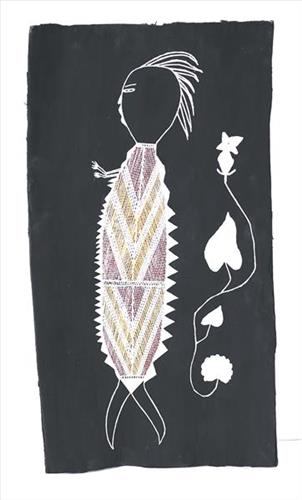
Djomi
There are two Dreaming ladies at Bábbarra billabong – Djómi and Bábbarra. These two are sisters: one freshwater ‘mermaid’ and one saltwater one. Big long head, big stomach and very skinny legs that Bábbarra.
Their mother is the crocodile who lives in the Bábbarra billabong.
Both sisters will give people babies through the drinking water at Bábbarra. That’s why men stay away and Bábbarra is a sacred women’s site. Too strong our Dreaming – even men can get that baby in their tummies!
When it rains at Bábbarra, or when a cyclone comes, it’s because our Dreaming is too strong. There are lots of women spirits. When the storms come, the spirits go in the underground rivers and hide safely.
If you go fishing in our country, you have to be careful not to catch the Bábbarra and Djómi ‘mermaids’. Some people catch them thinking they are barramundi, but they are actually the ‘mermaid’ spirits. You will know, because they have white hair.
Lena Djabibba, djungkay (mother’s country and ceremonial manager of Bábbarra) and Joy Garlbin (landowner for Bábbarra)
Text courtesy of Bábbarra Women’s Centre copyright 2017
111982133437
An-gujechiya (Fish Trap)
To make fish traps and fish net fences artists firstly get vine (mirlarl) from the jungle and they put it in water for one night to make it soft. Next they start weaving it; they make rings for the inside to keep the fish trap’s shape. Artists work for three or four weeks on the fish trap. They also make string from kurrajong (burdaga) to attach the hibiscus (bardainy) rings and to tie the conical end of the fish trap. This fish trap is used in saltwater and freshwater. People also use fish net fences called mun-dirra. A long time ago they would put the mun-dirra across rivers and creeks. In the middle they would place the an-gujechiya. They also used small things like sticks, rocks, mud and grass to block the fish from going through. People would then catch fish like saltwater barramundi rajarra, freshwater barramundi (janambal), small black freshwater catfish (buliya), bonefish (an-guwirrpiya), and sand bass (dalakan) in these fish traps.
111982133415
Wak Wak
This painting depicts a sacred site at ‘Kurrurldul’, an outstation south of Maningrida.
The ‘rarrk’, or abstract crosshatching, on this work represents the design for the crow totem ancestor called ‘Djimarr’. Today this being exists in the form of a rock, which is permanently submerged at the bottom of Kurrurldul Creek. The ‘Djimarr’ rock in the stream at Kurrurldul is said to move around and call out in a soft hooting tone at night. Both the stone itself and the area around it are considered sacred.
The imagery represents the rock mentioned above at the bottom of Kurrurldul creek, which is the final transmutation of the dreaming ancestor ‘Djimarr’. Finally, the pattern used here is also the crow design used in the sacred ‘Mardayin’ ceremony, which is a large regional patri-moiety ceremony now rarely conducted in central and eastern Arnhem Land.