
377810582149934
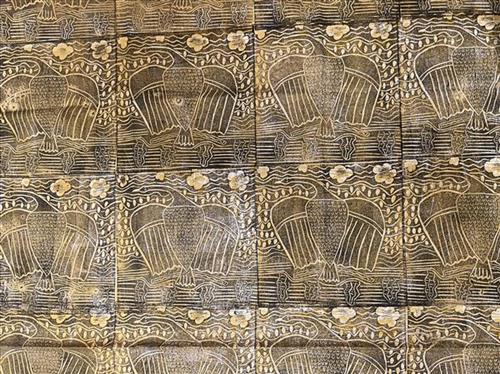
Gurrpurdu (Diving Bird)
A design by emerging textile designer, Charmaine Pascoe.
‘My Gurrpurdu (diving bird) was white. She flew from Gan Gan to Gapuwiyak and then to Yathalamarra. And then she flew to Gartji.
At Gartji two fresh water seaweed shoots, one long and one short were trying to keep diving bird down. They were saying, “Don’t go away you belong to this country”. Diving bird said “No! I’m going to travel around to other country”. She was flapping her wings and then those two seaweed shoots let her go.
Then diving bird flew to make water hole at Gamurra Gu-yurra. She tasted the water but it was salty not fresh water. Then she put her poo like white clay on the ground at Gamurra Gu-yurra. The while clay was used for painting, funerals and ceremonies.
Then she continued to fly to Ji-balbal where she put the white clay again and then from Ji-balbal she dived underwater to Gochan Jiny-jirra. When she got there she got out of the water and was flapping her wings. At the same time she was singing. She was using her wings to dry out so that she could fly to Nangak.’ Charmaine Pascoe 2020

377810582149933
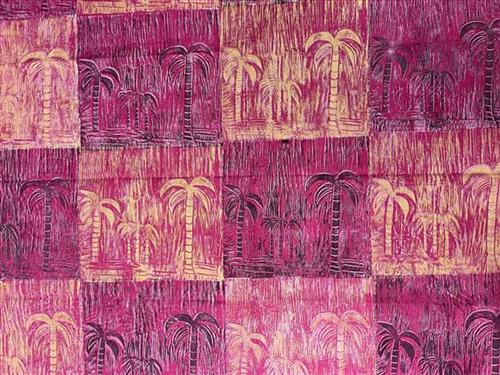
Palm tree on my country
This fabric was created using the linocut printing technique. The lino tile has been carved by the artist in Maningrida, and has been printed by hand using a variety of colours and layers. The linocut technique ensures each textile piece is a one-off, limited edition piece.

377810582149932
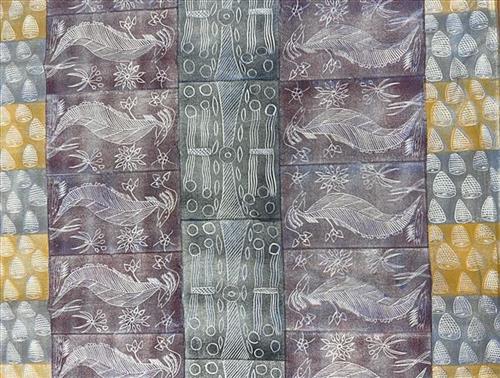
Ngalyod

377810582149930
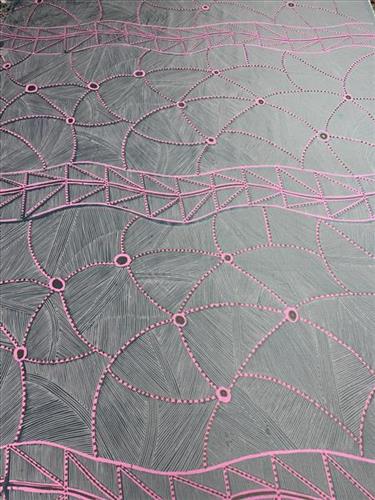
Kunkurra (Spiral Wind)
‘My designs, they are all alive living up in my head’- Janet Marawarr
Janet Marawarr has depicted kunkurra, the spiralling wind associated with several sites in the Kardbam clan. On one level, this design can be interpreted as a depiction of the kinds of mini-cyclones common during the wet season in Arnhem Land, where the artist lives. Kunkurra also relates specifically to a site called Bilwoyinj, near Mankorlod, on the artist’s clan estate.
At this site, two of the most important Kuninjku creation beings, a father and son known as na-korrkko, are believed to have hunted and eaten a goanna. They left some of the goanna fat behind at the site, which turned into the rock that still stands there today.
Bilwoyinj site is also a ceremonial ground for a ceremony called Yabbaduruwa, a major ceremony owned by the Yirridja patrimoiety. The Yabbaduruwa ceremony is primarily concerned with initiation, land ownership and promoting the cyclical regeneration of the human and natural worlds.

377810582149929
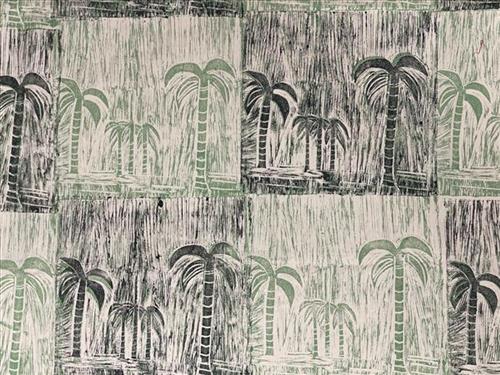
Palm tree on my country
This fabric was created using the linocut printing technique. The lino tile has been carved by the artist in Maningrida, and has been printed by hand using a variety of colours and layers. The linocut technique ensures each textile piece is a one-off, limited edition piece.

377810582149928
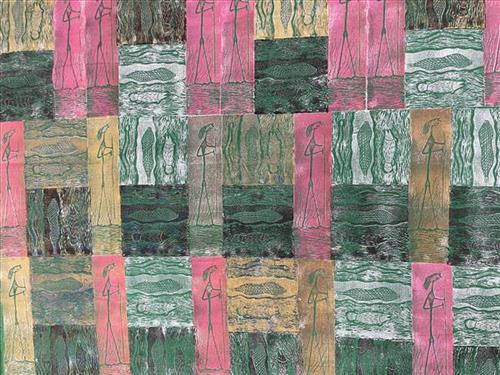
Mimih and Kunj

377810582149927
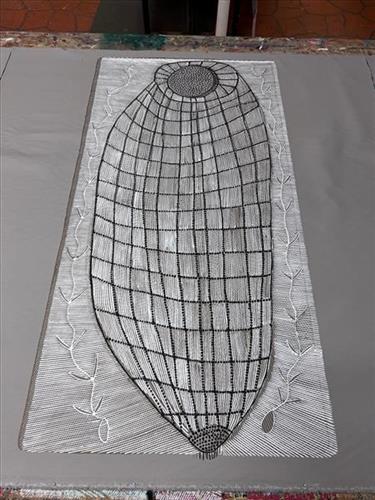
Mandjabu (Fish Trap)
“In old times people would make these mandjabu (fish traps) to go fishing. They are made with vine we find in the jungle. That old man, Anchor Gulunba, he showed me how to make these fish traps. I would sit there and watch him making them. We catch barramundi, catfish, all kinds of fish.” – Helen Lanyinwanga
Kuninjku people traditionally make two sorts of conical fish traps. One called mandjabu made from a vine called milil, and another smaller one called manylik mandjabu, made from the grass manylik. The mandjabu conical fish trap is bigger and stronger and used in tidal reaches of creeks to catch large fish. The smaller, lighter manylik trap is used in freshwater flowing creeks to catch smaller fish and freshwater prawns. Traditionally, only men were involved in the construction of the large fish traps, but children would often crawl inside and assist.
To make fish traps and fish net fences artists firstly get vine (milil) from the jungle and they put it in water for one night to make it soft. Next they start weaving it; they make rings for the inside to keep the fish trap’s shape. Artists work for three or four weeks on the fish trap. They also make string from kurrajong (burdaga) to attach the hibiscus (bardainy) rings and to tie the conical end of the fish trap. This fish trap is used in saltwater and freshwater. People also use fish net fences called mun-dirra. A long time ago they would put the mun-dirra across rivers and creeks. In the middle they would place the an-gujechiya. They also used small things like sticks, rocks, mud and grass to block the fish from going through. People would then catch fish like saltwater barramundi rajarra, freshwater barramundi (janambal), small black freshwater catfish (buliya), bonefish (an-guwirrpiya), and sand bass (dalakan) in these fish traps.

377810582149926
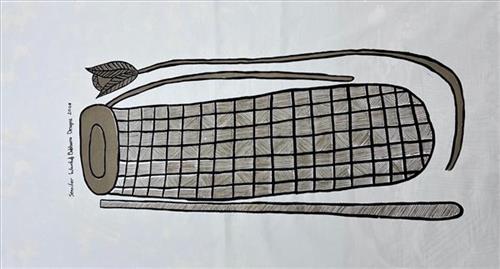
Kun-madj
In this design, Jennifer has depicted kun-madj (dillybag), which is a large woven collecting basket. These large bags are often made from the burney vine (Malaisia scandens), a strong, pliable plant that grows along the ground and into the canopy of monsoon vine thickets. The bags are used to collect heavy foods, such as fish caught in conical fish traps or yams. They can also be made from kun-dayarr (Pandanus spiralis), a palm that grows in many areas of Arnhem Land. Tightly woven dillybags are used to collect sugarbag, the native honey.
As well as being of practical use, dillybags are of cultural significance to Arnhem Land people. They are totemic objects associated with particular sites in the landscape.