111582147799


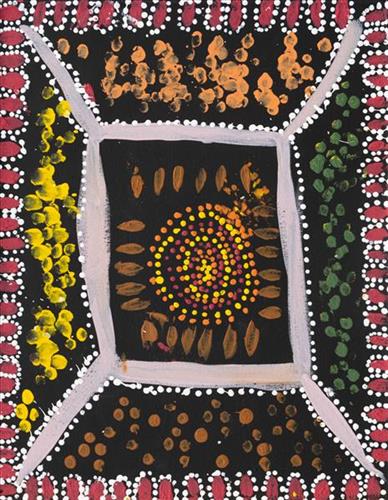
Waru (fire) and bush Tucker

Depicted in this work are traditional types of bush tucker, their habitats, and their related hunting and gathering methods. During the pujiman (traditional, desert dwelling) period, Martu would traverse very large distances annually in small family groups, moving seasonally from water source to water source, and hunting and gathering bush tucker as they went. Whilst desert life has moved away from mobile hunter-gatherer subsistence throughout the course of the twentieth century, bush tucker continues to be a significant component of the modern Martu diet. Hunting and gathering bush tucker remains equally valuable as an important cultural practice that is passed on intergenerationally. Though hunting and gathering implements have been modernised, methods of harvesting, tracking and the use of fire burning to drive animals from their retreats are still commonly practiced today. 

Typically, animals hunted for their kuwiyi (meat) include kirti-kirti (euro kangaroo) and marlu (plains kangaroo), parnajarrpa (sand goanna), kipara (Australian bustard, bush turkey) and karlaya (emu). Lunki (witchetty grub) and wuukurta (honey ants) are dug from tree and bush trunks, or from underground nests. Popular mayi (plant food) includes minyarra (bush onion), collected from small, grass like plants; root vegetables dug from underground such as kulyu and mata (types of bush potato); and seeds such as kalaru (samphire, salt bush), yuwinyji, and marnkalpa (spinifex species). Jawirli (quondong), wamurla (bush tomatoes), jinyjiwirrily (wild gooseberry), ngaputa (melon), and karlkula (bush banana) are some of the most popular bush fruits. These are often collected in the wantajarra (cool season) and tuulpara (spring) months, along with juri (sweet) botanical gums and wama (nectar), obtained from various plant species. 

Traditional tools used for hunting and gathering bush tucker were carved from wanari (mulga), mulunturu (desert oak), yurungkura (river red gum) and mijarrpa (bloodwoods), and included kurlata (spears), jurna (hitting stick), karli (boomerangs), wana (digging-sticks), piti (timber bowls used for carrying food and water), and jiwa (grinding stones for grinding seeds into flour). While carved objects retain enormous social and ceremonial importance in Martu life, they are no longer used for hunting and gathering.
111982147787


An-gujechiya (Fish Trap)

To make fish traps and fish net fences artists firstly get vine (mirlarl) from the jungle and they put it in water for one night to make it soft. Next they start weaving it; they make rings for the inside to keep the fish trap’s shape. Artists work for three or four weeks on the fish trap. They also make string from kurrajong (burdaga) to attach the hibiscus (bardainy) rings and to tie the conical end of the fish trap. This fish trap is used in saltwater and freshwater. People also use fish net fences called mun-dirra. A long time ago they would put the mun-dirra across rivers and creeks. In the middle they would place the an-gujechiya. They also used small things like sticks, rocks, mud and grass to block the fish from going through. People would then catch fish like saltwater barramundi rajarra, freshwater barramundi (janambal), small black freshwater catfish (buliya), bonefish (an-guwirrpiya), and sand bass (dalakan) in these fish traps.

111982147758


Wak Wak

This painting depicts a sacred site at ‘Kurrurldul’, an outstation south of Maningrida.

The ‘rarrk’, or abstract crosshatching, on this work represents the design for the crow totem ancestor called ‘Djimarr’. Today this being exists in the form of a rock, which is permanently submerged at the bottom of Kurrurldul Creek. The ‘Djimarr’ rock in the stream at Kurrurldul is said to move around and call out in a soft hooting tone at night. Both the stone itself and the area around it are considered sacred.

The imagery represents the rock mentioned above at the bottom of Kurrurldul creek, which is the final transmutation of the dreaming ancestor ‘Djimarr’. Finally, the pattern used here is also the crow design used in the sacred ‘Mardayin’ ceremony, which is a large regional patri-moiety ceremony now rarely conducted in central and eastern Arnhem Land.

111982147738


Burlupurr – large dillybag

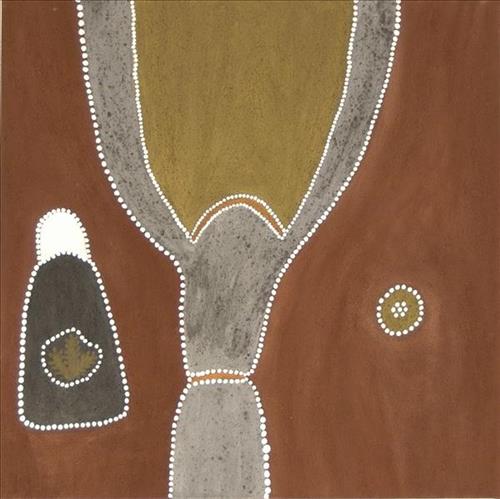
Burlupurr, or dilly bag, is a large woven collecting basket. These large bags are often made from the vine ‘Malasia scandens’, a strong pliable plant which grows along the floor and into the canopy of monsoon vine thickets. The bags are used to collect any kind of large numbers of heavy foods such as fish caught in conical fish traps or large collections of yams.

They can also be made from Pandanus spiralis, a plant which grows in many areas of Arnhem Land. These dilly bags are a tightly woven collecting basket, very finely made. These dilly bags are often used to collect sugarbag, the native honey 

As well as being of practical use, dilly bags are also of religious significance to Arnhem Land people. Dilly bags are said to be totemic objects and associated with particular sites in the landscape.

111982147737


Burlupurr – large dillybag

Burlupurr, or dilly bag, is a large woven collecting basket. These large bags are often made from the vine ‘Malasia scandens’, a strong pliable plant which grows along the floor and into the canopy of monsoon vine thickets. The bags are used to collect any kind of large numbers of heavy foods such as fish caught in conical fish traps or large collections of yams.

They can also be made from Pandanus spiralis, a plant which grows in many areas of Arnhem Land. These dilly bags are a tightly woven collecting basket, very finely made. These dilly bags are often used to collect sugarbag, the native honey 

As well as being of practical use, dilly bags are also of religious significance to Arnhem Land people. Dilly bags are said to be totemic objects and associated with particular sites in the landscape.

111982147736


Burlupurr – large dillybag

Burlupurr, or dilly bag, is a large woven collecting basket. These large bags are often made from the vine ‘Malasia scandens’, a strong pliable plant which grows along the floor and into the canopy of monsoon vine thickets. The bags are used to collect any kind of large numbers of heavy foods such as fish caught in conical fish traps or large collections of yams.

They can also be made from Pandanus spiralis, a plant which grows in many areas of Arnhem Land. These dilly bags are a tightly woven collecting basket, very finely made. These dilly bags are often used to collect sugarbag, the native honey 

As well as being of practical use, dilly bags are also of religious significance to Arnhem Land people. Dilly bags are said to be totemic objects and associated with particular sites in the landscape.

1106929269


WINUBA SPRING

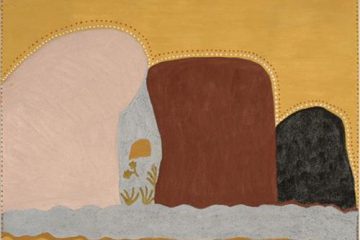
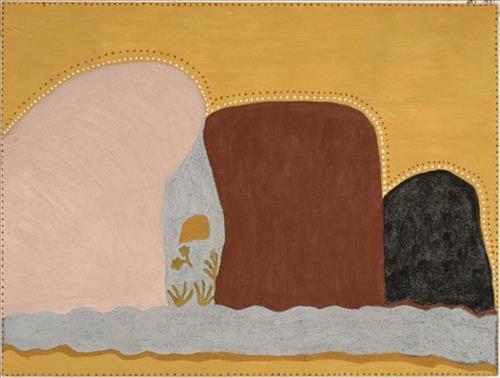
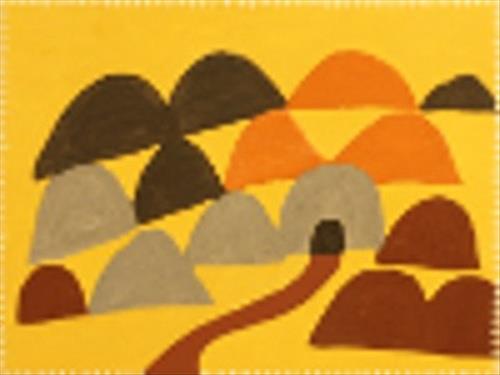
‘That’s Winuba Spring again,’ Evelyn Malgil says. ‘I just do him different shapes you know, different ways.’ ‘This is my father country. Hot water spring and cold water spring. Those big hills are my family place. That water live all year ’round.’ The waterhole at Winuba holds water all through the dry season, when other creeks and waterholes dry up. This is Malgil’s traditional country. Winuba Spring is the Ngarrangkarni (Dreaming) place for the sandfrog.

1106923513


LALANGGARRANY DU DARNDAL -CROCODILE & TURTLE

‘That’s that darndal and lalangkarrany. And that big mangkerrekerreny this side, big lizard. That his thamanyji –grandpa for lalangkarrany. And his grandma again old darndal, he Nangala. Yeah. Juwurruny, lalangkarrany and mangkerrgerreny [is] Jungurrany.  Jida wananyandeburru gurlum biya manamiyanda. He bin look round, digging all the way you know? Got ‘im that crocodile,  julij [carry] him all the way la coolamon, look around, he bin jidajida all the way, [stabbing the ground] jida all the way ‘til he bin come to Murruwuny. Rurd now, rurd nyiniyanya [she sat down] lalangkarrany, got a lalangkarrany got a coolamon, landurrbaya [with a coolamon].  La nyarnde[gum] he bin put ‘im down, la gum, you know gum tree, big one? La shady tree and he bin go got a ganany [digging stick] now yilag. He bin jida, jida, jida right down; water bin shoot out. Nerraj nginini now gurlun yilang balawabiny jidangarriny nyanini. [the water shot out when the turtle stabbed the ground] Jida nyanini daburr nyinamanya gurlun gulurrugu neraj nginini balawabiny. Well the water bin shoot up now he bin fill up now, go back wiji nyanini [she ran] . He bin get all the nyarnde for him, all the nyarnde.  He bin put ‘im right round la derla la tail all around la head everywhere. He bin tell ‘im “wiji buma now, yilag,[run now” he bin tell ‘im to run la that water now. Lalangkarrany bin run, he bin go down la water yilag, nothing. He bin shoot out you know? He wasn’t what’s-a-name, he wasn’t too happy to go down right down. That lalangkarrany he bin put ‘im la him more nyarnde, he never go down you know? He bin put ‘im la him more nyarnde he bin run fast, he never come out. Turtle now he bin put ‘im bat a more nyarnde again he bin try him. Nothing, he bin come out again. He bin go back put ‘im more nyarnde, finish. He bin nyirregnyirreg for good, stop there. And that mangkerre bin run, he bin go stand up la campground. You can see that rock la standing up. Murruwuny now that one.  Fish Hole, top way la Springvale way, well that dunbin [gap] down this way.  And he livin’ there. You can see big mob crocodile everywhere la bank when you light ‘im bat night-time you know? You can see murl there murl everywhere. Eye, murlu deg ngerne lirringbe nginji murlu he lookin’ out you know? He bin looking out, shiny.’  
This Ngarrangkarni involves Darndal the turtle and Lalangkarrany the crocodile. According to Gija kinship system, the turtle is Nangala skin, making her the crocodile’s grandmother, he is Juwurru. Waving Lizard, Mangkerrekerreny is Jungurra, the crocodile’s grandfather. Crocodile was mortally wounded in a fight with Binjirrminy the bat. The turtle placed her dying grandson in a coolamon (landurr) and carried him to this place. As she walked she stabbed the ground with her digging stick trying to find water. At Murruwuny, she put Crocodile down under a shady nyarndeny tree. She stabbed her stick into the sand again and a jet of water came shooting out, creating a deep pool. She covered crocodile in sap and told him to jump into the water, he did but floated to the top. She continued to cover him in more gum, all over his body until at last he jumped in and sank to the bottom. Turtle then covered herself in gum and tried to follow Crocodile. She too floated to the top. Covering herself with more gum, she again jumped in the water and like her grandson sank to the bottom and stayed there. Mangkerrekerreny ran away and turned to stone at a place close to Murruwun. This is Juli’s traditional country on Springvale Station. She says when you go to this spot on the river at night and shine a torch, you can see the glinting eyes of many crocodiles.
 

1106929347


Warndiwal

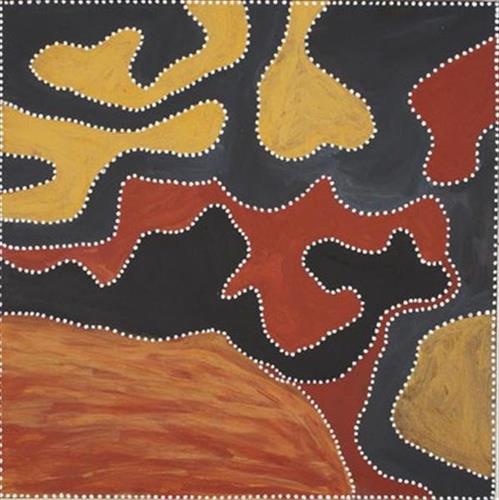
This painting is of the Country on Springvale station, Barlinyin.

Recently, in the wet season, Rusty travelled to this place with his grandchildren. There they were shown how to catch and kill a goanna, they learnt new Gija words, they learnt about Rusty’s life on this Country – it is where he was born and where he worked as a young man. They learnt about the historical, complicated politics of the land and Rusty’s expereince of it and relation to it. 

 
In the left hand corner, Rusty has painted red soil plains. The black area is black soil. The yellow ochre parts are flat country. The grey part of this painting is Warndiwal creek. It is a tributary of Bullock Hole, a popular rest spot for Rusty and others in his family when they lived and worked on Springvale Station.