377810582157032


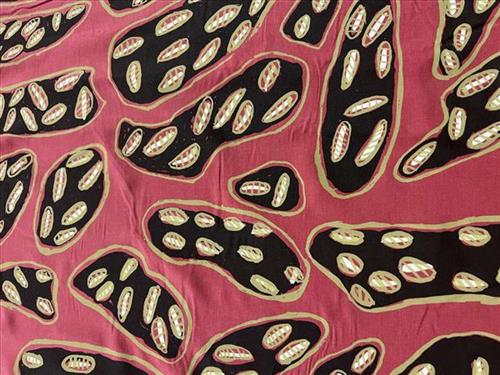
Sea Shells and Dilly Bags

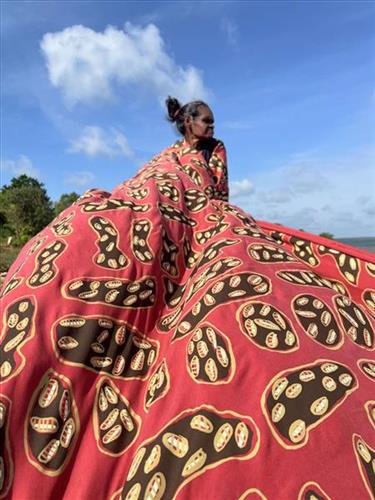
‘Sometimes when we go down to the beach in Maningrida we pick all these shells up. Some family make necklaces and earrings. In the olden days they used to collect shells and put them in the dilly bags. The old people used to carry dilly bags when they went hunting. They used the dilly bag for bush food. My design shows mud muscle and long bum and cockles.’ Belinda Kernan 2022

Belinda’s mother is from Eastern Arrernte country near Alice Springs, the community of Ltyentye Apurte (Santa Teresa), and her father’s country is Maningrida. Belinda speaks languages from both sides of her family, as well as various languages belonging to Central Arnhem Land. She lives in Maningrida and prints lino at the women centre. Belinda is also a strong leader for young people in her community.

377810582157028


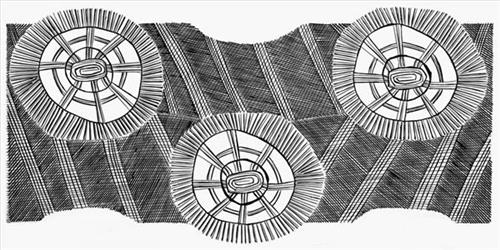
Murnun (Dugong)

Dugong can be found in the waters around Maningrida They are a protected species but do form part of a traditional manme (bushfood) diet for some saltwater communities.

377810582156991


Marebu

Deborah Wurrkidj is a Kuninjku artist from the Kurulk clan whose country lies around the outstation of Mumeka in central Arnhem Land. She is an accomplished artist working across mediums including painting, sculpture, weaving and textile design. For this design, Deborah Wurrkidj has depicted Marebu (woven pandanus mats).

Works in fibre from the Maningrida region are widely recognised as some of the finest in Australia. Artists confidently push the boundaries of fibre craft and cultural expression, adapting traditional techniques and forms to produce strikingly inventive and aesthetically exquisite artworks.

Artists weave many different kinds of mats. Conical mats were traditionally used to shield babies from mosquitoes. Long flat mats were used for blocking creeks so that fish would be diverted into fish traps. A small triangular mat made of pandanus fibre used to be worn by women during ceremonial gatherings, tied around their back and covering them at the front. Mats are also used for wrapping and rinsing food in water.

Artists usually use kundayarr, pandanus spiralis, to weave decorative round or oblong mats, as well as the less common triangular and conical shapes. Weaving is physically hard work, now done only by women. They colour the pandanus using natural dyes made from the roots, leaves or flowers of plants within the weaver’s clan estate.

The radial woven patterns of the finest round mats appear to vibrate with colour, sometimes regarded as an aesthetic manifestation of deep cultural meaning, as there is a significant spiritual dimension to pandanus mats.

37781054001865


Status: Stock


Ngarduk Kunred by H.Lanyinwanga – sold per metre

 NGARDUK KUNRED (My Country) by Helen Lanyinwanga (dec)

“This river we call Mangabo. It is near Gudjarrngarrl homeland of my daughters, Deborah and Jennifer Wurrkidj. We cross that river when travelling to Munmoy outstation. In the wet season, that water comes up and covers over those rocks, and when you look down there are rocks all under the water.”

– Helen Lanyinwanga

This fabric has been hand printed in Sydney by Publisher Textiles.  Earthy tones on a burnt red 30% Linen 70% Tencel blend. Sold Per Meter

37781054001867


Status: Stock


Kukurlk Kare – Jennifer Wurrkidj – Sold per meter

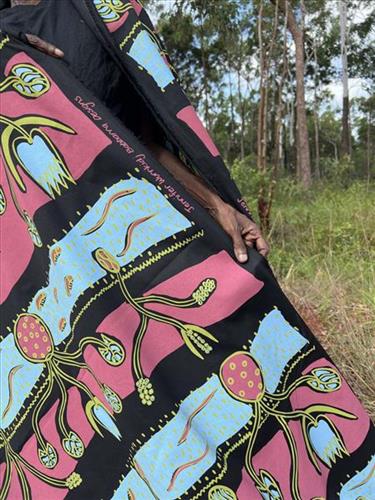
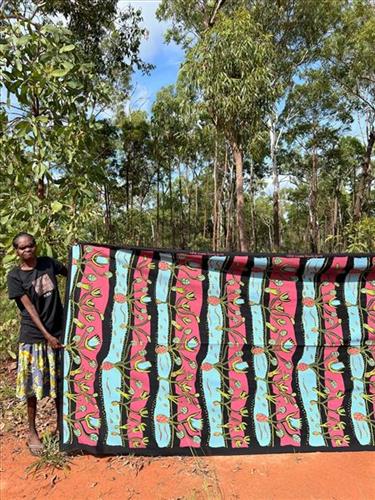
Karrinung kukurlk kare, karrijare manme (we are going underground looking for food).

“This is my country. In this painting, I’m looking at her little bit different way. This is what we see when we’re kukurlk kare (going underground)

Man-kurndalh (Black plum) I call mother. It is my mother’s Djang (dreaming). The bush onion (kulumuduk) is white, the same as onions you buy at the store. We don’t eat this one though, it’s poison.

Wayuk is the water lily, with the big root growing in the earth. This is when that water is drying up a bit. There are worms and beetles- this is what we see underground, when we are digging for manme (bush food).”

-Jennifer Wurrkidj

Hand Screen Printed by Publisher, Sydney Australia 100% Cotton Drill – Sold Per Meter


377810582155381


Gungura

Janet Marawarr has depicted kunkurra, the spiralling wind associated with several sites in the Kardbam clan. On one level, this design can be interpreted as a depiction of the kinds of mini-cyclones common during the wet season in Arnhem Land, where the artist lives. Kunkurra also relates specifically to a site called Bilwoyinj, near Mankorlod, on the artist’s clan estate.


At this site, two of the most important Kuninjku creation beings, a father and son known as na-korrkko, are believed to have hunted and eaten a goanna. They left some of the goanna fat behind at the site, which turned into the rock that still stands there today. The word Bilwoyinj, which is the name of this site, also refers to the fat of the goanna. Bilwoyinj site is also a ceremonial ground for a ceremony called Yabbaduruwa, a major ceremony owned by the Yirridja patrimoiety. The Yabbaduruwa ceremony is primarily concerned with initiation, land ownership and promoting the cyclical regeneration of the human and natural worlds.

377810582155380


Marebu

Deborah Wurrkidj is a Kuninjku artist from the Kurulk clan whose country lies around the outstation of Mumeka in central Arnhem Land. She is an accomplished artist working across mediums including painting, sculpture, weaving and textile design. For this design, Deborah Wurrkidj has depicted Marebu (woven pandanus mats).

Works in fibre from the Maningrida region are widely recognised as some of the finest in Australia. Artists confidently push the boundaries of fibre craft and cultural expression, adapting traditional techniques and forms to produce strikingly inventive and aesthetically exquisite artworks.

Artists weave many different kinds of mats. Conical mats were traditionally used to shield babies from mosquitoes. Long flat mats were used for blocking creeks so that fish would be diverted into fish traps. A small triangular mat made of pandanus fibre used to be worn by women during ceremonial gatherings, tied around their back and covering them at the front. Mats are also used for wrapping and rinsing food in water.

Artists usually use kundayarr, pandanus spiralis, to weave decorative round or oblong mats, as well as the less common triangular and conical shapes. Weaving is physically hard work, now done only by women. They colour the pandanus using natural dyes made from the roots, leaves or flowers of plants within the weaver’s clan estate.

The radial woven patterns of the finest round mats appear to vibrate with colour, sometimes regarded as an aesthetic manifestation of deep cultural meaning, as there is a significant spiritual dimension to pandanus mats.

111582155262


Nyirti Jukurrpa

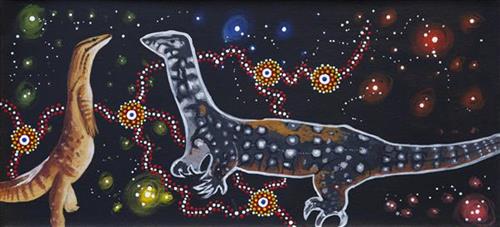
“When we was little kids, used to tell us this story. It was told by many generations – repeated. We still tell it today. One place to another, they keep on going. This one only we know – kids form the 80’s or 90’s. We grew up on the story, I’m bringing it back. White people have three little pigs, we have this one:

So in the beginning there was this black goanna called yalpara. He was plain black, no colour and he was looking at himself in the reflection of the water… “I’m not pretty enough!” He wanted to look good.

He came across this goanna and asked him for a favour – “if you could paint my back I can paint you black.” So, goanna did all the dots very unique, concentrating closely to the design. When yalpara looked into the reflection he said “oh he did a good job!”

Goanna gave yalpara the stick and said “paint me,” but yalpara was in a hurry so he just scribbled on his back. Yalpara didn’t do a good job, he just scribbled on his back. And that’s how the Yalpara got his spots.

– Owen John Biljabu

The term Jukurrpa is often translated in English as the ‘dreaming’, or ‘dreamtime’. In this case, Nyirti Jukurrpa can be understood in English as children’s stories, nyirti meaning ‘the littlest one’ in Martu language. Jukurrpa refers generally to the period in which the world was created by ancestral beings, who assumed both human and nonhuman forms. These beings shaped what had been a formless landscape; creating waters, plants, animals, and people. At the same time they provided cultural protocols for the people they created, as well as rules for interacting with the natural environment. At their journey’s end, the ancestral beings transformed themselves into important waters, hills, rocks, and even constellations.
111582155260


Nyirti Jukurrpa

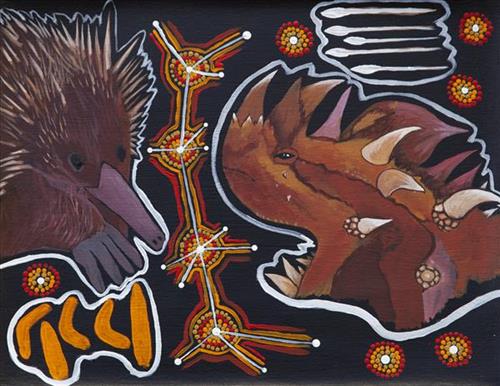
“When we was little kids, used to tell us this story. It was told by many generations – repeated. We still tell it today. One place to another, they keep on going. This one only we know – kids form the 80’s or 90’s. We grew up on the story, I’m bringing it back. White people have three little pigs, we have this one. They had a big fight. The echidna (minguwa) had no spikes. The lizard (kata puta) had no crown. The lizard had thousands of spears (kurlata). Echidna had a baton (jurna). He hit him really hard and that is why he got a big lump on him. So he threw all the spears really quickly and he got all the spikes on him”

– Owen John Biljabu

The term Jukurrpa is often translated in English as the ‘dreaming’, or ‘dreamtime’. In this case, Nyirti Jukurrpa can be understood in English as children’s stories, nyirti meaning ‘the littlest one’ in Martu language. Jukurrpa refers generally to the period in which the world was created by ancestral beings, who assumed both human and nonhuman forms. These beings shaped what had been a formless landscape; creating waters, plants, animals, and people. At the same time they provided cultural protocols for the people they created, as well as rules for interacting with the natural environment. At their journey’s end, the ancestral beings transformed themselves into important waters, hills, rocks, and even constellations.