377810582155143


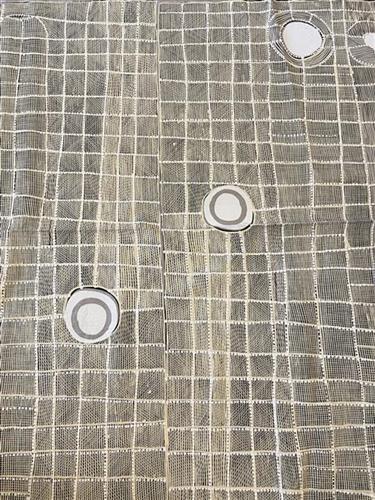
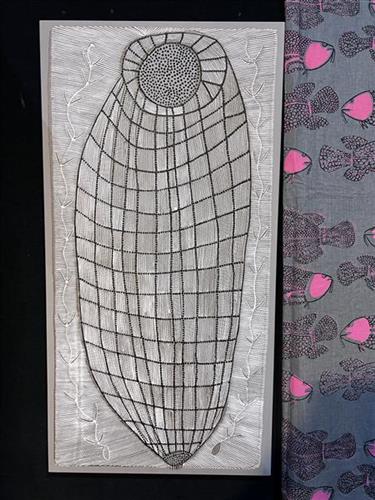
Mandjabu (Fish Trap) – Susan Marawarr

“In old times people would make these mandjabu (fish traps) to go fishing. They are made with vine we find in the jungle. That old man, Anchor Gulunba, he showed me how to make these fish traps. I would sit there and watch him making them. We catch barramundi, catfish, all kinds of fish.” – Helen Lanyinwanga

Kuninjku people traditionally make two sorts of conical fish traps. One called mandjabu made from a vine called milil, and another smaller one called manylik mandjabu, made from the grass manylik. The mandjabu conical fish trap is bigger and stronger and used in tidal reaches of creeks to catch large fish. The smaller, lighter manylik trap is used in freshwater flowing creeks to catch smaller fish and freshwater prawns. Traditionally, only men were involved in the construction of the large fish traps, but children would often crawl inside and assist.

To make fish traps and fish net fences artists firstly get vine (milil) from the jungle and they put it in water for one night to make it soft. Next they start weaving it; they make rings for the inside to keep the fish trap’s shape. Artists work for three or four weeks on the fish trap. They also make string from kurrajong (burdaga) to attach the hibiscus (bardainy) rings and to tie the conical end of the fish trap. This fish trap is used in saltwater and freshwater. People also use fish net fences called mun-dirra. A long time ago they would put the mun-dirra across rivers and creeks. In the middle they would place the an-gujechiya. They also used small things like sticks, rocks, mud and grass to block the fish from going through. People would then catch fish like saltwater barramundi rajarra, freshwater barramundi (janambal), small black freshwater catfish (buliya), bonefish (an-guwirrpiya), and sand bass (dalakan) in these fish traps.

377810582155359


Bawaliba and Ngalyod (Rainbow Serpent)

‘My Kikka (mother), when she was alive, she would tell me these stories. I was just a  little girl and she would tell us the stories in her language Gurrgoni.

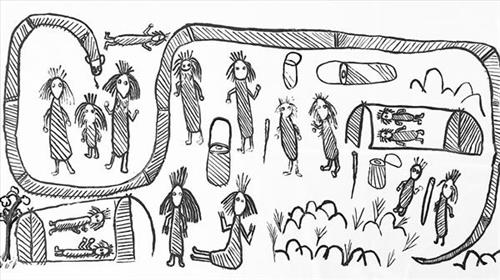
In the camps there were boy and girl Bawaliba, and old Bawaliba too. They loved to  dance by the firelight, keeping rhythm with a stick. They had lots of hair, they were  really tall and skinny, with spots on their bodies. The Bawaliba lived a long time in  peace. They were the only spirits on their country and so they were never disturbed.

One day, a long time ago, the Bawaliba were out hunting and they saw a large  snake- they didn’t know then but she was the Rainbow Serpent. They were really  scared, they had never seen that. creature before. She was really beautiful- like a  normal king brown snake but with a rainbow from the sky on her back. The rainbow  serpent was really hungry, and she could smell the Bawaliba from a long way away.  She was out looking for food.  The Bawaliba tried to stop Ngalyod coming for them but she was just too quick. She  snuck up behind the Bawaliba and before they could get away she ate them up.  When she was really full and couldn’t eat anymore Bawaliba she changed the rest of  them into stone. Still til this day, the Bawaliba stay on that same country as stones.’ Lucy Yarawanga

377810582155362


Mandjabu (Fish Trap) – Susan Marawarr

“In old times people would make these mandjabu (fish traps) to go fishing. They are made with vine we find in the jungle. That old man, Anchor Gulunba, he showed me how to make these fish traps. I would sit there and watch him making them. We catch barramundi, catfish, all kinds of fish.” – Helen Lanyinwanga

Kuninjku people traditionally make two sorts of conical fish traps. One called mandjabu made from a vine called milil, and another smaller one called manylik mandjabu, made from the grass manylik. The mandjabu conical fish trap is bigger and stronger and used in tidal reaches of creeks to catch large fish. The smaller, lighter manylik trap is used in freshwater flowing creeks to catch smaller fish and freshwater prawns. Traditionally, only men were involved in the construction of the large fish traps, but children would often crawl inside and assist.

To make fish traps and fish net fences artists firstly get vine (milil) from the jungle and they put it in water for one night to make it soft. Next they start weaving it; they make rings for the inside to keep the fish trap’s shape. Artists work for three or four weeks on the fish trap. They also make string from kurrajong (burdaga) to attach the hibiscus (bardainy) rings and to tie the conical end of the fish trap. This fish trap is used in saltwater and freshwater. People also use fish net fences called mun-dirra. A long time ago they would put the mun-dirra across rivers and creeks. In the middle they would place the an-gujechiya. They also used small things like sticks, rocks, mud and grass to block the fish from going through. People would then catch fish like saltwater barramundi rajarra, freshwater barramundi (janambal), small black freshwater catfish (buliya), bonefish (an-guwirrpiya), and sand bass (dalakan) in these fish traps.

377810582155357


Mududu

A new design by Lucy celebrating her love of eating mudcrab. 

Mududu is mudcrab in the Gurgoni language.

‘I feel good waking up in the morning, knowing I am going to Bábbarra. After work I go home and talk about my printing with all my family, and then I dream about it too. I am always thinking about my designs. They make me feel so proud.” – Lucy Yarawanga.

377810582155354


Mabbúlarr

Mabbúlarr is the Ndjébbana word describing calm and stillness – both regarding people and the ocean.

This design tells the story of underwater life in the shallows. The turtle we call marláddja (green turtle, Chelonia mydas) and the stingray we call marnandjúbba (Cowtail Stingray, Pastinachus sephen).

‘When strong wind blows the sea is rough, when there’s no wind the sea is calm. We call that mábbularr. You can see through the water and look at the turtle and stingray eating karlómerr (sea grass) and dancing underwater to find their mate. When we go on the boat hunting, we go at times of mábbularr.

In the old days men used to hunt with a canoe and with traditional made harpoon.  Guided by our ancestors’ spirits they would paddle all day to find sea turtle and dugongs in the right places. The men had to be smart for the tide and know the weather to balance their canoes. They would go at times of mábbularr (calm), early morning in daytime or at night-time when there is no moon and the water glows. We call the night-time glimmer of phosphorescence mílarrng-milarrng. Today people still go hunting, it brings a lot of families together and they share eating down the beach.

We have songline for sea turtle, also men paint turtle on their back and dance turtle in the Míddjarn the same way turtle dance underwater. It is very important we look after our country and songline passed on from many generations’. Josephine James 2021

37781054002239


Status: Stock


Lorrkon by Susan Marawarr – Sold per meter

Lorrkon ( Hollow Funeral Log) 

The Lorrkon or bone pole coffin ceremony was the final ceremony in a sequence of mortuary rituals celebrated by the people of Arnhem Land. This ceremony involves the placing of the deceased’s bones into a hollow log which was decorated with painted clan designs and ceremonially placed into the ground where it remained until it slowly decayed over many years.


The log is made from a termite hollowed Stringybark tree (Eucalyptus tetradonta) and is decorated with totemic emblems. The western Arnhem Land version of the Lorrkon ceremony involves the singing of sacred songs to the accompaniment of karlikarli, a pair of sacred boomerangs used as rhythm instruments. During the final evening of the ceremony, dancers decorate themselves with kapok down, or today, cotton wool and conduct much of the final segments of the ceremony in the secrecy of a restricted mens’ camp. The complete ceremony may stretch over a period of two weeks, but on the last night the bones of the deceased, which have been kept in a bark container or today wrapped in cloth and kept in a suitcase are taken out, are painted with red ochre and placed inside the hollow log. This ceremony may take place many years after the person has died.


At first light on the final morning of the Lorrkon ceremony, the men appear, coming out of their secret bush camp carrying the pole towards the women’s camp. The two groups call to each other using distinct ceremonial calls. The women have prepared a hole for the pole to be placed into and when it is stood upright, women in particular kinship relationships to the deceased dance around the pole in a jumping/shuffling motion. The Lorrkon is then often covered with a tarpaulin and left to slowly decay.

Printed by Puclisher Textiles Sydney – 100% Linen Cotton – Sold per meter

37781054002238


Status: Stock


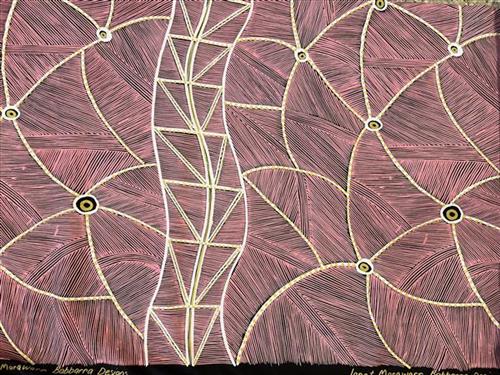
Kunkurra (pink) by Janet Marawarr – Sold Per Meter

Kunkurra (Spiral Wind)

My designs, they are all alive living up in my head’- Janet Marawarr

Janet Marawarr has depicted kunkurra, the spiralling wind associated with several sites in the Kardbam clan. On one level, this design can be interpreted as a depiction of the kinds of mini-cyclones common during the wet season in Arnhem Land, where the artist lives. Kunkurra also relates specifically to a site called Bilwoyinj, near Mankorlod, on the artist’s clan estate.

At this site, two of the most important Kuninjku creation beings, a father and son known as na-korrkko, are believed to have hunted and eaten a goanna. They left some of the goanna fat behind at the site, which turned into the rock that still stands there today.

Bilwoyinj site is also a ceremonial ground for a ceremony called Yabbaduruwa, a major ceremony owned by the Yirridja patrimoiety. The Yabbaduruwa ceremony is primarily concerned with initiation, land ownership and promoting the cyclical regeneration of the human and natural worlds.

Hand Printed by Publisher Textiles Sydney – Sold Per Meter – Tensel Linen Blend

37781054002237


Status: Stock


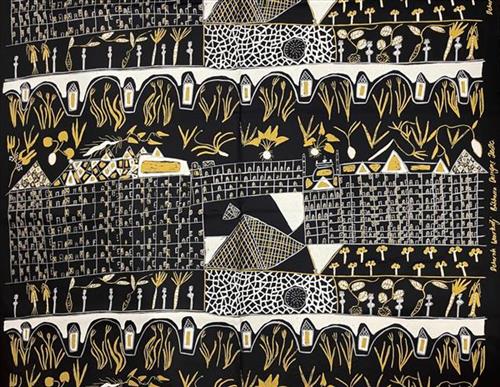
Kunred Kodbarre by Deborah Wurrkidj – Sold Per Met

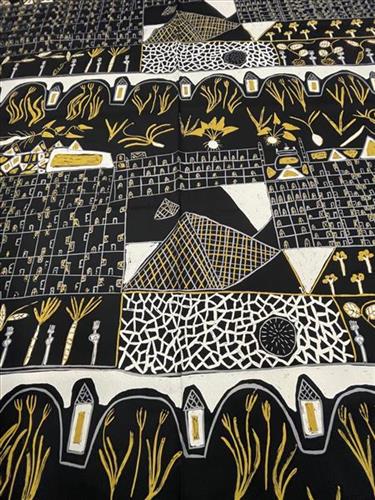
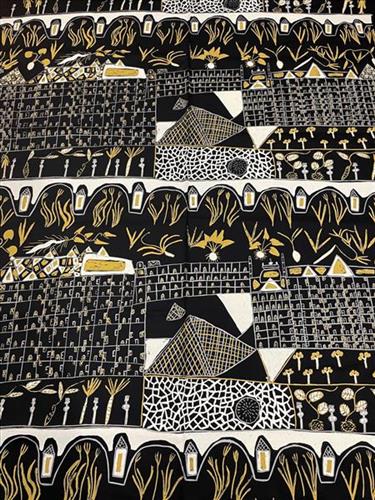
KUNRED KODBARRE (The Louvre)

‘This design is new and tells a different story of when I went to Paris. This building in the middle of my design is the Louvre. We went and saw that big building made of glass, and there were lots of people walking around. In Paris, there is a big creek made from bricks, with water flowing through the city. I have painted it here too, with the light poles next to it. There are so many tall buildings in Paris. When I see this design, I remember everything about my trip to Paris. For this design I had the idea of putting our Aboriginal bush tucker around the Louvre, so the plants here are kundayarr (pandanus), wayuk (water lily) and karrbarda (long yam). I painted some French trees too’. Deborah Wurrkidj

In 2019 five artists from Babbarra Women’s Centre travelled to France for the opening of their exhibition Jarracharra: Dry Season Wind. Deborah Wurrkidj, Jennifer Wurrkidj, Janet Marawarr, Jacinta Lami Lami and Elizabeth Kala Kala danced at the opening of the exhibition to a packed embassy gallery, and hosted various public panels including at the Musee du Quai Branly. The artists featured in Vogue magazine, wearing garments featuring their own printed designs on the balcony of the Ambassador to France, with a panoramic view of the Eiffel Tower in the background.

Inspired by the same voyage, on return to Maningrida Deborah Wurrkidj wove a sculpture of the Eiffel Tower out of naturally dyed pandanus, titled Ngaye ngawam nganang kunred  kukimukken, kubba nakornamkuyeng karri (I travelled a long way away, to that place with the tall tower). The work was a finalist in the prestigious 2020 Telstra National Aboriginal & Torres Strait Islander Art Awards (NATSIAA).

This fabric has been hand printed in Sydney by Publisher Textiles. 100% Cotton Drill –  Sold per meter

37781054002236


Status: Stock


Yawkyawk by Sonia Namarnyilk – Sold per meter

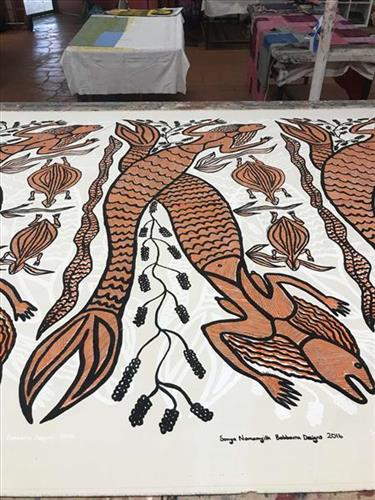
Our iconic design by Sonia Namarnyilk, a four screen design that is so beautiful that it is often used for wall panels. 

Yawkyawk is a word from the Aboriginal Kunwinjku language, meaning ‘young woman’ and ‘young woman spirit being’.

Sometimes compared to the European notion of mermaids, yawkyawks are usually depicted with the tails of fish. They have long hair, associated with trailing blooms of algae, typically found in Arnhem Land streams and rock pools.

Hand Printed by Publisher Textiles, Sydney. 100% Natural cotton canvas

37781054002235


Status: Stock


Kunronj (gold) -Jennifer Wurrkidj – Sold per Meter

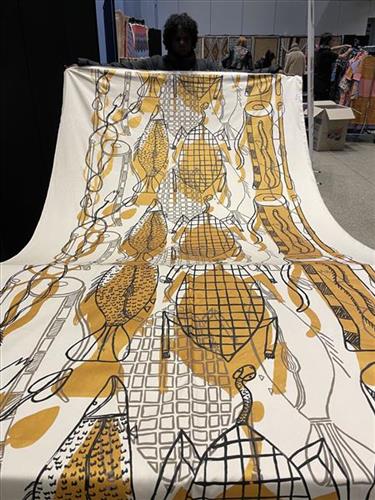
Kunronj (Freshwater Story)

Jennifer is a Kuninjku artist from the Kurulk clan whose country lies around the outstation of Mumeka in central Arnhem Land. Jennifer works at Bábbarra Women’s Centre alongside other members of her family who are also accomplished artists too: her mother, Helen Lanyinwanga (now deceased), sister Deborah Wurrkidj and daughter Abigail Namundja. She is a niece of Australia’s most highly acclaimed bark painter, John Mawurndjul, and she is renowned, in her own right, for her bark paintings, hollow logs and carved sculptures.

This design depicts important manme (food) sources from freshwater environments on Jennifer’s country and the implements used to gather these items.  The kunkaninj or digging stick featured in the design is used to dig for wayuk (waterlily) roots in billabongs, which are eaten fresh from the water or cooked on an open fire. The kunkaninj is also used to find and dig freshwater komrdawh (northern snake-necked turtle) that hibernate on the floodplains during the dry season.

Various fish species including the birlmu (barramundi), as shown here, are hunted with a spear or trapped inside a woven fish trap. This manme is carried within kunmadj (woven bags), which are made with fibres from the pandanus tree or sedge grasses, then enjoyed together by the family back at camp.

Hand printed by Publisher Textiles Sydney – 100% Cotton – Sold per meter