111982188272


Lorrkon (Hollow Log)

The Lorrkon or bone pole coffin ceremony was the final ceremony in a sequence of mortuary rituals celebrated by the people of Arnhem Land. This ceremony involves the placing of the deceased’s bones into a hollow log which was decorated with painted clan designs and ceremonially placed into the ground where it remained until it slowly decayed over many years.

The log is made from a termite hollowed Stringybark tree (Eucalyptus tetradonta) and is decorated with totemic emblems. The western Arnhem Land version of the Lorrkon ceremony involves the singing of sacred songs to the accompaniment of karlikarli, a pair of sacred boomerangs used as rhythm instruments. During the final evening of the ceremony, dancers decorate themselves with kapok down, or today, cotton wool and conduct much of the final segments of the ceremony in the secrecy of a restricted mens’ camp. The complete ceremony may stretch over a period of two weeks, but on the last night the bones of the deceased, which have been kept in a bark container or today wrapped in cloth and kept in a suitcase are taken out, are painted with red ochre and placed inside the hollow log. This ceremony may take place many years after the person has died.

At first light on the final morning of the Lorrkon ceremony, the men appear, coming out of their secret bush camp carrying the pole towards the women’s camp. The two groups call to each other using distinct ceremonial calls. The women have prepared a hole for the pole to be placed into and when it is stood upright, women in particular kinship relationships to the deceased dance around the pole in a jumping/shuffling motion. The Lorrkon is then often covered with a tarpaulin and left to slowly decay.

111982188269


Lorrkon (Hollow Log)

The Lorrkon or bone pole coffin ceremony was the final ceremony in a sequence of mortuary rituals celebrated by the people of Arnhem Land. This ceremony involves the placing of the deceased’s bones into a hollow log which was decorated with painted clan designs and ceremonially placed into the ground where it remained until it slowly decayed over many years.

The log is made from a termite hollowed Stringybark tree (Eucalyptus tetradonta) and is decorated with totemic emblems. The western Arnhem Land version of the Lorrkon ceremony involves the singing of sacred songs to the accompaniment of karlikarli, a pair of sacred boomerangs used as rhythm instruments. During the final evening of the ceremony, dancers decorate themselves with kapok down, or today, cotton wool and conduct much of the final segments of the ceremony in the secrecy of a restricted mens’ camp. The complete ceremony may stretch over a period of two weeks, but on the last night the bones of the deceased, which have been kept in a bark container or today wrapped in cloth and kept in a suitcase are taken out, are painted with red ochre and placed inside the hollow log. This ceremony may take place many years after the person has died.

At first light on the final morning of the Lorrkon ceremony, the men appear, coming out of their secret bush camp carrying the pole towards the women’s camp. The two groups call to each other using distinct ceremonial calls. The women have prepared a hole for the pole to be placed into and when it is stood upright, women in particular kinship relationships to the deceased dance around the pole in a jumping/shuffling motion. The Lorrkon is then often covered with a tarpaulin and left to slowly decay.

111982188175


Ngalkodjek Spirit Pole

Transcription of text by Jack Nawilil about two ceremonial objects— Karlanj and Ngalkodjek. Transcribed by Murray Garde and Margaret Carew 2 & 5 December 2017. Notes by Margaret Carew on 5 Dec 2017


Note: The site Jack refers to as Kœnœdjangka is in the Rembarrnga language. The ‘œ’ vowel sounds like the ‘ur’ in English ‘fur’. As this vowel does not exist in neighbouring languages, it is usually converted to an ‘i’ as Kinidjangka by Kuninjku and Burarra speakers. I have used that spelling also in the English translation but retained Kœnœdjangka in the transcription of Jack’s speech. Jack’s speech involves code switching amongst Kriol, Kune, Burarra and English.


[00:00:01] This one here, like ngaye ngakurrmeng, im my draw.


This one here [ceremonial objects], I have drawn my own personal designs on them.


[00:00:09] This one Ngalkodjek.


This one (is called) Ngalkodjek. (MG- note, that this is not the subsection term Ngalkodjok, rather the stem -kodjek is formative in the verb -kodjekmang ‘to abduct’ and may refer to a secret episode in the Nakorrkko story, the father and son cultural heroes for Bininj in western Arnhem Land).


[00:00:13] Daluk, im from Elcho im bin travellng, im from Elcho, gama ngarla, jiny-bona didjan na, and didjan du.


This represents a woman, she travelled (here) from Elcho Island, she is from Elcho, she was a woman indeed, she went/travelled, this one and this one too.


[00:00:27] Didjan najawan, didjan na.


This is another one however, this one.


[00:00:30] Shemaiah: Those two are the same story?


[00:00:33] Same story this mob but I’ll bringim next week. I’ll bring another one.


[00:00:39] This one here, an-nerranga, an-guna balaji, mun-anngiya langa djolworra kantri, im from gun-anngiya, im from like im 


This one here, this is a different one and represents a food plant, what’s its name (that tucker), it is from the saltwater country, from this way, like, it’s from what’s that place


(MC comment: -anngiya is a ‘what’s its name’ word, that inflects for noun class.)


[00:01:05] In my country where that Kœnidjangka way. Didjan na.


In my country there at Kinidjangka. This one here.


[00:01:09] Yo an-guna. Yo Murray, Murray im save, marn.gi.


This one. Murray knows about this.


[00:01:19] Yo, Murray ngudda yibengkan ngayi ngarduk nani Murray. From Kœnidjangka ngamarnbom.


Murray you know this one, it’s my design Murray. I made it, the one from Kinidjangka.


[00:01:28] En nani Kœnidjangka ngamarnbom, en nani kuluban kayo kure Nakorrkko wam. Nani ngamarnbom. Ungke nane ngamarnbom that story ngarduk na. Ngakurrmeng ngaye. Ngudda yibengkan. Kanmarnebengkan Bulanj. Yoh.


This one I made it, the design from Kinidjangka, the place where flying foxes live where the Nakorrkko passed through. I made that. I’ve made that story for you, that one of mine. I have put it there. You know that. You know what I’m talking about Bulanj (to Murray Garde).


[00:01:51] Didjan, nane, dijan gama i bin travelling garra didjei, garra didjei.


This one here, she is a woman who travelled this way, coming this way (to the west from north-east Arnhem Land).


[00:02:03] Im gona garra ebrijing. From Kunidjangka i bin make it. From Kœnidjangka ngamarnbom en nani Kœnidjangka ngamarnbom. En dijan Kœnidjangka ngamarnbom. Nane now.


She has many things. I made it, the one from Kinidjangka. From Kinidjangka I made it. It is from Kinidjangka, this thing i have made. That’s it now.


[00:02:25] Ngarduk my draw nane. Like ngamarnbun, like im nomo marrek ba morning star, im different nani. ngardapa ngardapa ngarla dreaming. Mu-gurrmurra, yo a-gurrmurra a-bona. Wangarr ngarla.


This design belongs to me. Like, I made it, and it should not be confused with a morning star pole, no, it is something different. they are separate indeed, these dreamings. It (an ancestral spirit) put it there. It is my totemic emblem. It is my ancestral design of the ancestral beings, indeed.


MC note: 

mu-gurrmurra

00:02:44.460 – 00:02:45.310

it put it (object belongs to mun- vegetable noun class)

00:02:44.460 – 00:02:45.310

a-gurrmurra a-bona

00:02:45.310 – 00:02:47.928

it put it (object now belongs to an- masculine noun class). a-bona here literally means ‘it (masculine) went’ but functions as an aspectual auxilliary, showing that the action is completed. Tense suffixes construe this in the past.


Shemaiah responds: yo gun-burral

00:02:49.570 – 00:02:51.155

yes that’s true

00:02:49.570 – 00:02:51.155


[00:02:53] Dijan, dijan, im from dijei na, from Elcho. mm dijan.


This one, its origins are from this way (the east), from Elcho, mm, this one.


[00:03:00] gama


a woman


[00:03:02] Shemaiah: Ngay ngay ngay


yeah yeah yeah


[00:03:05] Dijan, im daga ia la Kœnidjangka. Balajiya. But im Mardayin. Bad ai jas putumbat eniwe yuno?


This other one is an edible plant. Food. But it is a sacred thing from the Mardayin ceremony. But I have adapted it to make it a secular version.


MC note: balajiya – note emphasis -ya final syllable.


@Shemaiah: balaji murda

00:03:09.370 – 00:03:10.530

food this one

00:03:09.370 – 00:03:10.530

murda is a contracted demonstrative (from mun-narda), ‘this one in focus’ compare arda, jirda, gurda, other noun class inflected forms. These contracted demonstrative forms are a feature of modern Burarra. 

00:03:09.370 – 00:03:10.530


[00:03:19] Dijan na. Dijan, dijan mun-anngeyo balaji gen


This one. This is also a food.


[00:03:27] Shemaiah: balaji?


Food?


[00:03:28] Yo im my country igen bad awirri-gapajinga ngarla. We digim and karrimang. We eatim na, dijan na. 


Yes, in my country, we dig it, but has a secret element to the story. We dig it and take it out. Then we eat it, this thing.


MC note:

The transitive prefix awirri- (~abirri-) reads to me as ‘you and me plus one more’, ie inclusive unit augmented. If plural/augmented we’d expect mbi-gapajinga ie third person augmented acting on singular object, where there is noun class agreement with the object. If just ‘you and me’ is intended it would be ay-gapajinga. Quite commonly unit augmented prefixes are used in generic statements such as this, where one might expect another prefix going from the speech or discourse context.

00:03:29.960 – 00:03:31.565


[00:03:42] Like ngakurrmeng namekke Murray, Bulanj, nane Ngalkodjek wam from aa kure kamdolkkang from aam, Elcho.


So, Murray, that’s what I’ve put on it (the design). This is Ngalkodjek who travelled, setting out from Elcho Island.


[00:03:58] Ngamarnbom. Nabuyika nane, ngamarnbom manme rerri. Manme ngamarnbom, mane manme kangeydi manbingkanj.


I made it. The other one, I also made that one too. I made the plant food emblem, and the name of that plant is manbingkanj.


[00:04:16] Nane, nane ngamarnbom karlanj ngamarnbom, manme rerrih. Nane na Kœnidjangka ngamarnbom. Ngaleng nani, ngaleng Elcho kamwam daluk. Dijan na.


This thing here, I made it, this object is called karlanj and it represents a plant food. This one I have made is from Kinidjangka. She is a woman who came from Elcho Island. This one now.


[00:04:34] Im from long way dijan i bin travelling, from Elcho, (kala xxx ) like yu nomo save… yuno that, daluk, blanga im business, garra dijan i bin travelling. Yo. Dijan ia im mine dijan. Nane ngarduk rowk Bulanj, namekke draw namekke recordim ngayeman ngangeykurrmehkurrmeng nane.


She was travelling a long way, from Elcho Island (…..) like, you don’t know that story (it’s secret)… you know it related to a woman, it was her ceremonial story, and she was travelling. This thing here is my (clan) design. These are all mine Bulanj (to Garde) and what I have drawn, it’s being recorded now and I’m explaining all the names relating to it.


[00:05:03] Nane Ngalkodjek daluk, nane manme karlanj en nane mak, njamed, um. Karlanj manih manbu. Mak mane manbuyika, djal manbuyika yerri.


This woman, her name is Ngalkodjek, and this is the food, the karlanj, and this whatsit, um. Karlanj, that’s it. And there is another one but it is different again.


[00:05:24] Manbu rerri kayime wanjh mani nawu.


It is similar again, this one here.


[00:05:26] Ngamarnbom.


I made them.


[00:05:28] Ungke Murray. Kaluk yibekkan yingan kumekke mankarre yimarnbun. Yo namekke. Ma, thank you.


This (recording) is for you Murray (to transcribe for the art and cultural centre). You can listen to it and document the cultural story. That’s it. Okay, thank you.
377810582187983


Kunwardde dja Karrbarda (Rocks and Yam Vine)

Susan Marawarr is a Kuninjku artist from the Kurulk clan whose country lies around the outstation of Mumeka in central Arnhem Land. In this design, she has depicted karrbarda (long yam) on her traditional country, the kunwardde (stone country).

The large stones represent the kunwardde rocky outcrops, which are elevated above the flat floodplains. The vines creeping around the large rocks are from the karrbarda. Women dig up karrbarda with kungarrndutj (digging sticks) and they are then cooked in the ashes of the fire to be eaten.

These yams are purple on the saltwater side of country and on inland freshwater country they are white. Karrbarda are an important manme (bush food) that are collected during the wet and dry seasons.

377810582187647


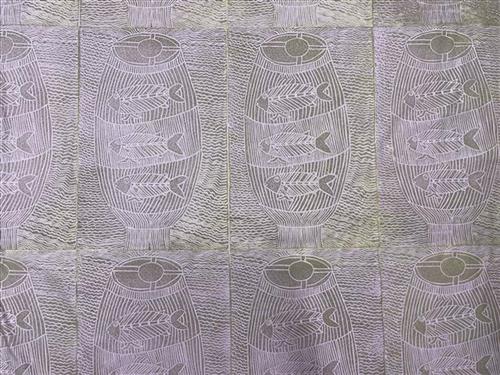
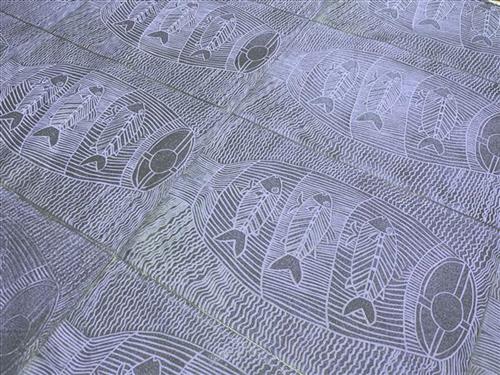
Au-gujechiya (fishtrap)

A detailed linocut design portraying a large Au-gujechiya (fishtrap) with an-maka (cowtail stingray), rajarra (barramundi) and other fish inside. 

Elizabeth is from the Burrarra language group and her homeland is Gupanga, Arnhem Land.  

Printed with two colours the second layer a metallic bronze. 

377810582187634


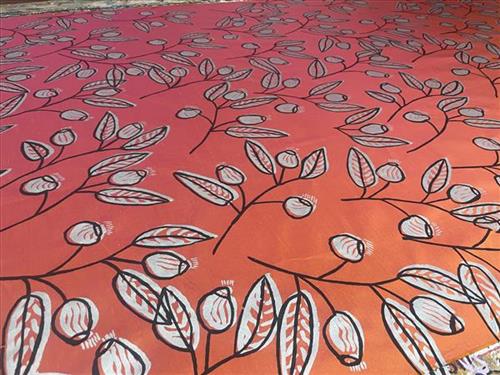
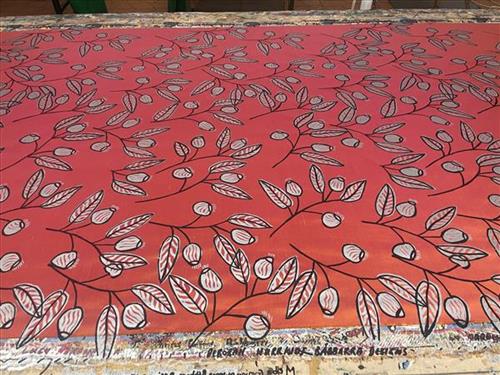
Man-djarduk (Red Bush Apples)

Deborah Wurrkidj is a Kuninjku artist from the Kurulk clan whose country lies around the outstation of Mumeka in central Arnhem Land.

In this design she has depicted man-djarduk (red bush apples) – a sweet, crisp bush food that is a favourite to collect.

Man-djarduk fruits in kurrung and kunumeleng seasons, the build-up and first rains seasons.

377810582187619


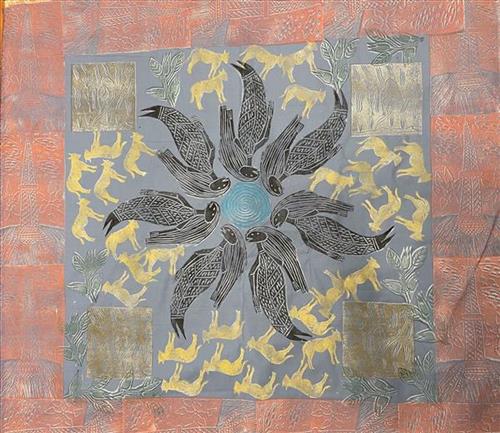
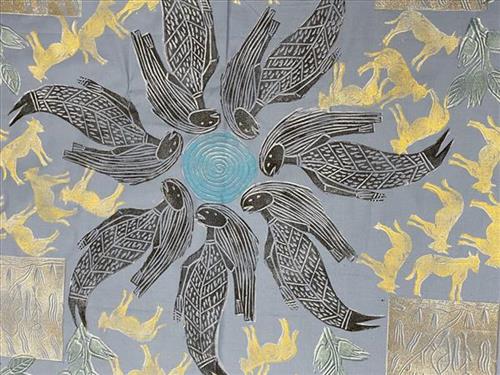
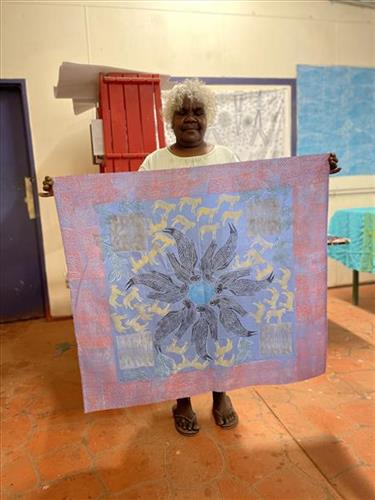
Yawkyawk

‘Yawkyawk swim underneath the rock. They always stay there. When the sun comes out they come out from underneath the river, make themselves warm. They sit and they look around. When they sit, they cry to themselves. Ngaldjorlhbo (mother of everything) she created them – yawkyawk and the other one [Ngalng].

The Mimih one is a long way from the stone country. He is from my uncles country Bardijokhang. My uncle is the famous artist Crusoe Kurddal and he carves and paints Mimih.  

Sometimes yawkyawk sit inside the rock. Sometimes they go out to find the food manme and the mankung (sugarbag). Also they can sing inside the rock cave. Sometimes yawkyawk will see the big rain. When the big rain comes they start looking and when the rain comes they go inside and hide themselves.

Some yawkyawk stay on the dry land in a special place inland from Bardijolhwang.

Some of the stones get stuck on the breasts of the yawkyawk.

There are two yawkyawk in this artwork. One, the wet season yawkyawk has a round face and long hair. The dry season yawkyawk has short hair. There are lots of different yawkyawk in the water.

In my fabric they are all coming together with the grass trees and leaves and the blowing wind. Some of the leaves will fall onto the water. All the round shapes are kunred (rocky country) with dry grass.

This country is called Gamadery (sp), which is located near Mankorlod and Korlobididah, Arnhem Land.’ 

Janet Marawarr 2022


377810582187934


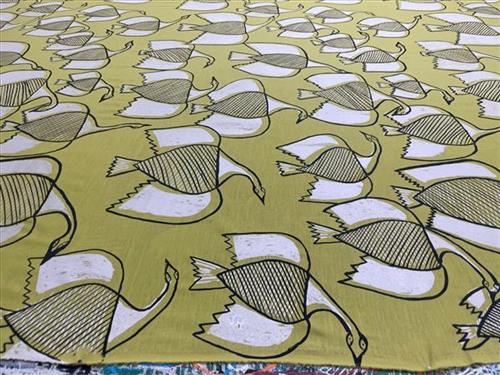
Gurrpurdu (Diving Bird)

A design by emerging textile designer, Charmaine Pascoe.

‘My Gurrpurdu (diving bird) was white. She flew from Gan Gan to Gapuwiyak and then to Yathalamarra. And then she flew to Gartji.

At Gartji two fresh water seaweed shoots, one long and one short were trying to keep diving bird down. They were saying, “Don’t go away you belong to this country”.  Diving bird said “No! I’m going to travel around to other country”.  She was flapping her wings and then those two seaweed shoots let her go.

Then diving bird flew to make water hole at Gamurra Gu-yurra. She tasted the water but it was salty not fresh water. Then she put her poo like white clay on the ground at Gamurra Gu-yurra. The while clay was used for painting, funerals and ceremonies.

Then she continued to fly to Ji-balbal where she put the white clay again and then from Ji-balbal she dived underwater to Gochan Jiny-jirra. When she got there she got out of the water and was flapping her wings. At the same time she was singing. She was using her wings to dry out so that she could fly to Nangak.’ Charmaine Pascoe 2020

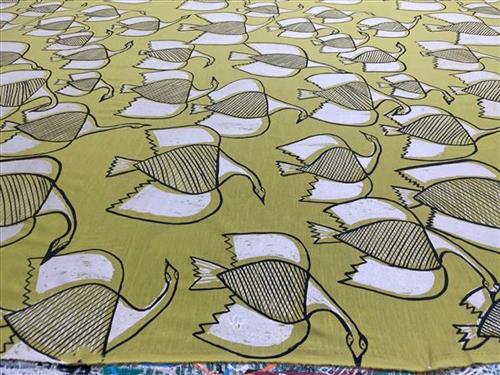
377810582187933


Gurrpurdu (Diving Bird)

A design by emerging textile designer, Charmaine Pascoe.

‘My Gurrpurdu (diving bird) was white. She flew from Gan Gan to Gapuwiyak and then to Yathalamarra. And then she flew to Gartji.

At Gartji two fresh water seaweed shoots, one long and one short were trying to keep diving bird down. They were saying, “Don’t go away you belong to this country”.  Diving bird said “No! I’m going to travel around to other country”.  She was flapping her wings and then those two seaweed shoots let her go.

Then diving bird flew to make water hole at Gamurra Gu-yurra. She tasted the water but it was salty not fresh water. Then she put her poo like white clay on the ground at Gamurra Gu-yurra. The while clay was used for painting, funerals and ceremonies.

Then she continued to fly to Ji-balbal where she put the white clay again and then from Ji-balbal she dived underwater to Gochan Jiny-jirra. When she got there she got out of the water and was flapping her wings. At the same time she was singing. She was using her wings to dry out so that she could fly to Nangak.’ Charmaine Pascoe 2020

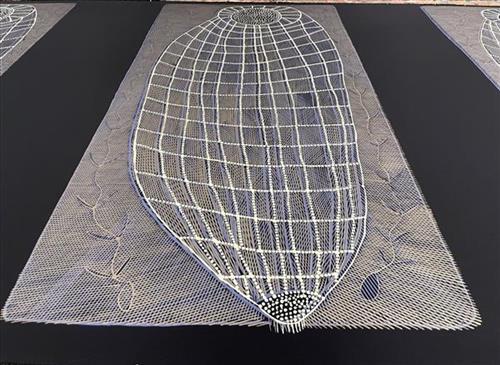
377810582187931


Mandjabu (Fish Trap)

“In old times people would make these mandjabu (fish traps) to go fishing. They are made with vine we find in the jungle. That old man, Anchor Gulunba, he showed me how to make these fish traps. I would sit there and watch him making them. We catch barramundi, catfish, all kinds of fish.” – Helen Lanyinwanga

Kuninjku people traditionally make two sorts of conical fish traps. One called mandjabu made from a vine called milil, and another smaller one called manylik mandjabu, made from the grass manylik. The mandjabu conical fish trap is bigger and stronger and used in tidal reaches of creeks to catch large fish. The smaller, lighter manylik trap is used in freshwater flowing creeks to catch smaller fish and freshwater prawns. Traditionally, only men were involved in the construction of the large fish traps, but children would often crawl inside and assist.

To make fish traps and fish net fences artists firstly get vine (milil) from the jungle and they put it in water for one night to make it soft. Next they start weaving it; they make rings for the inside to keep the fish trap’s shape. Artists work for three or four weeks on the fish trap. They also make string from kurrajong (burdaga) to attach the hibiscus (bardainy) rings and to tie the conical end of the fish trap. This fish trap is used in saltwater and freshwater. People also use fish net fences called mun-dirra. A long time ago they would put the mun-dirra across rivers and creeks. In the middle they would place the an-gujechiya. They also used small things like sticks, rocks, mud and grass to block the fish from going through. People would then catch fish like saltwater barramundi rajarra, freshwater barramundi (janambal), small black freshwater catfish (buliya), bonefish (an-guwirrpiya), and sand bass (dalakan) in these fish traps.