Bayaderra
My image show the Long Neck turtle which is the totem of the Yorta Yorta people.
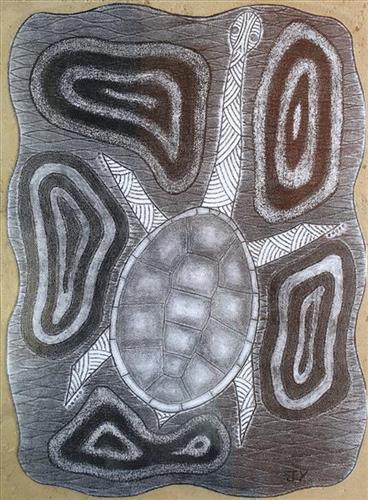
My image show the Long Neck turtle which is the totem of the Yorta Yorta people.

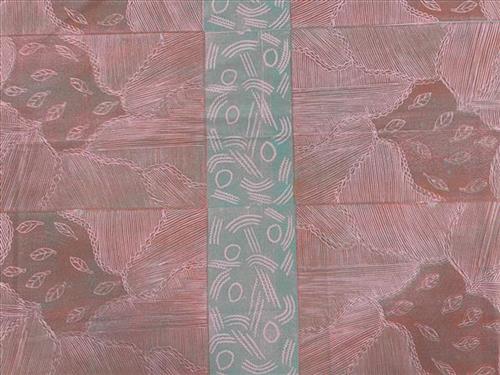
‘My designs, they are all alive living up in my head’- Janet Marawarr
Janet Marawarr has depicted kunkurra, the spiralling wind associated with several sites in the Kardbam clan. On one level, this design can be interpreted as a depiction of the kinds of mini-cyclones common during the wet season in Arnhem Land, where the artist lives. Kunkurra also relates specifically to a site called Bilwoyinj, near Mankorlod, on the artist’s clan estate.
At this site, two of the most important Kuninjku creation beings, a father and son known as na-korrkko, are believed to have hunted and eaten a goanna. They left some of the goanna fat behind at the site, which turned into the rock that still stands there today.
Bilwoyinj site is also a ceremonial ground for a ceremony called Yabbaduruwa, a major ceremony owned by the Yirridja patrimoiety. The Yabbaduruwa ceremony is primarily concerned with initiation, land ownership and promoting the cyclical regeneration of the human and natural worlds.
Bana Yirriji Art Centre represents artists from the Yalanji, Nyungkul and Jalunji clan groups.
Bama (local people) have had a long history of artistic expression, including ceremonial body painting, weavings made from local plants, rainforest shields and weaponry decorated with clan designs using earth pigments.
Today, artists create stunning contemporary arts and crafts; including paintings, prints, works on paper, textiles, weavings, artefacts and a range of merchandise. Artists draw on their rich cultural, historic, and contemporary stories and profound connection to country as inspiration.
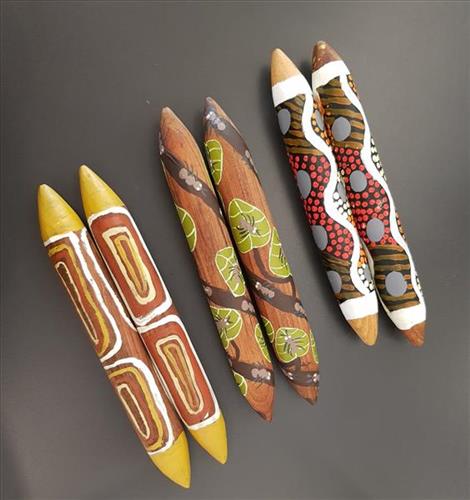
These clapsticks have been hand painted and represents the artists country and culture through designs and mark making.
Each pair is unique.
Bana Yirriji Art Centre represents artists from the Yalanji, Nyungkul and Jalunji clan groups.
Bama (local people) have had a long history of artistic expression, including ceremonial body painting, weavings made from local plants, rainforest shields and weaponry decorated with clan designs using earth pigments.
Today, artists create stunning contemporary arts and crafts; including paintings, prints, works on paper, textiles, weavings, artefacts and a range of merchandise. Artists draw on their rich cultural, historic, and contemporary stories and profound connection to country as inspiration.
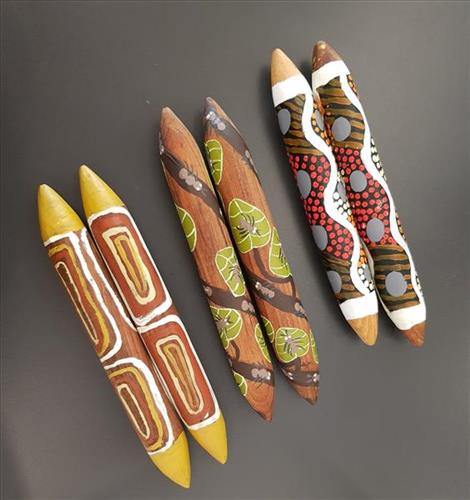
These clapsticks have been hand painted and represents the artists country and culture through designs and mark making.
Each pair is unique.

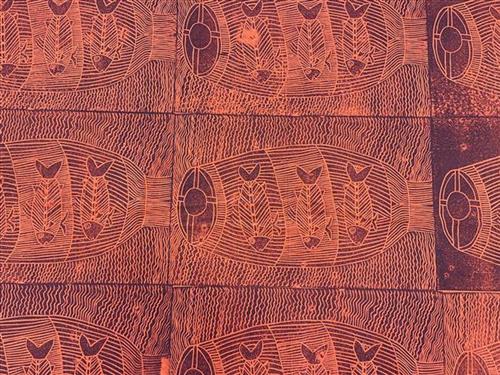
A detailed linocut design portraying a large Au-gujechiya (fishtrap) with an-maka (cowtail stingray), rajarra (barramundi) and other fish inside.
Elizabeth is from the Burrarra language group and her homeland is Gupanga, Arnhem Land.
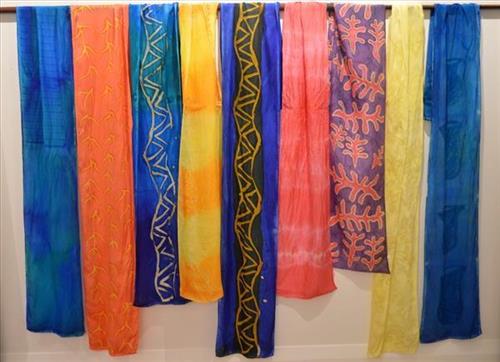
These silk scarves have been hand painted/ printed using different patterns, colours, shapes and designs to create a design that represents the artists country, culture and stories. All the scarves have been created at the Bana Yirriji Art and Cultural Centre by local community artists.
Bana Yirriji Art Centre represents artists from the Yalanji, Nyungkul and Jalunji clan groups.
Bama (local people) have had a long history of artistic expression, including ceremonial body painting, weavings made from local plants, rainforest shields and weaponry decorated with clan designs using earth pigments.
Today, artists create stunning contemporary arts and crafts; including paintings, prints, works on paper, textiles, weavings, artefacts and a range of merchandise. Artists draw on their rich cultural, historic, and contemporary stories and profound connection to country as inspiration.
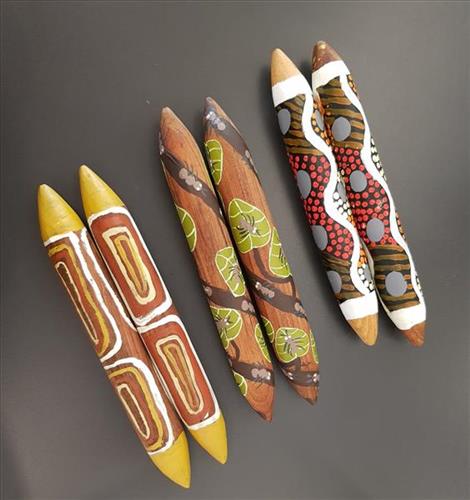
These clapsticks have been hand painted and represents the artists country and culture through designs and mark making.
Each pair is unique.


“My Country, Kulyakartu. I grew up there, from little boy to big boy grew up there.”
This painting depicts Muuki’s Country, Kulyakartu; an area in the far north of the Martu homelands, near the Percival Lakes in the northern Great Sandy Desert. The artist has extensive knowledge of the Country in this region, where he grew up living traditionally during the pujiman (traditional, desert dwelling) days with his family. Kulyakartu is mostly grass Country where there is very good hunting. There is no permanent water source in Kulyakartu, so his family would walk here annually following the wet season.
Muuki paints his Country in all its different seasonal stages. Often visible in his work is the patchwork of nyurnma (burnt ground) depicting the regrowth subsequent to the practice of waru (fire) burning that assists with hunting, regenerates growth, and encourages greater diversity in plant and animal life.


Parnngurr is an Aboriginal community located 370km east of Newman, at the Southern end of the Karlimilyi area in the Pilbara region of Western Australia. Created during the Return to Country movement of the 1980s, with the recognition of Aboriginal land rights and native title, the community was named after its original primary water source, a nearby rockhole and yinta (permanent water source). Until recently the community was widely known as Cotton Creek, after the European name for the ephemeral creek running alongside the community. Parngurr and its surrounds are physically dominated by distinctively red tali (sandhills), sparsely covered with spinifex and low lying shrub.
Historically and culturally Parnngurr was an important site for Aboriginal people during the pujiman (traditional, desert-dwelling) era. In the epic jukurrpa (dreamtime) story of the Jakulyukulyu, or Minyipuru (Seven Sisters), the sisters stop to rest on the adjacent Parnngurr hill before continuing on their long journey east. Throughout the pujiman period families stopped and camped here depending on the seasonal availability of water, and the corresponding cycles of plant and animal life on which hunting and gathering bush tucker was reliant. At Parnngurr and other similarly significant camp sites families would meet for a time before moving to their next destination.