111581638639


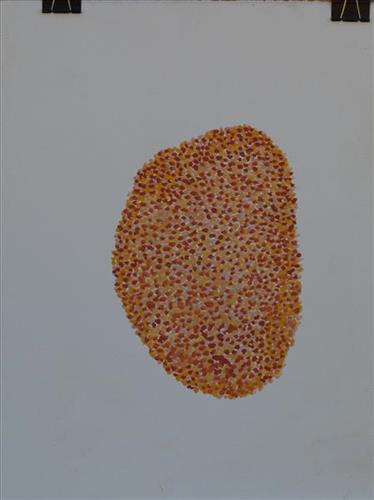
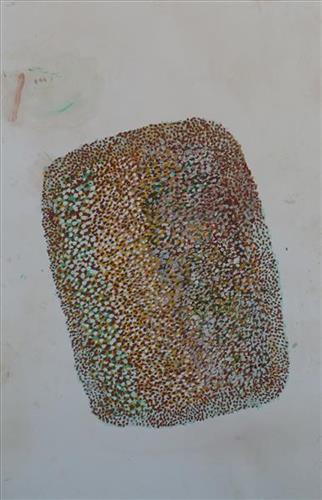
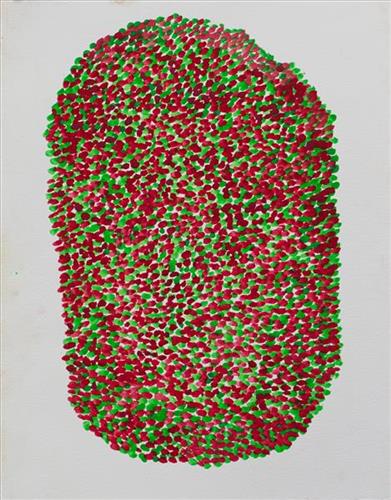
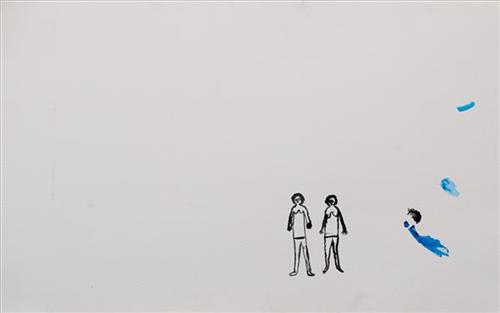
Kaalpa (Well 23)

“Kaalpa is my grandfather ngurra (home) where they walked, hunting bush tuckers. I went there for the first time this year [2018] on a Martumili KJ (Kanyirninpa Jukurrpa) trip. I went hunting there, got a parnajalpa (sand goanna).

When I went there I was pukurlpa (happy). It made you open up your spirt, it feels like home.

It’s got kapi (water) there, a well, jurnu (soak) and tuwa (sandhills)”

– Corban Clause Williams

Kaalpa is a place of great cultural significance, is also referred to as Well 23 on the Canning Stock Route. It is a good hunting place as there is permanent kapi.

111581649243


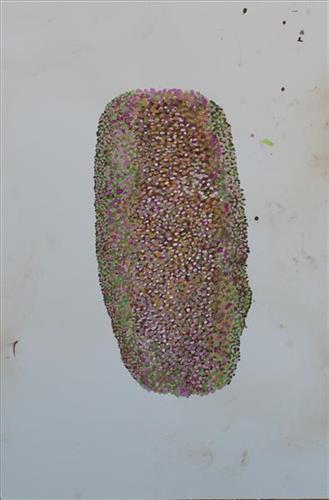
Kulyakartu

“My Country, Kulyakartu. I grew up there, from little boy to big boy grew up there.”

– Muuki Taylor

This painting depicts Muuki’s Country, Kulyakartu; an area in the far north of the Martu homelands, near the Percival Lakes in the northern Great Sandy Desert. The artist has extensive knowledge of the Country in this region, where he grew up living traditionally during the pujiman (traditional, desert dwelling) days with his family. Kulyakartu is mostly grass Country where there is very good hunting. There is no permanent water source in Kulyakartu, so his family would walk here annually following the wet season.

Muuki paints his Country in all its different seasonal stages. Often visible in his work is the patchwork of nyurnma (burnt ground) depicting the regrowth subsequent to the practice of waru (fire) burning that assists with hunting, regenerates growth, and encourages greater diversity in plant and animal life.

111581649235


Kulyakartu

“My Country, Kulyakartu. I grew up there, from little boy to big boy grew up there.”

– Muuki Taylor

This painting depicts Muuki’s Country, Kulyakartu; an area in the far north of the Martu homelands, near the Percival Lakes in the northern Great Sandy Desert. The artist has extensive knowledge of the Country in this region, where he grew up living traditionally during the pujiman (traditional, desert dwelling) days with his family. Kulyakartu is mostly grass Country where there is very good hunting. There is no permanent water source in Kulyakartu, so his family would walk here annually following the wet season.

Muuki paints his Country in all its different seasonal stages. Often visible in his work is the patchwork of nyurnma (burnt ground) depicting the regrowth subsequent to the practice of waru (fire) burning that assists with hunting, regenerates growth, and encourages greater diversity in plant and animal life.

111581649225


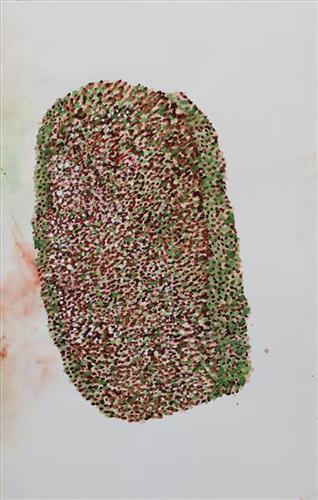
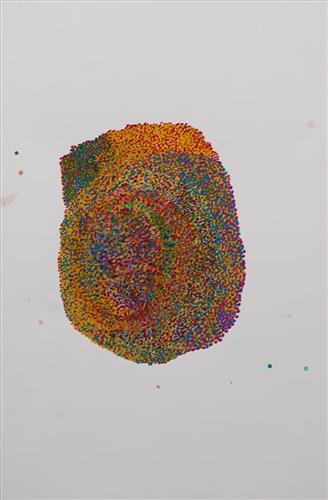
Untitled

This painting portrays physical elements of Martu Country, such as the dominant tali (sandhills), warta (trees, vegetation), and water sources. Rock holes, waterholes, soaks and springs were all extremely important sites for Martu people during the pujiman (nomadic bush) era, with many important jukurrpa (dreamtime stories) chronicling the creation of these landmarks. In the past the Martu lived nomadically, moving from water source to water source, and hunting and gathering bush tucker as they went. They would traverse very large distances annually, visiting specific areas in the dry and wet season depending on the availability of water. As they travelled and hunted they would also burn areas of country creating a larger diversity of plant and animal life.

111581733959


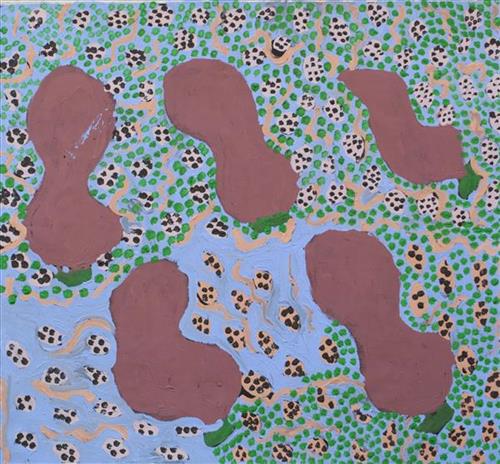
Bush Potato

Depicted in this work are traditional types of bush tucker, their habitats, and their related hunting and gathering methods. During the pujiman (traditional, desert dwelling) period, Martu would traverse very large distances annually in small family groups, moving seasonally from water source to water source, and hunting and gathering bush tucker as they went. Whilst desert life has moved away from mobile hunter-gatherer subsistence throughout the course of the twentieth century, bush tucker continues to be a significant component of the modern Martu diet. Hunting and gathering bush tucker remains equally valuable as an important cultural practice that is passed on intergenerationally. Though hunting and gathering implements have been modernised, methods of harvesting, tracking and the use of fire burning to drive animals from their retreats are still commonly practiced today. 

Typically, animals hunted for their kuwiyi (meat) include kirti-kirti (euro kangaroo) and marlu (plains kangaroo), parnajarrpa (sand goanna), kipara (Australian bustard, bush turkey) and karlaya (emu). Lunki (witchetty grub) and wuukurta (honey ants) are dug from tree and bush trunks, or from underground nests. Popular mayi (plant food) includes minyarra (bush onion), collected from small, grass like plants; root vegetables dug from underground such as kulyu and mata (types of bush potato); and seeds such as kalaru (samphire, salt bush), yuwinyji, and marnkalpa (spinifex species). Jawirli (quondong), wamurla (bush tomatoes), jinyjiwirrily (wild gooseberry), ngaputa (melon), and karlkula (bush banana) are some of the most popular bush fruits. These are often collected in the wantajarra (cool season) and tuulpara (spring) months, along with juri (sweet) botanical gums and wama (nectar), obtained from various plant species. 

Traditional tools used for hunting and gathering bush tucker were carved from wanari (mulga), mulunturu (desert oak), yurungkura (river red gum) and mijarrpa (bloodwoods), and included kurlata (spears), jurna (hitting stick), karli (boomerangs), wana (digging-sticks), piti (timber bowls used for carrying food and water), and jiwa (grinding stones for grinding seeds into flour). While carved objects retain enormous social and ceremonial importance in Martu life, they are no longer used for hunting and gathering.

111581906790


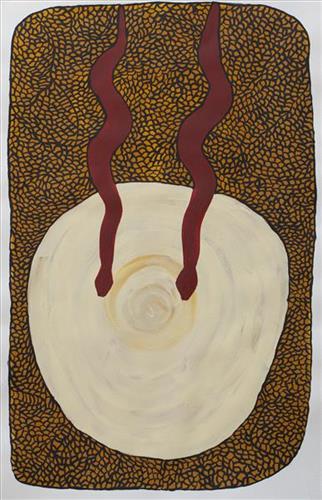
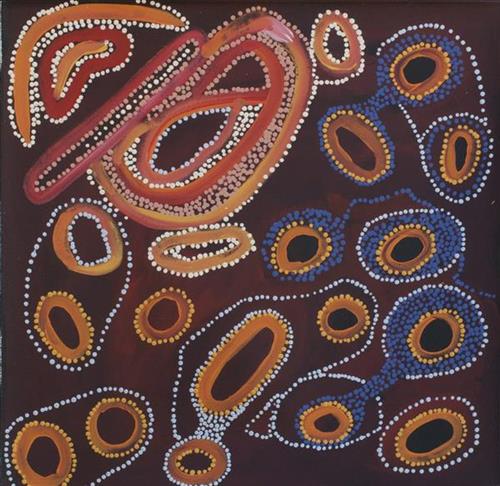
Niminjarra (nyurnma)

“Niminjarra is the two brothers transforming into a snake so they can go back home to Ngayartakujarra (Lake Dora). They were in training for ceremony, those two brothers, but they were kept too long and nobody was there to release them. They waited then they decided to transform into snakes to travel back to where they came from, because their mother was waiting for them. This is Jukurrpa (Dreaming story)

Here the Jila Kujarra are travelling West through the nyurnma (burnt Country) coming from the East, from Karilywara, trying to get closer to the lake.”

– Desmond Taylor

The term jukurrpa is often translated in English as the ‘dreaming’, or ‘dreamtime’. It refers generally to the period in which the world was created by ancestral beings, who assumed both human and nonhuman forms. These beings shaped what had been a formless landscape; creating waters, plants, animals, and people. At the same time they provided cultural protocols for the people they created, as well as rules for interacting with the natural environment. At their journey’s end, the ancestral beings transformed themselves into important waters, hills, rocks, and even constellations. 

Jila Kujarra (Two Snakes) is one of the key jukurrpa narratives for the Martu. Though the story belongs to Warnman people, it is shared across the Western Desert with several other language groups. The narrative centres on the travels of two snakes as they are pursued by the Niminjarra, spiritual ancestors of the Warnman people. Before transforming themselves into snakes, the Jila Kujarra were young brothers waiting to be released from ceremony at the boundary of Mukurtu, west of Mamunara (Canning Stock Route Well 28). They began travelling home to their mother in the west, but were intercepted by the Niminjarra as they hunted and hurled their spears in front of them. Suddenly the spears of the Niminjarra stuck in the ground and swayed in the air, alerting the Niminjarra to the tracks of the Jila Kujarra.

The Niminjarra started to track the Jila Kujarra, but stopped with their many weapons at Jantuwurujul (or Janturuly) to hunt for wild game. The Jila Kujarra continued to flee, reaching Paji, east of Nyayartakujarra (Lake Dora) before they were again intercepted by the Niminjarra. The Niminjarra believed the snakes had hidden in a cave north of Paji, and tried to smoke them out. Again, the Jila Kujarra eluded their pursuers, this time escaping under the lake at Paji and at the same time creating many small decoy snakes to lead the Niminjarra astray. 

Meanwhile, from a nearby hill, two Pukurti (initiates with bundled hair) prophesied that the Niminjarra would kill the Jila Kujarra. The Pukurti tracked the Jila Kujarra through to Nyayartakujarra, where they speared the snakes in the head to hold them down while they returned to Paji to summon the Niminjarra. The Niminjarra made a fire and cooked the snakes at Ngayartakujarra (Lake Dora). The snakes were too long to lay down on leafy branches to be cut up, so the Niminjarra lay down to make a human table. When the Niminjarra cut down the length of the Jila Kujarra, the snake’s bladders were pierced, causing an explosion of scalding hot urine in which the Niminjarra all perished and became black rocks at the site. At the same time, the urine of the Jila Kujarra formed the vast salt lake, Kumpupirntily, which translates to ‘bladder burst’.  

The spirits of the Jila Kujarra rose and continued to travel to their mother at Nyayartakujarra. She saw them coming towards her as flaming figures, and called out to them, piercing the surface of the salt lake with her digging stick. There, the mother and her sons entered the ground below Nyayartakujarra, where they remain to this day.


111581933969


Kulyakartu

“My Country, Kulyakartu. I grew up there, from little boy to big boy grew up there.”

– Muuki Taylor

This painting depicts Muuki’s Country, Kulyakartu; an area in the far north of the Martu homelands, near the Percival Lakes in the northern Great Sandy Desert. The artist has extensive knowledge of the Country in this region, where he grew up living traditionally during the pujiman (traditional, desert dwelling) days with his family. Kulyakartu is mostly grass Country where there is very good hunting. There is no permanent water source in Kulyakartu, so his family would walk here annually following the wet season.

Muuki paints his Country in all its different seasonal stages. Often visible in his work is the patchwork of nyurnma (burnt ground) depicting the regrowth subsequent to the practice of waru (fire) burning that assists with hunting, regenerates growth, and encourages greater diversity in plant and animal life.

111581933968


Kulyakartu

“My Country, Kulyakartu. I grew up there, from little boy to big boy grew up there.”

– Muuki Taylor

This painting depicts Muuki’s Country, Kulyakartu; an area in the far north of the Martu homelands, near the Percival Lakes in the northern Great Sandy Desert. The artist has extensive knowledge of the Country in this region, where he grew up living traditionally during the pujiman (traditional, desert dwelling) days with his family. Kulyakartu is mostly grass Country where there is very good hunting. There is no permanent water source in Kulyakartu, so his family would walk here annually following the wet season.

Muuki paints his Country in all its different seasonal stages. Often visible in his work is the patchwork of nyurnma (burnt ground) depicting the regrowth subsequent to the practice of waru (fire) burning that assists with hunting, regenerates growth, and encourages greater diversity in plant and animal life.

111581935229


Kulyakartu

“My Country, Kulyakartu. I grew up there, from little boy to big boy grew up there.”

– Muuki Taylor

This painting depicts Muuki’s Country, Kulyakartu; an area in the far north of the Martu homelands, near the Percival Lakes in the northern Great Sandy Desert. The artist has extensive knowledge of the Country in this region, where he grew up living traditionally during the pujiman (traditional, desert dwelling) days with his family. Kulyakartu is mostly grass Country where there is very good hunting. There is no permanent water source in Kulyakartu, so his family would walk here annually following the wet season.

Muuki paints his Country in all its different seasonal stages. Often visible in his work is the patchwork of nyurnma (burnt ground) depicting the regrowth subsequent to the practice of waru (fire) burning that assists with hunting, regenerates growth, and encourages greater diversity in plant and animal life.

111581935226


Minyipuru (Jakulyukulyu, Seven Sisters)

The term Jukurrpa is often translated in English as the ‘dreaming’, or ‘dreamtime’. It refers generally to the period in which the world was created by ancestral beings, who assumed both human and nonhuman forms. These beings shaped what had been a formless landscape; creating waters, plants, animals, and people. At the same time they provided cultural protocols for the people they created, as well as rules for interacting with the natural environment. At their journey’s end, the ancestral beings transformed themselves into important waters, hills, rocks, and even constellations. 

Minyipuru, or Jakulyukulyu (Seven Sisters) is a central Jukurrpa narrative for Martu, Ngaanyatjarra, Pitjantjatjara and Yankunytjatjara people that is associated with the seasonal Pleiades star constellation. Relayed in song, dance, stories and paintings, Minyipuru serves as a creation narrative, a source of information relating to the physical properties of the land, and an embodiment of Aboriginal cultural laws. When Martumili Artists was established in 2005, this was the first Jukurrpa story the artists agreed to paint for a broader public. 

Beginning in Roebourne on the west coast of Western Australia, the story morphs in its movement eastward across the land, following a group of women as they walk, dance, and even fly from waterhole to waterhole. As they travel the women camp, sing, wash, dance and gather food, leaving markers in the landscape and creating landforms that remain to this day, such as groupings of rocks and trees, grinding stones and seeds. During the entirety of their journey the women are pursued by a lustful old man, Yurla, although interactions with other animals, groups of men, and spirit beings are also chronicled.