111982209523


Mat

Mats can vary greatly. Artists commonly use a mix of naturally dyed and undyed fibre to create a striking variation of coloured bands. Some artists also incorporate different types of looping to produce different patterns and textured finishes. Each type of mat, fibre bag, basket and dilly bag has its own name in the various languages spoken in the Maningrida region.

111982209495


Barnda – long neck turtle

In the mythology or dreaming history of the Ganalbingu and Gurrgurrdjunggu peoples, two sisters who were the human forms of barnda ‘the Long-neck Turtle’ (Chelodina rugosa) came travelling a long distance from the east towards Ganalbingu country in Central Arnhem Land. They travelled through Martay country arriving at a place called Ji-malawa, the site today of a homeland/outstation community in the Blyth River district. At this place they turned their speech to the Burarra language and named sites as they travelled. The two Barnda sisters continued their journey to Gamardi, a site in Djinang country and they again changed their language to a dialect of Djinang called Wulagi.

Barnda is also Bulunbulun’s personal ‘Dreaming’ given to him by his father who was walking in the swamp at the time of the artist’s birth. 

While discussing the painting’s imagery, Bulunbulun explained that some components were the domain of ‘inside’ or secret ceremonial meaning and therefore he could only describe the ‘outside’ or public aspects of them.

In the painting Bulunbulun depicts the passage of the barnda through the country and the locations where the long neck turtle stopped to create features in the landscape in the Dreamtime. The two black circular forms are ngambul ‘a waterhole’ formed by barnda. The two horizontal bands of rarrk ‘crosshatching’ in the midlle and upper section of the painting are marwurru ‘a paperbark log’ over which barnda walked along the journey. The large areas of rarrk represent gurrwiling ‘the swamp’ created by barnda. The vertical swaying lines are gunbuluru and wuye different types of reeds that are so sharp that they can cut one legs when walking through the swamp. At the top of the painting above the head of the image of the turtle is a band of rarrk, which represents the view of the plain country and swamp from a hill.


111982209492


Birlmu or Namarnkorl (Barramundi)

It is well known that Aboriginal art often depicts images of sacred totems or dreamings of Aboriginal culture. However, the world of the non-sacred also provides a rich source of subject matter for Aboriginal art. Much of the rock art of western Arnhem Land for example features secular topics such as common food animals and plants, depicted because of their economic importance but also merely because of their existence in the environment. The artist has painted ‘birlmu’ or ‘namarnkorl’ (Barramundi [Lates calcarifer]). During the dry season the barramundi is an important food source for inland Aboriginal people. These fish are caught throughout the artist’s clan estate, either in fishtraps woven from pandanus or sedge grass, or else hunted with spears and fishing lines in billabongs and streams where they shelter from the sun under fallen logs or amongst the leaves of water plants.

111982209491


Wak Wak

This painting depicts a sacred site at ‘Kurrurldul’, an outstation south of Maningrida.

The ‘rarrk’, or abstract crosshatching, on this work represents the design for the crow totem ancestor called ‘Djimarr’. Today this being exists in the form of a rock, which is permanently submerged at the bottom of Kurrurldul Creek. The ‘Djimarr’ rock in the stream at Kurrurldul is said to move around and call out in a soft hooting tone at night. Both the stone itself and the area around it are considered sacred.

The imagery represents the rock mentioned above at the bottom of Kurrurldul creek, which is the final transmutation of the dreaming ancestor ‘Djimarr’. Finally, the pattern used here is also the crow design used in the sacred ‘Mardayin’ ceremony, which is a large regional patri-moiety ceremony now rarely conducted in central and eastern Arnhem Land.

111982209490


Wak Wak

This painting depicts a sacred site at ‘Kurrurldul’, an outstation south of Maningrida.

The ‘rarrk’, or abstract crosshatching, on this work represents the design for the crow totem ancestor called ‘Djimarr’. Today this being exists in the form of a rock, which is permanently submerged at the bottom of Kurrurldul Creek. The ‘Djimarr’ rock in the stream at Kurrurldul is said to move around and call out in a soft hooting tone at night. Both the stone itself and the area around it are considered sacred.

The imagery represents the rock mentioned above at the bottom of Kurrurldul creek, which is the final transmutation of the dreaming ancestor ‘Djimarr’. Finally, the pattern used here is also the crow design used in the sacred ‘Mardayin’ ceremony, which is a large regional patri-moiety ceremony now rarely conducted in central and eastern Arnhem Land.

111982209487


Kun-madj – large dillybag vine

Kun-madj, or dilly bag, is a large woven collecting basket. These large bags are often made from the vine ‘Malasia scandens’, a strong pliable plant which grows along the floor and into the canopy of monsoon vine thickets. The bags are used to collect any kind of large numbers of heavy foods such as fish caught in conical fish traps or large collections of yams.

They can also be made from Pandanus spiralis, a plant which grows in many areas of Arnhem Land. These dilly bags are a tightly woven collecting basket, very finely made. These dilly bags are often used to collect sugarbag, the native honey

As well as being of practical use, dilly bags are also of religious significance to Arnhem Land people. Dilly bags are said to be totemic objects and associated with particular sites in the landscape.

111982209483


Wak Wak.

This painting depicts a sacred site at ‘Kurrurldul’, an outstation south of Maningrida.

The ‘rarrk’, or abstract crosshatching, on this work represents the design for the crow totem ancestor called ‘Djimarr’. Today this being exists in the form of a rock, which is permanently submerged at the bottom of Kurrurldul Creek. The ‘Djimarr’ rock in the stream at Kurrurldul is said to move around and call out in a soft hooting tone at night. Both the stone itself and the area around it are considered sacred.

The imagery represents the rock mentioned above at the bottom of Kurrurldul creek, which is the final transmutation of the dreaming ancestor ‘Djimarr’. Finally, the pattern used here is also the crow design used in the sacred ‘Mardayin’ ceremony, which is a large regional patri-moiety ceremony now rarely conducted in central and eastern Arnhem Land.

111982209477


Buluwana at Dilebang

The Kuninjku people of Arnhem Land tell of a time when their ancestors suffered a terrible drought. People living in the rocky outlier region near the middle Mann River dug wells to get water until these too dried up. Then they obtained water by cutting the trunks of Melaleuca trees called djidjdjerok which store brackish water inside. When these trees were exhausted, people were surviving only on wild honey. Eventually people died of thirst. The bones of these people are said to be those found in the caves of the escarpment country of Western Arnhem Land in the Mann River district. In the ancestral time of creation was a great drought. During this time Buluwana and her family camped at Ngandarrayo on Kurulk clan land. They were weak from thirst and close to death. The malevolent gigantic form of the Death Adder snake confronted the group. Buluwana attempted to run away with the rest of her family but was crushed and turned to stone. Today an arrangement of rocks standing in the ground remains as Buluwana’s present day form. Only her head protrudes as a prismic standing stone, the rest of her body is under the ground. Other human remains lying on rock ledges are said to be the remains of other early ancestors. This painting is a reference to the very early time, before the people died. It depicts Buluwana superimposed on the background of crosshatching with her kun-madj (dilly bag) and digging stick. She is depicted at a site called Dilebang. Dilebang is regarded as one of the most dangerous and sacred of sites in the Kun-Kurulk clan estate. Travel in the area is undertaken with caution as site custodians are aware of the ancestral power of the area. The billabong at Dilebang is near escarpment country rich in rock art and with a high concentration of sacred sites. The use of rarrk (crosshatching) all over the surface of the bark painting creates a shimmering effect, which imbues the image with a spiritual power.

111982209476


Wak Wak

This painting depicts a sacred site at ‘Kurrurldul’, an outstation south of Maningrida.

The ‘rarrk’, or abstract crosshatching, on this work represents the design for the crow totem ancestor called ‘Djimarr’. Today this being exists in the form of a rock, which is permanently submerged at the bottom of Kurrurldul Creek. The ‘Djimarr’ rock in the stream at Kurrurldul is said to move around and call out in a soft hooting tone at night. Both the stone itself and the area around it are considered sacred.

The imagery represents the rock mentioned above at the bottom of Kurrurldul creek, which is the final transmutation of the dreaming ancestor ‘Djimarr’. Finally, the pattern used here is also the crow design used in the sacred ‘Mardayin’ ceremony, which is a large regional patri-moiety ceremony now rarely conducted in central and eastern Arnhem Land.

225682209334


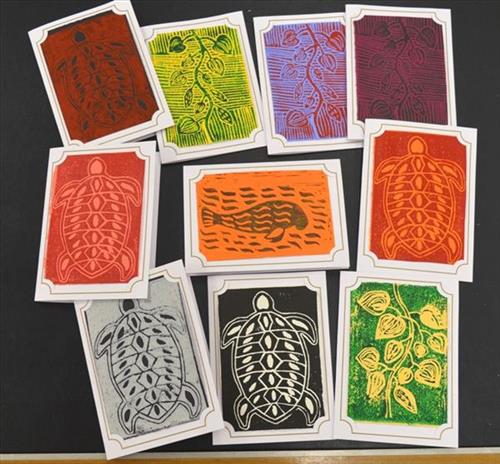
Hand Painted – Greeting Card (Earth Pigment)

Bana Yirriji Art Centre represents artists from the Yalanji, Nyungkul and Jalunji clan groups.  

Bama (local people) have had a long history of artistic expression, including ceremonial body painting, weavings made from local plants, rainforest shields and weaponry decorated with clan designs using earth pigments.

Today, artists create stunning contemporary arts and crafts; including paintings, prints, works on paper, textiles, weavings, artefacts and a range of merchandise. Artists draw on their rich cultural, historic, and contemporary stories and profound connection to country as inspiration.

This card has been painted with earth pigments with locally sourced and prepared by the artists. 

Individual hand painted card on Archers paper.