Plenty of water
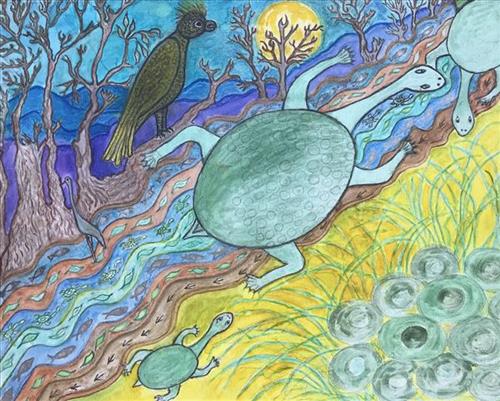
Bayadherra and Girriwa heading into the water
Bayadherra and Girriwa heading into the water
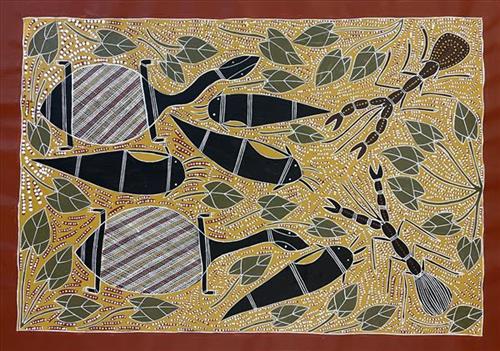
All Aboriginal people originate from a spiritual source, fixed in a particular place in their land or the sea. These ‘spiritual reservoirs’ are often in the form of special waterholes made by Wangarr (creative spirits) that were created long ago close to the beginning of time. These creator beings moved across the countryside, shaping the land and implanting in each tract of country, the spiritual life force for the people who were to own it. These creative spirits took many forms and when they gave the land to each group, they also gave songs, dances, ceremony, the associated laws and language.
The creation story for Ganalbingu people took place near the middle section of the Glyde River where it becomes the Goyder River. Their land, Ngaliyindi, sits astride the Arafura Swamp in Central Arnhem Land. Many Ganalbingu artists paint totemic species significant to their clan. These can include baru (crocodile), banda (long necked turtle), buliya (catfish), yalman (waterlilies), gumang (magpie geese), dakawa (fresh water yabby), ratjuk (barramundi), warrnyu (flying fox) and more.
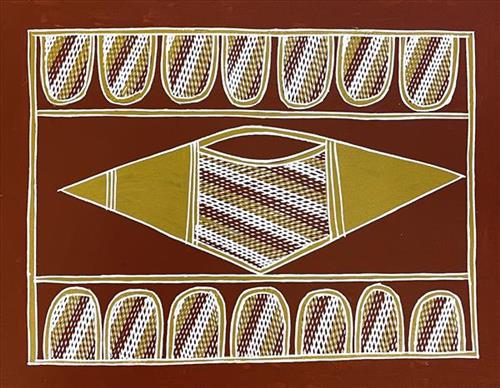
This painting is of a conch shell and the “U” shapes are oysters. The rrark (cross hatching) is representing water.
This painting is part of The Milky Way songline (Badurru) which takes place near Hutchinson Strait at a place called Gurruwana. It is a story affiliated with the Liyagalawumirr clan of the Dhuwa moiety. The conch shell and oysters are found in the Gurruwna landscape.
During the time of Creation, the Glider Possum Man lived with his two wives. After an argument, the women attacked their husband with burning sticks. His limbs shrivelled and he became a Glider Possum. He relayed the story of this transformation to his brother-in-law, The Crow Man. Glider Possum gathered his tribesmen and speared the wives to death. Their spirits went into fish in a nearby stream, but the Crow Man had a fish trap. The Glider Possum and his tribesman caught the spirits and ate the fish. With sorrow, the Crow Man gathered the bones of his sisters and held the first Hollow Log ceremony to put the women’s souls to rest. He carried the log holding their bones up to the sky and as he flew, some of the bones fell out making the stars of the Milky Way.
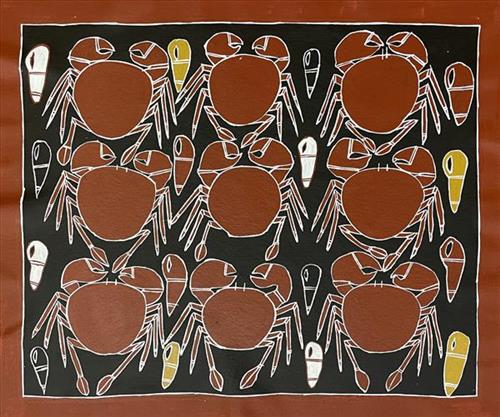
Here the artist paints shellfish and mud crabs at Gariyak, the county represented in many paintings relating to the Djang’kawu Sisters’ journey. In the coastal mangroves the sisters hunted mud crabs, and baler and conch shells to eat.
Bathi are woven from the split leaves of the Screw Palm (Pandanus Spiralis). Coil weaving was introduced to Arnhem Land in the 1930s. It was adapted from techniques used by Indigenous women throughout South East Australia.
Traditionally, Nganiyal (conical mats) were used as an insect screen when erected, and as a sitting mat when folded. They are used in Ceremony as well as a functional item.
Nowadays, artists weave many different shapes including flat, round and oblong.
Traditionally, Nganiyal (conical mats) were used as an insect screen when erected, and as a sitting mat when folded. They are used in Ceremony as well as a functional item.
Nowadays, artists weave many different shapes including flat, round and oblong.