Bathi (Pandanus Basket)
Bathi are woven from the split leaves of the Screw Palm (Pandanus Spiralis). Coil weaving was introduced to Arnhem Land in the 1930s. It was adapted from techniques used by Indigenous women throughout South East Australia.
Bathi are woven from the split leaves of the Screw Palm (Pandanus Spiralis). Coil weaving was introduced to Arnhem Land in the 1930s. It was adapted from techniques used by Indigenous women throughout South East Australia.
Fish traps are placed into the river to face the oncoming fish. The woven tunnel traps the fish and prevents their escape. The traps are tapered so when they are submerged in the water, the water pressure wedges them into place. Traditionally, the fish traps are operated at night time.
JB paints stories from his Dhuwa homeland in northeast Arnhem Land. Stories are passed on either paternally or maternally and JB would have learnt these stories from his ancestors. The cross-hatching style (Rrark) is a traditional painting style of this area and can represent elements such as water, air and wind.
His paintings often feature totemic animals of the fresh waters of North East Arnhem Land.
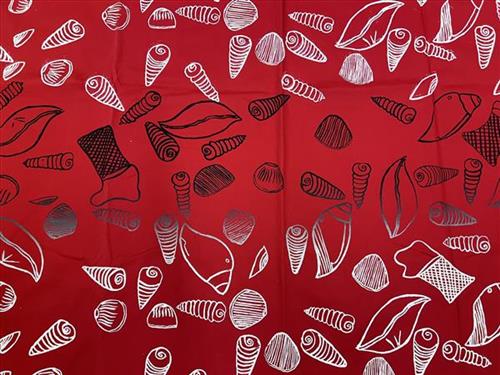
‘Sometimes when we go down to the beach in Maningrida we pick all these shells up. Some family make necklaces and earrings. In the olden days they used to collect shells and put them in the dilly bags. The old people used to carry dilly bags when they went hunting. They used the dilly bag for bush food. My design shows mud muscle and long bum and cockles.’ Belinda Kernan 2022
Belinda’s mother is from Eastern Arrernte country near Alice Springs, the community of Ltyentye Apurte (Santa Teresa), and her father’s country is Maningrida. Belinda speaks languages from both sides of her family, as well as various languages belonging to Central Arnhem Land. She lives in Maningrida and prints lino at the women centre. Belinda is also a strong leader for young people in her community.
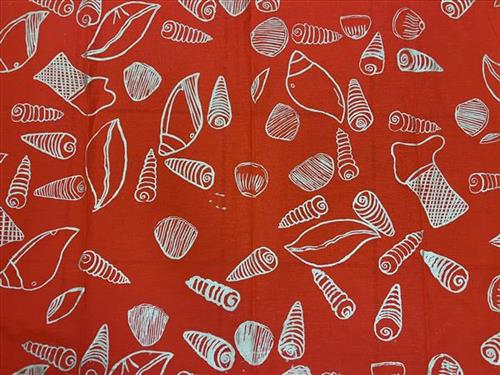
‘Sometimes when we go down to the beach in Maningrida we pick all these shells up. Some family make necklaces and earrings. In the olden days they used to collect shells and put them in the dilly bags. The old people used to carry dilly bags when they went hunting. They used the dilly bag for bush food. My design shows mud muscle and long bum and cockles.’ Belinda Kernan 2022
Belinda’s mother is from Eastern Arrernte country near Alice Springs, the community of Ltyentye Apurte (Santa Teresa), and her father’s country is Maningrida. Belinda speaks languages from both sides of her family, as well as various languages belonging to Central Arnhem Land. She lives in Maningrida and prints lino at the women centre. Belinda is also a strong leader for young people in her community.
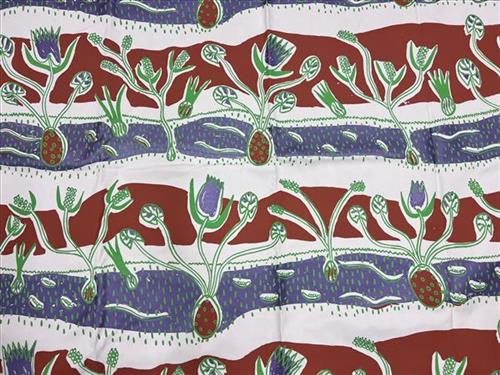
Karrinung kukurlk kare, karrijare manme (we are going underground looking for food).
“This is my country. In this painting, I’m looking at her little bit different way. This is what we see when we’re kukurlk kare (going underground)
Man-kurndalh (Black plum) I call mother. It is my mother’s Djang/Dreaming. The bush onion (kulumuduk) is white, the same as onions you buy at the store. We don’t eat this one though, it’s poison.
Wayuk is the water lily, with the big root growing in the earth. This is when that water is drying up a bit. There are worms and beetles- this is what we see underground, when we are digging for manme.”
-Jennifer Wurrkidj
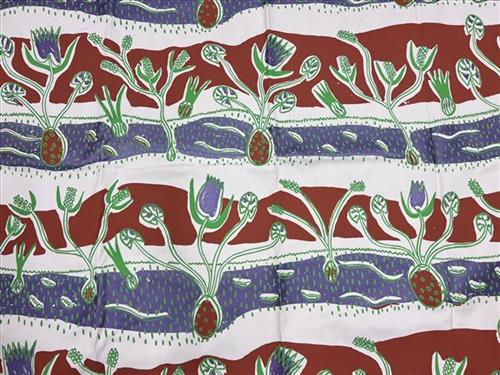
Karrinung kukurlk kare, karrijare manme (we are going underground looking for food).
“This is my country. In this painting, I’m looking at her little bit different way. This is what we see when we’re kukurlk kare (going underground)
Man-kurndalh (Black plum) I call mother. It is my mother’s Djang/Dreaming. The bush onion (kulumuduk) is white, the same as onions you buy at the store. We don’t eat this one though, it’s poison.
Wayuk is the water lily, with the big root growing in the earth. This is when that water is drying up a bit. There are worms and beetles- this is what we see underground, when we are digging for manme.”
-Jennifer Wurrkidj
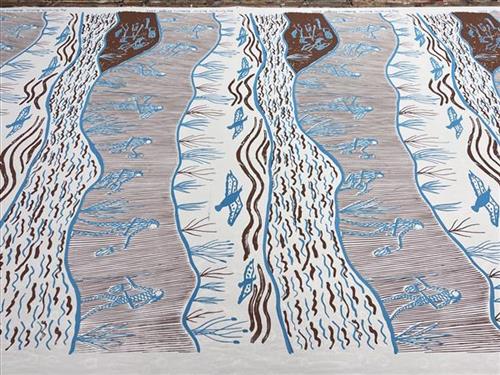
‘Bini-murreko means two brothers – big brother and little brother.
Two brothers were really strong leaders and good hunters, sharing animals with different tribes.
With those different tribe there were jealousy going on.
Little brother went walkabout and heard the different tribe was talking about his tribe.
They said ngarribin manre djed-djedme bokko
Meaning: will make spear for them
Ngarrbin danj-bun, ngarrbinbun
Meaning: will spear them kill them
little brother turn around went back tell his brother
Namurre bokko kadi marne djed-djedme Karre wonens, kardi-djal danjbun
Meaning: they making spear for us, they gonna spear us
Couple of months they saw different tribe
They changed their attitude
They been bringing lots of animals to them and start asking for women
And that tribe realise that’s how those brothers died.
They kill them
This Why? They got jealous because two brothers was a good hunter.
This story written on the rock art and it stays forever.’
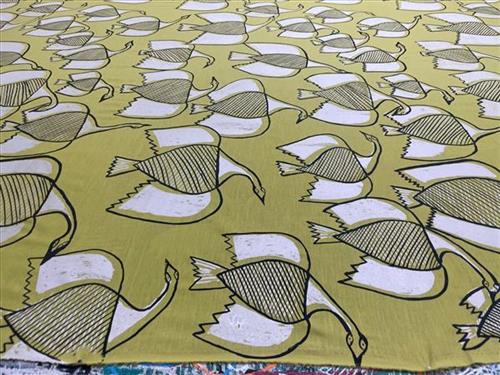
A design by emerging textile designer, Charmaine Pascoe.
‘My Gurrpurdu (diving bird) was white. She flew from Gan Gan to Gapuwiyak and then to Yathalamarra. And then she flew to Gartji.
At Gartji two fresh water seaweed shoots, one long and one short were trying to keep diving bird down. They were saying, “Don’t go away you belong to this country”. Diving bird said “No! I’m going to travel around to other country”. She was flapping her wings and then those two seaweed shoots let her go.
Then diving bird flew to make water hole at Gamurra Gu-yurra. She tasted the water but it was salty not fresh water. Then she put her poo like white clay on the ground at Gamurra Gu-yurra. The while clay was used for painting, funerals and ceremonies.
Then she continued to fly to Ji-balbal where she put the white clay again and then from Ji-balbal she dived underwater to Gochan Jiny-jirra. When she got there she got out of the water and was flapping her wings. At the same time she was singing. She was using her wings to dry out so that she could fly to Nangak.’ Charmaine Pascoe 2020
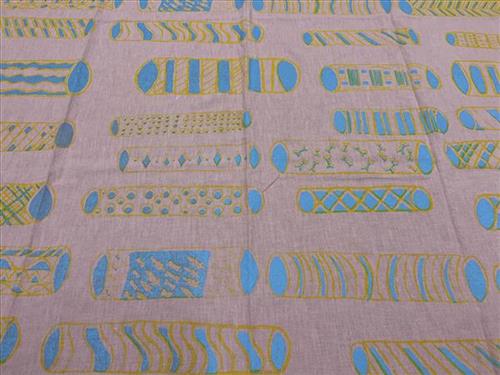
Marilyn’s first screen print design depicts the story of lorrkkon (hollow funeral logs). This the story of her great, great grandfather and grandmother who were bark painters, as well as also sacred lorrkkon painters.
When designing this screen print, Marilyn was remembering her childhood living in a small house on Liverpool river Ngar-wunja (Thompson hole) with other families.
Through the painting process, Marilyn remembered and relived the times when people still lived permanently on remote homelands, living off the land before balanda (non-indigenous people) arrived.
Marilyn recalls “it makes me think back, we did lots of things, some people was hunting, some was weaving, some was painting barks and lorrkkon. As my great, great grandfather and grandmother was painters, I painted this my story for them.”