115682205434


Raypiny Dhawu (Fresh Water Story)

All Aboriginal people originate from a spiritual source, fixed in a particular place in their land or the sea. These ‘spiritual reservoirs’ are often in the form of special waterholes made by Wangarr (creative spirits) that were created long ago close to the beginning of time. These creator beings moved across the countryside, shaping the land and implanting in each tract of country, the spiritual life force for the people who were to own it. These creative spirits took many forms and when they gave the land to each group, they also gave songs, dances, ceremony, the associated laws and language.


The creation story for Ganalbingu people took place near the middle section of the Glyde River where it becomes the Goyder River. Their land, Ngaliyindi, sits astride the Arafura Swamp in Central Arnhem Land. Many Ganalbingu artists paint totemic species significant to their clan. These can include baru (crocodile), banda (long necked turtle), buliya (catfish), yalman (waterlilies), gumang (magpie geese), dakawa (fresh water yabby), ratjuk (barramundi), warrnyu (flying fox) and more.
 

111982205700


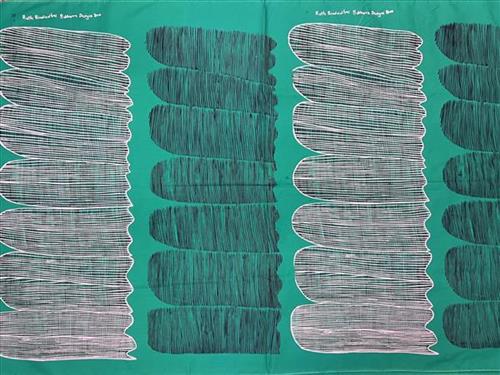
Kun-madj – large dillybag vine

Kun-madj, or dilly bag, is a large woven collecting basket. These large bags are often made from the vine ‘Malasia scandens’, a strong pliable plant which grows along the floor and into the canopy of monsoon vine thickets. The bags are used to collect any kind of large numbers of heavy foods such as fish caught in conical fish traps or large collections of yams.

They can also be made from Pandanus spiralis, a plant which grows in many areas of Arnhem Land. These dilly bags are a tightly woven collecting basket, very finely made. These dilly bags are often used to collect sugarbag, the native honey

As well as being of practical use, dilly bags are also of religious significance to Arnhem Land people. Dilly bags are said to be totemic objects and associated with particular sites in the landscape.

377810582205515


“This river we call Mangabo. It is near Gudjarrngarrl homeland of my daughters, Deborah and Jennifer Wurrkidj. We cross that river when travelling to Munmoy outstation. In the wet season, that water comes up and covers over those rocks, and when you look down there are rocks all under the water.” 

– Helen Lanyinwanga

377810582205509


Stingray – Debbie Pascoe

This is Debbie Pascoe’s first ever screen print design. Printed as a two colour design.

Debbie is from the Djinang language group in Maningrida, which according to the ABS Census has approximately 220 speakers.

377810582205506


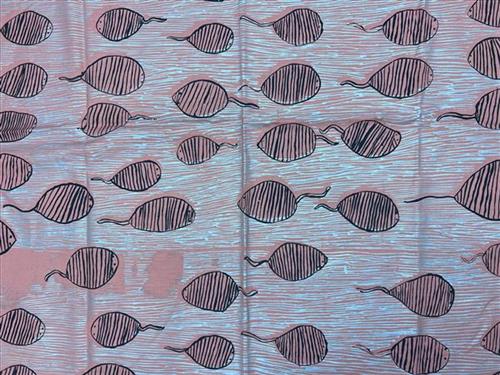
Djomi

This design depicts the story of the artist’s ancestral dreaming, the Djomi fresh water spirit mermaid.

The Djomi figure is a mermaid like spirit with fish tail that lives in the fresh water stream that flows out to the sea cliff near Maningrida. Djomi is a known to be a very powerful fertility symbol.

‘If you go there you can get pregnant easily. Djomi has babies, and they can give others babies too. The Djomi spirit is so powerful, that women can end up with multiple babies at once, twins or sometimes even more. The Djomi spirits lay eggs near the sacred freshwater stream in Maningrida. Inside the eggs are human babies as well as young Djomi.

Men do not go near that swamp, because Djomi is so powerful that men might get pregnant there too. So men, they are too scared of that Djomi. When we visit the Djomi freshwater spring, we can hear young Djomi crying. They sound like normal babies crying, those Djomi spirits. They are looking for a mother.

This Djomi is my dreaming, I got permission from my djunguys to paint this Djomi design. For me I always ask my djunguy permission to paint, because that is our cultural way.

This design also depicts the fresh water lily leaves, and seaweed from the base of the sea floor.

377810582205501


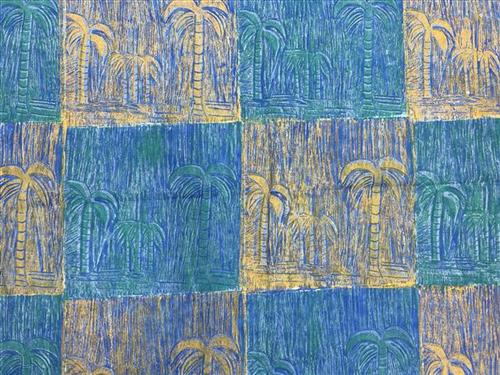
Palm tree on my country – Belinda Kernan

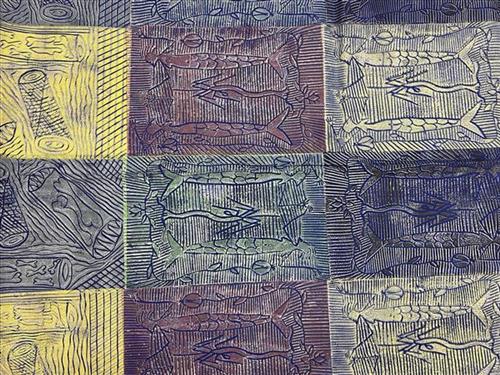
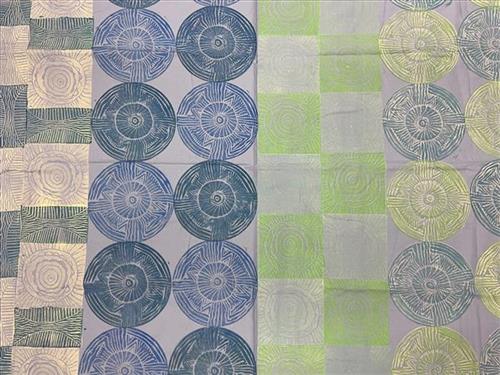
This fabric was created using the linocut printing technique. The lino tile has been carved by the artist in Maningrida, and has been printed by hand using a variety of colours and layers. The linocut technique ensures each textile piece is a one-off, limited edition piece.

111982205390


Waterholes (Kubumi)

Kubumi is a sacred site on the Mann River. This is its story, as told by a ritual manager of the site, Lulu Laradjbi, with the authority of her husband Mick Kubarkku, a land owner of that country.

Ngalyod the Rainbow Serpent pierced the rock at a place called Bolerrhlerrh and journeyed downstream from there to Ngalmalanj. The camping place Kubumi is downstream from there but at Ngalmalanj the serpent was blocked. It pushed down into the riverbed, pushed into the earth, sinking down forever. Now it lives under the rocky riverbed. That site continues downstream. Upstream is the site Molerrhlerrh, which has a waterfall and a big waterhole. There the serpent moved inside, downstream, to the lower region.

During the dry season at Kubumi, the Mann River shrinks to a series of deep waterholes, exposing the tunnels through the rocky outcrop that interconnect the pools.

111982205389


Waterholes (Kubumi)

Kubumi is a sacred site on the Mann River. This is its story, as told by a ritual manager of the site, Lulu Laradjbi, with the authority of her husband Mick Kubarkku, a land owner of that country.

Ngalyod the Rainbow Serpent pierced the rock at a place called Bolerrhlerrh and journeyed downstream from there to Ngalmalanj. The camping place Kubumi is downstream from there but at Ngalmalanj the serpent was blocked. It pushed down into the riverbed, pushed into the earth, sinking down forever. Now it lives under the rocky riverbed. That site continues downstream. Upstream is the site Molerrhlerrh, which has a waterfall and a big waterhole. There the serpent moved inside, downstream, to the lower region.

During the dry season at Kubumi, the Mann River shrinks to a series of deep waterholes, exposing the tunnels through the rocky outcrop that interconnect the pools.