Family
Family represents my family along the waterhole. Camping, Fishing or swimming.
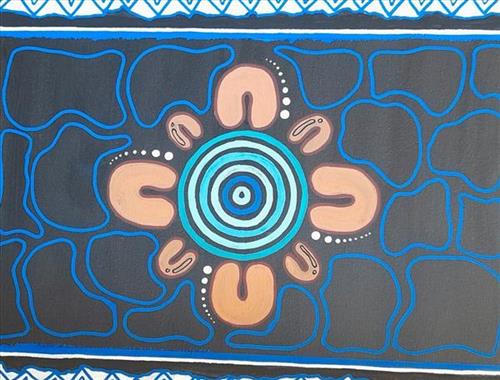
Family represents my family along the waterhole. Camping, Fishing or swimming.

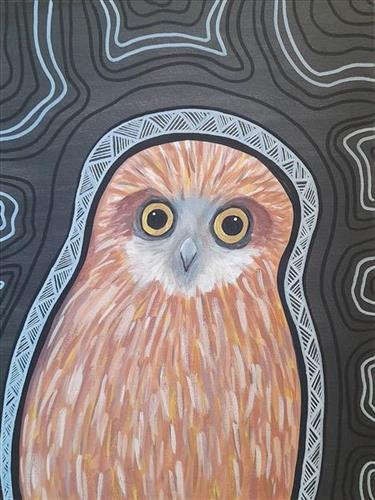
Mook Mook eye of the owl in the Night sky

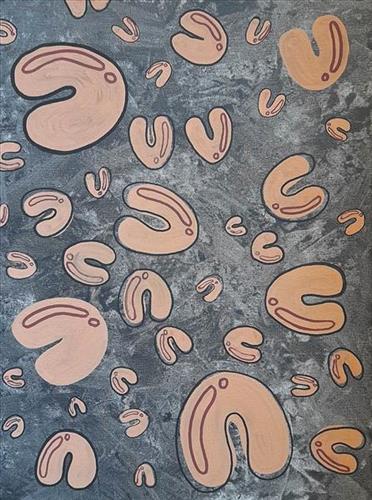
My people repersents the togetherness and the connection with have with our mob.
This artist has painted designs for two clans: Mapuy and Warrawarra. These are both Yirrichinga clans from the eastern bank of the Blyth River area in north-central Arnhem Land. These two clans are closely related and share a number of sites. One site they share is called Ji-gapala, where there is a dreaming for gorrpurda ‘diver duck’.
Gorrpurda travelled from the east, creating the landscape and naming clans as she went. She travelled across the land and underground in the same way that the diver duck dives from the air into the water, swims a long way underneath and then emerges from the water back into the air. She came from Mapuy clan and entered the ground at Ji-gapala, where she transformed into Warrawarra clan. The unity of the two clans is conveyed in this work with the combination of the diver duck emblem for Mapuy and the rectangular cross-hatched motif of Warrawarra.
Johnny Bulunbulan is a senior member of the Ganalbingu group and is one of the most important singers and Lives with the Burarra People at Wurdeja.
This painting depicts aspects of a large estate called Gunbarranga which lies around the seaward, “Bottom”, part of the Arafura Swamp. “Gunbarranga is biggest name for biggest country for Ganalbingu. For my father and grandfather.” the top Half shows Guwaynang, The fresh water long-necked turtle ( Chelodonia oblonga) and Marrur.tu, an unidentified tree which grows along the banks of creeks. Guwaynang is an especially important creature in Ganalbingu cosmology and is Bulunbulan’s personal totem. ‘He is the most important one because it was him that made my country and my people. ‘Before Guwaynang there was nothing. Marrur.tu is about the size of a banana tree and also has “really big” leaves; it is crowned by a red flower. “ Guwaynang is living at same place as that Marrur.tu Guwaynang make that place.’
The bottom half of the painting depicts a frieze of various snakes. Counting from left to right (the small snake at the top mid-left being #5 and the head of a snake at bottom mid-right being #10), the snakes are : 1 and 2 – golonggolg, a water snake or rainbow snake ; 3 and 7 – Biparran, a small snake up to 1 metre in length which is eaten as tucker ; 4,5 and 6 – Barringan, a water snake which always hunts in pairs; and 8 , 9 ,10 , 11, 12 and 13 – Gunungu, a black-headed python. Golonggolong and Gunungu are also associated with storms and rain: “one day they split and make rain. When they singing they make rain”.
The two halves of the painting are separated by a horizontal band which represents a dead log. This log is extremely sacred for the Ganalbingu who are the only ones that are allowed to paint it and it is associated with a very secret story. “That log has been like- you don’t know, I don’t know. Since dreamtime. It’s my father dreamtime and grandfather. “The log comes from a particular place called Junggibarparnyamurru but it can be depicted across painting of ant Ganalbingu country.
The cross- hatched borders represent the expanses of Ganalbingu country.
Coiling technique was introduced in the 1920s at Goulburn Island to the Maung people by missionaries and quickly spread to the mainland. Many artists produce coiled baskets of varied shapes, ranging from small round baskets to large oval baby baskets made from dyed pandanus. Artists combine colours and patterns to obtain intricate new graphic patterns.
Coiling technique was introduced in the 1920s at Goulburn Island to the Maung people by missionaries and quickly spread to the mainland. Many artists produce coiled baskets of varied shapes, ranging from small round baskets to large oval baby baskets made from dyed pandanus. Artists combine colours and patterns to obtain intricate new graphic patterns.
String bags can vary greatly. Artists commonly use a mix of naturally dyed and undyed fibre to create a striking variation of coloured bands. Some artists also incorporate different types of looping to produce different patterns and textured finishes. Each type of fibre bag, mat, basket and dilly bag has its own name in the various languages spoken in the Maningrida region.
Coiling technique was introduced in the 1920s at Goulburn Island to the Maung people by missionaries and quickly spread to the mainland. Many artists produce coiled baskets of varied shapes, ranging from small round baskets to large oval baby baskets made from dyed pandanus. Artists combine colours and patterns to obtain intricate new graphic patterns.
Coiling technique was introduced in the 1920s at Goulburn Island to the Maung people by missionaries and quickly spread to the mainland. Many artists produce coiled baskets of varied shapes, ranging from small round baskets to large oval baby baskets made from dyed pandanus. Artists combine colours and patterns to obtain intricate new graphic patterns.