111982254538


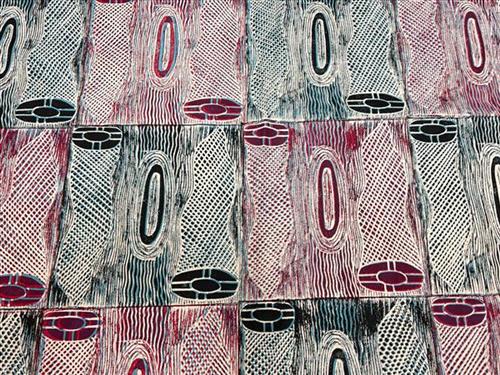
Burlupurr – large dillybag

Burlupurr, or dilly bag, is a large woven collecting basket. These large bags are often made from the vine ‘Malasia scandens’, a strong pliable plant which grows along the floor and into the canopy of monsoon vine thickets. The bags are used to collect any kind of large numbers of heavy foods such as fish caught in conical fish traps or large collections of yams.

They can also be made from Pandanus spiralis, a plant which grows in many areas of Arnhem Land. These dilly bags are a tightly woven collecting basket, very finely made. These dilly bags are often used to collect sugarbag, the native honey 

As well as being of practical use, dilly bags are also of religious significance to Arnhem Land people. Dilly bags are said to be totemic objects and associated with particular sites in the landscape.

111982254537


Burlupurr – large dillybag

Burlupurr, or dilly bag, is a large woven collecting basket. These large bags are often made from the vine ‘Malasia scandens’, a strong pliable plant which grows along the floor and into the canopy of monsoon vine thickets. The bags are used to collect any kind of large numbers of heavy foods such as fish caught in conical fish traps or large collections of yams.

They can also be made from Pandanus spiralis, a plant which grows in many areas of Arnhem Land. These dilly bags are a tightly woven collecting basket, very finely made. These dilly bags are often used to collect sugarbag, the native honey 

As well as being of practical use, dilly bags are also of religious significance to Arnhem Land people. Dilly bags are said to be totemic objects and associated with particular sites in the landscape.

111982254536


Burlupurr – large dillybag

Burlupurr, or dilly bag, is a large woven collecting basket. These large bags are often made from the vine ‘Malasia scandens’, a strong pliable plant which grows along the floor and into the canopy of monsoon vine thickets. The bags are used to collect any kind of large numbers of heavy foods such as fish caught in conical fish traps or large collections of yams.

They can also be made from Pandanus spiralis, a plant which grows in many areas of Arnhem Land. These dilly bags are a tightly woven collecting basket, very finely made. These dilly bags are often used to collect sugarbag, the native honey 

As well as being of practical use, dilly bags are also of religious significance to Arnhem Land people. Dilly bags are said to be totemic objects and associated with particular sites in the landscape.

377810582254460


Mandjabu

Kuninjku people traditionally make two sorts of conical fish traps. One is called mandjabu and is made from a strong, durable vine called milil, and a smaller one is called manylik mandjabu, and made from the grass manylik. The mandjabuconical fish trap is bigger and stronger and used in tidal reaches of creeks to catch large fish. The smaller, lighter manyliktrap is used in freshwater flowing creeks to catch smaller fish and freshwater prawns. In earlier times, only men were involved in the construction of the large fish traps, but children would often crawl inside and assist.

To make mandjabu, weavers firstly harvest milil (burney vine, Malaisia scandens) and put it in water overnight to make it soft. Then they start weaving it; they make rings for the inside to keep the fish trap’s shape. People also make string from the bark of burdaga (kurrajong) to attach the bardainy (hibiscus) rings and to tie the conical end of the fish trap. It’s hard work and it can take three or four weeks to make a fish trap. People also use fish-net fences called kunkarlewabe. They would put the kunkarlewabe  across rivers and creeks. In the middle they would place the mandjabu. They also used small things like sticks, rocks, mud and grass to block the fish from going through. This way we would catch fish such as saltwater barramundi rajarra, ngaldadmurrng (freshwater barramundi), small black freshwater catfish (buliya), bonefish (an-guwirrpiya), and sand bass (dalakan) in the mandjabu.

377810582254459


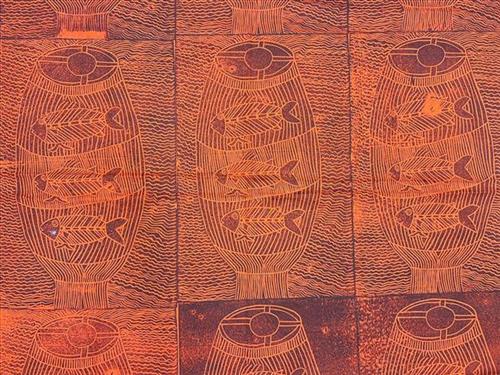
Au-gujechiya (fishtrap)

TITLE                          Au-gujechiya

YEAR                          2022

MEDIUM                     Screen print

DETAILS                    2 screen

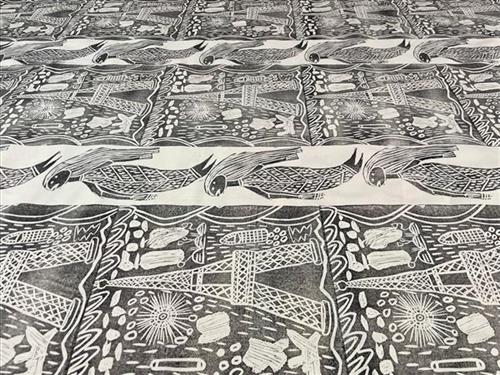
Au-gujechiya  means  fishtrap in the Burrarra language which is one of the traditional  languages spoken in the Maningrida region. Elizabeth’s homeland is Gupanga, Arnhem Land which located on a saltwater estuary, a great place for catching fish.

Elizabeth obtained permission from her djunkay to create a screen print design about a historic object traditionally used to trap fish in rivers, creeks, and estuaries. 

In the early wet season, fish swim upstream for breeding in creeks and billabongs, then downstream to spend the dry season in larger rivers. The traps would be set to face the oncoming fish, with woven fencing either side. Within the mouth of the trap is a woven funnel that guides the fish in and prevents their escape. The clever design ensures that only adult fish are caught as smaller fish can escape through the weaving or even through the funnel. The fish that are caught can survive in the trap for up to two months. Once the trap is removed, the end is untied to remove the fish. This sustainable design means the trap can be used again and again. 

116482254458


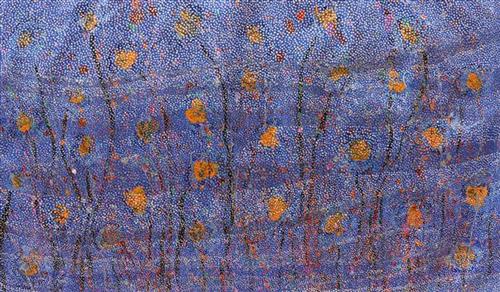
Our Country (The Pilbara)

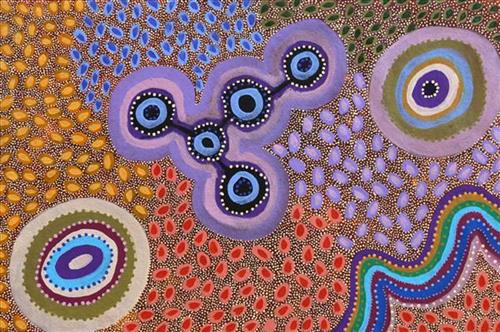
Pilbara is the country where we the Yindjibarndi people live and share many of our Cultural stories and history that have been passed onto us by our ancestors, of how they used to walk through the flat country we call the (Table Lands) visiting family members at nearby stations. Our country has so much to offer. Bush foods and medicine as well as animals such as kangaroo, emu, goanna, and turkey. When the rains come our rivers are full and we all love to go out and spend the day fishing. We are also close to the ocean, so we often go fishing there as well. During the holidays many of our families go bush to enjoy what the country offers the beauty of our country we see through our eyes. Wildflowers bloom as nature takes its course and our country is still full of riches it always gives me joy to be a part of it, we are connected to our land it is a part of who we are.

377810582254457


Eiffel tower and the Maladj spirit

“I want to tell you about my design, that Eiffel tower one.

This year it was my first time going to Paris. I didn’t know that place, nothing. We travelled around the world to get there, we flew underneath the world in an aeroplane.

Paris was a big, crowded city. They speak a different language there, just like here in Maningrida with all our different languages.

The Bábbarra artists and Ingrid, we were all walking around, like tourists. We went on the boat in the Paris river. There was a film crew taking videos of us. We saw so many beautiful buildings covered with black string (iron balconies) and big statues. We’d never seen things like that before.

I remember when we got off that boat and I looked up and saw that tower. When I first looked up at that tower, it made me happy- it’s so long up into the sky. We walked towards it. I was standing there watching that tower and thinking, ‘wow, first time for me seeing a tower like that’.

Then I was thinking, and I said to myself, when I go back to my own country, I’m going to paint that tower.

We came to Maningrida, I started to draw. I drew that tower from France, but also I drew maladj (stone country orphan spirit), women’s sacred woven mat, fish traps and rolk (insects). I also put round kunngol (clouds) in the design, those circles. That maladj spirit, it’s standing there next to the Eiffel tower, looking at the dancing lights at night. The tower is from Paris, but everything else in my design I took from my mother’s country and my father’s country.

Maybe one day I’ll travel back to France, and take my design with me to show them, all the French mob.” Janet Marawarr
377810582254454


Manbirrbbirr (small bush flowers)

In Kuninjku the name manbirrbbirr is used for a number of densely flowering shrubs and small trees including Verticordia cunninghamii, yellow flowering Austromyrtus species and also Acacia platycarpa which also has dense white. 


116482254451


Early Morning Mist

The early morning mist over the water is the smoke from the breakfast fires of the Marrga, the creation spirits. According to Yindjibarndi law, in the beginning the sky was very low. When the creation spirits, Marrga, arose from the ground they raised the sky and the world out of the ocean. This creation story is called Ngurru Nyujunnggama, ‘When the World was Soft’. The Marrga gave names and form to the country and then to all the birds and animals. Finally they created the Ngaardangarli, the Aboriginal people.