Pilbara Wildflowers
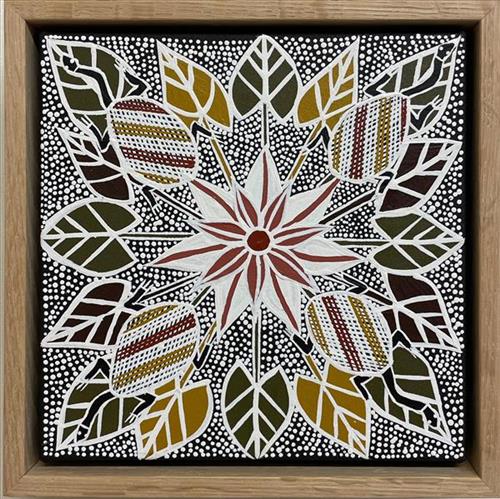
These are the Pilbara wildflower’s that grow on the ground they have a beautiful orange colour blending in the country during flower season
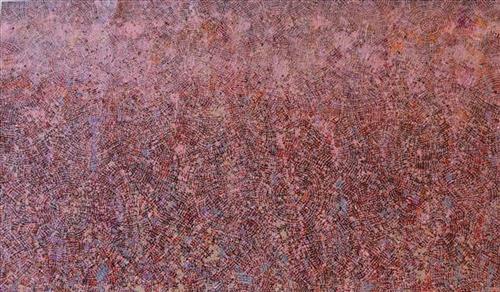
These are the Pilbara wildflower’s that grow on the ground they have a beautiful orange colour blending in the country during flower season
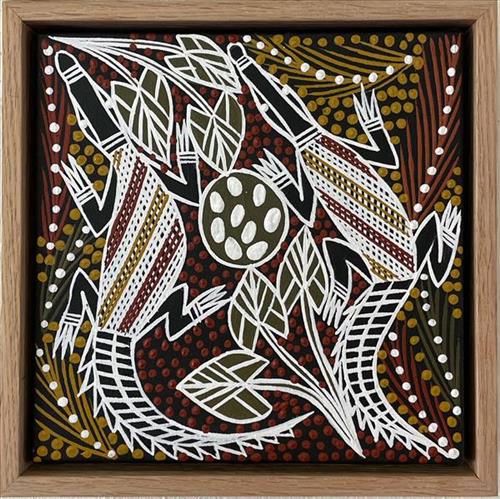
Baru (the crocodile man), was from the Gumatj clan. People usually call him Gurdu Gurdu or Baru which means crocodile. He lived his life at a place called Yirrkala. Living near him were other people, and when Baru didn’t have enough to eat he began to kill and eat these other people. After a while others noticed that some people were missing. When Baru went to the toilet, the people could smell this strong smell, so they knew that he ate the other people. Some men went to get help and they took message sticks to the other tribes. Some were sending smoke signals. When they came to Baru’s camp they started to spear him in the left side of his ribs. He dropped into the fire and burnt his left hand and maybe his right hand. He then ran into the bush and yelled to his countrymen – the animals, birds and fish that live on the land and in the sea. He stopped and he named the tribes and clans and also the places until he came to a place called Gamarru/Guyurru. There he took a rest and said to himself “This is where I stop and call this place Gamarru/Guyurru”. Baru, still in pain from the fire, then jumped into the water and turned himself into a crocodile. The fire left scars on his back. Baru paintings belong to Gumatj and Warrawarra and also the Marpi clan. This painting is used at death ceremonies or initiations and it normally is painted on the belly, which means the person the design is painted on is part of Gurdu Gurdu (the crocodile people).
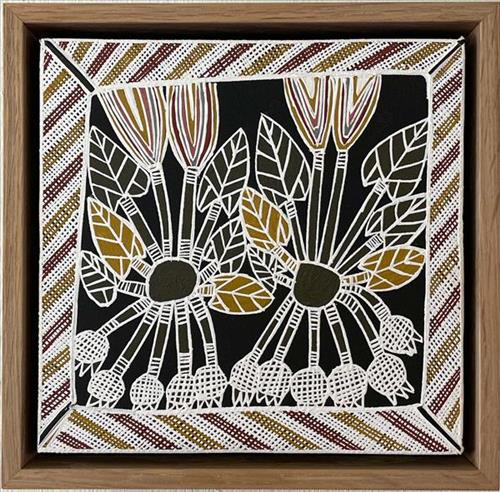
This painting depicts Dhulumburrk (Nymphaea violacea), a fresh waterlily. The flowers and lily pads of fresh waterlilies can be seen far and wide across the Arafura wetlands, providing coverage for many animal species including Banda (long-necked turtle) and Baru (crocodile). The flowers come in many beautiful colours, in particular a vibrant purple.
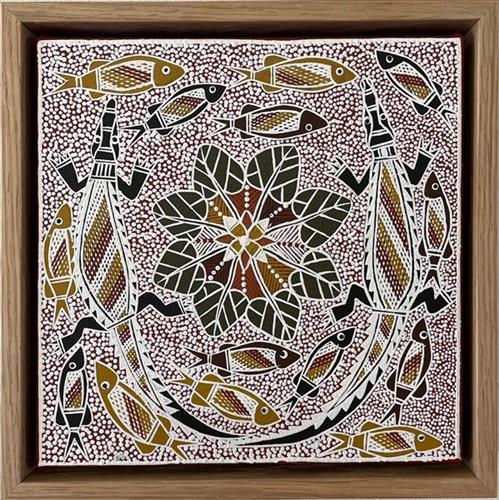
All Aboriginal people originate from a spiritual source, fixed in a particular place in their land or the sea. These ‘spiritual reservoirs’ are often in the form of special waterholes made by Wangarr (creative spirits) that were created long ago close to the beginning of time. These creator beings moved across the countryside, shaping the land and implanting in each tract of country, the spiritual life force for the people who were to own it. These creative spirits took many forms and when they gave the land to each group, they also gave songs, dances, ceremony, the associated laws and language.
The creation story for Ganalbingu people took place near the middle section of the Glyde River where it becomes the Goyder River. Their land, Ngaliyindi, sits astride the Arafura Swamp in Central Arnhem Land. Many Ganalbingu artists paint totemic species significant to their clan. These can include baru (crocodile), banda (long necked turtle), buliya (catfish), yalman (waterlilies), gumang (magpie geese), dakawa (fresh water yabby), ratjuk (barramundi), warrnyu (flying fox) and more.
The long necked turtle is a dreaming totem for the freshwater people, the Ganalbingu, whose country includes the World Heritage listed, Arafura Wetlands in Central Arnhem Land, Northern Territory
The Yolngu (people) of Arnhem Land originate from a spiritual source, fixed in a particular place in their land or the sea. These ‘Spiritual Reservoirs’ are often in the form of special waterholes made by Wangga (Creator Beings), long ago close to the beginning of time. These creator beings moved across the country side, shaping the land and implanting in each tract of country, the spiritual life force for the people who were to own it.
These creator spirits took many forms. When they gave the land to each group they also gave songs, dances, ceremony, the associated laws and language. The Creation story for Ganalbingu people took place near the middle section of the Glyde River where it becomes the Goyder River. Their land, Ngaliyindi, sits astride the Arafura Swamp in Central Arnhem Land. Some of their major Creative Beings include Banda (freshwater long neck turtle) and Yalman (water lilies).
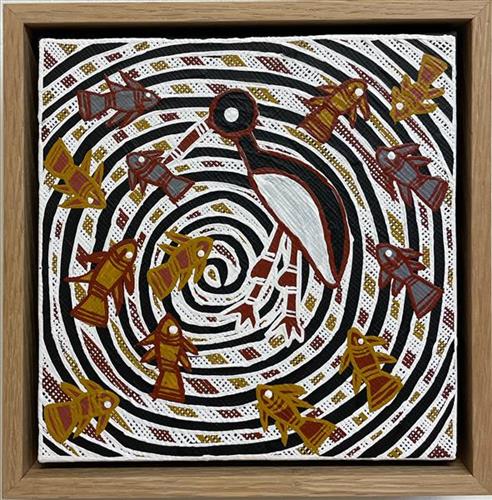
This is a story for the Wanybarrnga clan family. The Jabiru is in the water and he flaps his wings, hitting the water and causes it to ripple.
After a funeral ceremony, leaders for this clan family draw the Jabiru’s water ripples into the sand/earth. This symbolises a cleansing and washing for Yolngu to be free to go on with normal life.
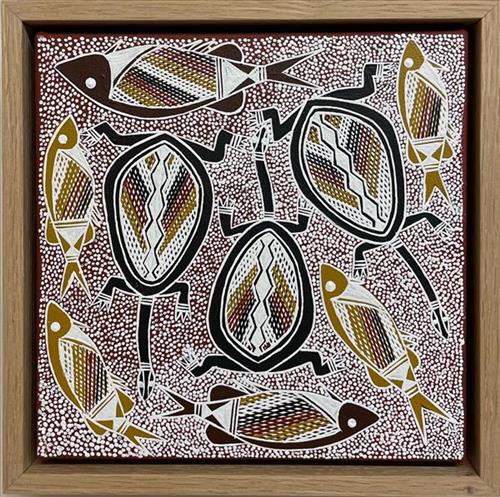
All Aboriginal people originate from a spiritual source, fixed in a particular place in their land or the sea. These ‘spiritual reservoirs’ are often in the form of special waterholes made by Wangarr (creative spirits) that were created long ago close to the beginning of time. These creator beings moved across the countryside, shaping the land and implanting in each tract of country, the spiritual life force for the people who were to own it. These creative spirits took many forms and when they gave the land to each group, they also gave songs, dances, ceremony, the associated laws and language.
The creation story for Ganalbingu people took place near the middle section of the Glyde River where it becomes the Goyder River. Their land, Ngaliyindi, sits astride the Arafura Swamp in Central Arnhem Land. Many Ganalbingu artists paint totemic species significant to their clan. These can include baru (crocodile), banda (long necked turtle), buliya (catfish), yalman (waterlilies), gumang (magpie geese), dakawa (fresh water yabby), ratjuk (barramundi), warrnyu (flying fox) and more.
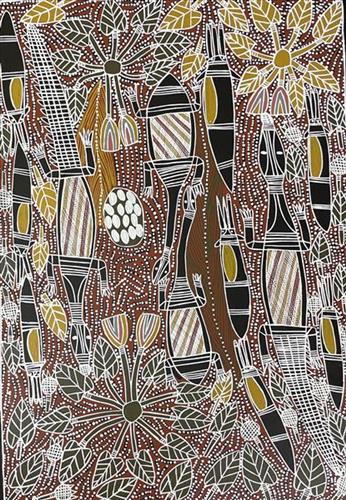
Baru (the crocodile man), was from the Gumatj clan. People usually call him Gurdu Gurdu or Baru which means crocodile. He lived his life at a place called Yirrkala. Living near him were other people, and when Baru didn’t have enough to eat he began to kill and eat these other people. After a while others noticed that some people were missing. When Baru went to the toilet, the people could smell this strong smell, so they knew that he ate the other people. Some men went to get help and they took message sticks to the other tribes. Some were sending smoke signals. When they came to Baru’s camp they started to spear him in the left side of his ribs. He dropped into the fire and burnt his left hand and maybe his right hand. He then ran into the bush and yelled to his countrymen – the animals, birds and fish that live on the land and in the sea. He stopped and he named the tribes and clans and also the places until he came to a place called Gamarru/Guyurru. There he took a rest and said to himself “This is where I stop and call this place Gamarru/Guyurru”. Baru, still in pain from the fire, then jumped into the water and turned himself into a crocodile. The fire left scars on his back. Baru paintings belong to Gumatj and Warrawarra and also the Marpi clan. This painting is used at death ceremonies or initiations and it normally is painted on the belly, which means the person the design is painted on is part of Gurdu Gurdu (the crocodile people).
The Kuninjku people of Arnhem Land tell of a time when their ancestors suffered a terrible drought. People living in the rocky outlier region near the middle Mann River dug wells to get water until these too dried up. Then they obtained water by cutting the trunks of Melaleuca trees called djidjdjerok which store brackish water inside. When these trees were exhausted, people were surviving only on wild honey. Eventually people died of thirst. The bones of these people are said to be those found in the caves of the escarpment country of Western Arnhem Land in the Mann River district. In the ancestral time of creation was a great drought. During this time Buluwana and her family camped at Ngandarrayo on Kurulk clan land. They were weak from thirst and close to death. The malevolent gigantic form of the Death Adder snake confronted the group. Buluwana attempted to run away with the rest of her family but was crushed and turned to stone. Today an arrangement of rocks standing in the ground remains as Buluwana’s present day form. Only her head protrudes as a prismic standing stone, the rest of her body is under the ground. Other human remains lying on rock ledges are said to be the remains of other early ancestors. This painting is a reference to the very early time, before the people died. It depicts Buluwana superimposed on the background of crosshatching with her kun-madj (dilly bag) and digging stick. She is depicted at a site called Dilebang. Dilebang is regarded as one of the most dangerous and sacred of sites in the Kun-Kurulk clan estate. Travel in the area is undertaken with caution as site custodians are aware of the ancestral power of the area. The billabong at Dilebang is near escarpment country rich in rock art and with a high concentration of sacred sites. The use of rarrk (crosshatching) all over the surface of the bark painting creates a shimmering effect, which imbues the image with a spiritual power.
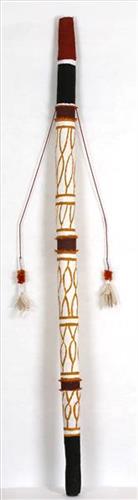
Transcription of text by Jack Nawilil about two ceremonial objects— Karlanj and Ngalkodjek. Transcribed by Murray Garde and Margaret Carew 2 & 5 December 2017. Notes by Margaret Carew on 5 Dec 2017
Note: The site Jack refers to as Kœnœdjangka is in the Rembarrnga language. The ‘œ’ vowel sounds like the ‘ur’ in English ‘fur’. As this vowel does not exist in neighbouring languages, it is usually converted to an ‘i’ as Kinidjangka by Kuninjku and Burarra speakers. I have used that spelling also in the English translation but retained Kœnœdjangka in the transcription of Jack’s speech. Jack’s speech involves code switching amongst Kriol, Kune, Burarra and English.
[00:00:01] This one here, like ngaye ngakurrmeng, im my draw.
This one here [ceremonial objects], I have drawn my own personal designs on them.
[00:00:09] This one Ngalkodjek.
This one (is called) Ngalkodjek. (MG- note, that this is not the subsection term Ngalkodjok, rather the stem -kodjek is formative in the verb -kodjekmang ‘to abduct’ and may refer to a secret episode in the Nakorrkko story, the father and son cultural heroes for Bininj in western Arnhem Land).
[00:00:13] Daluk, im from Elcho im bin travellng, im from Elcho, gama ngarla, jiny-bona didjan na, and didjan du.
This represents a woman, she travelled (here) from Elcho Island, she is from Elcho, she was a woman indeed, she went/travelled, this one and this one too.
[00:00:27] Didjan najawan, didjan na.
This is another one however, this one.
[00:00:30] Shemaiah: Those two are the same story?
[00:00:33] Same story this mob but I’ll bringim next week. I’ll bring another one.
[00:00:39] This one here, an-nerranga, an-guna balaji, mun-anngiya langa djolworra kantri, im from gun-anngiya, im from like im
This one here, this is a different one and represents a food plant, what’s its name (that tucker), it is from the saltwater country, from this way, like, it’s from what’s that place
(MC comment: -anngiya is a ‘what’s its name’ word, that inflects for noun class.)
[00:01:05] In my country where that Kœnidjangka way. Didjan na.
In my country there at Kinidjangka. This one here.
[00:01:09] Yo an-guna. Yo Murray, Murray im save, marn.gi.
This one. Murray knows about this.
[00:01:19] Yo, Murray ngudda yibengkan ngayi ngarduk nani Murray. From Kœnidjangka ngamarnbom.
Murray you know this one, it’s my design Murray. I made it, the one from Kinidjangka.
[00:01:28] En nani Kœnidjangka ngamarnbom, en nani kuluban kayo kure Nakorrkko wam. Nani ngamarnbom. Ungke nane ngamarnbom that story ngarduk na. Ngakurrmeng ngaye. Ngudda yibengkan. Kanmarnebengkan Bulanj. Yoh.
This one I made it, the design from Kinidjangka, the place where flying foxes live where the Nakorrkko passed through. I made that. I’ve made that story for you, that one of mine. I have put it there. You know that. You know what I’m talking about Bulanj (to Murray Garde).
[00:01:51] Didjan, nane, dijan gama i bin travelling garra didjei, garra didjei.
This one here, she is a woman who travelled this way, coming this way (to the west from north-east Arnhem Land).
[00:02:03] Im gona garra ebrijing. From Kunidjangka i bin make it. From Kœnidjangka ngamarnbom en nani Kœnidjangka ngamarnbom. En dijan Kœnidjangka ngamarnbom. Nane now.
She has many things. I made it, the one from Kinidjangka. From Kinidjangka I made it. It is from Kinidjangka, this thing i have made. That’s it now.
[00:02:25] Ngarduk my draw nane. Like ngamarnbun, like im nomo marrek ba morning star, im different nani. ngardapa ngardapa ngarla dreaming. Mu-gurrmurra, yo a-gurrmurra a-bona. Wangarr ngarla.
This design belongs to me. Like, I made it, and it should not be confused with a morning star pole, no, it is something different. they are separate indeed, these dreamings. It (an ancestral spirit) put it there. It is my totemic emblem. It is my ancestral design of the ancestral beings, indeed.
MC note:
mu-gurrmurra
00:02:44.460 – 00:02:45.310
it put it (object belongs to mun- vegetable noun class)
00:02:44.460 – 00:02:45.310
a-gurrmurra a-bona
00:02:45.310 – 00:02:47.928
it put it (object now belongs to an- masculine noun class). a-bona here literally means ‘it (masculine) went’ but functions as an aspectual auxilliary, showing that the action is completed. Tense suffixes construe this in the past.
Shemaiah responds: yo gun-burral
00:02:49.570 – 00:02:51.155
yes that’s true
00:02:49.570 – 00:02:51.155
[00:02:53] Dijan, dijan, im from dijei na, from Elcho. mm dijan.
This one, its origins are from this way (the east), from Elcho, mm, this one.
[00:03:00] gama
a woman
[00:03:02] Shemaiah: Ngay ngay ngay
yeah yeah yeah
[00:03:05] Dijan, im daga ia la Kœnidjangka. Balajiya. But im Mardayin. Bad ai jas putumbat eniwe yuno?
This other one is an edible plant. Food. But it is a sacred thing from the Mardayin ceremony. But I have adapted it to make it a secular version.
MC note: balajiya – note emphasis -ya final syllable.
@Shemaiah: balaji murda
00:03:09.370 – 00:03:10.530
food this one
00:03:09.370 – 00:03:10.530
murda is a contracted demonstrative (from mun-narda), ‘this one in focus’ compare arda, jirda, gurda, other noun class inflected forms. These contracted demonstrative forms are a feature of modern Burarra.
00:03:09.370 – 00:03:10.530
[00:03:19] Dijan na. Dijan, dijan mun-anngeyo balaji gen
This one. This is also a food.
[00:03:27] Shemaiah: balaji?
Food?
[00:03:28] Yo im my country igen bad awirri-gapajinga ngarla. We digim and karrimang. We eatim na, dijan na.
Yes, in my country, we dig it, but has a secret element to the story. We dig it and take it out. Then we eat it, this thing.
MC note:
The transitive prefix awirri- (~abirri-) reads to me as ‘you and me plus one more’, ie inclusive unit augmented. If plural/augmented we’d expect mbi-gapajinga ie third person augmented acting on singular object, where there is noun class agreement with the object. If just ‘you and me’ is intended it would be ay-gapajinga. Quite commonly unit augmented prefixes are used in generic statements such as this, where one might expect another prefix going from the speech or discourse context.
00:03:29.960 – 00:03:31.565
[00:03:42] Like ngakurrmeng namekke Murray, Bulanj, nane Ngalkodjek wam from aa kure kamdolkkang from aam, Elcho.
So, Murray, that’s what I’ve put on it (the design). This is Ngalkodjek who travelled, setting out from Elcho Island.
[00:03:58] Ngamarnbom. Nabuyika nane, ngamarnbom manme rerri. Manme ngamarnbom, mane manme kangeydi manbingkanj.
I made it. The other one, I also made that one too. I made the plant food emblem, and the name of that plant is manbingkanj.
[00:04:16] Nane, nane ngamarnbom karlanj ngamarnbom, manme rerrih. Nane na Kœnidjangka ngamarnbom. Ngaleng nani, ngaleng Elcho kamwam daluk. Dijan na.
This thing here, I made it, this object is called karlanj and it represents a plant food. This one I have made is from Kinidjangka. She is a woman who came from Elcho Island. This one now.
[00:04:34] Im from long way dijan i bin travelling, from Elcho, (kala xxx ) like yu nomo save… yuno that, daluk, blanga im business, garra dijan i bin travelling. Yo. Dijan ia im mine dijan. Nane ngarduk rowk Bulanj, namekke draw namekke recordim ngayeman ngangeykurrmehkurrmeng nane.
She was travelling a long way, from Elcho Island (…..) like, you don’t know that story (it’s secret)… you know it related to a woman, it was her ceremonial story, and she was travelling. This thing here is my (clan) design. These are all mine Bulanj (to Garde) and what I have drawn, it’s being recorded now and I’m explaining all the names relating to it.
[00:05:03] Nane Ngalkodjek daluk, nane manme karlanj en nane mak, njamed, um. Karlanj manih manbu. Mak mane manbuyika, djal manbuyika yerri.
This woman, her name is Ngalkodjek, and this is the food, the karlanj, and this whatsit, um. Karlanj, that’s it. And there is another one but it is different again.
[00:05:24] Manbu rerri kayime wanjh mani nawu.
It is similar again, this one here.
[00:05:26] Ngamarnbom.
I made them.
[00:05:28] Ungke Murray. Kaluk yibekkan yingan kumekke mankarre yimarnbun. Yo namekke. Ma, thank you.
This (recording) is for you Murray (to transcribe for the art and cultural centre). You can listen to it and document the cultural story. That’s it. Okay, thank you.