111582264923


Untitled

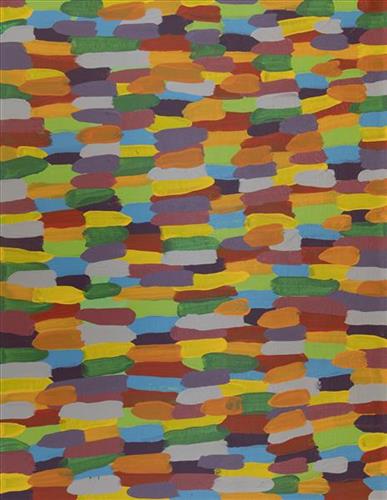
“When Martu paint, it’s like a map. Martu draw story on the ground and on the canvas, and all the circle and line there are the hunting areas and different waters and tracks where people used to walk, and [some you] can’t cross, like boundaries. So nowadays you see a colourful painting and wonder what it is, but that’s how Martu tell story long ago. It’s not just a lovely painting, it’s a story and a songline and a history and everything that goes with it.” 

– Ngalangka Nola Taylor and Joshua Booth

This work portrays an area of Country that can be interpreted in multiple ways. Firstly, the image may be read as an aerial representation of a particular location known to the artist- either land that they or their family travelled, from the pujiman (traditional, desert dwelling) era to now. During the pujiman period, Martu would traverse very large distances annually in small family groups, moving seasonally from water source to water source, and hunting and gathering bush tucker as they went. At this time, one’s survival depended on their intimate knowledge of the location of resources; thus physical elements of Country, such as sources of kapi (water), tali (sandhills), different varieties of warta (trees, vegetation), ngarrini (camps), and jina (tracks) are typically recorded with the use of a use of a system of iconographic forms universally shared across the desert. 

An additional layer of meaning in the work relates to more intangible concepts; life cycles based around kalyu (rain, water) and waru (fire) are also often evident. A thousands of year old practice, fire burning continues to be carried out as both an aid for hunting and a means of land management today. As the Martu travelled and hunted they would burn tracts of land, ensuring plant and animal biodiversity and reducing the risk of unmanageable, spontaneous bush fires. The patchwork nature of regrowth is evident in many landscape works, with each of the five distinctive phases of fire burning visually described with respect to the cycle of burning and regrowth.  

Finally, metaphysical information relating to a location may also be recorded; Jukurrpa (Dreaming) narratives chronicle the creation of physical landmarks, and can be referenced through depictions of ceremonial sites, songlines, and markers left in the land. Very often, however, information relating to Jukurrpa is censored by omission, or alternatively painted over with dotted patterns.
111582264922


Yalta

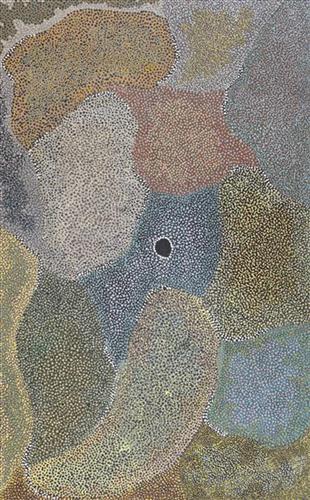
“This is my grandmother’s and mother’s Country, Yalta. It’s very close to Kunawarritji side. I’ve never been there. That was where my mother was born during the pujiman (traditional, desert dwelling) times. All the tali (sandhills) around. I want to go there one day, to see that Country, I might go there one day” 

 – Marianne Burton

Yalta is a waterhole located between the Great Sandy Desert’s Percival Lakes region and Kunawarritji Aboriginal community. This site was visited by the Ngayurnangalku (cannibals) during the Jukurrpa (Dreaming). These fearsome ancestral cannibal beings are said to resemble people in their appearance, except for their fangs and long curved knife like fingernails they use to catch and hold their human victims. The Ngayurnangalku continue to live beneath the crust of Kumpupirntily (Kumpupintily, Lake Disappointment), south east of Yalta.  

Yalta lies within Marianne’s ngurra (home Country, camp) through her grandmother and mother. As stated by Marianne here, the site is especially significant to her as it was here that her mother was born. The Western Desert term ‘ngurra’ is hugely versatile in application. Broadly denoting birthplace and belonging, ngurra can refer to a body of water, a camp site, a large area of Country, or even a modern house. People identify with their ngurra in terms of specific rights and responsibilities, and the possession of intimate knowledge of the physical and cultural properties of one’s Country. This knowledge is traditionally passed intergenerationally through family connections. Painting ngurra, and in so doing sharing the Jukurrpa stories and physical characteristics of that place, has today become an important means of cultural maintenance. Physical maintenance of one’s ngurra, like cultural maintenance, ensures a site’s wellbeing, and is a responsibility of the people belonging to that area.

115682264725


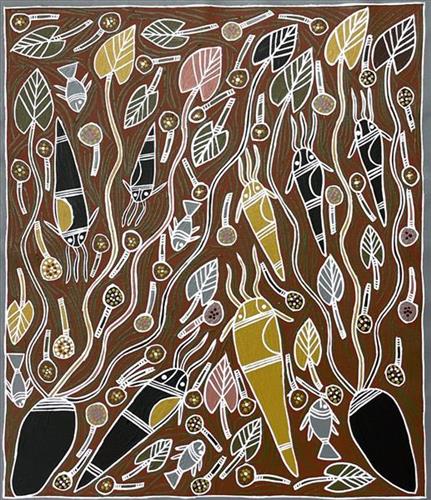
Buliya (catfish)

Buliya (catfish) are a favourite fish for Yolngu, They are often depicted amongst the waterlillies, leeches and natural debris such as leaves and reeds.


110682213266


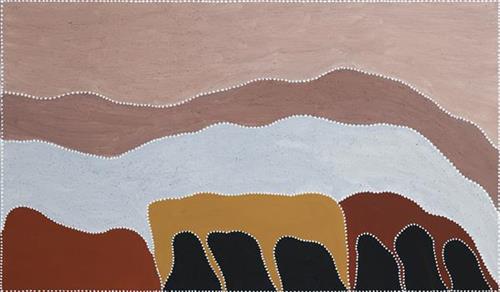
Birnoo Country- Lorraine Daylight

This is a painting of Birnoo Country – Birnoo is on what is now known as Alice Downs Station and belonged to Lorraine’s paternal grandmother.

Lorraine was taught to paint this Country by her father, Warmun artist Gordon Barney.

Gordon was a skilled stockman, horsebreaker and buckjumper and spent much of his early adulthood mustering cattle through this Country. As a result he was intimately familiar with Birnoo and would take his family, including Lorraine, out on to Country during holidays from station work.

As a result of these trips Lorraine learned of her father and grandmother’s Country and gradually began to paint it herself. Birnoo was also rich in ochre, so these trips could double as ochre collection trips, returning to Warmun with a fresh connection to Country and a renewed batch of ochre.


110682213251


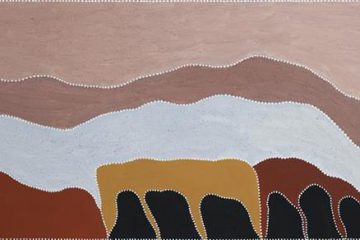
Birnoo Country- Lorraine Daylight

This is a painting of Birnoo Country – Birnoo is on what is now known as Alice Downs Station and belonged to Lorraine’s paternal grandmother.

Lorraine was taught to paint this Country by her father, Warmun artist Gordon Barney.

Gordon was a skilled stockman, horsebreaker and buckjumper and spent much of his early adulthood mustering cattle through this Country. As a result he was intimately familiar with Birnoo and would take his family, including Lorraine, out on to Country during holidays from station work.

As a result of these trips Lorraine learned of her father and grandmother’s Country and gradually began to paint it herself. Birnoo was also rich in ochre, so these trips could double as ochre collection trips, returning to Warmun with a fresh connection to Country and a renewed batch of ochre.


115682258881


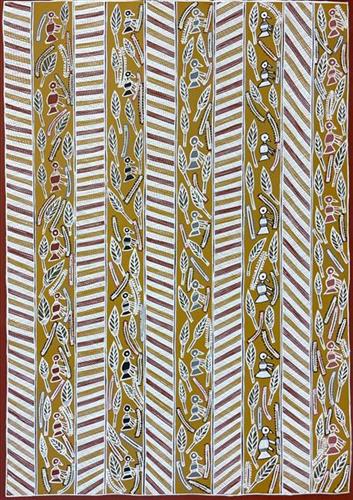
Lidjilidji (Crimson finches)

This artwork represents totemic finches. These birds herald the beginning of the dry season and are associated with the Ganalbingu clan. Lidji Lidji are also represented in ceremonial song and dance.

225682264719


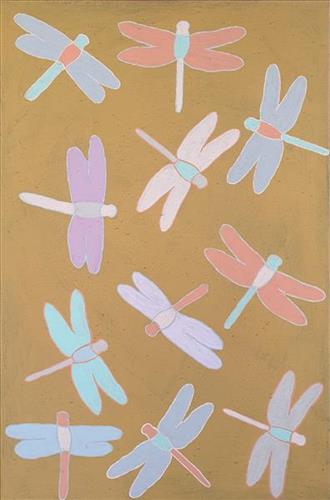
Bulbuji

I’m Kuku-Yalanji woman. My mum is from Wujal Wujal and my dad is from Laura, Chillagoe and Cooktown. For us Bama (Kuku-Yalanji people), we can’t touch bulbuji or wurarr-wurarr. They are sacred. Bulbuji start flying around once the rains come, they are also maja (boss) for bana (water) and the walkurr (water goanna).

After the rains come everything comes to life.  It’s the time when special plants flower and tell us to go hunting for different animals.  Everything is connected for us.  The plants and animals.  Everything.

377810582264727


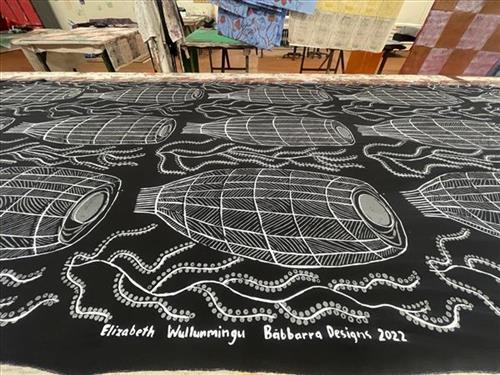
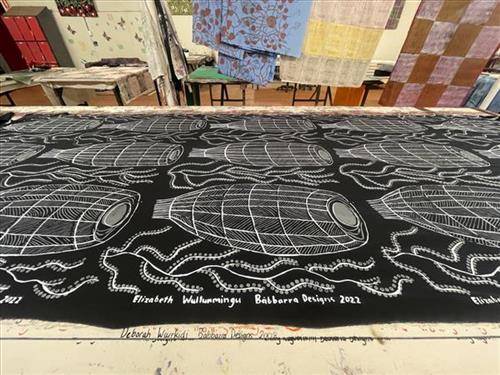
Au-gujechiya (fishtrap)

TITLE                          Au-gujechiya

YEAR                          2022

MEDIUM                     Screen print

DETAILS                    2 screen

Au-gujechiya  means  fishtrap in the Burrarra language which is one of the traditional  languages spoken in the Maningrida region. Elizabeth’s homeland is Gupanga, Arnhem Land which located on a saltwater estuary, a great place for catching fish.

Elizabeth obtained permission from her djunkay to create a screen print design about a historic object traditionally used to trap fish in rivers, creeks, and estuaries. 

In the early wet season, fish swim upstream for breeding in creeks and billabongs, then downstream to spend the dry season in larger rivers. The traps would be set to face the oncoming fish, with woven fencing either side. Within the mouth of the trap is a woven funnel that guides the fish in and prevents their escape. The clever design ensures that only adult fish are caught as smaller fish can escape through the weaving or even through the funnel. The fish that are caught can survive in the trap for up to two months. Once the trap is removed, the end is untied to remove the fish. This sustainable design means the trap can be used again and again. 

115682264724


Warraburnburn (spirit)

This carving is representational of a “ghost spirit”.  Yolngu lore says they are a lot like Yolngu, they like to live in the bush and go hunting and fishing with their families.

115682264723


Bapi (snake)

Aboriginal art in Ramingining, Central Arnhem Land is commonly illustrated through designs and images of animals, plants, and landscape. These motifs commonly reflect the artists ancestral inheritance and their dreamings and are referred to as totems.

For this painting a snake is depicted.