110682247826


Ant Hills – Tatum Rivers

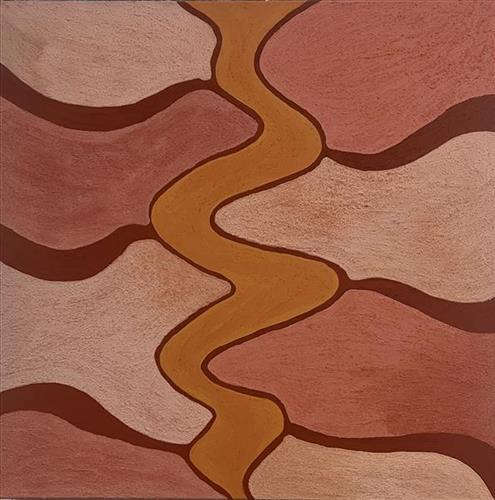
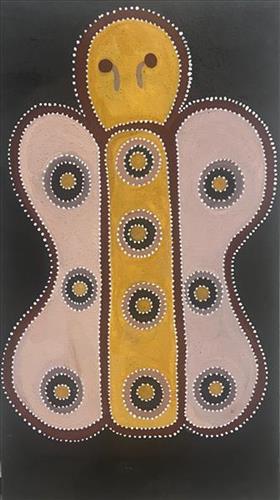
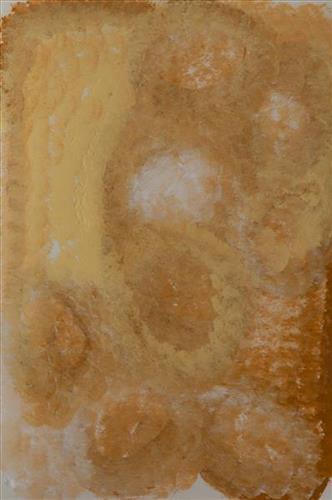
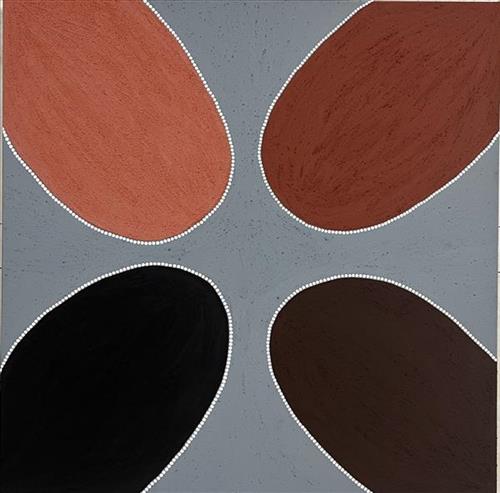
Tatum has found her voice recently painting these beautiful Ant Hills, at times framed as they are and at others whimsically sitting within an East Kimberley landscape. Depicted in the classic Warmun style but with a fresh new take and colour palate. Tatum was drawn to painting antills as they are significant to the Kimberley landscape but also because of their meaning to her and her family. 

Her ancestors were placed in anthills of a particular colour when they passed away as these helped the body to change swiftly from form to soil, and her Jaru family believe anthills are for healing. In this ritual you are “rubbed down using soil from the anthills, and after you wash it off you feel refreshed. This process will wash away any difficult or negative feelings and also heals sickness and colds.”

110682248854


Argyle Diamond Mind Rehab

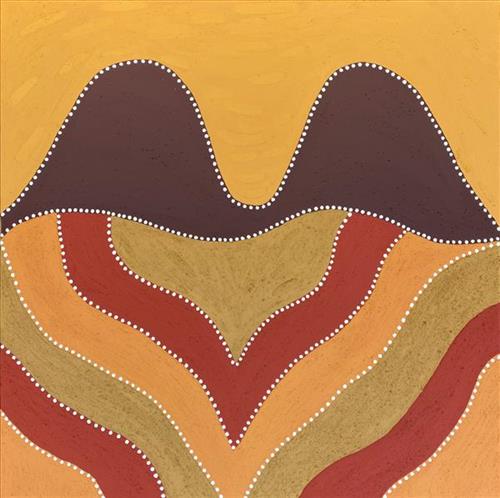
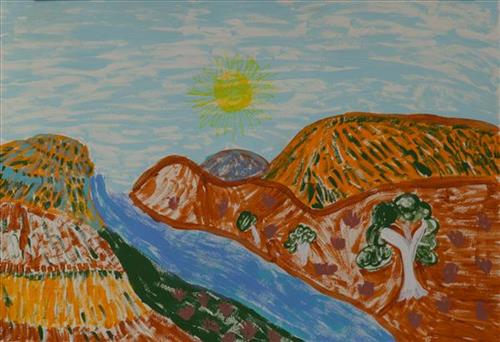
This painting is about the closure of Argyle mine – the right hand side depicts the devastation caused by the site, and the left hand side depicts how we would would like it to be rehabilitated for our future generations.

The current rehabilitation project started in 2020 and we can see some positive changes, however we know that our land will never be the same again.

110682248706


Kilkayi Barramundi Dreaming

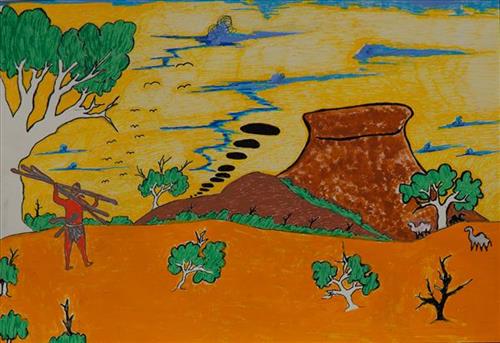
Three women trying to trap Dayiwul the great barramundi with spinifex nets. This is a traditional method of fishing where by nyiyirriny (river spinifex) is rolled and placed in the water forming a kind of net. Dayiwul was too clever for the women and jumped over the barrier they had laid.  She pushed her body through the rock of what is now called Pitt Range. The women gave up and walked to a place called Gawinyji (Cattle Creek) where they turned into rocks.
The scales of Dayiwul embedded in the rock, became the diamonds that are extracted from the Argyle Diamond Mine.

115682259663


Wagilag ga Wititj Dhawu (Wagilag Sisters and Olive Python Story)

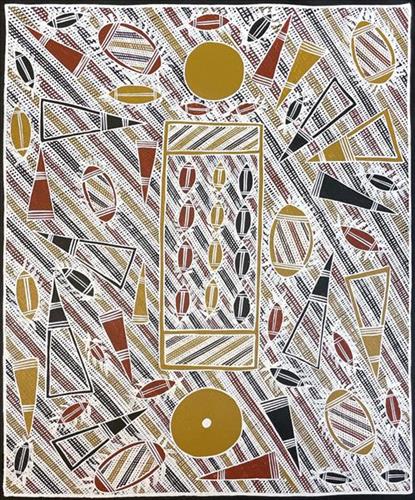
The Wagilag Sisters are central to the four important ceremonies of the Dhuwa moiety; the Djungguwan, the Gunabibi, the Ngulmarrk, and the Mandaialla.

The story is primarily an account of how, in the distant past, the two Wagilag Sisters came out of the southern interior and across the countryside to the Liyagalawumirr waterhole at Mirarrmina. There the younger sister profaned the pool of Wititj (the great Olive Python) by accidently allowing her blood to fall into the waterhole. Because of this, the women (and their children) were swallowed by Wititj.

All of the other sacred snakes stood up with their heads in the clouds and talked to each other with voices like thunder. The Pythons discovered that they had different languages and ‘skins’. Wititj confessed to eating the two women; his own moiety and fell to earth making a big depression in the ground. The big wind blew across the land making the first dry season. Wititj was ordered by the snakes to vomit the women and children back up. When he did this he also vomited up all the water from the waterhole, creating the monsoonal rains.

115682261301


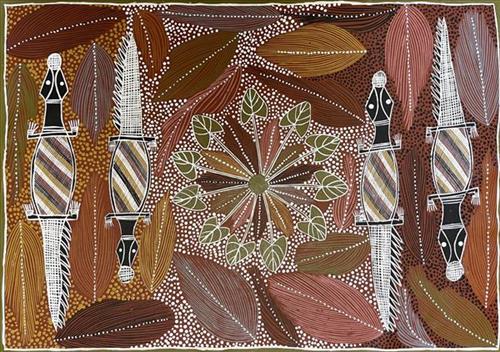
Baru Dhawu (Crocodile Story)

Baru (the crocodile man), was from the Gumatj clan. People usually call him Gurdu Gurdu or Baru which means crocodile. He lived his life at a place called Yirrkala. Living near him were other people, and when Baru didn’t have enough to eat he began to kill and eat these other people. After a while others noticed that some people were missing. When Baru went to the toilet, the people could smell this strong smell, so they knew that he ate the other people. Some men went to get help and they took message sticks to the other tribes. Some were sending smoke signals. When they came to Baru’s camp they started to spear him in the left side of his ribs. He dropped into the fire and burnt his left hand and maybe his right hand. He then ran into the bush and yelled to his countrymen – the animals, birds and fish that live on the land and in the sea. He stopped and he named the tribes and clans and also the places until he came to a place called Gamarru/Guyurru. There he took a rest and said to himself “This is where I stop and call this place Gamarru/Guyurru”. Baru, still in pain from the fire, then jumped into the water and turned himself into a crocodile. The fire left scars on his back. Baru paintings belong to Gumatj and Warrawarra and also the Marpi clan. This painting is used at death ceremonies or initiations and it normally is painted on the belly, which means the person the design is painted on is part of Gurdu Gurdu (the crocodile people).

110682262175


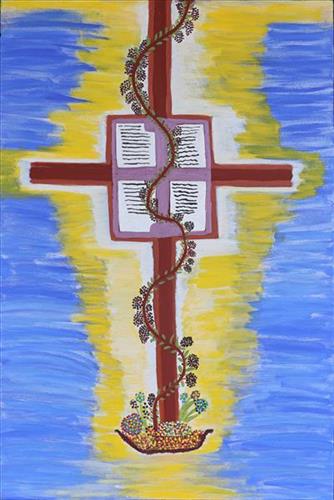
When I found Jesus- My spiritual journey by Kathy Ramsey

I, Kathy Ramsay during my younger years I’ve struggle with many things in life. nothing worked out the way I wanted it to be. i had a pretty rough and tough times, but I was always humble in my ways.

I was an alcoholic drink 7 days a week in town Kununurra, walking around dirty. i felt no one loved me. My love life was very bad. I used to swear bad but not my parents and brothers and sisters. I used to love them so much.

Until one day in the year of 1008, I lost my eldest son and became more sad for me. I felt like doing something bad to myself. But my Mum was always there for me, where ever I make a move to go somewhere, she would ask me and have someone to watch me, my family members.

Then I buried my son in Bow River.

Then on 2017 without knowing I felt something come over me. Spiritually I was led to a Bible reading. Church called the assembly of God, until I got born again, got Baptised and gave my heart and life to Jesus Christ Forever.

111582263446


Untitled

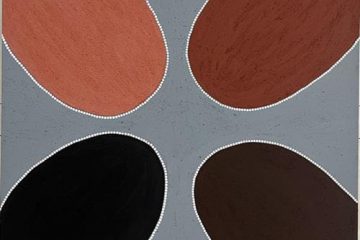
This is Bugai’s Country- her ‘ngurra’ (home Country, camp). People identify with their ngurra in terms of specific rights and responsibilities, and the possession of intimate knowledge of the physical and cultural properties of one’s Country. Painting ngurra, and in so doing sharing the Jukurrpa (Dreaming) stories and physical characteristics of that place, has today become an important means of cultural maintenance. 

Bugai’s ngurra encompasses the Country that she and her family walked in the pujiman (traditional, desert-dwelling) era. At this time Bugai travelled nomadically with her own and other family groups, most notably the Bidu family. The Country they traversed encompassed an enormous tract of land, with an aerial distance of more than 600 kilometres, from present day Balfour Downs Station to Kunawarritji (Canning Stock Route Well 33). Bugai was born at Pulkinya. She grew up, walked and hunted primarily around Parnngurr, Punmu, Kun Kun (Kuny-kuny) and Kunawarritji. As a young woman Bugai travelled with her husband through the Karlamilyi (Rudall River) region and up and down the Canning Stock Route, where she first met cattle drovers. She continued to live nomadically before eventually deciding to move to Jigalong Mission along with many other relatives following an extreme and prolonged drought in the 1960s. 

Portrayed in this work are features of Bugai’s ngurra, such as the striking salt lakes, dominant permanent red tali (sandhills), warta (trees, vegetation), and the individually named water sources Bugai and her family camped at. These include Parnngurr, Martilirri, Wangkakalu, Kurta-kurta (Camel Rock), Pimurlu, Jilkupuka (Canning Stock Route Well 21), Kaalpa (Canning Stock Route Well 23), Kartarru (Canning Stock Route Well 24), Wantili (Warntili, Canning Stock Route Well 25), Tiwa (Canning Stock Route Well 26), Partujarrapirri, Raarki (Canning Stock Route Well 27), Wuranu (Canning Stock Route Well 29), Juntu- juntu (Canning Stock Route Well 30), and Kunawarritji. Rock holes, waterholes, soaks and springs were all extremely important sites for Martu people during the pujiman period, and are generally depicted with circular forms. 

The encyclopaedic knowledge of the location, quality and seasonal availability of the hundreds of water bodies found in one’s Country sustained Martu as they travelled across their Country, hunting and gathering, visiting family, and fulfilling ceremonial obligations. They would traverse very large distances annually, visiting specific areas in the dry and wet season depending on the availability of water and the corresponding cycles of plant and animal life on which hunting and gathering bush tucker was reliant. As they travelled and hunted they would also burn areas of Country, generating a greater diversity of plant and animal life.
111582263445


Untitled

This work portrays an area known to the artist, painted here from memory. During the pujiman (traditional, desert dwelling) era one’s survival depended on their intimate knowledge of the location of resources; thus physical elements of Country, such as sources of kapi (water), tali (sandhills), and different varieties of warta (trees, vegetation) were carefully observed and remembered. Today, this relationship with Country remains equally strong, despite the movement of Martu out of the desert and into remote Aboriginal communities, towns and cities.

Also visible may be traces of life cycles based around kalyu (rain, water) and waru (fire). A thousands of year old practice, fire burning continues to be carried out as both an aid for hunting and a means of land management today. As the Martu travelled and hunted they would burn tracts of land, ensuring plant and animal biodiversity and reducing the risk of unmanageable, spontaneous bush fires. The patchwork nature of regrowth is visible in many landscape works, with each of the five distinctive phases of fire burning visually described with respect to the cycle of burning and regrowth.  

Finally, metaphysical information relating to a location may also be recorded; Jukurrpa (Dreaming) narratives chronicle the creation of physical landmarks, and can be referenced through depictions of ceremonial sites, songlines, and markers left in the land. 

111582263444


Untitled

This work portrays an area known to the artist, painted here from memory. During the pujiman (traditional, desert dwelling) era one’s survival depended on their intimate knowledge of the location of resources; thus physical elements of Country, such as sources of kapi (water), tali (sandhills), and different varieties of warta (trees, vegetation) were carefully observed and remembered. Today, this relationship with Country remains equally strong, despite the movement of Martu out of the desert and into remote Aboriginal communities, towns and cities.

Also visible may be traces of life cycles based around kalyu (rain, water) and waru (fire). A thousands of year old practice, fire burning continues to be carried out as both an aid for hunting and a means of land management today. As the Martu travelled and hunted they would burn tracts of land, ensuring plant and animal biodiversity and reducing the risk of unmanageable, spontaneous bush fires. The patchwork nature of regrowth is visible in many landscape works, with each of the five distinctive phases of fire burning visually described with respect to the cycle of burning and regrowth.  

Finally, metaphysical information relating to a location may also be recorded; Jukurrpa (Dreaming) narratives chronicle the creation of physical landmarks, and can be referenced through depictions of ceremonial sites, songlines, and markers left in the land.