377816182261311


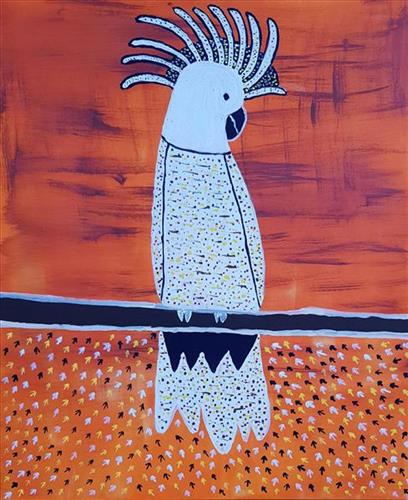
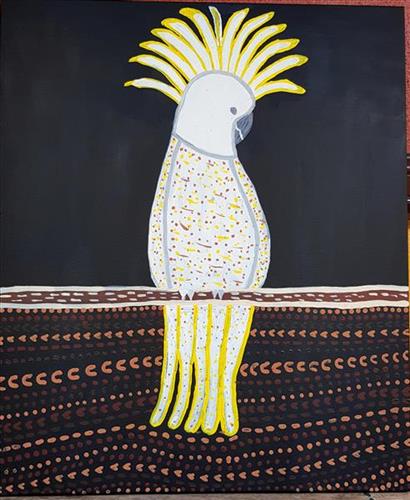
Birmba

Birmba, the white cockatoo is a cheeky bird. Stealing fruit all the time.

In our culture some birds are messengers. In our lore Birmba brings us news.

My mothers Bubu is the Shipton Flat/Helenvale area.

I love taking family to our bubu, fishing and hunting for food and having a fire with damper.

377816182261310


Birmba

Birmba, the white cockatoo is a cheeky bird. Stealing fruit all the time.

In our culture some birds are messengers. In our lore Birmba brings us news.

My mothers Bubu is the Shipton Flat/Helenvale area.

I love taking family to our bubu, fishing and hunting for food and having a fire with damper.

115682258886


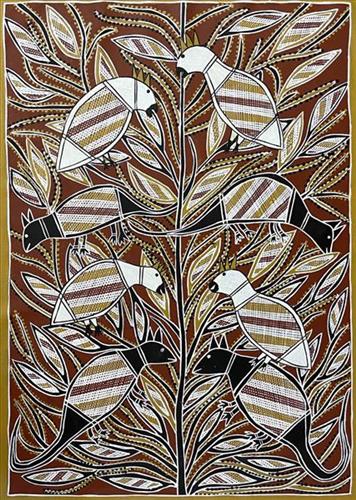
Lorrpu ga Marrngu in the Mayku tree

This painting depicts Lurrpu (Sulphur-crested cockatoo) and Marrngu (possum) in a Mayku Tree (Paper Bark Tree) and is a song line for the Gupapuyngu people. In the song line the Lurrpu feed on nuts and seeds of the Mayku Tree across the vast landscapes of Arnhem Land.

115682258880


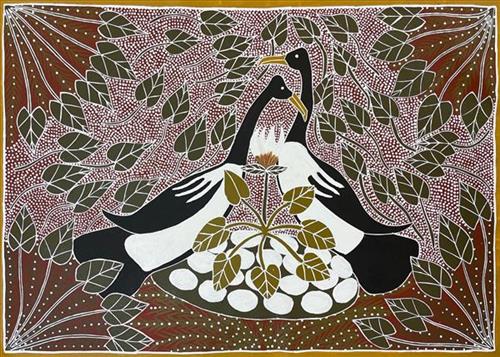
Gumang (Magpie Geese)

The Yolngu people of Arnhem Land originate from a spiritual source, fixed in a particular place in their land or the sea. These ‘Spiritual Reservoirs’ are often in the form of special waterholes made by Wangarr (Creative Beings) long ago close to the beginning of time.

The creator beings moved across the country side, shaping the land and implanting in each tract of country, the spiritual life force for the people who were to own it. These Creative Spirits took many forms. When they gave the land to each group they also gave songs, dances, ceremony, the associated laws and language. The Creation story for Ganalbingu people took place near the middle section of the Glyde River where it becomes the Goyder River. Their land, Ngaliyindi, sits astride the Arafura Swamp in Central Arnhem Land.

In this painting, the artist has depicted Gumang (magpie geese), which are sacred to the Ganalbingu people. To the east of the Arafura Swamp is a freshwater billabong which is said to have been made by the Goose Spirit and is in the shape of a goose nest. As a result, geese, their eggs and their nests are sacred.

115682260161


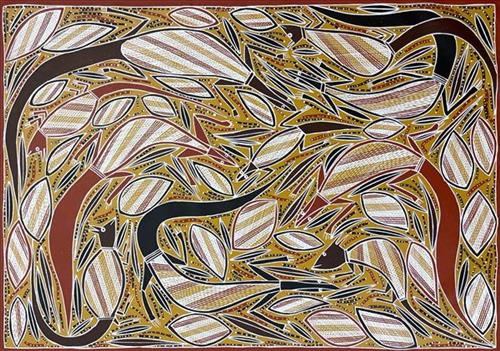
JB Fisher – Djanda (lizard)

JB paints stories from his Dhuwa homeland in northeast Arnhem Land. Stories are passed on either paternally or maternally and JB would have learnt these stories from his ancestors. The cross-hatching style (Rrark) is a traditional painting style of this area and can represent elements such as water, air and wind.

His paintings often feature totemic animals of the fresh waters of North East Arnhem Land.

111982260112


Yawkyawk

Yawkyawk is a word in the Kunwinjku/Kunwok language of Western Arnhem Land meaning ‘young woman’ and ‘young woman spirit being’. The different groups of Kunwinjku people (one of the Eastern dialect groups call themselves Kuninjku) each have Yawkyawk mythologies, which relate to specific locations in clan estates. These mythologies are represented in bark paintings and sculptures of Yawkyawk beings. There are also a few examples of rock art images of these beings.
The female water spirits Yawkyawk or Ngalkunburriyaymi are perhaps the most enigmatic of mythological themes. Sometimes compared to the European notion of mermaids, they exist as spiritual beings living in freshwater streams and rock pools, particularly those in the stone country. The spirit Yawkyawk is usually described and depicted with the tail of a fish. Thus the Kuninjku people sometimes call them ngalberddjenj which literally means ‘the young woman who has a tail like a fish’. They have long hair, which is associated with trailing blooms of green algae (called man-bak in Kuninjku). At times they leave their aquatic homes to walk about on dry land, particularly at night.
Aboriginal people believe that in the beginning most animals were humans. During the time of the creation of landscapes and plants and animals, these ancestral heroes in human form transmutated into their animal forms via a series of various significant events now recorded as oral mythologies. The creation ancestor Yawkyawk travelled the country in human form and changed into the form of Ngalkunburriyaymi as a result of various ancestral adventures. Today the Kuninjku believe that Ngalkunburriyaymi are alive and well and living in freshwater sites in a number of sacred locations.
Some features of a respective country are equated with body parts of Yawkyawk. For example a bend in a river or creek may be said to be ‘the tail of the Yawkyawk, a billabong may be ‘the head of the Yawkyawk and so on. Thus different groups can be linked together by means of a shared mythology featured in the landscape, which crosscuts clan and language group boundaries.

111582260379


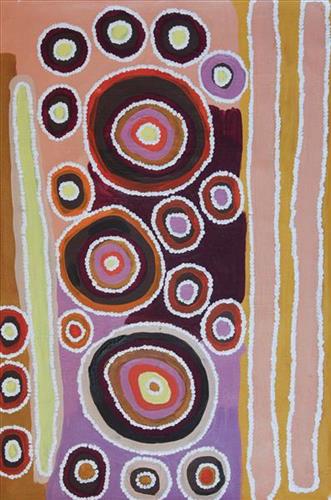
Partjanta

“Katjarra’s  [Katjarra Butler] ngurra (home Country, camp). Birthplace. [It is] sandhill country. Rockhole, little bit of rocks. And in the sandhill, there is a jurnu (soakwater). They take that water, come out [of the soakwater]. Partjanta the name of that jurnu. Main one. She [Katjarra Butler] been go jina [foot, walking]. Early days. Walking [to] Kintore, Papunya.”

“I’m painting my grandmother’s country, her way. Katjarra style.”

-Sharon Porter

This site forms part of Sharon’s ngurra (home Country, camp) through her grandmother, Katjarra Butler. Located east of Kiwirrkurra and on Pintupi country.

The Western Desert term ‘ngurra’ is hugely versatile in application. Broadly denoting birthplace and belonging, ngurra can refer to a body of water, a camp site, a large area of Country, or even a modern house. People identify with their ngurra in terms of specific rights and responsibilities, and the possession of intimate knowledge of the physical and cultural properties of one’s Country. This knowledge is traditionally passed intergenerationally through family connections. Country for Martu is full of memory; not just the memory of their own movement through it, but also of their family. As summarised by Ngalangka Nola Taylor, “painting the ngurra, they do it to remember their connections.”

Painting ngurra, and in so doing sharing the Jukurrpa (Dreaming) stories and physical characteristics of that place, has today become an important means of cultural maintenance. Physical maintenance of one’s ngurra, like cultural maintenance, ensures a site’s wellbeing, and is a responsibility of the people belonging to that area. 

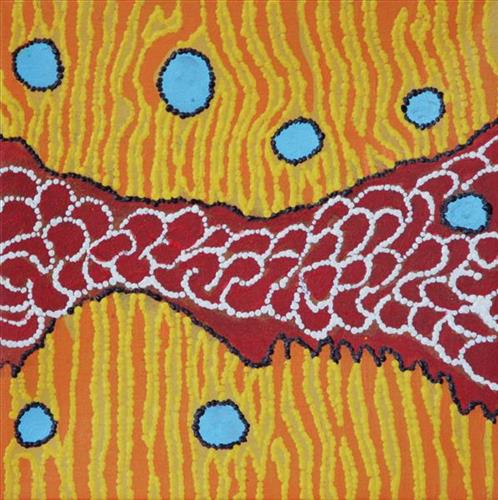
This work depicts a yinta (permanent spring) within the artists’ ngurra (home Country, camp), typically depicted with circular forms. Yinta provided a reliable source of water and were traditionally used as camping sites throughout the year.

During the pujiman (traditional, desert dwelling) period, knowledge of water sources was critical for survival, and today Martu Country is still defined in terms of the location and type of water. Each of the hundreds of claypans, rockholes, waterholes, soaks and springs found in the Martu desert homelands is known through real life experience and the recounting of Jukurrpa (Dreaming) narratives by name, location, quality and seasonal availability. This encyclopedic knowledge extends even to the nature and movement of arterial waterways, and sustained Martu as they travelled across their Country, hunting and gathering, visiting family, and fulfilling ceremonial obligations. They would traverse very large distances annually, visiting specific areas in the dry and wet season depending on the availability of water and the corresponding cycles of plant and animal life on which hunting and gathering bush tucker was reliant.
111582260377


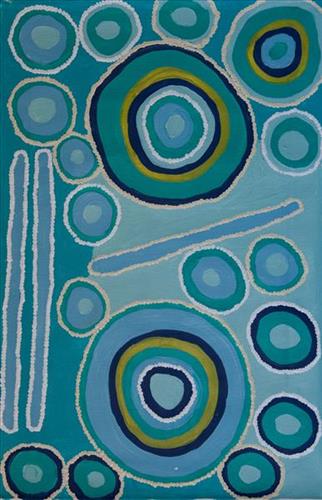
Partjanta

“Katjarra’s  [Katjarra Butler] ngurra (home Country, camp). Birthplace. [It is] sandhill country. Rockhole, little bit of rocks. And in the sandhill, there is a jurnu (soakwater). They take that water, come out [of the soakwater]. Partjanta the name of that jurnu. Main one. She [Katjarra Butler] been go jina [foot, walking]. Early days. Walking [to] Kintore, Papunya.”

“I’m painting my grandmother’s country, her way. Katjarra style.”

-Sharon Porter

This site forms part of Sharon’s ngurra (home Country, camp) through her grandmother, Katjarra Butler. Located east of Kiwirrkurra and on Pintupi country.

The Western Desert term ‘ngurra’ is hugely versatile in application. Broadly denoting birthplace and belonging, ngurra can refer to a body of water, a camp site, a large area of Country, or even a modern house. People identify with their ngurra in terms of specific rights and responsibilities, and the possession of intimate knowledge of the physical and cultural properties of one’s Country. This knowledge is traditionally passed intergenerationally through family connections. Country for Martu is full of memory; not just the memory of their own movement through it, but also of their family. As summarised by Ngalangka Nola Taylor, “painting the ngurra, they do it to remember their connections.”

Painting ngurra, and in so doing sharing the Jukurrpa (Dreaming) stories and physical characteristics of that place, has today become an important means of cultural maintenance. Physical maintenance of one’s ngurra, like cultural maintenance, ensures a site’s wellbeing, and is a responsibility of the people belonging to that area. 

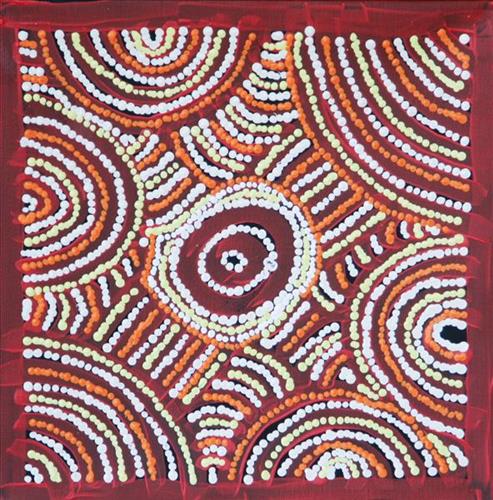
This work depicts a yinta (permanent spring) within the artists’ ngurra (home Country, camp), typically depicted with circular forms. Yinta provided a reliable source of water and were traditionally used as camping sites throughout the year.

During the pujiman (traditional, desert dwelling) period, knowledge of water sources was critical for survival, and today Martu Country is still defined in terms of the location and type of water. Each of the hundreds of claypans, rockholes, waterholes, soaks and springs found in the Martu desert homelands is known through real life experience and the recounting of Jukurrpa (Dreaming) narratives by name, location, quality and seasonal availability. This encyclopedic knowledge extends even to the nature and movement of arterial waterways, and sustained Martu as they travelled across their Country, hunting and gathering, visiting family, and fulfilling ceremonial obligations. They would traverse very large distances annually, visiting specific areas in the dry and wet season depending on the availability of water and the corresponding cycles of plant and animal life on which hunting and gathering bush tucker was reliant.
111582260367


Around Kinyu (Canning Stock Route Well 35)

“That flat hill. You can see it when you climb up to [the Kunawarritji] airport. This one here, this the main place. This is where Manyjilyjarra people start. The dreaming is right here. Kinyu (Well 34, Canning Stock Route). When people are sick they just go here [to Kinyu). Sleep, they get better. They don’t go right in, they just go there and sleep, healing.”

-Nigel Neech

Kinyu (Canning Stock Route Well 35) is a small yinta (permanent spring) that was a popular camping ground during the pujiman (traditional, desert dwelling) era. The site is home to the ancestral mother dingo, who is both a generous provider and fierce protector of her Martu countrymen. Kinyu is so revered that the site and its associated ancestral being are often deferentially referred to as jarntu (dog) in place of uttering the actual name. The site is believed to possess healing and magical powers, and children born here are said to inherit these same powers.

During the Jukurrpa (Dreaming), Kinyu was the home for a family of dingoes; a mother, father, and their litter of pups. Originally the family had travelled to Wirlarra, following the call of the moon. At Wirlarra the moon cared for them and created a windbreak for the family to shelter. The dingoes stayed for a time at Wirlarra, scratching into the earth to create several distinctive small salt water pools which are still visited by the Martu for their healing properties. After a time, the dingoes continued travelling eastward toward the rising moon until they reached Kinyu, where they remained until all of the dingo pups had grown up. From Kinyu the family travelled further east. 

The intersection of the Canning Stock Route with Kinyu also made this a site of early contact with Europeans for many Martu then living a pujiman life in the desert. Following the route’s construction, Martu encountered Europeans and other Martu working as cattle drovers as they would travel up and down the Stock Route from water source to water source. Increasingly, pujimanpa (desert dwellers) followed the route to newly established ration depots, mission and pastoral stations. They were drawn to the route in search of food, by a sense of curiosity, or by loneliness. By the late 1950s and early 1960s, most of the desert family groups had left the desert. Eventually, these factors combined with an extreme and prolonged drought in the 1960s to prompt the few remaining pujimanpa to move in from the desert.


111582260369


All the mima (women) -Sharon Porter

The site depicted in this work, situated to the east of Kiwirrkurra and on Pintupi Country, forms part of Sharon’s ngurra (home Country, camp) through her grandmother, Katjarra Butler. Katjarra shared with Sharon the jukurrpa (dreaming) story for this area. This narrative describes how a distinctive group of rocks located here came to be formed by “all the mima (women) sitting down next to two rocks and one rockhole. They was eating bush tucker, yellow berries, and they was drinking water from one rockhole. They was in one place, and they was eating a big round one, that yellow berry. They was looking round and round for more. They never went, they stayed sitting in one place. They still there, they turned into rocks there.” (Sharon Porter)

The term Jukurrpa is often translated in English as the ‘dreaming’, or ‘dreamtime’. It refers generally to the period in which the world was created by ancestral beings, who assumed both human and nonhuman forms. These beings shaped what had been a formless landscape; creating waters, plants, animals, and people. At the same time they provided cultural protocols for the people they created, as well as rules for interacting with the natural environment. At their journey’s end, the ancestral beings transformed themselves into important waters, hills, rocks, and even constellations.