115682258627


Woven Mat

Traditionally, Nganiyal (conical mats) were used as an insect screen when erected, and as a sitting mat when folded. They are used in Ceremony as well as a functional item. 

Nowadays, artists weave many different shapes including flat, round and oblong. 

115682258626


Woven Mat

Traditionally, Nganiyal (conical mats) were used as an insect screen when erected, and as a sitting mat when folded. They are used in Ceremony as well as a functional item. 

Nowadays, artists weave many different shapes including flat, round and oblong. 

116482258646


Our Country (The Pilbara)

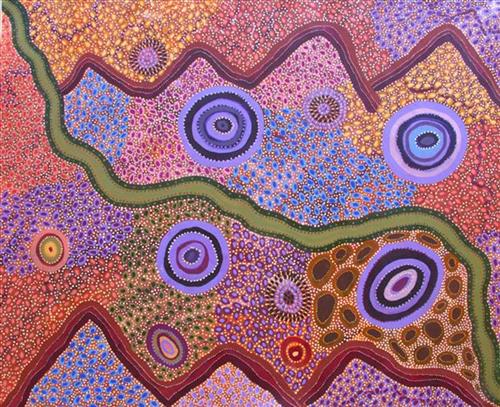
The Pilbara is the country where we the Yindjibarndi people live and share many of our Cultural stories and history that have been passed onto us by our ancestors, of how they used to walk through the flat country we call the (Table Lands) visiting family members at nearby stations. Our country has so much to offer. Bush foods and medicine as well as animal like Kangaroo, Emu, Goanna and Turkey. When the rains come our rivers are full and we all love to go out and spend the day fishing. We are also close to the ocean,so we often go fishing there as well. During the holidays many of our families go bush to enjoy what the country offers the beauty of our country we see through our eyes wildflowers blooming as nature takes its course. Our country is still full of riches it always gives me joy to be a part of it we are connected to our land it is a part of who we are.

116482258645


Pilbara Iron Ore Hills

At golden hour, when driving through the country, the iron ore in the Pilbara Hills glows and glimmers in the sunlight. I’ve captured this glimmer with copper paint in my work.

116482258644


Wildflower Patch

In spring I can never get over the beauty of these purple, Mulla Mulla’s when they are in bloom along with the other yellow, pink and white flowers, and the yellow Blue Gum flower. It’s like a beautiful garden that you never have to water.

111982258641


An-gujechiya (Fish Trap)

To make fish traps and fish net fences artists firstly get vine (mirlarl) from the jungle and they put it in water for one night to make it soft. Next they start weaving it; they make rings for the inside to keep the fish trap’s shape. Artists work for three or four weeks on the fish trap. They also make string from kurrajong (burdaga) to attach the hibiscus (bardainy) rings and to tie the conical end of the fish trap. This fish trap is used in saltwater and freshwater. People also use fish net fences called mun-dirra. A long time ago they would put the mun-dirra across rivers and creeks. In the middle they would place the an-gujechiya. They also used small things like sticks, rocks, mud and grass to block the fish from going through. People would then catch fish like saltwater barramundi rajarra, freshwater barramundi (janambal), small black freshwater catfish (buliya), bonefish (an-guwirrpiya), and sand bass (dalakan) in these fish traps.

111982258639


Mat

Mats can vary greatly. Artists commonly use a mix of naturally dyed and undyed fibre to create a striking variation of coloured bands. Some artists also incorporate different types of looping to produce different patterns and textured finishes. Each type of mat, fibre bag, basket and dilly bag has its own name in the various languages spoken in the Maningrida region.

111982258638


Mat

Mats can vary greatly. Artists commonly use a mix of naturally dyed and undyed fibre to create a striking variation of coloured bands. Some artists also incorporate different types of looping to produce different patterns and textured finishes. Each type of mat, fibre bag, basket and dilly bag has its own name in the various languages spoken in the Maningrida region.

111982258637


Mat

Mats can vary greatly. Artists commonly use a mix of naturally dyed and undyed fibre to create a striking variation of coloured bands. Some artists also incorporate different types of looping to produce different patterns and textured finishes. Each type of mat, fibre bag, basket and dilly bag has its own name in the various languages spoken in the Maningrida region.

111982258636


Wak Wak

This painting depicts a sacred site at ‘Kurrurldul’, an outstation south of Maningrida.

The ‘rarrk’, or abstract crosshatching, on this work represents the design for the crow totem ancestor called ‘Djimarr’. Today this being exists in the form of a rock, which is permanently submerged at the bottom of Kurrurldul Creek. The ‘Djimarr’ rock in the stream at Kurrurldul is said to move around and call out in a soft hooting tone at night. Both the stone itself and the area around it are considered sacred.

The imagery represents the rock mentioned above at the bottom of Kurrurldul creek, which is the final transmutation of the dreaming ancestor ‘Djimarr’. Finally, the pattern used here is also the crow design used in the sacred ‘Mardayin’ ceremony, which is a large regional patri-moiety ceremony now rarely conducted in central and eastern Arnhem Land.