Joomooloony (Boab tree)
Joomooloony (he Kimberley Boab tree), through all the different seasons and colours. Some of the Boabs are burnt, some with nuts and some green and dry.
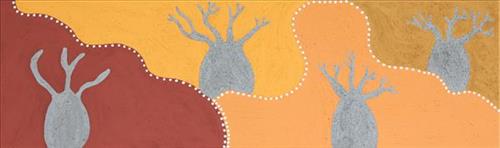
Joomooloony (he Kimberley Boab tree), through all the different seasons and colours. Some of the Boabs are burnt, some with nuts and some green and dry.
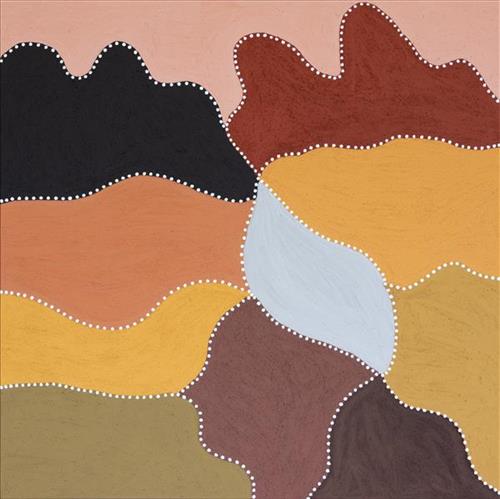
“Goorra-goorran Country is my grandfather’s Country – Sandy Thomas. This painting represents a special waterhole way out there; the bright section in the middle is special healing water.
“In the early days you would go and drink it when you’re feeling sick or sore. The animals could be healed by drinking the water too. If they have broken legs even.
Goorra-goorran Country spans from Violet valley and up past Warmun and out around Bow River; and this waterhole is a long way out in that country. Nowadays you can only get there via helicopter.
I hope to get there one day soon.”
Madeline Purdie
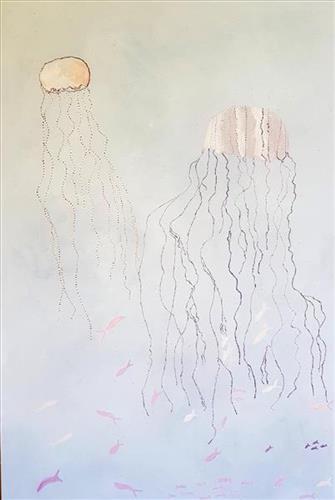
I am a Jalanji saltwater woman. Jalanji people have lots of stories about the reef. My painting’s story is about Mili (stinging jellyfish) stirring out on the reef.
We were taught at a young age to watch out because these mili sting and can be very dangerous. There are special plants that we can use on mili stings. Our elders passed on this knowledge to us.
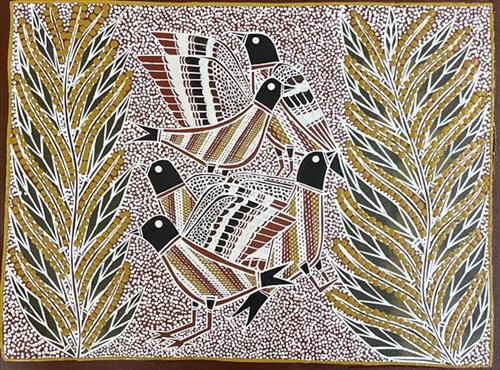
This artwork represents totemic finches. These birds herald the beginning of the dry season and are associated with the Ganalbingu clan. Lidji Lidji are also represented in ceremonial song and dance.
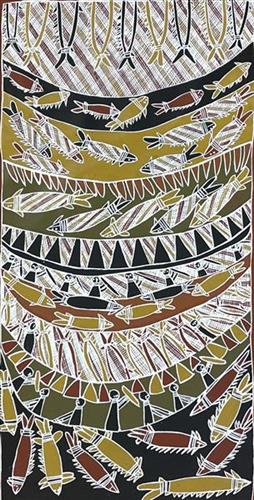
This is a story from the old times, about how Yolngu ancestors used to live. Here the men are in the Arafura Swamp, catching the fish with a drag net, through the flooded plains and into the fish trap.
Eggs are very important to Yolngu people. They are very common in the bush from both birds and reptiles such as magpie geese, lizards, turtles and crocodiles. They are used in ceremony and a food source.
The artists in Ramingining paint designs and images of animals, plants, and landscape. These motifs commonly reflect the artists ancestral inheritance and their totems and dreamings.
Traditionally, Nganiyal (conical mats) were used as an insect screen when erected, and as a sitting mat when folded. They are used in Ceremony as well as a functional item.
Nowadays, artists weave many different shapes including flat, round and oblong.
The Yolngu people of Arnhem Land originate from a spiritual source, fixed in a particular place in their land or the sea. These ‘Spiritual Reservoirs’ are often in the form of special waterholes made by Wangarr (Creative Beings) long ago close to the beginning of time.
The creator beings moved across the country side, shaping the land and implanting in each tract of country, the spiritual life force for the people who were to own it. These Creative Spirits took many forms. When they gave the land to each group they also gave songs, dances, ceremony, the associated laws and language. The Creation story for Ganalbingu people took place near the middle section of the Glyde River where it becomes the Goyder River. Their land, Ngaliyindi, sits astride the Arafura Swamp in Central Arnhem Land.
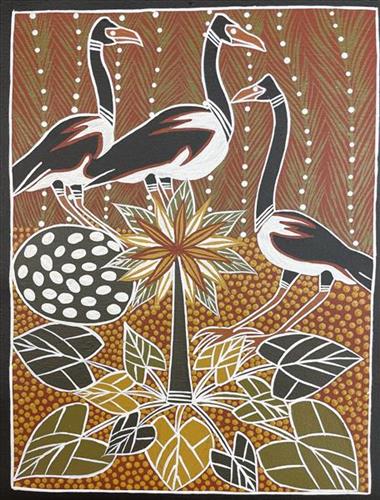
In this painting, the artist has depicted Gumang (magpie geese), which are sacred to the Ganalbingu people. To the east of the Arafura Swamp is a freshwater billabong which is said to have been made by the Goose Spirit and is in the shape of a goose nest. As a result, geese, their eggs and their nests are sacred.

The striking yellow – gold hue comes from the root of the man-kurdudjumuk plant (coelospermum reticulatum) which has been harvested from the sandy country near the flood plains. This laborious and tiring process requires digging up the entire shrub. The root is shaven into a pot of water and the colour is released into water through the boiling process.
How did you get to this style of painting?
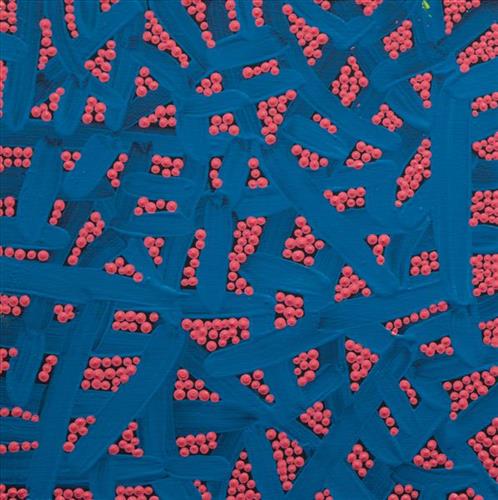
“Do you mean, what have I done with my life? (chuckles to herself) To me these paintings are a sense of energy. So if I see someone and they’re happy, I paint a happy vibe. Cos their spirit is happy. And sometimes it’s hard because on the outside they’re real happy but on the inside they’re real sad. Sometimes you do stuff (like a painting) and it adds up later on. But I still don’t know what it means and don’t know where my style comes from because it’s both the path I walk on and the cracks in the dirt. It’s like looking at a landscape but I haven’t been there yet. Maybe I’ll get there one day. I believe things happen for a reason.”
– Sylvia Wilson