111982267765


Mat

Mats can vary greatly. Artists commonly use a mix of naturally dyed and undyed fibre to create a striking variation of coloured bands. Some artists also incorporate different types of looping to produce different patterns and textured finishes. Each type of mat, fibre bag, basket and dilly bag has its own name in the various languages spoken in the Maningrida region.

111982267764


Mat

Mats can vary greatly. Artists commonly use a mix of naturally dyed and undyed fibre to create a striking variation of coloured bands. Some artists also incorporate different types of looping to produce different patterns and textured finishes. Each type of mat, fibre bag, basket and dilly bag has its own name in the various languages spoken in the Maningrida region.

111982267763


Warraburnburn

In Burarra and Gun-nartpa languages the figure represented in this artwork is generally known as a wangarra ‘ghost spirit’. For the Warrawarra clan ghost spirits have their own particular characteristics and their own name – Warraburnburn.

The Warraburnburn and the closely related Galabarrbarr spirit (owned by the Balkarranga clan) are also manikay song topics.  The spirits are related to each other as maternal grandparent and grandchild, just as the people of Warrawarra and Balkarranga are. The dancing of the two ghost spirit figures forms the finale performance for funerals, and is the final goodbye to a deceased family member.

In many ways the Warraburnburn and Galabarrbarr ghost spirits are like people. They emerge from the patches of jungle on Warrawarra and Balkarranga country in the late afternoon and go hunting in family groups of men, women and children. They stay in contact with each other by calling out as the men hunt for fish and the women walk with their dillybags looking for vegetable food. 

The ghost spirits are associated closely with white ochre and artists commonly paint the bodies of carved figures in white. Different types of ghost spirit wear different patterns. Warraburnburn is decorated with uniform white dots while others are painted white all over. Some ghost spirits are shown with a design painted on their chest infilled with rarrk ‘cross-hatching’, the same designs that are painted onto japi an-guyinda ‘male initiations’. 

They also have supernatural characteristics including superhuman size (jarra anbaykarda ‘super tall’). They know the country intimately – some are malevolent towards humans and will lead people astray, taking them to unfamiliar and dangerous places. These malevolent spirits are likened to an-muburda ‘sorcerers’ and can conduct dangerous rituals that cause harm to people. Others are benign and will lead humans back to familiar paths and their own camps.
 

110682259625


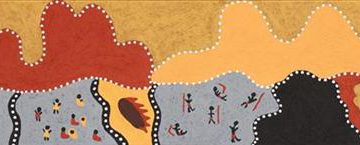
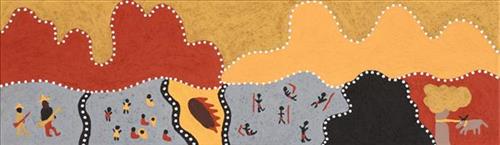
Mistake Creek Massacre – Madeline Purdie

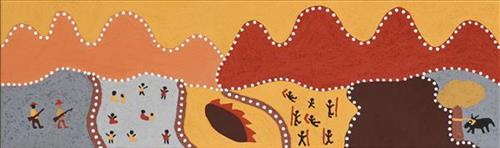
“This story what my old people told me. They told me that they were sleeping here now in this building. Old mister Radigan he as a policeman, white gardier policeman, white man. He was living in this house in the art centre (what’s known the green house). He was the sergeant and he had an employee, this employee was an aboriginal employee from Darwin somewhere. Somewhere that side, NT and this employee for him he went to mistake creek there, where this mob bin having their holiday camp. Everybody used to come to gather from different area out there and holiday camp there. At mistake creek they was having it this time. And all my old people ancestors and anyway… that employee for my Radigan bin trying have an affair with one of these ladies and she said no I already got husband, so he took a sulk. He got angry that she didn’t want to have an affair with him, so he took that pet cow – the police, they had a pet cow with a big bell on it. He took it long way behind that hill and hide it, he tied it up to a tree and he took the bell off the cow and bought it back to sergeant and he said “My boss look here them people there at that holiday camp la mistake creek here them kill you cow and they cooking it up!” but they was cooking kangaroo. They had kangaroo covered up. And he bin go and tell this boss liar and this boss and ‘im bin go back and shoot all them people there… at mistake creek they just go an kill the lot. And they was waiting for their dinner to be cook. Then after he killed them he opened them thing to find that they was cooking five kangaroo’s in there, all that kangaroo. And so all that thing now they just chucked them in the fire. Burnt them. Burnt all the remains for our people them old people that them kill.” – Madeline Purdie

110682259623


Mistake Creek Massacre – Madeline Purdie

“This story what my old people told me. They told me that they were sleeping here now in this building. Old mister Radigan he as a policeman, white gardier policeman, white man. He was living in this house in the art centre (what’s known the green house). He was the sergeant and he had an employee, this employee was an aboriginal employee from Darwin somewhere. Somewhere that side, NT and this employee for him he went to mistake creek there, where this mob bin having their holiday camp. Everybody used to come to gather from different area out there and holiday camp there. At mistake creek they was having it this time. And all my old people ancestors and anyway… that employee for my Radigan bin trying have an affair with one of these ladies and she said no I already got husband, so he took a sulk. He got angry that she didn’t want to have an affair with him, so he took that pet cow – the police, they had a pet cow with a big bell on it. He took it long way behind that hill and hide it, he tied it up to a tree and he took the bell off the cow and bought it back to sergeant and he said “My boss look here them people there at that holiday camp la mistake creek here them kill you cow and they cooking it up!” but they was cooking kangaroo. They had kangaroo covered up. And he bin go and tell this boss liar and this boss and ‘im bin go back and shoot all them people there… at mistake creek they just go an kill the lot. And they was waiting for their dinner to be cook. Then after he killed them he opened them thing to find that they was cooking five kangaroo’s in there, all that kangaroo. And so all that thing now they just chucked them in the fire. Burnt them. Burnt all the remains for our people them old people that them kill.” – Madeline Purdie

110682259574


Goorlabal Ngarranggarni – Marlene Juli

This work is inspired by a Ngarranggarni (Dreaming) story about Goorlabal the Serpent.

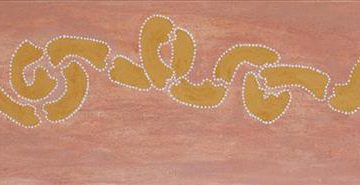
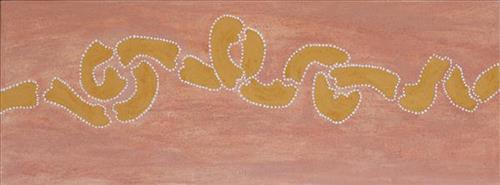
In the Ngarranggarni, Goorlabal travelled from One Mile in search of water. He found water in the Springvale River. He rolled on his back in the water because he was over-heated. He turned into stone and is still there today.

Goorlabal protects the waterways near Warmun, and this work shows the waterways entwined with the vertebrae of Goorlabal.

110682262169


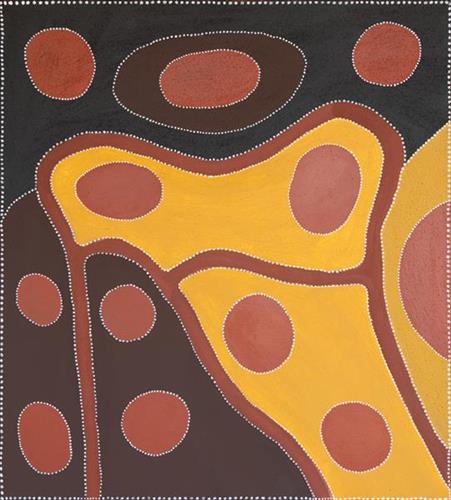
NUGUWARRDING (Snake Dreaming) – Tommy Carroll

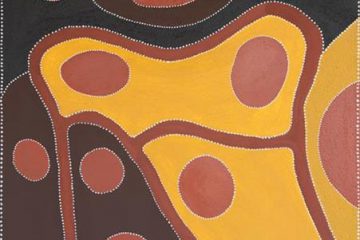
This painting tells a story about NUGUWARRDING, that rainbow serpent, who travelled and lived around this area now called Doon Doon. Tommy says, “He went up to my grandfather’s country at the back of Speewah where there are gorges and rock holes.”

The solid circles represent the water holes in this area and the fluid lines are the hills around Doon Doon.

Tommy continues, “the story of this place was told to me when I was a young fella by my grandfather and his father. This snake was a father for this country, he traveled all over, sometimes he would stay for a few days then he would leave and pass through the next water place and stayed a bit longer.”

110682262166


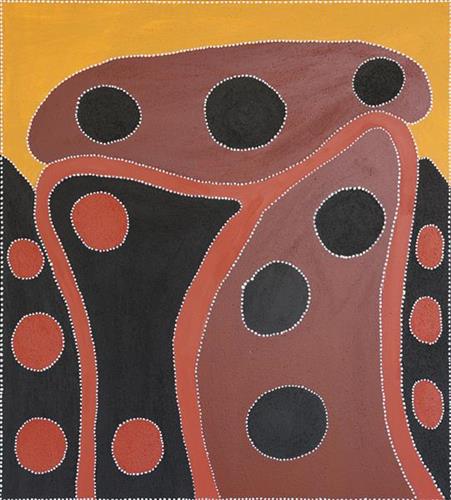
NUGUWARRDING (Snake Dreaming) – Tommy Carroll

This painting tells a story about NUGUWARRDING, that rainbow serpent, who travelled and lived around this area now called Doon Doon. Tommy says, “He went up to my grandfather’s country at the back of Speewah where there are gorges and rock holes.”

The solid circles represent the water holes in this area and the fluid lines are the hills around Doon Doon.

Tommy continues, “the story of this place was told to me when I was a young fella by my grandfather and his father. This snake was a father for this country, he traveled all over, sometimes he would stay for a few days then he would leave and pass through the next water place and stayed a bit longer.”

115682264913


Freshwater Story

The Yolngu people of Arnhem Land originate from a spiritual source, fixed in a particular place in their land or the sea. These ‘Spiritual Reservoirs’ are often in the form of special waterholes made by Wangarr (Creative Beings) long ago close to the beginning of time.

The creator beings moved across the country side, shaping the land and implanting in each tract of country, the spiritual life force for the people who were to own it. These Creative Spirits took many forms. When they gave the land to each group they also gave songs, dances, ceremony, the associated laws and language. The Creation story for Ganalbingu people took place near the middle section of the Glyde River where it becomes the Goyder River. Their land, Ngaliyindi, sits astride the Arafura Swamp in Central Arnhem Land.

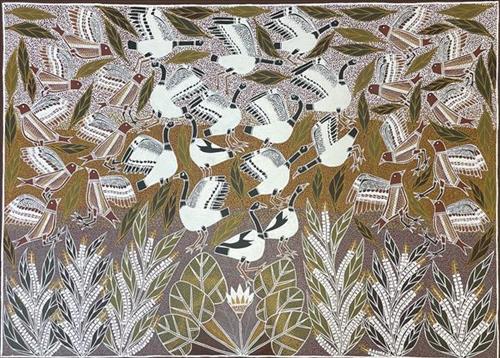
In this painting, the artist has depicted Gumang (magpie geese), which are sacred to the Ganalbingu people. To the east of the Arafura Swamp is a freshwater billabong which is said to have been made by the Goose Spirit and is in the shape of a goose nest. As a result, geese, their eggs and their nests are sacred.

111982266804


Coil Basket

Coil basketry is a well-established fibre art form in the Maningrida region, especially for women from the Kuninjku, Rembarrnga, Ndjebbana and Nakkara language groups. 

Artists make coiled baskets of many shapes and sizes, ranging from small round baskets to large oval baby baskets, and made mostly from pandanus fibre that is dyed with natural pigments. Bundles of fibre are formed into coils which are covered and stitched together with strands of fibre threaded onto a needle. Artists combine colours and patterns to obtain intricate new graphic patterns.

These techniques are believed to have been introduced to Arnhem Land by Greta Matthews, a missionary on Goulburn Island in the 1920s. She had probably learnt coil basketry from Aboriginal people in the south-east of Australia, possibly the Murray River people such as the Yorta Yorta or the coastal Ngarrindjeri. 

The coiling technique spread quickly from Goulburn Island to people on mainland Arnhem Land.